Comprehensive overview of CNS stimulants and nootropics, including classification, mechanisms, pharmacological actions, adverse effects, and therapeutic applications in cognitive enhancement and neurological disorders.
1
Dr. Rajendra GodeInstitute of Pharmacy,
University - Mardi Road, Amravati - 444602
Pharmacology – I (BP 404 T)
“ Pharmacology of Drugs acting on CNS ”
CNS Stimulants & Nootropics
1
Presented by
Ms. Shraddha S. Raut
M. Pharm (Pharmacology)
Assistant Professor
UNIT V
2.
MAY 21, 20262
Contents
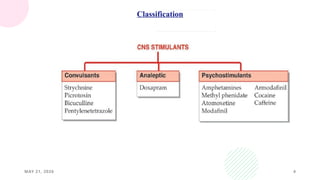
Classification
Individual Agents
Introduction to CNS Stimulants
1
3
2
Nootropics
3
3.
MAY 21, 20263
Introduction to CNS Stimulant
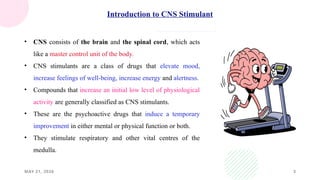
• CNS consists of the brain and the spinal cord, which acts
like a master control unit of the body.
• CNS stimulants are a class of drugs that elevate mood,
increase feelings of well-being, increase energy and alertness.
• Compounds that increase an initial low level of physiological
activity are generally classified as CNS stimulants.
• These are the psychoactive drugs that induce a temporary
improvement in either mental or physical function or both.
• They stimulate respiratory and other vital centres of the
medulla.
MAY 21, 20265
Convulsant
Strychnine
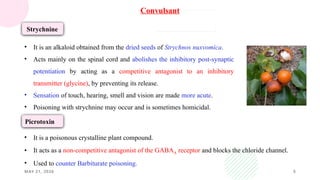
• It is an alkaloid obtained from the dried seeds of Strychnos nuxvomica.
• Acts mainly on the spinal cord and abolishes the inhibitory post-synaptic
potentiation by acting as a competitive antagonist to an inhibitory
transmitter (glycine), by preventing its release.
• Sensation of touch, hearing, smell and vision are made more acute.
• Poisoning with strychnine may occur and is sometimes homicidal.
Picrotoxin
• It is a poisonous crystalline plant compound.
• It acts as a non-competitive antagonist of the GABAA receptor and blocks the chloride channel.
• Used to counter Barbiturate poisoning.
6.
MAY 21, 20266
Analeptics
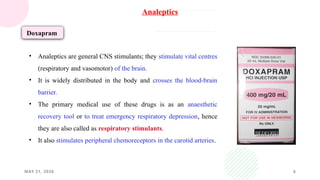
Doxapram
• Analeptics are general CNS stimulants; they stimulate vital centres
(respiratory and vasomotor) of the brain.
• It is widely distributed in the body and crosses the blood-brain
barrier.
• The primary medical use of these drugs is as an anaesthetic
recovery tool or to treat emergency respiratory depression, hence
they are also called as respiratory stimulants.
• It also stimulates peripheral chemoreceptors in the carotid arteries.
7.
MAY 21, 20267
Psychostimulants
Amphetamine
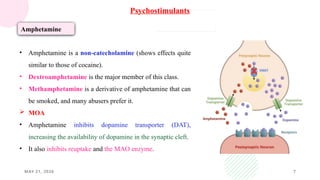
• Amphetamine is a non-catecholamine (shows effects quite
similar to those of cocaine).
• Dextroamphetamine is the major member of this class.
• Methamphetamine is a derivative of amphetamine that can
be smoked, and many abusers prefer it.
MOA
• Amphetamine inhibits dopamine transporter (DAT),
increasing the availability of dopamine in the synaptic cleft.
• It also inhibits reuptake and the MAO enzyme.
8.
MAY 21, 20268
Pharmacological Actions
1. CNS
• The major behavioural effect results from a combination of its dopamine and NE release-
enhancing properties.
• It stimulates the entire cerebrospinal axis and medulla.
• This leads to increased alertness, decreased fatigue, depressed appetite and insomnia.
2. Sympathetic NS
• Indirectly stimulating the receptor through NE release.
Adverse Effect
1. CNS: Insomnia, irritability, weakness, tremor, delirium and suicidal tendency
2. CVS: Palpitation, arrhythmia, anginal pain, circulatory collapse
3. GIT: Anorexia, nausea, vomiting, abdominal cramps and diarrhoea
9.
MAY 21, 20269
Cocaine
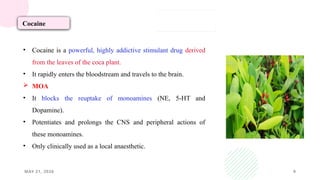
• Cocaine is a powerful, highly addictive stimulant drug derived
from the leaves of the coca plant.
• It rapidly enters the bloodstream and travels to the brain.
MOA
• It blocks the reuptake of monoamines (NE, 5-HT and
Dopamine).
• Potentiates and prolongs the CNS and peripheral actions of
these monoamines.
• Only clinically used as a local anaesthetic.
10.
MAY 21, 202610
Pharmacological Actions
1. CNS
• Cocaine acutely increases mental awareness and produces a feeling of well-being and euphoria
similar to that produced by amphetamine.
• It increases motor activity.
2. Sympathetic NS
• Peripherally potentiate the action of NE – fight or flight.
3. Local Anaesthetic action
• It blocks the voltage-gated Na+
channel.
• Cocaine is the only LA that causes vasoconstriction.
• Chronic inhalation of cocaine powder which leads to necrosis and perforation of nasal septum.
11.
MAY 21, 202611
Adverse Effect
• Anxiety reaction that includes: hypertension, tachycardia, sweating and paranoia.
• Depression: Cocaine stimulation of the CNS is followed by a period of mental depression.
• A cocaine-addicted person, after withdrawal, exhibits physical and emotional depression as
well as agitation.
12.
MAY 21, 202612
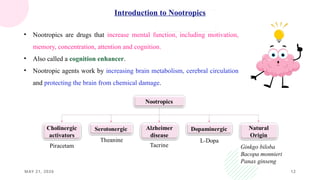
Introduction to Nootropics
• Nootropics are drugs that increase mental function, including motivation,
memory, concentration, attention and cognition.
• Also called a cognition enhancer.
• Nootropic agents work by increasing brain metabolism, cerebral circulation
and protecting the brain from chemical damage.
Ginkgo biloba
Bacopa monnieri
Panax ginseng
13.
MAY 21, 202613
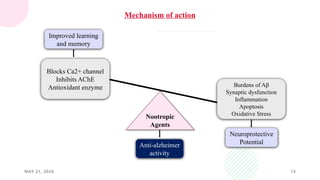
Mechanism of action
Nootropic
Agents
Blocks Ca2+ channel
Inhibits AChE
Antioxidant enzyme Burdens of Aβ
Synaptic dysfunction
Inflammation
Apoptosis
Oxidative Stress
Improved learning
and memory
Neuroprotective
Potential
Anti-alzheimer
activity
14.
MAY 21, 202614
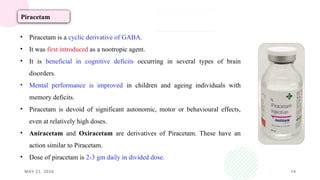
Piracetam
• Piracetam is a cyclic derivative of GABA.
• It was first introduced as a nootropic agent.
• It is beneficial in cognitive deficits occurring in several types of brain
disorders.
• Mental performance is improved in children and ageing individuals with
memory deficits.
• Piracetam is devoid of significant autonomic, motor or behavioural effects,
even at relatively high doses.
• Aniracetam and Oxiracetam are derivatives of Piracetam. These have an
action similar to Piracetam.
• Dose of piracetam is 2-3 gm daily in divided dose.
15.
MAY 21, 202615
Uses
• In cognitive defects associated with AD and ageing.
• In children with learning and ADHD (Attention Deficit Hyperactivity Disorder).
• Amnesia following cerebral trauma, drug abuse, including alcoholism and seizures.
• Co-existing memory deficits in neurological and psychiatric illness.
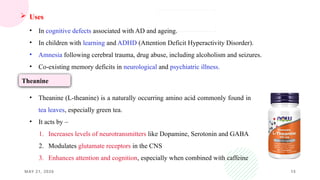
• Theanine (L-theanine) is a naturally occurring amino acid commonly found in
tea leaves, especially green tea.
• It acts by –
1. Increases levels of neurotransmitters like Dopamine, Serotonin and GABA
2. Modulates glutamate receptors in the CNS
3. Enhances attention and cognition, especially when combined with caffeine
Theanine
16.
MAY 21, 202616
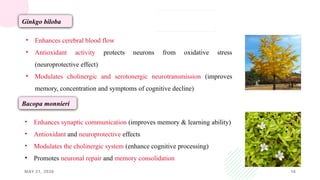
Ginkgo biloba
• Enhances cerebral blood flow
• Antioxidant activity protects neurons from oxidative stress
(neuroprotective effect)
• Modulates cholinergic and serotonergic neurotransmission (improves
memory, concentration and symptoms of cognitive decline)
Bacopa monnieri
• Enhances synaptic communication (improves memory & learning ability)
• Antioxidant and neuroprotective effects
• Modulates the cholinergic system (enhance cognitive processing)
• Promotes neuronal repair and memory consolidation
17.
MAY 21, 202617
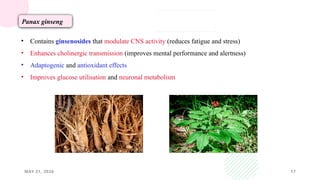
Panax ginseng
• Contains ginsenosides that modulate CNS activity (reduces fatigue and stress)
• Enhances cholinergic transmission (improves mental performance and alertness)
• Adaptogenic and antioxidant effects
• Improves glucose utilisation and neuronal metabolism
18.
18
References
1) Essentialsof Medical Pharmacology, 8th
Edition by KD Tripathi, Pg no. 320-353
2) Rang and Dale's Pharmacology, 8th Edition by H. P. Rang, J. M. Ritter, R. J. Flower, G. Henderson;
Elsevier Churchill Livingstone; Pg no. 425-455
3) Goodman and Gilman's The Pharmacological Basis of Therapeutics, 12th Edition by Laurence L.
Brunton and Bjorn C. Knollmann, Pg no. 978-1019
MAY 21, 2026
19.
T H AN K
Y O U
19
MAY 21, 2026
“Nootropics improve
memory, yet students forget
assignment deadlines.”
 Most read
 Most read
 Most read