Pharmacology of Blood-Acting Drugs: Hematinics, Coagulants, and Anticoagulants
1.
AUGUST 21, 20261
Dr. Rajendra Gode Institute of Pharmacy,
University - Mardi Road, Amravati - 444602
Pharmacology – II (BP 503 T)
“Pharmacology of drugs acting on Blood”
b. Hematinics, Coagulants and Anticoagulants
1
Presented by
Ms. Shraddha S. Raut
M. Pharm (Pharmacology)
Assistant Professor
UNIT II
2.
AUGUST 21, 20262
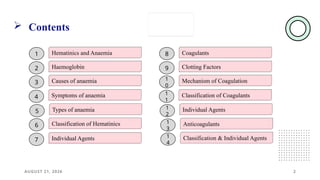
Contents
Haemoglobin
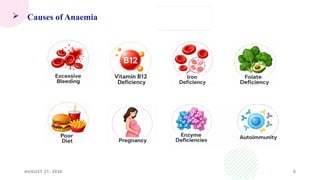
Causes of anaemia
Hematinics and Anaemia
1
3
2
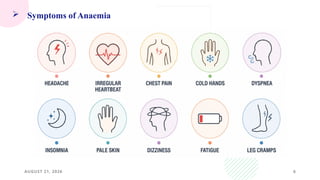
Symptoms of anaemia
4
Types of anaemia
5
Classification of Hematinics
6
Individual Agents
7
Clotting Factors
Mechanism of Coagulation
Coagulants
8
1
0
9
Classification of Coagulants
1
1
Individual Agents
1
2
Anticoagulants
1
3
Classification & Individual Agents
1
4
3.
AUGUST 21, 2026
Hematinics and Anaemia
3
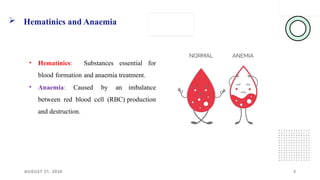
• Hematinics: Substances essential for
blood formation and anaemia treatment.
• Anaemia: Caused by an imbalance
between red blood cell (RBC) production
and destruction.
4.
AUGUST 21, 20264
Haemoglobin
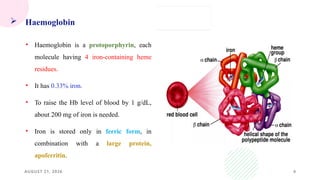
• Haemoglobin is a protoporphyrin, each
molecule having 4 iron-containing heme
residues.
• It has 0.33% iron.
• To raise the Hb level of blood by 1 g/dL,
about 200 mg of iron is needed.
• Iron is stored only in ferric form, in
combination with a large protein,
apoferritin.
AUGUST 21, 20268
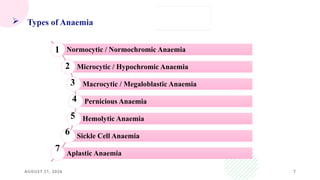
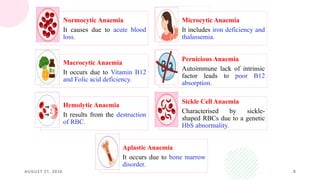
Normocytic Anaemia
It causes due to acute blood
loss.
Microcytic Anaemia
It includes iron deficiency and
thalassemia.
Macrocytic Anaemia
It occurs due to Vitamin B12
and Folic acid deficiency.
Pernicious Anaemia
Autoimmune lack of intrinsic
factor leads to poor B12
absorption.
Hemolytic Anaemia
It results from the destruction
of RBC.
Sickle Cell Anaemia
Characterised by sickle-
shaped RBCs due to a genetic
HbS abnormality.
Aplastic Anaemia
It occurs due to bone marrow
disorder.
AUGUST 21, 202610
• Iron is a vital mineral essential for oxygen transport and cellular energy production.
• Iron is a key component of haemoglobin, cytochromes and respiratory enzymes.
• Iron-containing enzymes support cellular oxidation and energy generation.
• Iron deficiency leads to anaemia, causing fatigue and weakened immunity.
• Iron supplementation helps restore blood iron levels in anaemia.
• Adult total body iron ranges from 2.5 to 5 grams, higher in men (50 mg/kg) than
women (38 mg/kg).
• Iron distribution: 66% in haemoglobin, 25% in storage (ferritin, haemosiderin), 3% in
myoglobin, 6% in enzymes and proteins.
Iron
11.
AUGUST 21, 202611
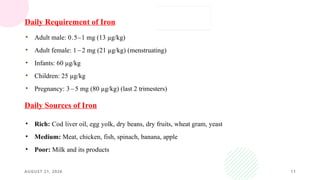
• Adult male: 0.5–1 mg (13 µg/kg)
• Adult female: 1 – 2 mg (21 µg/kg) (menstruating)
• Infants: 60 µg/kg
• Children: 25 µg/kg
• Pregnancy: 3 – 5 mg (80 µg/kg) (last 2 trimesters)
Daily Requirement of Iron
• Rich: Cod liver oil, egg yolk, dry beans, dry fruits, wheat gram, yeast
• Medium: Meat, chicken, fish, spinach, banana, apple
• Poor: Milk and its products
Daily Sources of Iron
12.
AUGUST 21, 202612
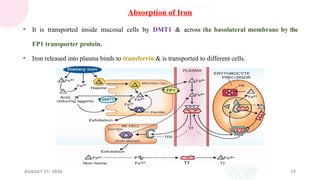
Absorption of Iron
• It is transported inside mucosal cells by DMT1 & across the basolateral membrane by the
FP1 transporter protein.
• Iron released into plasma binds to transferrin & is transported to different cells.
13.
AUGUST 21, 202613
Vitamin B12: Cobalamine
• It occurs as red crystals synthesised in nature only by microorganisms; plants and animals acquire it
from them.
• Deficiency causes megaloblastic anaemia and neurological damage.
• Mechanism of Action:
1. Vitamin B12 is an essential constituent of the human diet, necessary for DNA synthesis and,
consequently, for cell proliferation.
2. Vitamin B12 is important in the normal functioning of the nervous system due to its role in the
synthesis of myelin and in the maturation of developing red blood cells in the bone marrow.
3. Lifelong therapy is needed in pernicious anaemia.
• Dietary sources: Sea fish, egg yolk, meat, legumes, etc.
• Daily requirement: 1 - 3 µg; pregnancy and lactation 3 – 5 µg.
14.
AUGUST 21, 202614
Vitamin B9: Folic Acid
• Chemically, it is Pteroylglutamic acid (PGA) consisting of pteridine + para-aminobenzoic
acid (PABA) + glutamic acid.
• Folic acid is a precursor needed to make, repair, and methylate DNA; a cofactor in cell division and
growth, such as in infancy and pregnancy.
• Folate is itself inactive. After absorption, it is converted into the active coenzyme,
tetrahydrofolic acid, essential for amino acid and DNA biosynthesis and cell division.
• Sources: Yeast, green vegetables, fruits, nuts and cereals
• Daily requirements:
1. Adult: 50 mcg/day
2. Pregnant women: 100–200 mcg/day
3. Lactating women: 100–200 mcg/day
15.
AUGUST 21, 202615
Copper
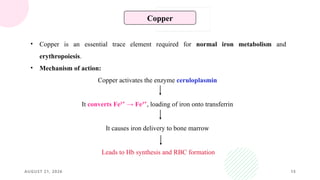
• Copper is an essential trace element required for normal iron metabolism and
erythropoiesis.
• Mechanism of action:
Copper activates the enzyme ceruloplasmin
It converts Fe² → Fe³
⁺ ⁺, loading of iron onto transferrin
It causes iron delivery to bone marrow
Leads to Hb synthesis and RBC formation
16.
AUGUST 21, 202616
Erythropoietin
• Erythropoietin
Erythropoietin is a glycoprotein, normally produced by the kidneys, that regulates red blood
cell production.
• Actions: Induces haemoglobin formation & erythroblast maturation.
• Epoetin (α, β) is a recombinant human erythropoietin administered by i.v. or s.c. injection and
has a plasma half-life of 6-10 hr.
17.
AUGUST 21, 202617
Coagulants
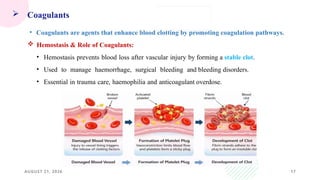
• Coagulants are agents that enhance blood clotting by promoting coagulation pathways.
Hemostasis & Role of Coagulants:
• Hemostasis prevents blood loss after vascular injury by forming a stable clot.
• Used to manage haemorrhage, surgical bleeding and bleeding disorders.
• Essential in trauma care, haemophilia and anticoagulant overdose.
18.
AUGUST 21, 202618
Clotting Factors
1. Clotting factors as plasma proteins: These are specialised proteins circulating in the blood plasma
in an inactive state, ready to respond when vascular injury occurs.
2. Activation by partial proteolysis: When a blood vessel is damaged, specific enzymes cleave
these inactive proteins partially, converting them into their active forms. This activation
triggers a cascade in which each activated factor stimulates the next, rapidly amplifying the clotting
response.
3. Number and location of clotting factors: There are 12 primary clotting factors identified,
present not only in the plasma but also within various tissues, ensuring a coordinated response
to injury throughout the body.
4. Impact of factor deficiency: A lack or malfunction of any one of these clotting factors can
disrupt the clotting cascade, leading to bleeding disorders such as haemophilia, which can
cause excessive bleeding even from minor injuries.
19.
AUGUST 21, 202619
Clotting Factor
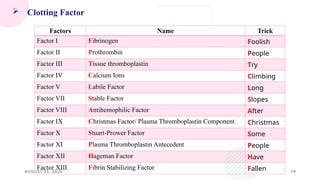
Factors Name Trick
Factor I Fibrinogen Foolish
Factor II Prothrombin People
Factor III Tissue thromboplastin Try
Factor IV Calcium Ions Climbing
Factor V Labile Factor Long
Factor VII Stable Factor Slopes
Factor VIII Antihemophilic Factor After
Factor IX Christmas Factor/ Plasma Thromboplastin Component Christmas
Factor X Stuart-Prower Factor Some
Factor XI Plasma Thromboplastin Antecedent People
Factor XII Hageman Factor Have
Factor XIII Fibrin Stabilizing Factor Fallen
20.
AUGUST 21, 202620
Mechanism of Coagulation
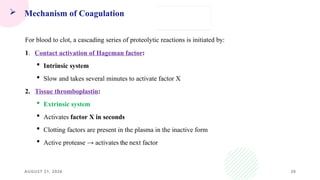
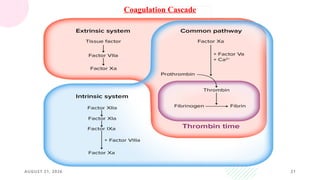
For blood to clot, a cascading series of proteolytic reactions is initiated by:
1. Contact activation of Hageman factor:
Intrinsic system
Slow and takes several minutes to activate factor X
2. Tissue thromboplastin:
Extrinsic system
Activates factor X in seconds
Clotting factors are present in the plasma in the inactive form
Active protease → activates the next factor
AUGUST 21, 202623
Vitamin K
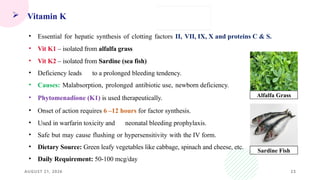
• Essential for hepatic synthesis of clotting factors II, VII, IX, X and proteins C & S.
• Vit K1 – isolated from alfalfa grass
• Vit K2 – isolated from Sardine (sea fish)
• Deficiency leads to a prolonged bleeding tendency.
• Causes: Malabsorption, prolonged antibiotic use, newborn deficiency.
• Phytomenadione (K1) is used therapeutically.
• Onset of action requires 6 –12 hours for factor synthesis.
• Used in warfarin toxicity and neonatal bleeding prophylaxis.
• Safe but may cause flushing or hypersensitivity with the IV form.
• Dietary Source: Green leafy vegetables like cabbage, spinach and cheese, etc.
• Daily Requirement: 50-100 mcg/day
Alfalfa Grass
Sardine Fish
24.
AUGUST 21, 202624
Pharmacokinetics
• Vitamin K1 is absorbed actively, while K2 and K3 are absorbed by simple diffusion.
• It is stored in the liver.
• It is metabolised in the liver by glucuronide conjugation.
• Excreted in bile and urine.
Uses
• Dietary deficiency of Vitamin K
• Prolonged antimicrobial therapy
• Jaundice or malabsorption syndrome
• Liver Disease
• New born
• Overdose of oral anticoagulants
25.
AUGUST 21, 202625
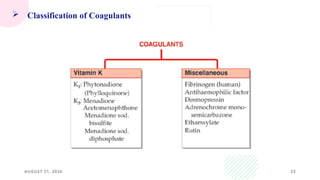
Miscellaneous
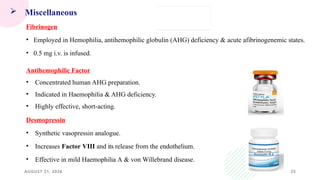
Fibrinogen
• Employed in Hemophilia, antihemophilic globulin (AHG) deficiency & acute afibrinogenemic states.
• 0.5 mg i.v. is infused.
Antihemophilic Factor
• Concentrated human AHG preparation.
• Indicated in Haemophilia & AHG deficiency.
• Highly effective, short-acting.
Desmopressin
• Synthetic vasopressin analogue.
• Increases Factor VIII and its release from the endothelium.
• Effective in mild Haemophilia A & von Willebrand disease.
26.
AUGUST 21, 202626
Adrenochrome monosemicarbazone
• Reduces capillary fragility & prevents microvessel bleeding.
• Dose: 1-5 mg oral, i.m.
Rutin
• A plant glycoside claimed to reduce capillary bleeding.
• Used along with Vit. C, which is believed to facilitate its action.
• Dose: 60 mg b.d/t.d.s orally.
Ethamsylate
• It decreases capillary bleeding when platelets are adequate; probably exerts antihyaluronidase
action & improves capillary wall stability.
• It is used in capillary bleeding in menorrhagia after abortion and bleeding after tooth extraction.
27.
AUGUST 21, 202627
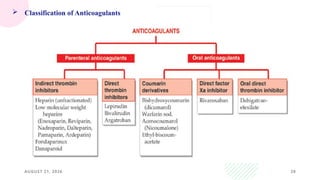
Anticoagulants
• Anticoagulants: These are medications designed to inhibit the blood's natural clotting
process, reducing the risk of harmful clots forming inside blood vessels. They are crucial in
managing conditions like deep vein thrombosis, pulmonary embolism and preventing stroke in
patients with atrial fibrillation.
• Coagulation initiation: When a blood vessel is injured, the body triggers a rapid response
where platelets gather at the site, and clotting factors activate to form a stable clot. This
immediate reaction is essential to minimise blood loss and begin tissue repair.
• Blood solidification purpose: The transformation of blood from liquid to a gel-like clot
serves two main functions: it prevents excessive bleeding by sealing the wound and acts as
a barrier to block bacteria and other foreign substances from entering the bloodstream,
thereby protecting against infection.
AUGUST 21, 202629
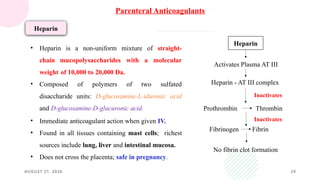
Heparin
• Heparin is a non-uniform mixture of straight-
chain mucopolysaccharides with a molecular
weight of 10,000 to 20,000 Da.
• Composed of polymers of two sulfated
disaccharide units: D-glucosamine-L-iduronic acid
and D-glucosamine-D-glucuronic acid.
• Immediate anticoagulant action when given IV.
• Found in all tissues containing mast cells; richest
sources include lung, liver and intestinal mucosa.
• Does not cross the placenta; safe in pregnancy.
Heparin
Activates Plasma AT III
Heparin - AT III complex
Prothrombin Thrombin
Fibrinogen Fibrin
No fibrin clot formation
Inactivates
Inactivates
Parenteral Anticoagulants
30.
AUGUST 21, 202630
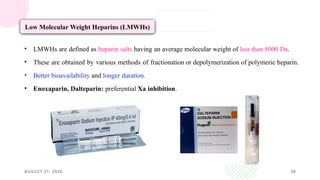
Low Molecular Weight Heparins (LMWHs)
• LMWHs are defined as heparin salts having an average molecular weight of less than 8000 Da.
• These are obtained by various methods of fractionation or depolymerization of polymeric heparin.
• Better bioavailability and longer duration.
• Enoxaparin, Dalteparin: preferential Xa inhibition.
31.
AUGUST 21, 202631
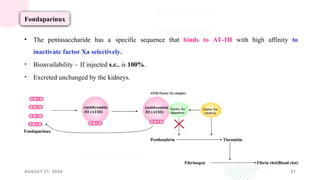
Fondaparinux
• The pentasaccharide has a specific sequence that binds to AT-III with high affinity to
inactivate factor Xa selectively.
• Bioavailability – If injected s.c., is 100%.
• Excreted unchanged by the kidneys.
32.
AUGUST 21, 202632
Oral Anticoagulants
Warfarin
• It is a coumarin derivative.
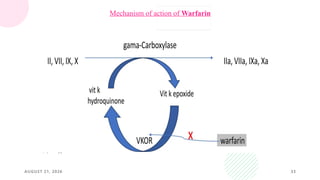
• Inhibits Vitamin K epoxide reductase, ↓ synthesis of factors II, VII, IX, X.
• Oral administration; onset is slow (3–5 days) due to existing clotting factors.
• Narrow therapeutic index requires careful titration.
• Used in prosthetic valves and recurrent thrombosis prevention.
• Highly protein-bound; numerous drug and food interactions.
• Uses: DVT, pulmonary embolism and atrial fibrillation.
AUGUST 21, 202634
Dabigatran etixilate
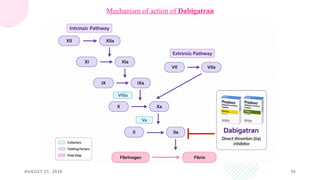
• It is an oral direct thrombin inhibitor.
• Dabigatran inhibits thrombin directly.
• Reversibly blocks the catalytic site of thrombin and produces a rapid (within 2 hours)
anticoagulant effect.
• Oral bioavailability is low.
• The plasma t½ is 12–14 hours.
• Duration of action: 24 hours.
36
References
1) Essentialsof Medical Pharmacology, 8th
Edition by KD Tripathi.
2) Rang and Dale's Pharmacology, 8th Edition by H. P. Rang, J. M. Ritter, R. J. Flower, G. Henderson;
Elsevier Churchill Livingstone.
3) Goodman and Gilman's The Pharmacological Basis of Therapeutics, 12th Edition by Laurence L.
Brunton and Bjorn C. Knollmann.
4) Principles of Pharmacology by HL Sharma and KK Sharma, 2nd
Edition, Paras Publication.
AUGUST 21, 2026
 Most read
 Most read
 Most read