PHARMACOKINETICS
PREPARED BY
ASHISH N. UMALE
M. PHARM IN PHARMACOLOGY
ASSISTANT PROFESSOR
SHRADDHA INSTITUTE OF PHARMACY, WASHIM-444505
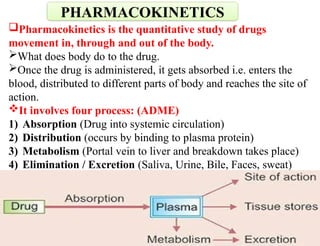
Pharmacokinetics is the quantitative study of drugs
movement in, through and out of the body.
What does body do to the drug.
Once the drug is administered, it gets absorbed i.e. enters the
blood, distributed to different parts of body and reaches the site of
action.
It involves four process: (ADME)
1) Absorption (Drug into systemic circulation)
2) Distribution (occurs by binding to plasma protein)
3) Metabolism (Portal vein to liver and breakdown takes place)
4) Elimination / Excretion (Saliva, Urine, Bile, Faces, sweat)
PHARMACOKINETICS
It is defined as the movement of drug molecules from
its site of administration to the systemic circulation.
It is first and important step of pharmacokinetics.
When we take any drug through oral route, it goes into
stomach in which it disintegrate (breakdown by acid) and
dissolution (substance present in stomach) take place,
then drug reach into intestine with the help of bile.
After dissolution drug absorb into blood from small
intestine or from the stomach through membrane.
ABSORPTION
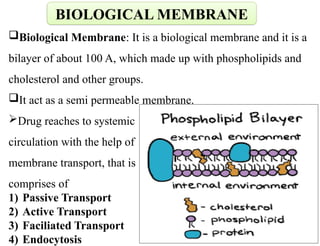
Biological Membrane: It is a biological membrane and it is a
bilayer of about 100 A, which made up with phospholipids and
cholesterol and other groups.
It act as a semi permeable membrane.
Drug reaches to systemic
circulation with the help of
membrane transport, that is
comprises of
1) Passive Transport
2) Active Transport
3) Faciliated Transport
4) Endocytosis
BIOLOGICAL MEMBRANE
Concentration Gradient :- when any drug or substance
move from high concentration to lower concentration. {Across
and Against (Energy)}
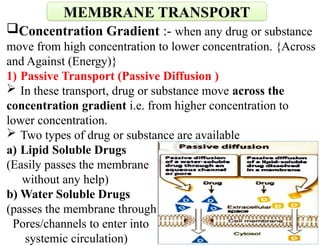
1) Passive Transport (Passive Diffusion )
 In these transport, drug or substance move across the
concentration gradient i.e. from higher concentration to
lower concentration.
 Two types of drug or substance are available
a) Lipid Soluble Drugs
(Easily passes the membrane
without any help)
b) Water Soluble Drugs
(passes the membrane through
Pores/channels to enter into
systemic circulation)
MEMBRANE TRANSPORT
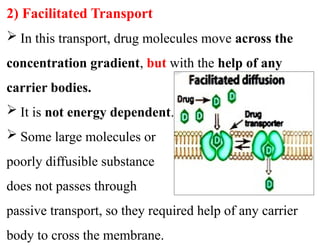
2) Facilitated Transport
 In this transport, drug molecules move across the
concentration gradient, but with the help of any
carrier bodies.
 It is not energy dependent.
 Some large molecules or
poorly diffusible substance
does not passes through
passive transport, so they required help of any carrier
body to cross the membrane.
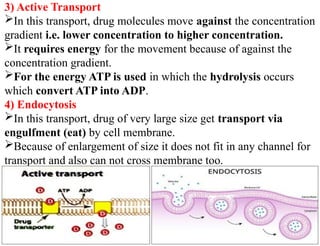
3) Active Transport
In this transport, drug molecules move against the concentration
gradient i.e. lower concentration to higher concentration.
It requires energy for the movement because of against the
concentration gradient.
For the energy ATP is used in which the hydrolysis occurs
which convert ATP into ADP.
4) Endocytosis
In this transport, drug of very large size get transport via
engulfment (eat) by cell membrane.
Because of enlargement of size it does not fit in any channel for
transport and also can not cross membrane too.
I) Particle Size
 It is inversely proportional to the absorption
 The smaller the particle size, the greater will be its absorption.
II) Formulation
 In case of solid, liquid, and injection the absorption occurs in
direction of = injection >liquid>solid
III) pH
 It gives information about the nature of drug (Acidic/Basic) were
 In case of Acidic Drug – absorbed in stomach
 In case of basic drug – absorbed in intestine
IV) Lipid Solubility
 Due to lipophilic nature of the membrane the lipid soluble drug
has slightly higher absorption than water soluble drug.
V) Ionisation
 Ionised and unionised forms are important for the pharmacological
response but for the better absorption drug must be in unionised form.
FACTORS AFFECTING DRUG ABSORPTION
1) Physio-chemical Properties
I) Surface Area = Directly proportional to the absorption.
II) Gastric Empting Time
 Drugs having the more/fast gastric empting time has the high rate of
absorption
III) Membrane Transport = Passive > Facilitated > Active
IV) Blood Flow Circulation = Directly Proportional
 ROA affects the bioavailability of drug.
 (Bioavailability = the actual amount of drug which reach into the
systemic circulation. )
 Parenteral route has maximum bioavailability.
 In I.V., drug directly releases into blood results into 100%
absorption and bioavailability
 Enteral/Oral has less bioavailability and absorption because it
follows First Pass Metabolism i.e. drug passes through liver which
decreases the absorption.
2) Biological Factors
3) Route Of Administration
The movement of drug from systemic circulation to
interstitial fluid / extracellular fluid and various other part of
body.
Drug distribute non uniformly throughout the body.
It is passive and reversible process.
Volume of Distribution
The apparent volume of distribution, Vd is the fluid volume
required to contain entire drug in the body at the same
concentration measured in the plasma.
It is calculated by dividing the dose that ultimately gets into
the systemic circulation by the plasma concentration at time
zero.
Vd = total amount of drug in body
concentration of drug in plasma
DISTRIBUTION
Distribution is very important step of PK, because in
which the drug reaches to the site of action then bind
with the receptor and gives its pharmacological action.
I) Lipophilicity = High the lipid solubility faster is
distribution
II) Blood Flow
 More blood flow, more distribution
 High BF = Brain, Heart, Kidney etc.
 Low BF = Muscle, Tissues etc.
III) Age = It also affect distribution, due to different in
total body weight, fat content etc.
FACTORS AFFECTING DRUG ABSORPTION
1) Plasma protein binding
 On reaching the circulation most drugs binds to plasma
proteins
 Acidic drugs binds mainly albumin
 Basic drug to Alpha acid glycoprotein
 The free or unbound fraction of the drug is the only form
available for action, metabolism and excretion while the
protein serves as a reservoir.
 Bound drug i.e. plasma protein bound drug has less
distribution, because their size increases and can not cross the
membrane.
2) Tissue Binding
 Some drugs get bound to certain tissue constituents because of
special affinity for them .
 Tissue binding delays elimination and thus prolong duration
of action of the drug.
BARRIERS OF DRUG
3) Redistribution
 When highly lipid soluble drugs given by I.V. or inhalation,
they rapidly distributed in highly perfused tissues like brain,
heart, and kidney.
 But soon they get redistributed into less vascular tissues like
the muscle & fat resulting in termination of the action of these
drugs.
4) Penetration into brain and CSF
The capillary endothelial cells in brain have tight junctions and
lack large paracellullar spaces.
Further an investment of neural tissue covers the capillaries.
Together they constitute thus said as Blood Brain Barrier
(BBB)
So these barriers are lipoidal and limit the entry of non lipid
soluble drugs.
Only lipid soluble drugs, therefore are able to penetrate and
have action on the CNS.
DRUG METABOLISM / BIOTRANSFORMATION
Biotransformation (or drug metabolism) is the process by
which the body chemically modifies drugs into forms that
are easier to eliminate. OR
 The body changes drugs into safer, more water-soluble
substances so they can be removed.
Most of the drug are lipid soluble (lipophilic), So it can be
easily excreted out through metabolism.
But some drugs are hydrophilic (eg. Streptomycin,
neostigmine etc) are less bio-transformed and excreted
unchanged form.
Objectives of Biotransformation
Convert lipid-soluble drugs → water-soluble metabolites
Facilitate excretion via urine or bile
Usually inactivates drugs
Sometimes activates drugs (prodrugs)
Site of Biotransformation
Primary site: Liver (most important organ)
Other sites: Intestine , Kidney, Lungs, Plasma
Mostly biotransformation and done by P-450 microsomal
enzymes such as Oxidase, glucuronyl transferase, Cytochrome
etc.
Types of Biotransformation Reactions
Biotransformation occurs in 2 phases
PHASE I REACTIONS (Functionalization Reactions)
Purpose: Introduce or expose a functional group (–OH, –
NH , –SH)
₂
Types
Oxidation (most common)
Reduction
Hydrolysis
 1. Oxidation
Occurs mainly via Cytochrome P450 enzymes (CYP450)
Adds oxygen or removes hydrogen
 Example: Paracetamol metabolism
 2. Reduction
Occurs in low oxygen conditions
 Example: Nitro drugs reduced to amines
 3. Hydrolysis
Breaking drug using water
 Example: Ester drugs → alcohol + acid
Phase I may
Inactivate drug
Activate drug
Produce toxic metabolite
PHASE II REACTIONS (Conjugation Reactions)
Purpose: Combine drug with endogenous substances
to increase water solubility.
These reaction are more polar, so drug can easily
excreted by the kidney & liver (bile)
Phase II reactions always produce inactive, non-toxic,
water-soluble metabolites
Types of Conjugation
Glucuronidation (most common)
Sulfation
Acetylation
Methylation
Glutathione conjugation
Phase I = Modify,
Phase II = Multiply (attach)
Factors Affecting Biotransformation
 1. Genetic Factors
Some people metabolize drugs faster/slower
 2. Age
Neonates → slow metabolism
Elderly → reduced metabolism
 3. Diet & Nutrition
Protein-rich diet ↑ metabolism
 4. Drug Interactions
Some drugs:
Induce enzymes → faster metabolism
Inhibit enzymes → slower metabolism
 5. Liver Disease
Decreases metabolism
6. Smoking & Alcohol
Can increase enzyme activity
Elimination is the process by which a drug is removed
from the body, either Unchanged (excretion) or After
metabolism (biotransformation)
Components of Elimination
1. Metabolism (Biotransformation)
Conversion of drug into metabolites (mainly in liver)
2. Excretion
Removal of drug/metabolites from the body
ELIMINATION
ROUTES OF EXCRETION
1. Renal Excretion (Kidney) – MOST IMPORTANT
Drugs are eliminated via urine by 3 processes:
(a) Glomerular Filtration
Free (unbound) drug is filtered
Depends on Molecular size & Protein binding
(b) Tubular Secretion
Active process
Drugs transported from blood → urine
Example: Penicillin
(c) Tubular Reabsorption
Lipid-soluble drugs may be reabsorbed
Ionization affects reabsorption:
Ionized drugs → excreted
Non-ionized drugs → reabsorbed
 2. Biliary Excretion
Drugs excreted via bile → intestine
 Can undergo: Enterohepatic circulation (reabsorption)
 3. Pulmonary Excretion
Via lungs (expired air)
Example: Volatile anesthetics
 4. Other Routes
Sweat
Saliva
Breast milk
 FACTORS AFFECTING ELIMINATION
 Physiological Factors:
Age (neonates & elderly ↓ elimination)
Body weight
Pathological Factors
Kidney disease ↓ renal clearance
Liver disease ↓ metabolism
Drug Factors
Protein binding
Lipid solubility
Drug Interactions
Enzyme induction → ↑ elimination
Enzyme inhibition → ↓ elimination
CLINICAL SIGNIFICANCE
Dose Adjustment : Required in Renal failure & Hepatic
impairment
Drug Accumulation : Occurs if elimination is slow
Toxicity Risk : Increased when clearance is reduced
Enzyme induction is the process by which a drug increases the
activity or synthesis of drug-metabolizing enzymes (mainly liver
enzymes like CYP450).
Mechanism
↑ Production of enzymes
↑ Metabolism of drugs
↓ Plasma drug concentration
Common Enzyme Inducers
Rifampicin , Phenobarbital , Phenytoin , Carbamazepine etc
Effects
↓ Drug action
↓ Duration of action
↑ Dose may be required
Clinical Significance
Failure of therapy
Example: Oral contraceptives + Rifampicin → pregnancy risk
Enzyme Induction
 Enzyme inhibition is when a drug reduces or blocks
enzyme activity, slowing drug metabolism.
 Mechanism
↓ Enzyme activity
↓ Drug metabolism
↑ Drug concentration in blood
 Common Enzyme Inhibitors
Cimetidine, Erythromycin, Ketoconazole, Chloramphenicol
 Effects
↑ Drug action
↑ Duration
↑ Risk of toxicity
 Clinical Significance
Example: Warfarin + enzyme inhibitor → bleeding risk
Enzyme Inhibition
 1. CLEARANCE (Cl)
Volume of plasma cleared of drug per unit time
 Cl = Rate of elimination / Plasma drug concentration
 Units: mL/min or L/hr
 Types of Clearance
Renal clearance, Hepatic clearance, Total body clearance
 2. HALF-LIFE (t½)
Time required for plasma drug concentration to reduce to half
 t1/2=0.693×Vd / Cl
 Importance
Determines dosing interval
Time to reach steady state
 3. ELIMINATION RATE CONSTANT (k)
Fraction of drug eliminated per unit time
 k=0.693 / t1/2
Kinetics of Elimination
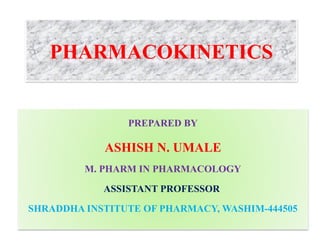
 1. First-Order Kinetics (MOST COMMON)
Characteristics:
Constant fraction of drug eliminated
Rate depends on concentration
Half-life is constant
 Rate = k × C
Examples: Paracetamol (normal dose)
 2. Zero-Order Kinetics
Characteristics:
Constant amount eliminated
Independent of concentration
Half-life is NOT constant
 Rate = k
Examples: Alcohol, High-dose phenytoin
ORDER OF ELIMINATION