Pharmaceutical Technology Transfer Processes and Quality Control
Detailed overview of technology transfer in pharma, covering API, excipients, finished products, packaging, analytical method transfer, validation, quality control, and Indian TT agencies.
Pharmaceutical Technology Transfer Processes and Quality Control
1.
Subject Expert
Mr. SakhareR. S.
D. Pharm., B. Pharm., B. A., M. Pharm., (Ph.D.)
Assistant Professor, Latur College Of Pharmacy.
GPAT 2020, NIPER JEE 2020, GPAT 2022, NIPER PhD Entrance 2022,
SRTMU Nanded PET 2022 Qualified
1
2.
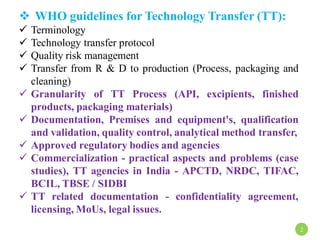
WHO guidelinesfor Technology Transfer (TT):
Terminology
Technology transfer protocol
Quality risk management
Transfer from R & D to production (Process, packaging and
cleaning)
Granularity of TT Process (API, excipients, finished
products, packaging materials)
Documentation, Premises and equipment's, qualification
and validation, quality control, analytical method transfer,
Approved regulatory bodies and agencies
Commercialization - practical aspects and problems (case
studies), TT agencies in India - APCTD, NRDC, TIFAC,
BCIL, TBSE / SIDBI
TT related documentation - confidentiality agreement,
licensing, MoUs, legal issues.
2
3.
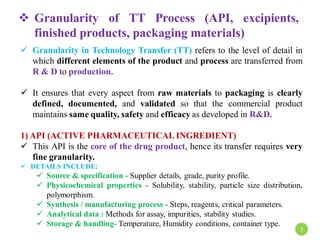
Granularity ofTT Process (API, excipients,
finished products, packaging materials)
Granularity in Technology Transfer (TT) refers to the level of detail in
which different elements of the product and process are transferred from
R & D to production.
It ensures that every aspect from raw materials to packaging is clearly
defined, documented, and validated so that the commercial product
maintains same quality, safety and efficacy as developed in R&D.
1) API (ACTIVE PHARMACEUTICAL INGREDIENT)
This API is the core of the drug product, hence its transfer requires very
fine granularity.
DETAILS INCLUDE:
Source & specification - Supplier details, grade, purity profile.
Physicochemical properties - Solubility, stability, particle size distribution,
polymorphism.
Synthesis / manufacturing process - Steps, reagents, critical parameters.
Analytical data : Methods for assay, impurities, stability studies.
Storage & handling- Temperature, Humidity conditions, container type.
3
4.
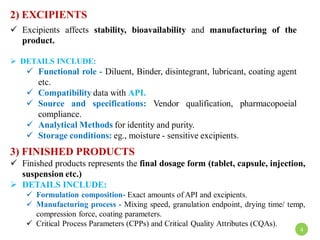
Excipients affectsstability, bioavailability and manufacturing of the
product.
DETAILS INCLUDE:
Functional role - Diluent, Binder, disintegrant, lubricant, coating agent
etc.
Compatibility data with API.
Source and specifications: Vendor qualification, pharmacopoeial
compliance.
Analytical Methods for identity and purity.
Storage conditions: eg., moisture - sensitive excipients.
2) EXCIPIENTS
3) FINISHED PRODUCTS
Finished products represents the final dosage form (tablet, capsule, injection,
suspension etc.)
DETAILS INCLUDE:
Formulation composition- Exact amounts of API and excipients.
Manufacturing process - Mixing speed, granulation endpoint, drying time/ temp,
compression force, coating parameters.
Critical Process Parameters (CPPs) and Critical Quality Attributes (CQAs).
4
5.
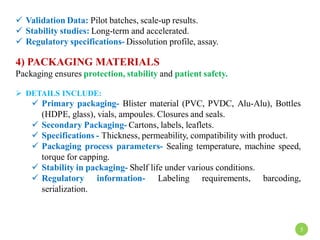
Validation Data:Pilot batches, scale-up results.
Stability studies: Long-term and accelerated.
Regulatory specifications- Dissolution profile, assay.
4) PACKAGING MATERIALS
Packaging ensures protection, stability and patient safety.
DETAILS INCLUDE:
Primary packaging- Blister material (PVC, PVDC, Alu-Alu), Bottles
(HDPE, glass), vials, ampoules. Closures and seals.
Secondary Packaging- Cartons, labels, leaflets.
Specifications - Thickness, permeability, compatibility with product.
Packaging process parameters- Sealing temperature, machine speed,
torque for capping.
Stability in packaging- Shelf life under various conditions.
Regulatory information- Labeling requirements, barcoding,
serialization.
5
6.
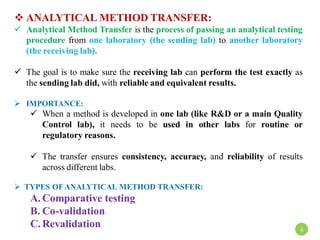
ANALYTICAL METHODTRANSFER:
Analytical Method Transfer is the process of passing an analytical testing
procedure from one laboratory (the sending lab) to another laboratory
(the receiving lab).
The goal is to make sure the receiving lab can perform the test exactly as
the sending lab did, with reliable and equivalent results.
IMPORTANCE:
When a method is developed in one lab (like R&D or a main Quality
Control lab), it needs to be used in other labs for routine or
regulatory reasons.
The transfer ensures consistency, accuracy, and reliability of results
across different labs.
TYPES OFANALYTICAL METHOD TRANSFER:
A. Comparative testing
B. Co-validation
C. Revalidation 6
7.
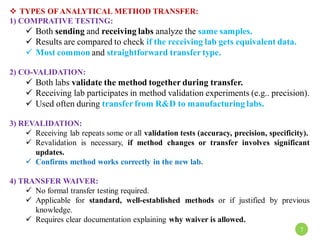
TYPES OFANALYTICALMETHOD TRANSFER:
1) COMPRATIVE TESTING:
Both sending and receiving labs analyze the same samples.
Results are compared to check if the receiving lab gets equivalent data.
Most common and straightforward transfer type.
2) CO-VALIDATION:
Both labs validate the method together during transfer.
Receiving lab participates in method validation experiments (e.g.. precision).
Used often during transfer from R&D to manufacturing labs.
3) REVALIDATION:
Receiving lab repeats some or all validation tests (accuracy, precision, specificity).
Revalidation is necessary, if method changes or transfer involves significant
updates.
Confirms method works correctly in the new lab.
4) TRANSFER WAIVER:
No formal transfer testing required.
Applicable for standard, well-established methods or if justified by previous
knowledge.
Requires clear documentation explaining why waiver is allowed.
7
8.
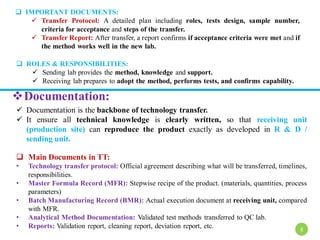
IMPORTANT DOCUMENTS:
Transfer Protocol: A detailed plan including roles, tests design, sample number,
criteria for acceptance and steps of the transfer.
Transfer Report: After transfer, a report confirms if acceptance criteria were met and if
the method works well in the new lab.
ROLES & RESPONSIBILITIES:
Sending lab provides the method, knowledge and support.
Receiving lab prepares to adopt the method, performs tests, and confirms capability.
Documentation:
Documentation is the backbone of technology transfer.
It ensure all technical knowledge is clearly written, so that receiving unit
(production site) can reproduce the product exactly as developed in R & D /
sending unit.
Main Documents in TT:
• Technology transfer protocol: Official agreement describing what will be transferred, timelines,
responsibilities.
• Master Formula Record (MFR): Stepwise recipe of the product. (materials, quantities, process
parameters)
• Batch Manufacturing Record (BMR): Actual execution document at receiving unit, compared
with MFR.
• Analytical Method Documentation: Validated test methods transferred to QC lab.
• Reports: Validation report, cleaning report, deviation report, etc. 8
9.
Premises andequipment's
During transfer, receiving unit premises and equipment must be assessed for suitability.
Premises:
Layout should allow smooth material flow, prevent cross contamination.
Adequate utilities (Water system, HVAC, Compressed air).
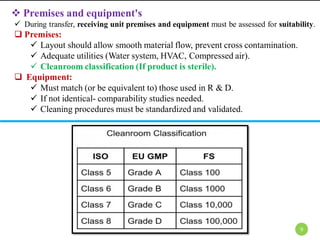
Cleanroom classification (If product is sterile).
Equipment:
Must match (or be equivalent to) those used in R & D.
If not identical- comparability studies needed.
Cleaning procedures must be standardized and validated.
9
10.
Validation
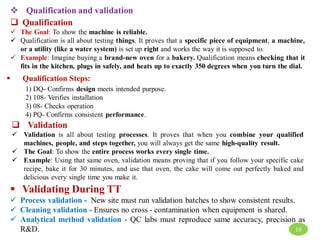
Validationis all about testing processes. It proves that when you combine your qualified
machines, people, and steps together, you will always get the same high-quality result.
The Goal: To show the entire process works every single time.
Example: Using that same oven, validation means proving that if you follow your specific cake
recipe, bake it for 30 minutes, and use that oven, the cake will come out perfectly baked and
delicious every single time you make it.
1) DQ- Confirms design meets intended purpose.
2) 108- Verifies installation
3) 08- Checks operation
4) PQ- Confirms consistent performance.
Qualification Steps:
Validating During TT
Process validation - New site must run validation batches to show consistent results.
Cleaning validation - Ensures no cross - contamination when equipment is shared.
Analytical method validation - QC labs must reproduce same accuracy, precision as
R&D. 10
Qualification
The Goal: To show the machine is reliable.
Qualification is all about testing things. It proves that a specific piece of equipment, a machine,
or a utility (like a water system) is set up right and works the way it is supposed to.
Example: Imagine buying a brand-new oven for a bakery. Qualification means checking that it
fits in the kitchen, plugs in safely, and heats up to exactly 350 degrees when you turn the dial.
Qualification and validation
11.
QUALITY CONTROL
QCplays a vital role in confirming that the transferred technology works
properly.
It includes:
Raw material testing (API, excipients) at receiving site
In- process control checks (e.g., pH, granule size, weight variation).
Finished product testing (assay, dissolution, sterility etc.)
Comparative analysis product from receiving site is compared with product
from sending unit.
Stability studies ensure product remains stable under storage.
TECHNOLOGY TRANSFER Agencies In INDIA
There are some agencies which Technology transfer in India as follows:
APCTT
NRDC
TIFAC
BCIL
TBSE - SIDBI
11
12.
APCTT
APCTT standsfor Asian and Pacific Center for Transfer of Technology.
Established in 1977 at Bangalore, later shifted to New Delhi in 1993.
A regional institution of UN-ESCAP (United nations Economic and Social
Commission for Asia and Pacific).
Works with Asia-Pacific countries to promote sustainable technology transfer
and innovation.
FUNCTIONS
Facilitates transfer of environment-friendly technologies.
Provides policy advice to governments for technology adoption.
Promotes South-South cooperation (collaboration among developing
countries).
Organizes training programme, exhibitions and workshops.
Builds capacity of SMEs (small and medium-sized enterprises), research
institutes and startups in the Asia-Pacific region.
12
13.
NRDC
NRDC standsfor National Research Development Corporation.
Established in 1953 by the Government of India.
Headquarter in New Delhi
Acts as a bridge between R&D institutions, universities and industries.
Main aim is to commercialize indigenous technologies.
FUNCTIONS
Provides patenting and IP protection for inventions.
Licenses technologies from R&D labs to industries.
Offers consultancy and advisory services on technology transfer.
Supports startups and SMEs with affordable technology.
Has licensed over 4,500 technologies in fields like drugs, vaccines, agro -
products, and engineering.
13
14.
TIFAC
TIFAC standsfor Technology Information, Forecasting and Assessment Council.
Established in 1988 as an autonomous body under Department of Science and
Technology (DST).
Acts as a national think-tank for technology forecasting (prediction) and planning.
The organization known for preparing both Technology Vision 2020 (under the
chairmanship of Dr. A.P.J. Abdul Kalam's leadership in 1996) and Technology Vision
2035 (under the chairmanship of Prime Minister Narendra Modi) is the Technology
Information, Forecasting and Assessment Council (TIFAC).
FUNCTIONS
Forecasts future technology needs of the nation.
Prepares long-term technology vision documents.
Facilitates collaboration b/w industry, academia and government.
Operates Ekaswa (India's first patent database) and other innovation support programmes.
Promotes research in energy, healthcare, environment, agriculture, and rural development.
14
15.
BCIL
BCILstands for Biotech Consortium India Limited.
Established in 1990 as a Public limited company.
Promoted by the Department of Biotechnology (DBT), Government of India.
Supported by financial institutions and industry bodies.
Main focus is on biotechnology commercialization and biosafety awareness.
FUNCTIONS
Facilitates technology transfer and project consultancy in biotechnology.
Provides financial linkages and venture (new) capital support to biotech startups.
Organizes biosafety training and awareness programmes.
Implements DBT's flagship schemes like SBIRI (Small Business Innovation Research
Initiative) and biotech industrial training programmes.
Supports commercialization of biotech products such as vaccines, diagnostics, enzymes
and GM (Genetically modified) crops.
15
16.
TBSE - SIDBI
TBSE stands for Technology Bureau for Small Enterprises while SIDBI stands
for Small Industries Development Bank of India.
It's a joint initiative of SIDBI and APCIT (Advanced Professional Certificate in
International Taxation).
Specially designed to support MSMEs (Micro, Small and Medium Enterprises).
Helps small businesses to adopt modern technologies and remain competitive.
FUNCTIONS
Provides information on domestic and international technologies.
Assists in technology partner search and business collaboration.
Helps MSMEs in project appraisal, business plan preparation, and financial
support.
Facilitates import and adaptation of global technologies for Indian industries.
Promotes technology - based entrepreneurship in small enterprises.
16
17.
TECHNOLOGY TRANSFERRELATED
DOCUMENTATION
Technology transfer (TT) in the pharmaceutical industry involves moving a product or
process from R&D (Research and Development) to production (manufacturing).
Proper documentation is crucial to ensure transparency, accountability, and legal
compliance-
CONFIDENTIALLY AGREEMENT (NON - DISCLOSURE
AGREEMENT - NDA)
A legal document signed b/w two parties (eg., R&D team and manufacturing site).
Ensures that sensitive information (formulation details, process, tests methods) is not
shared with unauthorized persons.
Protect intellectual property (IP).
17
18.
LICENSING AGREEMENT
A contract where the owner of technology (licensor) gives permission to another
party (license) to use the technology.
Common in cases where pharmaceutical companies outsource manufacturing or
allow other firms to market their products.
Includes terms like royalty, duration, territory and responsibilities.
MEMORANDUM OF UNDERSTANDING (MOU)
A formal but less legally binding agreement b/w two parties before signing a full
contract.
Defines the intent of collaboration, such as knowledge sharing, transfer of data, or
training.
Acts as a roadmap for future legal agreements.
18
19.
LEGAL ISSUESIN TT
Technology transfer may face multiple legal challenges, such as:
Intellectual Property Rights (IPR): Patents, Trademarks, Copyrights.
Regulatory Compliance: Must follow national and international
guidelines (FDA, EMA, CDSCO).
Liability issues: Who is responsible in case of product failure or
adverse effects.
Dispute resolution: Arbitration, legal jurisdiction in case of conflicts.
19
 Most read
 Most read
 Most read