Introduction
•Pakistan’s agriculture reliesheavily on fruit crops such as mango, citrus, banana, guava, grapes,
dates, and apple.
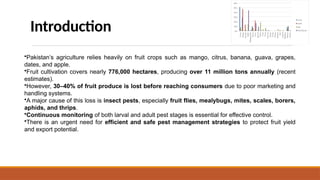
•Fruit cultivation covers nearly 776,000 hectares, producing over 11 million tons annually (recent
estimates).
•However, 30–40% of fruit produce is lost before reaching consumers due to poor marketing and
handling systems.
•A major cause of this loss is insect pests, especially fruit flies, mealybugs, mites, scales, borers,
aphids, and thrips.
•Continuous monitoring of both larval and adult pest stages is essential for effective control.
•There is an urgent need for efficient and safe pest management strategies to protect fruit yield
and export potential.
3.
Gall Midge MangoPest
(Procontarinia sp.)
Pest Identification
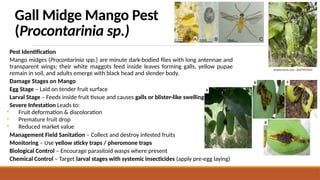
Mango midges (Procontarinia spp.) are minute dark-bodied flies with long antennae and
transparent wings; their white maggots feed inside leaves forming galls, yellow pupae
remain in soil, and adults emerge with black head and slender body.
Damage Stages on Mango
Egg Stage – Laid on tender fruit surface
Larval Stage – Feeds inside fruit tissue and causes galls or blister-like swellings
Severe Infestation Leads to:
◦ Fruit deformation & discoloration
◦ Premature fruit drop
◦ Reduced market value
Management Field Sanitation – Collect and destroy infested fruits
Monitoring – Use yellow sticky traps / pheromone traps
Biological Control – Encourage parasitoid wasps where present
Chemical Control – Target larval stages with systemic insecticides (apply pre-egg laying)
4.
Peach fruit fly(PFF), Bractocera.
zonata (Saunders) (Diptera: Tephritidae)
Identification Features
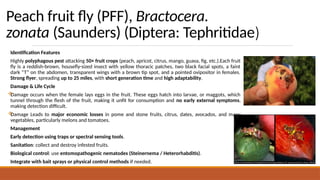
Highly polyphagous pest attacking 50+ fruit crops (peach, apricot, citrus, mango, guava, fig, etc.).Each fruit
fly is a reddish-brown, housefly-sized insect with yellow thoracic patches, two black facial spots, a faint
dark “T” on the abdomen, transparent wings with a brown tip spot, and a pointed ovipositor in females.
Strong flyer, spreading up to 25 miles, with short generation time and high adaptability.
Damage & Life Cycle
Damage occurs when the female lays eggs in the fruit. These eggs hatch into larvae, or maggots, which
tunnel through the flesh of the fruit, making it unfit for consumption and no early external symptoms,
making detection difficult.
Damage Leads to major economic losses in pome and stone fruits, citrus, dates, avocados, and many
vegetables, particularly melons and tomatoes.
Management
Early detection using traps or spectral sensing tools.
Sanitation: collect and destroy infested fruits.
Biological control: use entomopathogenic nematodes (Steinernema / Heterorhabditis).
Integrate with bait sprays or physical control methods if needed.
5.
Citrus whiteflies (Dialeurodescitri)
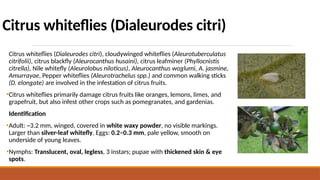
Citrus whiteflies (Dialeurodes citri), cloudywinged whiteflies (Aleurotuberculatus
citrifolii), citrus blackfly (Aleurocanthus husaini), citrus leafminer (Phyllocnistis
citrella), Nile whitefly (Aleurolobus niloticus), Aleurocanthus woglumi, A. jasmine,
Amurrayae, Pepper whiteflies (Aleurotrachelus spp.) and common walking sticks
(D. elongate) are involved in the infestation of citrus fruits.
•Citrus whiteflies primarily damage citrus fruits like oranges, lemons, limes, and
grapefruit, but also infest other crops such as pomegranates, and gardenias.
Identification
•Adult: ~3.2 mm, winged, covered in white waxy powder, no visible markings.
Larger than silver-leaf whitefly. Eggs: 0.2–0.3 mm, pale yellow, smooth on
underside of young leaves.
•Nymphs: Translucent, oval, legless, 3 instars; pupae with thickened skin & eye
spots.
6.
Damage
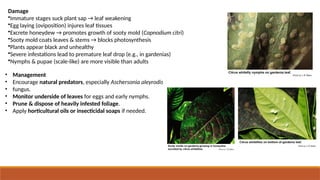
•Immature stages suckplant sap → leaf weakening
•Egg laying (oviposition) injures leaf tissues
•Excrete honeydew → promotes growth of sooty mold (Capnodium citri)
•Sooty mold coats leaves & stems → blocks photosynthesis
•Plants appear black and unhealthy
•Severe infestations lead to premature leaf drop (e.g., in gardenias)
•Nymphs & pupae (scale-like) are more visible than adults
• Management
• Encourage natural predators, especially Aschersonia aleyrodis
• fungus.
• Monitor underside of leaves for eggs and early nymphs.
• Prune & dispose of heavily infested foliage.
• Apply horticultural oils or insecticidal soaps if needed.
7.
Mealybugs (Family Pseudococcidae)
Scientific/ Common Name:
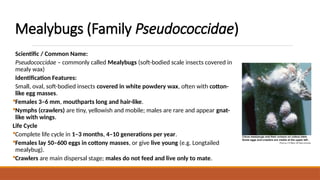
Pseudococcidae – commonly called Mealybugs (soft-bodied scale insects covered in
mealy wax)
Identification Features:
Small, oval, soft-bodied insects covered in white powdery wax, often with cotton-
like egg masses.
Females 3–6 mm, mouthparts long and hair-like.
Nymphs (crawlers) are tiny, yellowish and mobile; males are rare and appear gnat-
like with wings.
Life Cycle
Complete life cycle in 1–3 months, 4–10 generations per year.
Females lay 50–600 eggs in cottony masses, or give live young (e.g. Longtailed
mealybug).
Crawlers are main dispersal stage; males do not feed and live only to mate.
8.
Conti….
Important Types &Fruit Hosts:
Pseudococcus longispinus – Longtailed mealybug (citrus, grape, ornamentals)
Planococcus citri – Citrus mealybug (citrus, mango, guava, pomegranate, grapes)
Pseudococcus affinis – Obscure mealybug (nursery stock, fruits)
Rhizoecus spp. – Ground / Root mealybugs (roots of potted fruit plants)
Damage Stages & Symptoms:
Feeding on sap of leaves, stems, fruits and roots → causes yellowing, curling, stunting, fruit drop & twig
dieback.
Honeydew secretion leads to black sooty mould, reducing marketability.
High populations can wilt and kill plants; root infestations remain hidden until severe.
Management Strategy (Integrated):
Cultural: Inspect new stock, remove infested parts, destroy debris, space plants well, control ants.
Biological: Release Cryptolaemus montrouzieri (Mealybug destroyer) or Green lacewings.
Chemical: Target crawler stage with contact sprays; rotate systemic + oil-based products carefully.
9.
Fruit Flies Pest
CommonScientific Pests Name:
•Ceratitis capitata (Mediterranean fruit fly) , Anastrepha ludens (Mexican fruit fly)
•Bactrocera dorsalis (Oriental fruit fly / Mango fruit fly), Anastrepha suspensa (Caribbean fruit fly)
•Bactrocera tryoni (Queensland fruit fly), Drosophila suzukii (Spotted-wing drosophila)
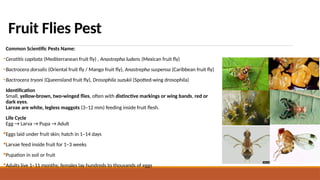
Identification
Small, yellow-brown, two-winged flies, often with distinctive markings or wing bands, red or
dark eyes.
Larvae are white, legless maggots (3–12 mm) feeding inside fruit flesh.
Life Cycle
Egg → Larva → Pupa → Adult
Eggs laid under fruit skin; hatch in 1–14 days
Larvae feed inside fruit for 1–3 weeks
Pupation in soil or fruit
Adults live 1–11 months; females lay hundreds to thousands of eggs
10.
Host / EncounterPlants:
Mango, citrus, guava, papaya, tomatoes, apples, pears, cherries, and many ripening or ripe fruits and vegetables
in tropical & temperate regions.
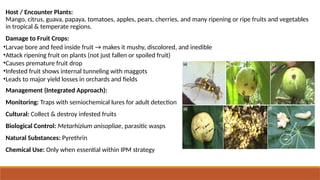
Damage to Fruit Crops:
•Larvae bore and feed inside fruit → makes it mushy, discolored, and inedible
•Attack ripening fruit on plants (not just fallen or spoiled fruit)
•Causes premature fruit drop
•Infested fruit shows internal tunneling with maggots
•Leads to major yield losses in orchards and fields
Management (Integrated Approach):
Monitoring: Traps with semiochemical lures for adult detection
Cultural: Collect & destroy infested fruits
Biological Control: Metarhizium anisopliae, parasitic wasps
Natural Substances: Pyrethrin
Chemical Use: Only when essential within IPM strategy
11.
Aphids on FruitTrees
Major Aphid Pests (Common & Scientific Names):
oGreen Peach Aphid – Myzus persicae (Peach, Plum, Apricot)
oRosy Apple Aphid – Dysaphis plantaginea (Apple)
oWoolly Apple Aphid – Eriosoma lanigerum (Apple – roots, trunk, branches)
oBlack Cherry Aphid – Myzus cerasi (Cherry)
oApple Grain Aphid – Rhopalosiphum insertum (Apple, Pear)
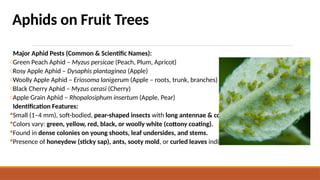
Identification Features:
Small (1–4 mm), soft-bodied, pear-shaped insects with long antennae & cornicles (tailpipes).
Colors vary: green, yellow, red, black, or woolly white (cottony coating).
Found in dense colonies on young shoots, leaf undersides, and stems.
Presence of honeydew (sticky sap), ants, sooty mold, or curled leaves indicates activity.
12.
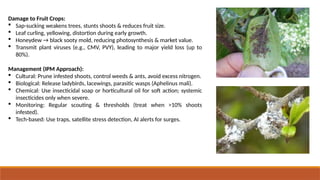
Damage to FruitCrops:
Sap-sucking weakens trees, stunts shoots & reduces fruit size.
Leaf curling, yellowing, distortion during early growth.
Honeydew → black sooty mold, reducing photosynthesis & market value.
Transmit plant viruses (e.g., CMV, PVY), leading to major yield loss (up to
80%).
Management (IPM Approach):
Cultural: Prune infested shoots, control weeds & ants, avoid excess nitrogen.
Biological: Release ladybirds, lacewings, parasitic wasps (Aphelinus mali).
Chemical: Use insecticidal soap or horticultural oil for soft action; systemic
insecticides only when severe.
Monitoring: Regular scouting & thresholds (treat when >10% shoots
infested).
Tech-based: Use traps, satellite stress detection, AI alerts for surges.
13.
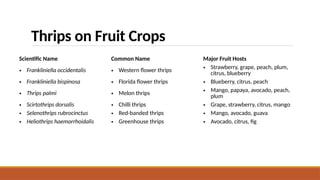
Thrips on FruitCrops
Scientific Name Common Name Major Fruit Hosts
• Frankliniella occidentalis • Western flower thrips • Strawberry, grape, peach, plum,
citrus, blueberry
• Frankliniella bispinosa • Florida flower thrips • Blueberry, citrus, peach
• Thrips palmi • Melon thrips • Mango, papaya, avocado, peach,
plum
• Scirtothrips dorsalis • Chilli thrips • Grape, strawberry, citrus, mango
• Selenothrips rubrocinctus • Red-banded thrips • Mango, avocado, guava
• Heliothrips haemorrhoidalis • Greenhouse thrips • Avocado, citrus, fig
14.
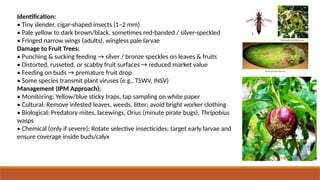
Identification:
• Tiny slender,cigar-shaped insects (1–2 mm)
• Pale yellow to dark brown/black, sometimes red-banded / silver-speckled
• Fringed narrow wings (adults), wingless pale larvae
Damage to Fruit Trees:
• Punching & sucking feeding → silver / bronze speckles on leaves & fruits
• Distorted, russeted, or scabby fruit surfaces → reduced market value
• Feeding on buds → premature fruit drop
• Some species transmit plant viruses (e.g., TSWV, INSV)
Management (IPM Approach):
• Monitoring: Yellow/blue sticky traps, tap sampling on white paper
• Cultural: Remove infested leaves, weeds, litter; avoid bright worker clothing
• Biological: Predatory mites, lacewings, Orius (minute pirate bugs), Thripobius
wasps
• Chemical (only if severe): Rotate selective insecticides; target early larvae and
ensure coverage inside buds/calyx