Personalized Mindfulness Activities and Fitness Routine Plan for Holistic Well-being
Explore practical mindfulness exercises and fitness routines designed to enhance physical health, emotional balance, and self-care through daily personalized practices.
OBJECTIVES:
Develop personalized mindfulnessactivities and fitness routines that enhance
physiological health, support physical development, and promote overall well-being.
Demonstrate commitment by integrating personalized mindfulness activities and fitness
routines into their daily lives, fostering a positive attitude towards self-care and holistic
wellness.
4.
MINDFULNESS
Mindfulness means
paying closeattention
to your thoughts,
feelings, and body in a
calm and kind way
Studies show that when
children and teens
practice mindfulness,
they often feel less
stressed and worried.
It also helps them stay
calm and deal with big
emotions better.
5.
SOME
PRACTICAL
PHYSICAL
ACTIVITIES
THAT HAVE
MINDFULNESS
APPLICATIONS
Shadowboxingwith Breath Control - Movements matched
to inhaling and exhaling.
Obstacle Course or Circuit Training with Focus – Doing
tasks one at a time with full attention
Mindful Biking – Riding at a slow pace while focusing on
rhythm, wind, and balance.
Animal Flow Exercises – Ground-based movements like
crawling, requiring concentration and control.
Balloon Breathing – Pretend to blow up a balloon with
deep breaths, raising arms as it “inflates.”
6.
SOME
PRACTICAL
PHYSICAL
ACTIVITIES
THAT HAVE
MINDFULNESS
APPLICATIONS
AnimalWalks – Move like animals (bear crawl, frog jump)
while paying attention to how the body feels.
Rainbow Stretching – Reach arms in an arc like a rainbow,
matching movement with slow breathing.
Mindful Freeze Dance – Dance to music and freeze when
the music stops—notice your breath and heartbeat.
Nature Walk – Walk slowly outside and focus on five
things you can see, hear, smell, or touch.
Bubble Blowing – Blow bubbles slowly and focus on the
breath and how the bubbles float.
7.
SOME PRACTICAL
PHYSICAL
ACTIVITIESTHAT
HAVE
MINDFULNESS
APPLICATIONS
Belly Breathingwith a Stuffed Animal – Lie down, place a
toy on the belly, and watch it rise and fall.
Mindful Marching – March in place, notice how your feet
hit the ground, and swing your arms with control.
Follow the Leader (Mindful Edition) – One child leads
slow, focused movements that others copy.
Windmill Arms – Swing arms gently in circles, syncing
with slow breaths.
Balance Beam Walk – Walk slowly on a line or board,
paying attention to balance and foot placement.
8.
SOME PRACTICAL
PHYSICAL
ACTIVITIESTHAT
HAVE
MINDFULNESS
APPLICATIONS
Tighten andRelease (Progressive Muscle Relaxation) – Squeeze muscles
(like fists) and then release them, noticing the difference.
Mirror Movement Game – Partner up and mirror each other’s slow
movements like a reflection.
Mindful Jumping Jacks – Do jumping jacks slowly, counting each one with full
attention.
Wiggle and Freeze – Wiggle the whole body for 10 seconds, then freeze and
notice how your body feels.
Ball Rolling Focus – Roll a ball back and forth to a partner while focusing on
breath and movement.
Simon Says (MindfulVersion) – Include directions like “touch your toes and
take a deep breath.”
Bubble Walk – Pretend you are inside a bubble and walk gently so it doesn’t
pop.
9.
THE KEY
CONCEPTS
MINDFULNESS
PRACTICE
Mindfulness andmindfulness skills can be practiced at any
time, anywhere, while doing anything. Intentionally paying
attention to the moment, without judging it or holding on
to it, is all that is needed.
Meditation is practicing mindfulness and mindfulness skills
while sitting, standing, or lying quietly for a predetermined
period of time.When meditating, we focus the mind (for
example, we focus on body sensations, emotions,
thoughts, or our breath), or we open the mind (paying
attention to whatever comes into our awareness).
10.
THE KEY CONCEPTSMINDFULNESS PRACTICE
Contemplative prayer refers to focusing on what you are praying for in your line of
faith.
•• Mindfulness movement also has many forms. Examples include martial arts (such as
arnis, pencak, silat ,tai chi, aikido, and karate), and dancing. Hiking and walking while
savoring the environment can also be ways to practice mindfulness.
11.
PICK-PAK-BOOM
Here aresome more mindfulness activities. Pick 5 activities that you can do:
Observe with your eyes:
● Lie on the ground and watch the clouds in the sky.
● Walking slowly, stopping somewhere with a view, notice flowers, trees, and nature itself.
● Sit outside.Watch who and what go by in front of you, without following them with your head
or your eyes.
● Notice the facial expression and movements of another person. Refrain from labeling the
person’s emotions, thoughts, or interests.
● Notice just the eyes, lips, or hands of another person (or just one feature of an animal).
● Pick up a leaf, a flower, or a pebble. Look at it closely, trying to see each detail.
● Find something beautiful to look at, and spend a few minutes contemplating it.
12.
Observe sounds:
●Stop for a moment and just listen. Listen to the texture and shape
of the sounds around you. Listen to the silences between the sounds.
● If someone is talking, listen to the pitch of the voice, to the
smoothness or roughness of the sounds, to the clarity or the mumbling of
the speech, to the pauses between the words.
● Listen to music, observing each note as it comes and the spaces
between the notes.Try breathing the sounds into your body and letting
them flow out again on your breath.
13.
Observe smellsaround you:
● Breathing in, notice any smells around you. Bring something close to your nose,
and notice the smells.Take it away, and then notice the smells again. Do they linger?
● When eating, notice the aroma of the food; when cooking, notice the aroma of
the spices or other ingredients; when bathing, smell the soap or shampoo; when walking
outside, notice the aroma of the air; when near flowers, bend down and “smell the roses.”
● Observe taste and the act of eating:
● Put something in your mouth, pay attention to the taste. Keep it in your mouth,
and notice all the taste sensations.
14.
● Lick alollipop or something else. Notice just the sensation of taste.
● Eat a meal, or even a part of a meal, paying attention to the taste of each
mouthful.
● Notice any urge to avoid someone or something.
● Scan your entire body, and notice the sensations.Where in the body is the
urge?
● When you are chewing your food, notice when you have the urge to
swallow.
15.
Observe sensationsof touch on your skin:
● When walking, notice the sensations of walking—your feet hitting
the ground and rising up and down. Sometimes I walk very slowly and
notice. Sometimes I walk very fast and notice.
● When sitting, notice your thighs on the chair. Notice the curve of
your knees and your back.
● Pay attention to anything touching you.
● Try to feel your feet in your shoes, your body touching your
clothes.
16.
● Feel yourarms touching a chair.
● Notice the sensations of your hands.
● Touch something—the wall, a fabric, a table top, a pet, a piece of fruit, a person.
● Notice the texture of what you feel, notice the sensations on your skin.
● Try it again with another part of your body. Notice the sensations again.
●
● Focus your attention on the sensations in your chest, your stomach, or your
shoulders.
● Focus your attention on the place in your body where you feel tight or tense.
● Focus your attention on the space between your eyes.
17.
BEYOND WORDS:A GESTUREOF MEANING
Choose a local dance, a mime, or any meaningful movement activity for you.
Focus on why this chosen activity is meaningful.
Carefully choose the steps or choreography to it.
Remember to give your full attention to this task.
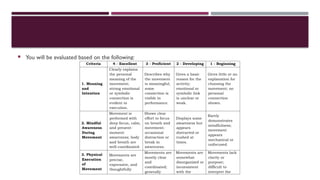
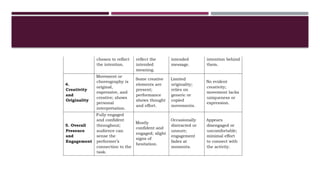
You will be evaluated based on your degree of executing the movement and
how well you focus on it to denote mindfulness.
Record this meaningful movement or present it in class.
OTHER ACTIVITIES
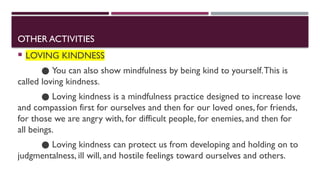
LOVINGKINDNESS
● You can also show mindfulness by being kind to yourself.This is
called loving kindness.
● Loving kindness is a mindfulness practice designed to increase love
and compassion first for ourselves and then for our loved ones, for friends,
for those we are angry with, for difficult people, for enemies, and then for
all beings.
● Loving kindness can protect us from developing and holding on to
judgmentalness, ill will, and hostile feelings toward ourselves and others.
23.
Do thisactivity to yourself while practicing mindfulness.
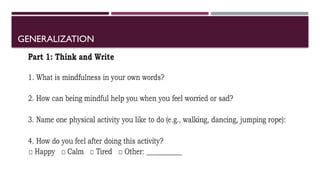
1. How does it feel to be mindful toward yourself?
2. How did you feel while doing the loving kindness exercise to yourself?
● Remember to slowly do the activity and feel each word that you give to yourself.:
● Radiate loving kindness by reciting a set of warm wishes, such as “May I be happy,” “May I be at peace,”
“May I be healthy,” “May I be safe,” or another set of positive wishes of your own.
●
● Repeat the script slowly, and focus on the meaning of each word as you say it in your mind. (If you have
distracting thoughts, just notice them as they come and go and gently bring your mind back to your script.)
● Continue until you feel yourself immersed in loving kindness
24.
Processing Questions:
Howdoes it feel to be mindful toward yourself? 2. How did
you feel while doing the loving kindness exercise to yourself?
How did you feel after doing the loving kindness exercise to
yourself? 4. How did the loving kindness exercise change the
views that you have toward yourself?
25.
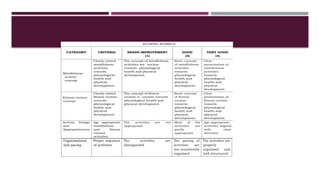
ASSESSMENT
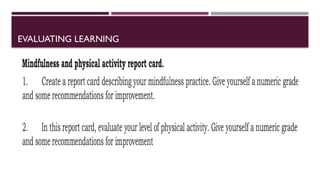
MINDFULNESS ACTIVITIESAND FITNESS ROUTINE PLAN
Develop a personalized mindfulness activities and fitness
routine plan that enhances physiMatrix of activities that
must be done daily to demonstrate the integration of mindfulness
and physical activity. Refer to the previous discussions for your
reference in the development of the said plan. ological health and
physical development.