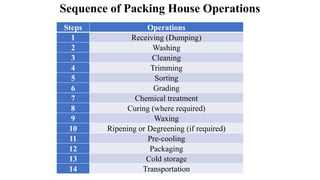
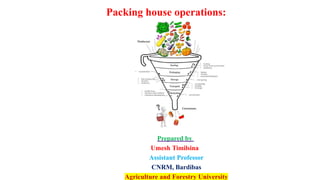
Packing House Operations for Horticultural Produce
Detailed overview of packing house processes including washing, cleaning, sorting, grading, curing, waxing, ripening, chemical treatments, and pre-cooling to enhance quality, shelf life, and market value of fruits and vegetables.
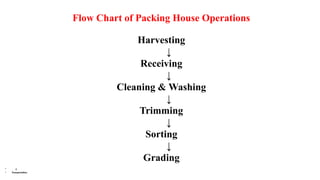
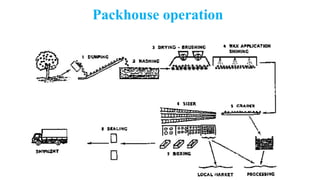
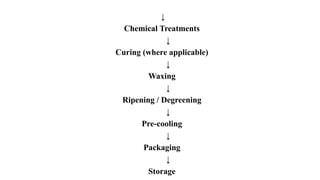
Packhouse operations
• Apacking house is a place/facility where freshly harvested fruits, vegetables, and
flowers are received, cleaned, graded, treated, packed, and prepared for storage or
marketing.
• Proper packing house operations minimize post-harvest losses, maintain quality,
and increase the market value of horticultural produce.
Objectives of Packing House Operations
• Remove field heat and contaminants.
• Improve appearance and quality.
• Reduce mechanical damage and microbial infection.
• Increase shelf life.
• Facilitate transportation and marketing.
• Meet domestic and export quality standards.
• Ensure uniformity in size and quality.
3.
Advantages of EfficientPacking House Operations
• Minimize post-harvest losses.
• Improve product quality and appearance.
• Extend shelf life.
• Increase consumer acceptance.
• Facilitate long-distance transport and export.
• Improve food safety and hygiene.
• Enhance market value and farmer income.
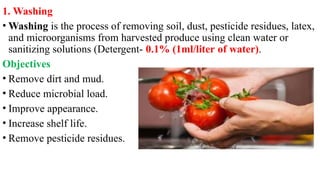
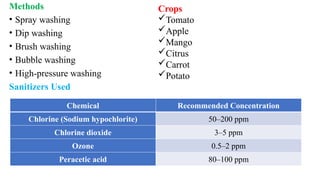
1. Washing
• Washingis the process of removing soil, dust, pesticide residues, latex,
and microorganisms from harvested produce using clean water or
sanitizing solutions (Detergent- 0.1% (1ml/liter of water).
Objectives
• Remove dirt and mud.
• Reduce microbial load.
• Improve appearance.
• Increase shelf life.
• Remove pesticide residues.
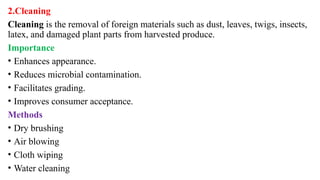
2.Cleaning
Cleaning is theremoval of foreign materials such as dust, leaves, twigs, insects,
latex, and damaged plant parts from harvested produce.
Importance
• Enhances appearance.
• Reduces microbial contamination.
• Facilitates grading.
• Improves consumer acceptance.
Methods
• Dry brushing
• Air blowing
• Cloth wiping
• Water cleaning
10.
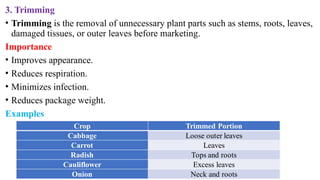
3. Trimming
• Trimmingis the removal of unnecessary plant parts such as stems, roots, leaves,
damaged tissues, or outer leaves before marketing.
Importance
• Improves appearance.
• Reduces respiration.
• Minimizes infection.
• Reduces package weight.
Examples
11.
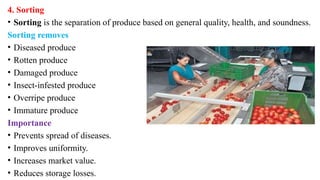
4. Sorting
• Sortingis the separation of produce based on general quality, health, and soundness.
Sorting removes
• Diseased produce
• Rotten produce
• Damaged produce
• Insect-infested produce
• Overripe produce
• Immature produce
Importance
• Prevents spread of diseases.
• Improves uniformity.
• Increases market value.
• Reduces storage losses.
12.
5. Grading
• Gradingis the classification of produce into different quality classes based on
predetermined standards.
Grading Parameters
• Size
• Weight
• Shape
• Colour
• Maturity
• Freedom from defects
13.
Types
A. Manual grading
•Performed by workers.
B. Mechanical grading
• Performed using grading machines.
Advantages
• Uniform quality
• Better pricing
• Export suitability
• Consumer satisfaction
14.
Difference Between Sortingand Grading
Sorting Grading
Removes defective produce Classifies good produce into grades
Based on defects Based on quality standards
First operation Performed after sorting
15.
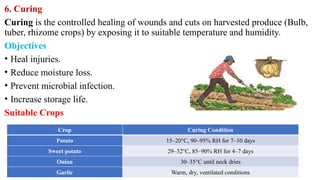
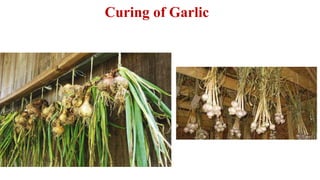
6. Curing
Curing isthe controlled healing of wounds and cuts on harvested produce (Bulb,
tuber, rhizome crops) by exposing it to suitable temperature and humidity.
Objectives
• Heal injuries.
• Reduce moisture loss.
• Prevent microbial infection.
• Increase storage life.
Suitable Crops
Crop Curing Condition
Potato 15–20°C, 90–95% RH for 7–10 days
Sweet potato 29–32°C, 85–90% RH for 4–7 days
Onion 30–35°C until neck dries
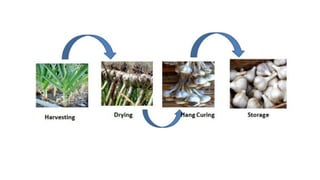
Garlic Warm, dry, ventilated conditions
16.
Curing
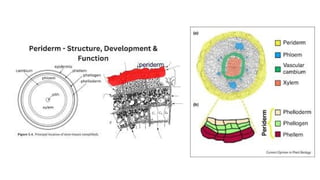
• It refersto the process of healing and toughening wounds and
periderm (new skin) formation in root, tuber crops and bulb
crops.
• Curing is conducted immediately after harvesting.
• It is technique where commodity is left in the field itself under
shade for few days.
• It strengthens the skin.
• Closing neck (onion and garlic) and toughening of skin
(Potato) in bulb crop is also known as curing.
• Sometimes lignification (strengthen the plant vascular body)
in the surface of citrus cell is also termed as curing.
17.
Curing
• It refersto the process of healing and toughening wounds and
periderm (new skin) formation in root, tuber crops and bulb
crops.
• Curing is conducted immediately after harvesting.
• It is technique where commodity is left in the field itself under
shade for few days.
• It strengthens the skin.
• Closing neck (onion and garlic) and toughening of skin
(Potato) in bulb crop is also known as curing.
• Sometimes lignification (strengthen the plant vascular body)
in the surface of citrus cell is also termed as curing.
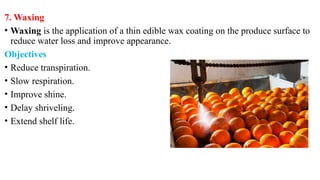
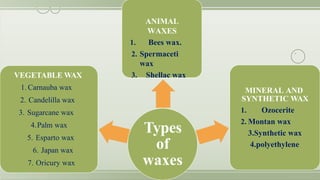
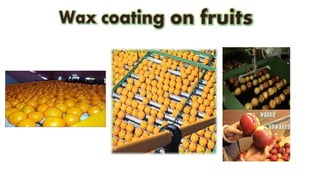
7. Waxing
• Waxingis the application of a thin edible wax coating on the produce surface to
reduce water loss and improve appearance.
Objectives
• Reduce transpiration.
• Slow respiration.
• Improve shine.
• Delay shriveling.
• Extend shelf life.
22.
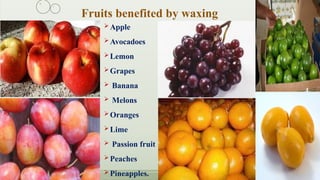
Apple
Avocadoes
Lemon
Grapes
Banana
Melons
Oranges
Lime
Passion fruit
Peaches
Pineapples.
Fruits benefited by waxing
23.
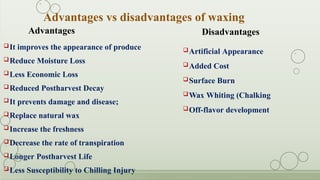
Artificial Appearance
Added Cost
SurfaceBurn
Wax Whiting (Chalking
Off-flavor development
Disadvantages
Advantages
It improves the appearance of produce
Reduce Moisture Loss
Less Economic Loss
Reduced Postharvest Decay
It prevents damage and disease;
Replace natural wax
Increase the freshness
Decrease the rate of transpiration
Longer Postharvest Life
Less Susceptibility to Chilling Injury
Advantages vs disadvantages of waxing
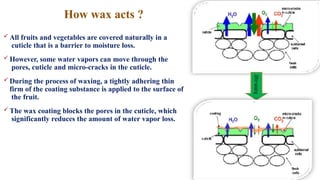
All fruitsand vegetables are covered naturally in a
cuticle that is a barrier to moisture loss.
However, some water vapors can move through the
pores, cuticle and micro-cracks in the cuticle.
During the process of waxing, a tightly adhering thin
firm of the coating substance is applied to the surface of
the fruit.
The wax coating blocks the pores in the cuticle, which
significantly reduces the amount of water vapor loss.
How wax acts ?
8. Ripening
• Ripeningis the series of physiological and biochemical changes that make
fruits edible and attractive.
Changes During Ripening
• Colour development
• Softening
• Sweetness increases
• Acidity decreases
• Aroma develops
• Chlorophyll breaks down
29.
Artificial Ripening
Safe Methods
•Ethylene gas (100–150 ppm)
• Ethephon solution
Unsafe Method
• Calcium carbide (banned in many countries due to health hazards)
Crops
• Banana
• Mango
• Papaya
• Tomato
• Avocado
30.
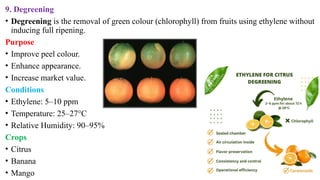
9. Degreening
• Degreeningis the removal of green colour (chlorophyll) from fruits using ethylene without
inducing full ripening.
Purpose
• Improve peel colour.
• Enhance appearance.
• Increase market value.
Conditions
• Ethylene: 5–10 ppm
• Temperature: 25–27°C
• Relative Humidity: 90–95%
Crops
• Citrus
• Banana
• Mango
31.
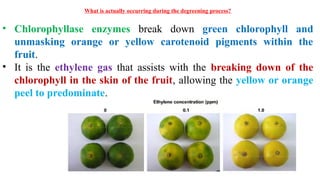
What is actuallyoccurring during the degreening process?
• Chlorophyllase enzymes break down green chlorophyll and
unmasking orange or yellow carotenoid pigments within the
fruit.
• It is the ethylene gas that assists with the breaking down of the
chlorophyll in the skin of the fruit, allowing the yellow or orange
peel to predominate.
32.
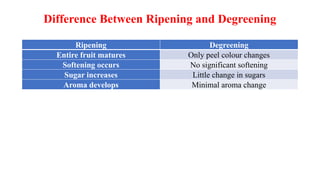
Difference Between Ripeningand Degreening
Ripening Degreening
Entire fruit matures Only peel colour changes
Softening occurs No significant softening
Sugar increases Little change in sugars
Aroma develops Minimal aroma change
33.
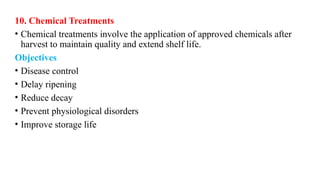
10. Chemical Treatments
•Chemical treatments involve the application of approved chemicals after
harvest to maintain quality and extend shelf life.
Objectives
• Disease control
• Delay ripening
• Reduce decay
• Prevent physiological disorders
• Improve storage life
11. Fumigation
• Fumigationis the treatment of produce with gaseous chemicals to eliminate insects and pests before
storage or export.
Objectives
• Kill insects.
• Meet quarantine requirements.
• Prevent pest spread.
Common Fumigants
• Phosphine
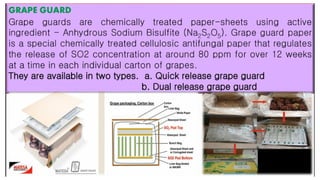
• Sulfur dioxide (grapes)
• Controlled atmosphere gases (for specific applications)
Crops
• Grapes
• Mango
• Citrus
• Stored onions
• Export commodities
36.
12. Colour Adding
•Colour adding is the application of approved food-grade colour to improve the
appearance of fruits that have developed poor natural colour.
Purpose
• Improve visual appeal.
• Increase market value.
• Meet market standards.
Common Crops
• Citrus fruits
• Apples (in some countries, under strict regulations)
• Note: Artificial colour addition must comply with national food safety
regulations and is prohibited for many fresh fruits in numerous countries.
37.
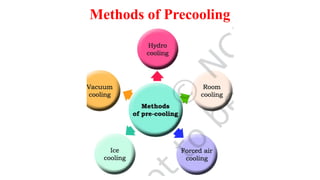
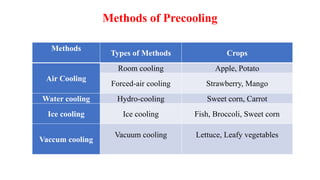
13. Pre-cooling
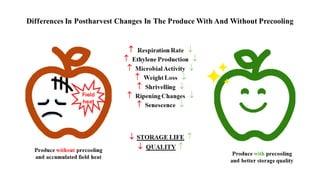
• Pre-coolingis the rapid removal of field heat from freshly harvested produce
immediately after harvest before storage or transportation.
Importance
• Slows respiration.
• Reduces water loss.
• Delays ripening.
• Minimizes microbial growth.
• Extends shelf life.
• Maintains freshness.
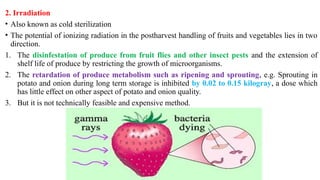
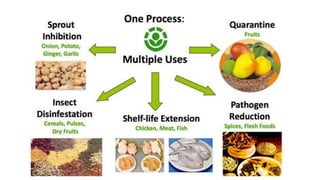
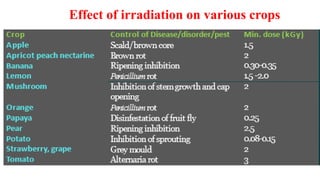
2. Irradiation
• Alsoknown as cold sterilization
• The potential of ionizing radiation in the postharvest handling of fruits and vegetables lies in two
direction.
1. The disinfestation of produce from fruit flies and other insect pests and the extension of
shelf life of produce by restricting the growth of microorganisms.
2. The retardation of produce metabolism such as ripening and sprouting, e.g. Sprouting in
potato and onion during long term storage is inhibited by 0.02 to 0.15 kilogray, a dose which
has little effect on other aspect of potato and onion quality.
3. But it is not technically feasible and expensive method.
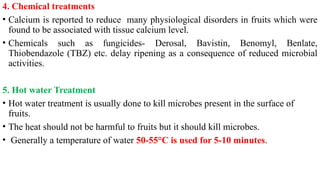
4. Chemical treatments
•Calcium is reported to reduce many physiological disorders in fruits which were
found to be associated with tissue calcium level.
• Chemicals such as fungicides- Derosal, Bavistin, Benomyl, Benlate,
Thiobendazole (TBZ) etc. delay ripening as a consequence of reduced microbial
activities.
5. Hot water Treatment
• Hot water treatment is usually done to kill microbes present in the surface of
fruits.
• The heat should not be harmful to fruits but it should kill microbes.
• Generally a temperature of water 50-55°C is used for 5-10 minutes.
45.
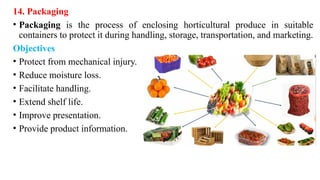
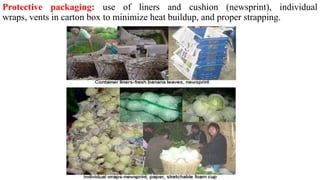
14. Packaging
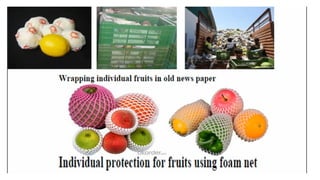
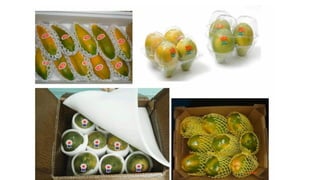
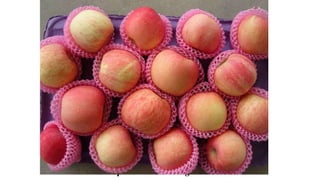
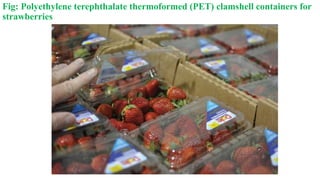
• Packagingis the process of enclosing horticultural produce in suitable
containers to protect it during handling, storage, transportation, and marketing.
Objectives
• Protect from mechanical injury.
• Reduce moisture loss.
• Facilitate handling.
• Extend shelf life.
• Improve presentation.
• Provide product information.
46.
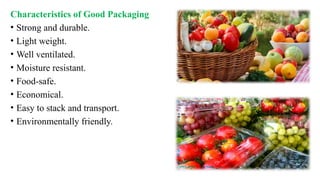
Characteristics of GoodPackaging
• Strong and durable.
• Light weight.
• Well ventilated.
• Moisture resistant.
• Food-safe.
• Economical.
• Easy to stack and transport.
• Environmentally friendly.
47.
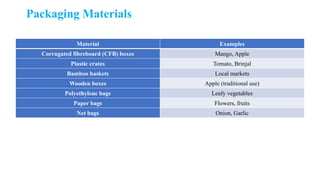
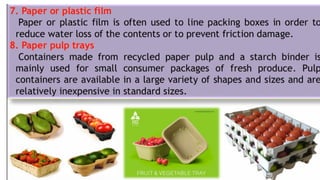
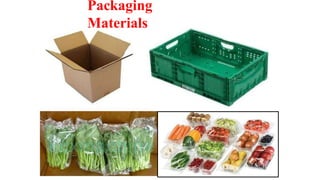
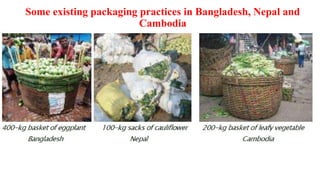
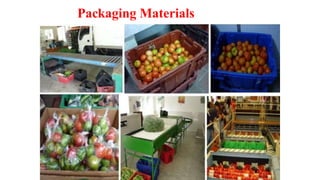
Packaging Materials
Material Examples
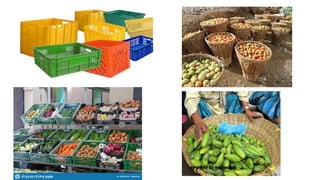
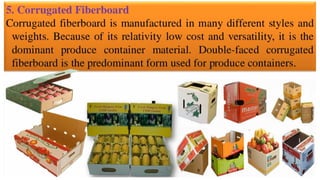
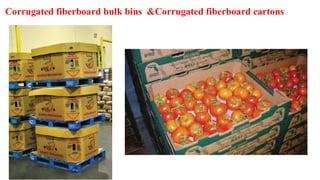
Corrugatedfibreboard (CFB) boxes Mango, Apple
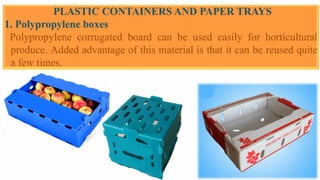
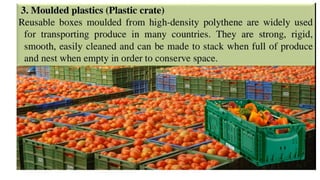
Plastic crates Tomato, Brinjal
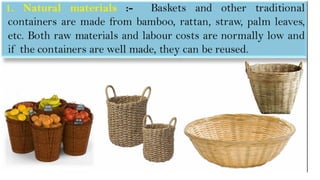
Bamboo baskets Local markets
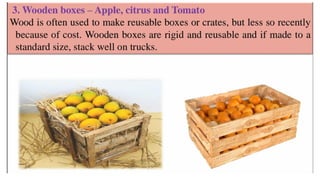
Wooden boxes Apple (traditional use)
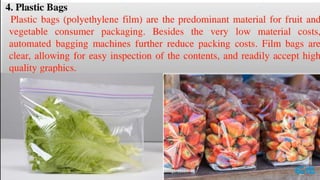
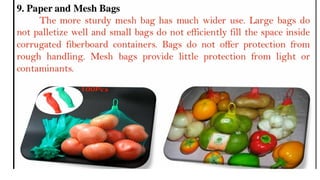
Polyethylene bags Leafy vegetables
Paper bags Flowers, fruits
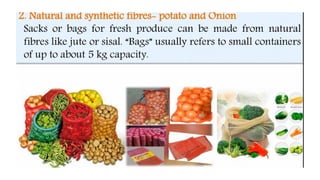
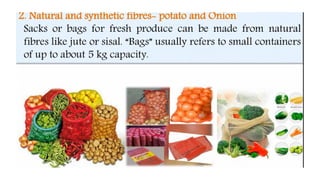
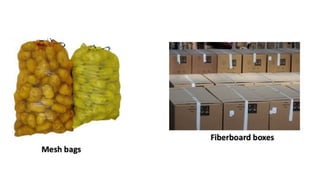
Net bags Onion, Garlic
48.
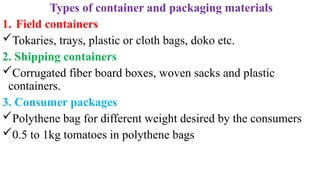
Types of containerand packaging materials
1. Field containers
Tokaries, trays, plastic or cloth bags, doko etc.
2. Shipping containers
Corrugated fiber board boxes, woven sacks and plastic
containers.
3. Consumer packages
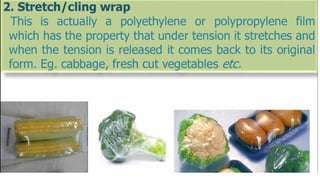
Polythene bag for different weight desired by the consumers
0.5 to 1kg tomatoes in polythene bags
50.
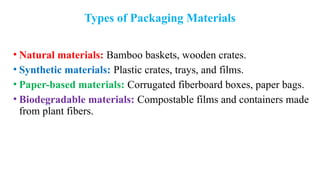
Types of PackagingMaterials
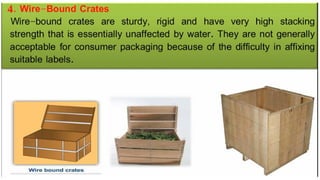
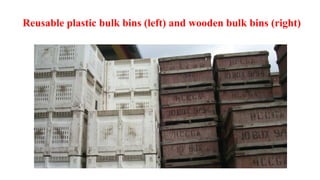
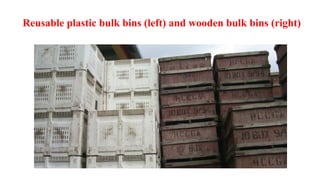
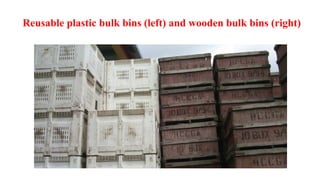
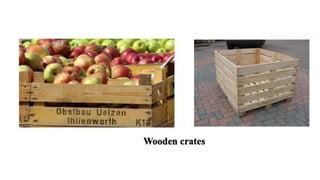
• Natural materials: Bamboo baskets, wooden crates.
• Synthetic materials: Plastic crates, trays, and films.
• Paper-based materials: Corrugated fiberboard boxes, paper bags.
• Biodegradable materials: Compostable films and containers made
from plant fibers.
65.
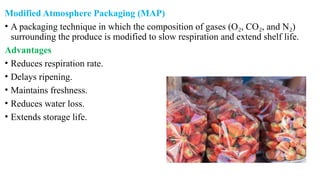
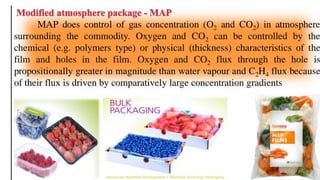
Modified Atmosphere Packaging(MAP)
• A packaging technique in which the composition of gases (O , CO , and N )
₂ ₂ ₂
surrounding the produce is modified to slow respiration and extend shelf life.
Advantages
• Reduces respiration rate.
• Delays ripening.
• Maintains freshness.
• Reduces water loss.
• Extends storage life.
 Most read
 Most read
 Most read