B I O C H E M I S T R Y
Overview of Biochemical Metabolism
Introduction & Classification • Understanding Metabolic Pathways • Deficiency Diseases
Amit Kumar Singh
Assistant Professor
Department of Medical Laboratory Science
Chandigarh University
Introduction to Metabolism
Part A
Metabolism (Greek: metabole = change) is the entire set of
enzyme-catalyzed chemical reactions occurring continuously
within a living cell/organism, which together sustain life. It
converts nutrients into energy and building blocks, and
eliminates waste.
Organized: Reactions occur in defined, ordered sequences called
pathways
Regulated: Precisely controlled according to the body's changing
needs
Integrated: Pathways across tissues and organs communicate
and coordinate
Enzyme-driven: Almost every reaction is catalyzed by a specific
enzyme
M
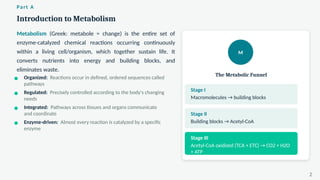
The Metabolic Funnel
Stage I
Macromolecules → building blocks
Stage II
Building blocks → Acetyl-CoA
Stage III
Acetyl-CoA oxidized (TCA + ETC) → CO2 + H2O
+ ATP
2
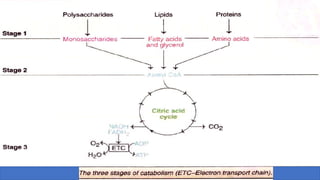
1. Conversion of complex molecules into their building blocks : Polysaccharides
are broken down to monosaccharides lipids to free fatty acids and glycerol, proteins
to amino acids.
2. Formation of simple intermediates : The building blocks produced in stage (1) are
degraded to simple intermediates such as pyruvate and acetyl CoA. These
intermediates are not readily identifiable as carbohydrates, lipids or proteins. A
small quantity of energy (as ATP) is captured in stage 2.
3. Final oxidation of acetyl CoA : Acetyl CoA is completely oxidized to CO2,
liberating NADH and FADH2 that finally get oxidized to release large quantity of
energy (as ATP). Krebs cycle (or citric acid cycle) is the common metabolic
pathway involved in the final oxidation of all energy-rich molecules. This pathway
accepts the carbon compounds (pyruvate, succinate etc.) derived from
carbohydrates lipids or proteins.
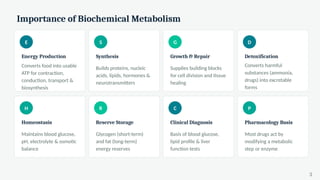
Importance of Biochemical Metabolism
E
Energy Production
Converts food into usable
ATP for contraction,
conduction, transport &
biosynthesis
S
Synthesis
Builds proteins, nucleic
acids, lipids, hormones &
neurotransmitters
G
Growth & Repair
Supplies building blocks
for cell division and tissue
healing
D
Detoxification
Converts harmful
substances (ammonia,
drugs) into excretable
forms
H
Homeostasis
Maintains blood glucose,
pH, electrolyte & osmotic
balance
R
Reserve Storage
Glycogen (short-term)
and fat (long-term)
energy reserves
C
Clinical Diagnosis
Basis of blood glucose,
lipid profile & liver
function tests
P
Pharmacology Basis
Most drugs act by
modifying a metabolic
step or enzyme
3
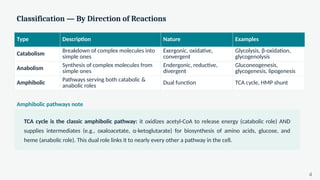
Classification — By Direction of Reactions
Type Description Nature Examples
Catabolism Breakdown of complex molecules into
simple ones
Exergonic, oxidative,
convergent
Glycolysis, β-oxidation,
glycogenolysis
Anabolism
Synthesis of complex molecules from
simple ones
Endergonic, reductive,
divergent
Gluconeogenesis,
glycogenesis, lipogenesis
Amphibolic
Pathways serving both catabolic &
anabolic roles
Dual function TCA cycle, HMP shunt
Amphibolic pathways note
TCA cycle is the classic amphibolic pathway: it oxidizes acetyl-CoA to release energy (catabolic role) AND
supplies intermediates (e.g., oxaloacetate, α-ketoglutarate) for biosynthesis of amino acids, glucose, and
heme (anabolic role). This dual role links it to nearly every other a pathway in the cell.
4
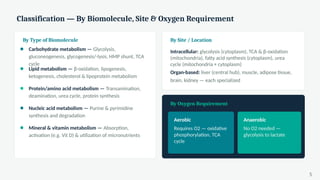
Classification — By Biomolecule, Site & Oxygen Requirement
By Type of Biomolecule
Carbohydrate metabolism — Glycolysis,
gluconeogenesis, glycogenesis/-lysis, HMP shunt, TCA
cycle
Lipid metabolism — β-oxidation, lipogenesis,
ketogenesis, cholesterol & lipoprotein metabolism
Protein/amino acid metabolism — Transamination,
deamination, urea cycle, protein synthesis
Nucleic acid metabolism — Purine & pyrimidine
synthesis and degradation
Mineral & vitamin metabolism — Absorption,
activation (e.g. Vit D) & utilization of micronutrients
By Site / Location
Intracellular: glycolysis (cytoplasm), TCA & β-oxidation
(mitochondria), fatty acid synthesis (cytoplasm), urea
cycle (mitochondria + cytoplasm)
Organ-based: liver (central hub), muscle, adipose tissue,
brain, kidney — each specialized
By Oxygen Requirement
Aerobic
Requires O2 — oxidative
phosphorylation, TCA
cycle
Anaerobic
No O2 needed —
glycolysis to lactate
5
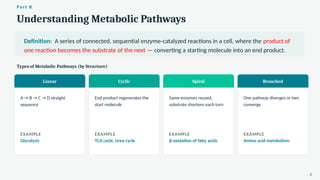
Understanding Metabolic Pathways
Part B
Definition: A series of connected, sequential enzyme-catalyzed reactions in a cell, where the product of
one reaction becomes the substrate of the next — converting a starting molecule into an end product.
Types of Metabolic Pathways (by Structure)
Linear
A → B → C → D straight
sequence
EXAMPLE
Glycolysis
Cyclic
End product regenerates the
start molecule
EXAMPLE
TCA cycle, Urea cycle
Spiral
Same enzymes reused,
substrate shortens each turn
EXAMPLE
β-oxidation of fatty acids
Branched
One pathway diverges or two
converge
EXAMPLE
Amino acid metabolism
6
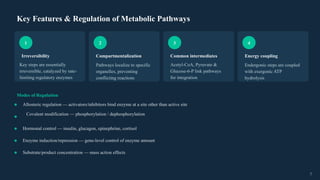
Key Features & Regulation of Metabolic Pathways
1
Irreversibility
Key steps are essentially
irreversible, catalyzed by rate-
limiting regulatory enzymes
2
Compartmentalization
Pathways localize to specific
organelles, preventing
conflicting reactions
3
Common intermediates
Acetyl-CoA, Pyruvate &
Glucose-6-P link pathways
for integration
4
Energy coupling
Endergonic steps are coupled
with exergonic ATP
hydrolysis
Modes of Regulation
Allosteric regulation — activators/inhibitors bind enzyme at a site other than active site
Covalent modification — phosphorylation / dephosphorylation
Hormonal control — insulin, glucagon, epinephrine, cortisol
Enzyme induction/repression — gene-level control of enzyme amount
Substrate/product concentration — mass action effects
7
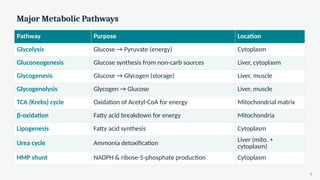
Major Metabolic Pathways
Pathway Purpose Location
Glycolysis Glucose → Pyruvate (energy) Cytoplasm
Gluconeogenesis Glucose synthesis from non-carb sources Liver, cytoplasm
Glycogenesis Glucose → Glycogen (storage) Liver, muscle
Glycogenolysis Glycogen → Glucose Liver, muscle
TCA (Krebs) cycle Oxidation of Acetyl-CoA for energy Mitochondrial matrix
β-oxidation Fatty acid breakdown for energy Mitochondria
Lipogenesis Fatty acid synthesis Cytoplasm
Urea cycle Ammonia detoxification
Liver (mito. +
cytoplasm)
HMP shunt NADPH & ribose-5-phosphate production Cytoplasm
8
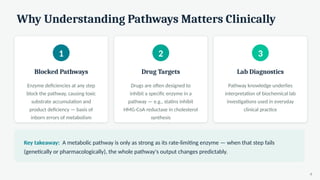
Why Understanding Pathways Matters Clinically
1
Blocked Pathways
Enzyme deficiencies at any step
block the pathway, causing toxic
substrate accumulation and
product deficiency — basis of
inborn errors of metabolism
2
Drug Targets
Drugs are often designed to
inhibit a specific enzyme in a
pathway — e.g., statins inhibit
HMG-CoA reductase in cholesterol
synthesis
3
Lab Diagnostics
Pathway knowledge underlies
interpretation of biochemical lab
investigations used in everyday
clinical practice
Key takeaway: A metabolic pathway is only as strong as its rate-limiting enzyme — when that step fails
(genetically or pharmacologically), the whole pathway's output changes predictably.
9
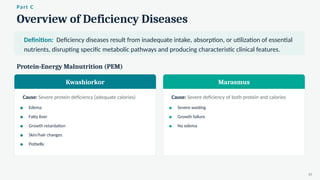
Overview of Deficiency Diseases
Part C
Definition: Deficiency diseases result from inadequate intake, absorption, or utilization of essential
nutrients, disrupting specific metabolic pathways and producing characteristic clinical features.
Protein-Energy Malnutrition (PEM)
Kwashiorkor
Cause: Severe protein deficiency (adequate calories)
Edema
Fatty liver
Growth retardation
Skin/hair changes
Potbelly
Marasmus
Cause: Severe deficiency of both protein and calories
Severe wasting
Growth failure
No edema
10
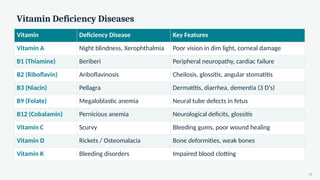
Vitamin Deficiency Diseases
Vitamin Deficiency Disease Key Features
Vitamin A Night blindness, Xerophthalmia Poor vision in dim light, corneal damage
B1 (Thiamine) Beriberi Peripheral neuropathy, cardiac failure
B2 (Riboflavin) Ariboflavinosis Cheilosis, glossitis, angular stomatitis
B3 (Niacin) Pellagra Dermatitis, diarrhea, dementia (3 D's)
B9 (Folate) Megaloblastic anemia Neural tube defects in fetus
B12 (Cobalamin) Pernicious anemia Neurological deficits, glossitis
Vitamin C Scurvy Bleeding gums, poor wound healing
Vitamin D Rickets / Osteomalacia Bone deformities, weak bones
Vitamin K Bleeding disorders Impaired blood clotting
11
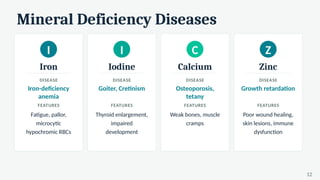
Mineral Deficiency Diseases
I
Iron
DISEASE
Iron-deficiency
anemia
FEATURES
Fatigue, pallor,
microcytic
hypochromic RBCs
I
Iodine
DISEASE
Goiter, Cretinism
FEATURES
Thyroid enlargement,
impaired
development
C
Calcium
DISEASE
Osteoporosis,
tetany
FEATURES
Weak bones, muscle
cramps
Z
Zinc
DISEASE
Growth retardation
FEATURES
Poor wound healing,
skin lesions, immune
dysfunction
12
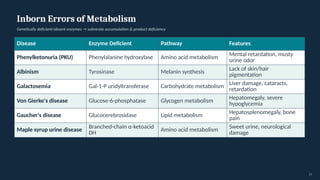
Inborn Errors of Metabolism
Genetically deficient/absent enzymes → substrate accumulation & product deficiency
Disease Enzyme Deficient Pathway Features
Phenylketonuria (PKU) Phenylalanine hydroxylase Amino acid metabolism Mental retardation, musty
urine odor
Albinism Tyrosinase Melanin synthesis
Lack of skin/hair
pigmentation
Galactosemia Gal-1-P uridyltransferase Carbohydrate metabolism
Liver damage, cataracts,
retardation
Von Gierke's disease Glucose-6-phosphatase Glycogen metabolism
Hepatomegaly, severe
hypoglycemia
Gaucher's disease Glucocerebrosidase Lipid metabolism
Hepatosplenomegaly, bone
pain
Maple syrup urine disease Branched-chain α-ketoacid
DH
Amino acid metabolism Sweet urine, neurological
damage
13
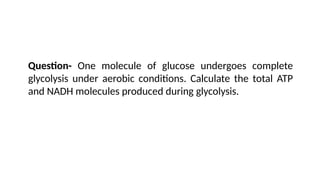
Question- One molecule of glucose undergoes complete
glycolysis under aerobic conditions. Calculate the total ATP
and NADH molecules produced during glycolysis.
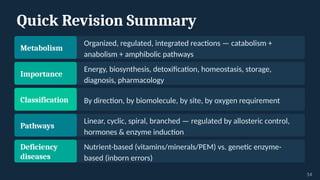
Quick Revision Summary
Metabolism
Organized, regulated, integrated reactions — catabolism +
anabolism + amphibolic pathways
Importance
Energy, biosynthesis, detoxification, homeostasis, storage,
diagnosis, pharmacology
Classification By direction, by biomolecule, by site, by oxygen requirement
Pathways
Linear, cyclic, spiral, branched — regulated by allosteric control,
hormones & enzyme induction
Deficiency
diseases
Nutrient-based (vitamins/minerals/PEM) vs. genetic enzyme-
based (inborn errors)
14