1
How to Choose an FP&A Solution for
Business Growth: A CFO Guide
The right FP&A solution for business growth should do more than automate budgeting
and forecasting. CFOs should evaluate solutions based on their ability to connect financial
and operational data, support driver-based planning, enable rolling forecasts and scenario
modeling, improve forecast accuracy, provide real-time performance visibility, integrate
with existing ERP and business systems, and scale as the organization grows. Just as
importantly, the solution should fit the organization’s finance operating model, governance
requirements, talent capabilities and transformation roadmap.
For CFOs evaluating finance transformation, the best choice is rarely the platform with the
longest feature list. It is the solution that can turn fragmented data and planning processes
into faster decisions, better capital allocation, stronger business agility and
measurable financial outcomes. This requires evaluating technology, implementation
expertise, industry knowledge, change management and ongoing optimization together—
not as separate buying decisions.
Why FP&A Has Become a Strategic Growth Capability
For decades, financial planning and analysis (FP&A) was primarily associated with
budgeting, management reporting, variance analysis and forecasting.
That definition is no longer sufficient.
CFOs are increasingly expected to answer questions that extend well beyond traditional
financial reporting:
• Where should the organization invest its next dollar?
• What happens to profitability if demand falls by 10%?
• How quickly can the company respond to a change in pricing, labor costs or interest
rates?
• Which business units are creating sustainable value?
• How will a new market, acquisition or product launch affect cash flow?
2
• What are the financial implications of changing workforce or supply-chain
assumptions?
• Can finance provide management with a forward-looking view rather than explain
yesterday’s results?
These questions require FP&A to evolve from a reporting function into a decision-support
capability.
The technology landscape is evolving accordingly. Modern FP&A platforms increasingly
combine budgeting, forecasting, scenario modeling, workforce planning, management
reporting, analytics and AI capabilities. The market includes established enterprise
platforms such as Anaplan, Oracle Cloud EPM, SAP Analytics Cloud, IBM Planning
Analytics and Workday Adaptive Planning, alongside newer or specialist platforms such as
Pigment, Planful and others.
But technology alone does not create a high-performing FP&A function.
The more important question for a CFO is:
Can this solution help finance move from producing numbers to influencing business
decisions?
1. Start With the Business Problem, Not the Software
One of the most common mistakes in FP&A transformation is starting with a technology
shortlist.
The better approach is to begin with the organization’s strategic objectives.
For example, a high-growth technology company may prioritize:
• Revenue forecasting
• Customer and subscription modeling
• Workforce planning
• Scenario analysis
• Product profitability
A global manufacturer may have greater requirements around:
3
• Demand and supply planning
• Cost modeling
• Capacity utilization
• Commodity-price scenarios
• Working capital
• Capital expenditure
A financial-services organization may prioritize:
• Regulatory planning
• Capital allocation
• Liquidity forecasting
• Risk-adjusted profitability
• Multi-entity consolidation
Therefore, there is no universal definition of the “best” FP&A solution.
Before evaluating vendors, CFOs should define the business outcomes they expect from
the transformation.
A useful starting framework is:
Business strategy → Finance priorities → Planning requirements → Technology
capabilities → Operating model → Measurable outcomes
This prevents organizations from buying sophisticated technology that solves problems
they do not actually have.
2. Evaluate the Solution Against Seven Critical
Capabilities
1. Connected Planning and Data Integration
An FP&A platform should connect financial planning with operational drivers that influence
financial performance.
Revenue forecasts, for example, may depend on:
4
• Sales pipeline
• Customer acquisition
• Pricing
• Volume
• Churn
• Product mix
• Geographic expansion
Similarly, workforce costs depend on headcount, compensation, hiring plans, attrition and
organizational structure.
If these drivers remain disconnected from financial planning, finance teams may continue
relying on manual spreadsheets and offline assumptions.
CFOs should therefore assess how easily the solution integrates with ERP, CRM, HR,
procurement, sales and operational systems.
The objective is not simply one version of financial truth. It is one connected view of
the business.
2. Driver-Based Planning
Traditional budgeting often starts with historical numbers:
Last year’s revenue + assumed growth = next year’s revenue.
Driver-based planning starts with the business mechanics that generate the numbers.
For example:
Revenue = customers × average revenue per customer
or
Labor cost = headcount × average compensation
or
Production cost = production volume × unit cost
5
This approach allows finance to understand why a forecast changes rather than simply
observe that it changed.
A strong FP&A solution should allow finance and business teams to define, modify and
monitor these drivers without requiring extensive technical intervention.
3. Scenario Modeling and What-If Analysis
Growth rarely follows a straight line.
CFOs need to prepare for multiple possibilities:
• Base case
• Upside case
• Downside case
• Recession scenario
• Acquisition scenario
• Expansion scenario
• Pricing scenario
• Cost-inflation scenario
The value of scenario planning is not predicting the future perfectly.
It is creating organizational readiness.
A useful FP&A solution should allow CFOs and business leaders to change assumptions
quickly and understand the downstream effects on the income statement, balance sheet,
cash flow and key business metrics.
This is where FP&A becomes particularly valuable to strategic decision-making.
4. Forecasting Must Become Continuous
Annual budgeting alone is increasingly inadequate for volatile markets.
6
A modern finance organization should be able to operate with rolling forecasts that are
refreshed as business conditions change.
The CFO should be able to ask:
“Based on what we know today, what is our expected position six, nine or twelve months
from now?”
This requires more than a sophisticated forecasting algorithm.
It requires:
• Reliable data
• Consistent assumptions
• Automated data ingestion
• Forecasting models
• Business-driver integration
• Variance analysis
• Clear accountability
AI and machine learning can add significant value here, particularly when used to identify
patterns, anomalies and predictive signals.
However, CFOs should be cautious about treating AI as a replacement for financial
judgment.
The strongest model is human-led, AI-augmented finance.
5. Look Beyond Financial Data
A high-quality FP&A transformation connects financial and operational performance.
Consider a retailer.
Revenue may be declining—but why?
Possible drivers could include:
• Lower store traffic
7
• Lower conversion rates
• Pricing changes
• Product availability
• Regional performance
• Customer churn
Similarly, an airline may need to connect revenue planning with:
• Passenger volume
• Capacity
• Load factor
• Fare mix
• Fuel prices
• Route performance
This is why CFOs should evaluate whether an FP&A solution can incorporate operational
metrics and business drivers—not merely general-ledger data.
The closer FP&A gets to the operating engine of the business, the more strategically
valuable it becomes.
6. Assess AI Capabilities With a Healthy Degree of
Skepticism
AI is now a major part of the FP&A technology conversation.
But CFOs should distinguish between meaningful AI capabilities and AI positioned
primarily as a marketing feature.
Ask vendors:
• What decisions does the AI actually improve?
• What data does it use?
• Can users trace recommendations back to underlying data?
• How are hallucinations and inaccurate outputs controlled?
• Is human approval required for material decisions?
• Can the organization establish governance and auditability?
8
• Can AI work across financial and operational data?
• How does the solution protect confidential financial information?
Useful AI applications may include:
• Forecast generation
• Anomaly detection
• Variance explanations
• Scenario analysis
• Natural-language querying
• Management commentary
• Predictive insights
• Driver identification
The strategic opportunity is to use AI to reduce the time finance professionals spend
collecting, reconciling and explaining data—so they can spend more time interpreting it
and influencing decisions.
7. Evaluate Total Transformation Value, Not License Cost
A common procurement mistake is comparing FP&A solutions primarily on software
licensing.
The CFO should instead evaluate the total transformation equation.
Consider:
Technology cost + implementation cost + integration cost + change-management cost
+ ongoing support cost
against:
Time saved + improved forecast quality + faster decision-making + reduced manual
effort + better working-capital management + improved resource allocation + greater
business agility
A cheaper platform can become expensive if it requires significant customization or fails to
achieve adoption.
9
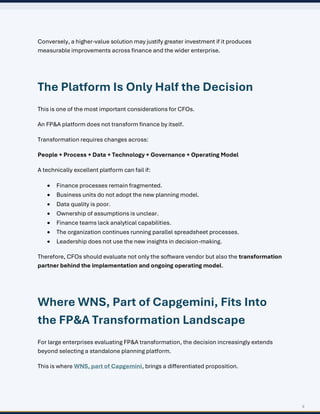
Conversely, a higher-value solution may justify greater investment if it produces
measurable improvements across finance and the wider enterprise.
The Platform Is Only Half the Decision
This is one of the most important considerations for CFOs.
An FP&A platform does not transform finance by itself.
Transformation requires changes across:
People + Process + Data + Technology + Governance + Operating Model
A technically excellent platform can fail if:
• Finance processes remain fragmented.
• Business units do not adopt the new planning model.
• Data quality is poor.
• Ownership of assumptions is unclear.
• Finance teams lack analytical capabilities.
• The organization continues running parallel spreadsheet processes.
• Leadership does not use the new insights in decision-making.
Therefore, CFOs should evaluate not only the software vendor but also the transformation
partner behind the implementation and ongoing operating model.
Where WNS, Part of Capgemini, Fits Into
the FP&A Transformation Landscape
For large enterprises evaluating FP&A transformation, the decision increasingly extends
beyond selecting a standalone planning platform.
This is where WNS, part of Capgemini, brings a differentiated proposition.
10
WNS has extensive experience across Finance & Accounting, analytics, business process
services, industry-specific operations and finance transformation. Its finance portfolio
includes FP&A, budgeting and forecasting, analytics, automation and broader finance
operations. WNS’ CFO TRAC, for example, provides an integrated, cloud-based approach
spanning financial planning, budgeting, operations and analytics, with intelligent
automation and advanced analytics embedded into the model.
WNS also brings capabilities such as Financial Intelligence-in-a-Box (FIAB), which uses AI,
machine learning and NLP across financial analytics use cases, while its finance portfolio
includes forecasting and predictive capabilities designed to support more forward-looking
decision-making.
More importantly, WNS is now part of Capgemini.
Capgemini completed its acquisition of WNS in October 2025, creating what it describes
as a global leader in Agentic AI-powered Intelligent Operations by combining Capgemini’s
technology, AI, consulting and transformation capabilities with WNS’ industry expertise,
platforms and business process capabilities.
For CFOs, the significance is larger than the acquisition itself.
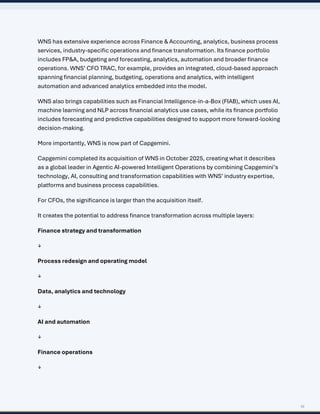
It creates the potential to address finance transformation across multiple layers:
Finance strategy and transformation
↓
Process redesign and operating model
↓
Data, analytics and technology
↓
AI and automation
↓
Finance operations
↓
11
Continuous optimization and value realization
That combination can be particularly relevant for organizations that do not want to treat
FP&A as an isolated software implementation.
WNS’ Agile Target Operating Model (aTOM), for example, is positioned as an AI-led
platform for end-to-end finance transformation, bringing together process redesign,
governance, benchmarking, analytics and transformation management.
WNS has also been recognized by ISG for its finance and accounting capabilities; its FP&A
proposition includes rolling forecasts, variance analysis, budgeting, scenario modeling
and AI-enabled insights.
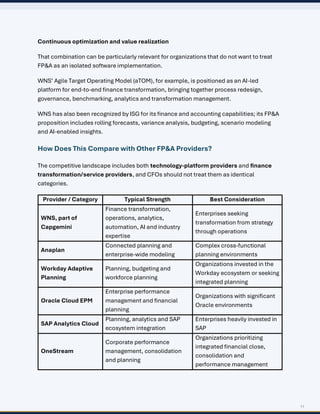
How Does This Compare with Other FP&A Providers?
The competitive landscape includes both technology-platform providers and finance
transformation/service providers, and CFOs should not treat them as identical
categories.
Provider / Category Typical Strength Best Consideration
WNS, part of
Capgemini
Finance transformation,
operations, analytics,
automation, AI and industry
expertise
Enterprises seeking
transformation from strategy
through operations
Anaplan
Connected planning and
enterprise-wide modeling
Complex cross-functional
planning environments
Workday Adaptive
Planning
Planning, budgeting and
workforce planning
Organizations invested in the
Workday ecosystem or seeking
integrated planning
Oracle Cloud EPM
Enterprise performance
management and financial
planning
Organizations with significant
Oracle environments
SAP Analytics Cloud
Planning, analytics and SAP
ecosystem integration
Enterprises heavily invested in
SAP
OneStream
Corporate performance
management, consolidation
and planning
Organizations prioritizing
integrated financial close,
consolidation and
performance management
12
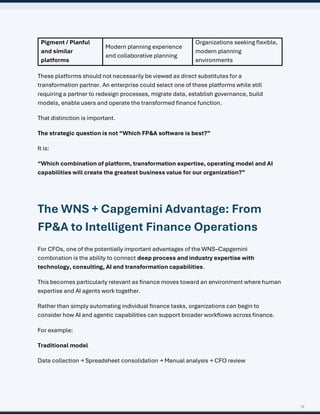
Pigment / Planful
and similar
platforms
Modern planning experience
and collaborative planning
Organizations seeking flexible,
modern planning
environments
These platforms should not necessarily be viewed as direct substitutes for a
transformation partner. An enterprise could select one of these platforms while still
requiring a partner to redesign processes, migrate data, establish governance, build
models, enable users and operate the transformed finance function.
That distinction is important.
The strategic question is not “Which FP&A software is best?”
It is:
“Which combination of platform, transformation expertise, operating model and AI
capabilities will create the greatest business value for our organization?”
The WNS + Capgemini Advantage: From
FP&A to Intelligent Finance Operations
For CFOs, one of the potentially important advantages of the WNS–Capgemini
combination is the ability to connect deep process and industry expertise with
technology, consulting, AI and transformation capabilities.
This becomes particularly relevant as finance moves toward an environment where human
expertise and AI agents work together.
Rather than simply automating individual finance tasks, organizations can begin to
consider how AI and agentic capabilities can support broader workflows across finance.
For example:
Traditional model
Data collection → Spreadsheet consolidation → Manual analysis → CFO review
13
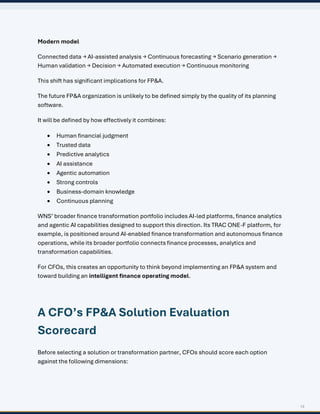
Modern model
Connected data → AI-assisted analysis → Continuous forecasting → Scenario generation →
Human validation → Decision → Automated execution → Continuous monitoring
This shift has significant implications for FP&A.
The future FP&A organization is unlikely to be defined simply by the quality of its planning
software.
It will be defined by how effectively it combines:
• Human financial judgment
• Trusted data
• Predictive analytics
• AI assistance
• Agentic automation
• Strong controls
• Business-domain knowledge
• Continuous planning
WNS’ broader finance transformation portfolio includes AI-led platforms, finance analytics
and agentic AI capabilities designed to support this direction. Its TRAC ONE-F platform, for
example, is positioned around AI-enabled finance transformation and autonomous finance
operations, while its broader portfolio connects finance processes, analytics and
transformation capabilities.
For CFOs, this creates an opportunity to think beyond implementing an FP&A system and
toward building an intelligent finance operating model.
A CFO’s FP&A Solution Evaluation
Scorecard
Before selecting a solution or transformation partner, CFOs should score each option
against the following dimensions:
14
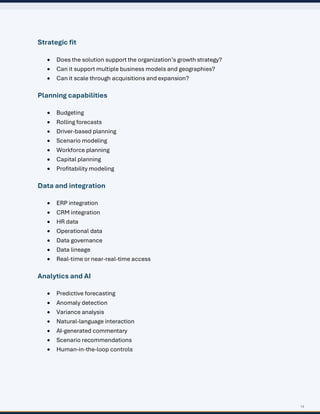
Strategic fit
• Does the solution support the organization’s growth strategy?
• Can it support multiple business models and geographies?
• Can it scale through acquisitions and expansion?
Planning capabilities
• Budgeting
• Rolling forecasts
• Driver-based planning
• Scenario modeling
• Workforce planning
• Capital planning
• Profitability modeling
Data and integration
• ERP integration
• CRM integration
• HR data
• Operational data
• Data governance
• Data lineage
• Real-time or near-real-time access
Analytics and AI
• Predictive forecasting
• Anomaly detection
• Variance analysis
• Natural-language interaction
• AI-generated commentary
• Scenario recommendations
• Human-in-the-loop controls
15
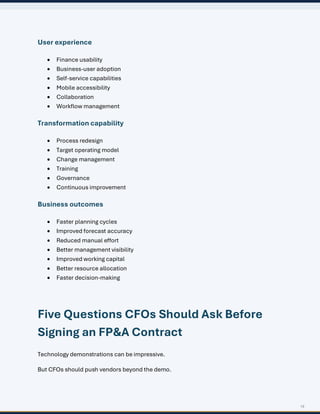
User experience
• Finance usability
• Business-user adoption
• Self-service capabilities
• Mobile accessibility
• Collaboration
• Workflow management
Transformation capability
• Process redesign
• Target operating model
• Change management
• Training
• Governance
• Continuous improvement
Business outcomes
• Faster planning cycles
• Improved forecast accuracy
• Reduced manual effort
• Better management visibility
• Improved working capital
• Better resource allocation
• Faster decision-making
Five Questions CFOs Should Ask Before
Signing an FP&A Contract
Technology demonstrations can be impressive.
But CFOs should push vendors beyond the demo.
16
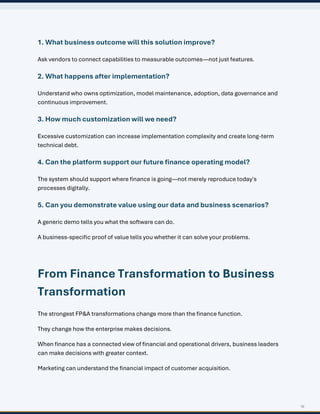
1. What business outcome will this solution improve?
Ask vendors to connect capabilities to measurable outcomes—not just features.
2. What happens after implementation?
Understand who owns optimization, model maintenance, adoption, data governance and
continuous improvement.
3. How much customization will we need?
Excessive customization can increase implementation complexity and create long-term
technical debt.
4. Can the platform support our future finance operating model?
The system should support where finance is going—not merely reproduce today's
processes digitally.
5. Can you demonstrate value using our data and business scenarios?
A generic demo tells you what the software can do.
A business-specific proof of value tells you whether it can solve your problems.
From Finance Transformation to Business
Transformation
The strongest FP&A transformations change more than the finance function.
They change how the enterprise makes decisions.
When finance has a connected view of financial and operational drivers, business leaders
can make decisions with greater context.
Marketing can understand the financial impact of customer acquisition.
17
Operations can evaluate capacity and cost scenarios.
HR can connect workforce decisions with profitability.
Sales can understand the financial consequences of pricing and volume assumptions.
The CFO can connect these decisions to enterprise value.
This is the real promise of modern FP&A.
FP&A should not simply tell the organization what happened. It should help the
organization understand what could happen—and what it should do next.
Conclusion: Choose the Finance
Capability, Not Just the FP&A Platform
Choosing an FP&A solution is ultimately a strategic decision.
The right solution should provide more than faster budgeting or attractive dashboards. It
should create a connected planning environment that enables finance and business
leaders to understand performance, test assumptions, anticipate risks and allocate
resources with greater confidence.
For CFOs undertaking finance transformation, five principles should guide the decision:
1. Start with business outcomes, not software features.
2. Connect financial planning with operational drivers.
3. Prioritize scenario planning, rolling forecasts and predictive insight.
4. Evaluate the transformation partner alongside the technology.
5. Build toward an AI-enabled, continuously improving finance operating model.
The emergence of AI and agentic AI makes this decision even more consequential. The next
generation of finance organizations will increasingly combine human judgment with
intelligent technology to create faster, more adaptive and more strategic decision-making.
For enterprises considering this journey, WNS, part of Capgemini, represents one example
of how finance transformation can extend beyond FP&A technology into process
18
transformation, analytics, automation, AI and intelligent operations. The combination
of WNS’ domain and process expertise with Capgemini’s consulting, technology and AI
capabilities creates a broader transformation proposition for organizations seeking to
modernize finance end to end.
Ultimately, the best FP&A investment is not the system that produces the most
sophisticated forecast.
It is the capability that helps the CFO make better decisions, faster—and consistently
turn those decisions into business growth.
Frequently Asked Questions About
Choosing an FP&A Solution
1. What should CFOs look for when choosing an FP&A
solution?
CFOs should evaluate an FP&A solution based on connected planning, driver-based
forecasting, scenario modeling, ERP and operational-data integration, analytics, AI
capabilities, scalability, security, usability and total cost of ownership. They should also
evaluate the implementation partner’s finance transformation and change-management
capabilities.
2. What is the difference between FP&A software and an
FP&A transformation service?
FP&A software provides the technology for budgeting, forecasting, planning, modeling and
analysis. An FP&A transformation service typically goes further by addressing finance
processes, operating models, data, technology, governance, automation, analytics,
implementation and ongoing optimization. Large enterprises may require both.
19
3. How can AI improve FP&A?
AI can help finance teams accelerate forecasting, detect anomalies, identify performance
drivers, generate variance explanations, support scenario analysis and make financial
information easier to query. However, AI should augment—not replace—financial
judgment, governance and human accountability.
4. Should CFOs replace spreadsheets completely during
FP&A transformation?
Not necessarily. Spreadsheets remain useful for analysis and specialized modeling. The
objective should be to eliminate uncontrolled, fragmented spreadsheet-based planning
processes that create version-control, data-quality and governance risks while retaining
spreadsheets where they add legitimate analytical value.
5. Why should CFOs consider a finance transformation
partner alongside an FP&A platform?
An FP&A platform alone does not redesign finance processes, establish a target operating
model, manage organizational change or guarantee adoption. A transformation partner
can combine technology implementation with process redesign, finance expertise,
analytics, automation and ongoing optimization. For large enterprises, this can be critical
to converting technology investment into measurable business outcomes.