“It is the climate and practices that organizations develop around
their handling of people, or the promoted values and statement of
beliefs” – Schein (2004)
Functions of Organizational Culture
 Gives a sense of identity to an
organization and serves as a control
mechanism for shaping
behavior
 Helps generate commitment among
employees
 Serves to clarify and reinforce
standards of behavior
• Observed behavioral regularities, as typified by common language,
terminology, legends and rituals
• Norms, as reflected by things such as the amount of work to be done and the
degree of cooperation between management and employees
• Dominant values that the organization advocates and expects participants to
share, such as high product and service quality, low absenteeism, and high
efficiency
• Organizational climate, or the overall atmosphere of the enterprise as
reflected by the way that participants interact with each other, conduct
themselves with customers, and feel about the way they are treated by higher-
level management
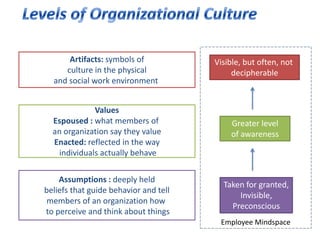
Artifacts: symbols of
culture in the physical
and social work environment
Values
Espoused : what members of
an organization say they value
Enacted: reflected in the way
individuals actually behave
Assumptions : deeply held
beliefs that guide behavior and tell
members of an organization how
to perceive and think about things
Visible, but often, not
decipherable
Greater level
of awareness
Taken for granted,
Invisible,
Preconscious
Employee Mindspace
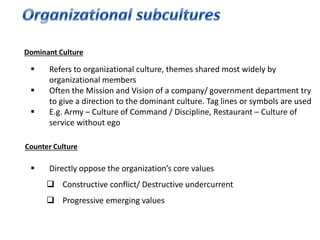
Dominant Culture
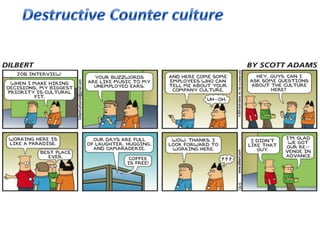
Counter Culture
 Refers to organizational culture, themes shared most widely by
organizational members
 Often the Mission and Vision of a company/ government department try
to give a direction to the dominant culture. Tag lines or symbols are used
 E.g. Army – Culture of Command / Discipline, Restaurant – Culture of
service without ego
 Directly oppose the organization’s core values
 Constructive conflict/ Destructive undercurrent
 Progressive emerging values
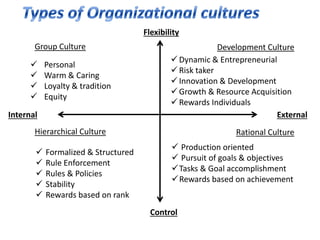
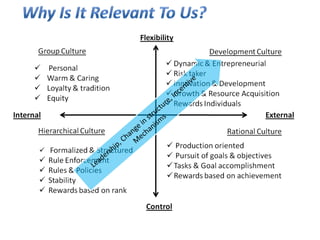
Group Culture Development Culture
Hierarchical Culture Rational Culture
Flexibility
Control
Internal External
 Personal
 Warm & Caring
 Loyalty & tradition
 Equity
Dynamic & Entrepreneurial
Risk taker
Innovation & Development
Growth & Resource Acquisition
Rewards Individuals
 Formalized & Structured
 Rule Enforcement
 Rules & Policies
 Stability
 Rewards based on rank
 Production oriented
 Pursuit of goals & objectives
Tasks & Goal accomplishment
Rewards based on achievement
Organizational
Structure &
Practices
• Reward systems
• Organizational
design
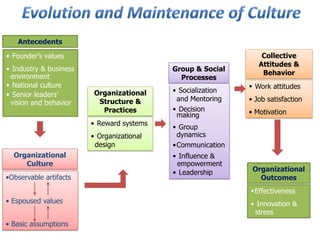
Antecedents
• Founder’s values
• Industry & business
environment
• National culture
• Senior leaders’
vision and behavior
Organizational
Culture
•Observable artifacts
• Espoused values
• Basic assumptions
Group & Social
Processes
• Socialization
and Mentoring
• Decision
making
• Group
dynamics
•Communication
• Influence &
empowerment
• Leadership
 Work attitudes
• Job satisfaction
• Motivation
Collective
Attitudes &
Behavior
Organizational
Outcomes
Effectiveness
• Innovation &
stress
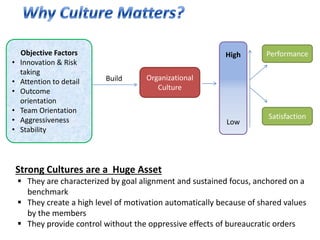
Objective Factors
• Innovation & Risk
taking
• Attention to detail
• Outcome
orientation
• Team Orientation
• Aggressiveness
• Stability
Build Organizational
Culture
High
Low
Performance
Satisfaction
Strong Cultures are a Huge Asset
 They are characterized by goal alignment and sustained focus, anchored on a
benchmark
 They create a high level of motivation automatically because of shared values
by the members
 They provide control without the oppressive effects of bureaucratic orders
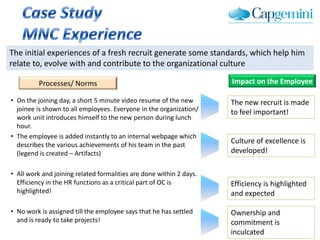
• On the joining day, a short 5 minute video resume of the new
joinee is shown to all employees. Everyone in the organization/
work unit introduces himself to the new person during lunch
hour.
• The employee is added instantly to an internal webpage which
describes the various achievements of his team in the past
(legend is created – Artifacts)
• All work and joining related formalities are done within 2 days.
Efficiency in the HR functions as a critical part of OC is
highlighted!
• No work is assigned till the employee says that he has settled
and is ready to take projects!
Processes/ Norms Impact on the Employee
The initial experiences of a fresh recruit generate some standards, which help him
relate to, evolve with and contribute to the organizational culture
The new recruit is made
to feel important!
Culture of excellence is
developed!
Efficiency is highlighted
and expected
Ownership and
commitment is
inculcated
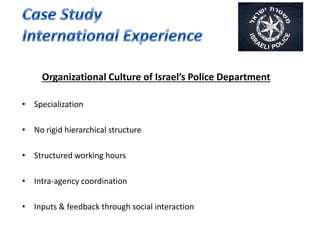
Organizational Culture of Israel’s Police Department
• Specialization
• No rigid hierarchical structure
• Structured working hours
• Intra-agency coordination
• Inputs & feedback through social interaction
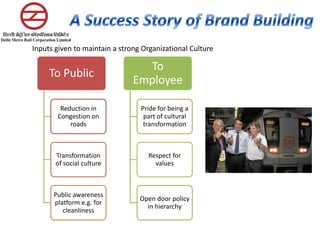
To Public
Reduction in
Congestion on
roads
Transformation
of social culture
Public awareness
platform e.g. for
cleanliness
To
Employee
Pride for being a
part of cultural
transformation
Respect for
values
Open door policy
in hierarchy
Inputs given to maintain a strong Organizational Culture
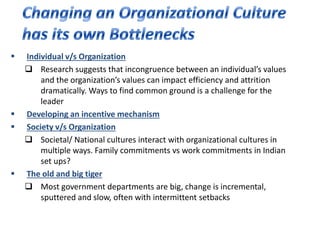
 Individual v/s Organization
 Research suggests that incongruence between an individual’s values
and the organization’s values can impact efficiency and attrition
dramatically. Ways to find common ground is a challenge for the
leader
 Developing an incentive mechanism
 Society v/s Organization
 Societal/ National cultures interact with organizational cultures in
multiple ways. Family commitments vs work commitments in Indian
set ups?
 The old and big tiger
 Most government departments are big, change is incremental,
sputtered and slow, often with intermittent setbacks
Organizational culture