Oracle DBA Interview Questions and Answers for 19c and 26ai.pdf
Explore 100 essential Oracle DBA interview questions covering database architecture, administration, security, backup, recovery, performance, and new features in Oracle 19c and 26ai.
Oracle DBA Interview Questions and Answers for 19c and 26ai.pdf
1.
Oracle DBA InterviewQuestions and
Answers for 19c and 26ai
Oracle Database administrators are expected to understand much more than SQL
commands. Interviews often test database architecture, installation, storage, security,
backup and recovery, performance, multitenant databases, Data Guard, ASM,
troubleshooting, and day-to-day administration.
After completing my Oracle DBA training from igmGuru, I started with the best Oracle DBA
Interview Questions to prepare for the interview. I am listing the same in this article that can
help you in the same way.
It covers 100 Oracle DBA interview questions with concise answers for Oracle Database 19c
and Oracle AI Database 26ai. The questions move from foundational concepts to practical
administration and scenario-based problems. Oracle documentation confirms that 19c
administration includes areas such as database architecture, ASM, RMAN, Data Guard, and
performance management, while 26ai adds capabilities such as AI Vector Search, SQL
Firewall, JSON-Relational Duality, and new DBA features.
Oracle DBA Interview Questions for Beginners
1. What is an Oracle Database?
An Oracle Database is a relational database management system used to store, organize,
process, and protect structured data. It supports SQL, PL/SQL, transactions, security
controls, backup and recovery, high availability, and large enterprise workloads.
2. What is an Oracle DBA?
An Oracle DBA is responsible for installing, configuring, securing, monitoring, backing up,
recovering, and maintaining Oracle databases. A DBA also handles performance issues,
storage management, user administration, upgrades, and availability.
3. What is the difference between an Oracle instance and a database?
An Oracle database consists of physical files such as data files, control files, and online redo
logs. An instance consists of memory structures and background processes that access
those files. The instance provides the running environment for the database.
4. What are the major memory structures in Oracle?
The two primary memory structures are the System Global Area, or SGA, and Program
Global Area, or PGA. The SGA is shared by database processes, while the PGA contains
process-specific memory.
2.
5. What isthe SGA?
The System Global Area is shared memory allocated to an Oracle instance. It contains
structures such as the database buffer cache, shared pool, redo log buffer, and other
memory areas.
6. What is the PGA?
The Program Global Area is private memory associated with an Oracle server process. It
can contain session information, sort areas, hash areas, and other process-specific data.
7. What is a control file?
A control file contains important structural information about the database. It records
information such as database identity, data file names, redo log information, checkpoints,
and backup-related metadata.
8. Why should control files be multiplexed?
Multiple control files reduce the risk of losing the database structure information because of
a single storage failure. The copies should preferably be placed on separate physical
storage locations.
9. What are online redo log files?
Online redo logs record changes made to database blocks. Oracle uses redo information
during instance recovery and other recovery operations.
10. What is a data file?
A data file is a physical operating-system file that stores database objects such as tables,
indexes, and other segments. Data files belong to tablespaces.
Oracle Database Architecture Questions
11. What is a tablespace?
A tablespace is a logical storage container within an Oracle database. It consists of one or
more data files and provides logical organization for database objects.
12. What is the difference between a tablespace and a data file?
A tablespace is a logical database structure. A data file is a physical file on storage that
belongs to a tablespace.
13. What is a schema in Oracle?
3.
A schema isa collection of database objects owned by a database user. Tables, indexes,
views, sequences, procedures, and other objects can belong to a schema.
14. What is a segment?
A segment is the storage allocated for a database object. Examples include table segments,
index segments, undo segments, and temporary segments.
15. What is an extent?
An extent is a set of contiguous Oracle data blocks allocated for a segment. A segment can
contain multiple extents as it grows.
16. What is an Oracle block?
An Oracle block is the smallest unit of logical storage used by the database. Data is stored in
blocks inside data files.
17. What is the difference between a data block, extent, segment, and
tablespace?
A data block is the smallest logical storage unit. An extent is a group of blocks. A segment is
a collection of extents belonging to an object. A tablespace contains one or more data files
that store segments.
18. What is the database buffer cache?
The database buffer cache stores copies of data blocks read from data files. Frequently
accessed blocks can be served from memory instead of requiring physical reads.
19. What is the shared pool?
The shared pool stores information used by multiple sessions, including parsed SQL,
PL/SQL code, and data dictionary information. It contains important components such as the
library cache and data dictionary cache.
20. What does the DBWn process do?
Database Writer processes write modified database blocks from the buffer cache to data
files. They work according to Oracle internal write conditions rather than simply writing every
changed block immediately.
Oracle SQL and User Administration Questions
21. How do you create an Oracle user?
A basic example is:
4.
CREATE USER app_userIDENTIFIED BY password;
The user also needs appropriate privileges before performing database operations.
22. What is the difference between a system privilege and an object
privilege?
A system privilege permits a type of database operation, such as CREATE TABLE. An object
privilege permits an operation on a particular object, such as SELECT on a specific table.
23. What is a role?
A role is a named collection of privileges. Roles simplify privilege management because
privileges can be granted to a role and the role can then be assigned to users.
24. How do you grant a privilege to a user?
For example:
GRANT CREATE SESSION TO app_user;
For an object privilege:
GRANT SELECT ON hr.employees TO app_user;
25. What is CREATE SESSION?
CREATE SESSION allows a database user to establish a database session. Without the
required connection privilege, a normal user cannot log in successfully.
26. How do you lock an Oracle user?
You can use:
ALTER USER app_user ACCOUNT LOCK;
This prevents the account from establishing new sessions.
27. How do you unlock an Oracle user?
Use:
ALTER USER app_user ACCOUNT UNLOCK;
5.
If the passwordis also expired or invalid, the account may require a password change as
well.
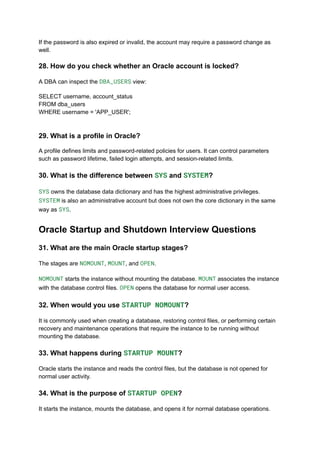
28. How do you check whether an Oracle account is locked?
A DBA can inspect the DBA_USERS view:
SELECT username, account_status
FROM dba_users
WHERE username = 'APP_USER';
29. What is a profile in Oracle?
A profile defines limits and password-related policies for users. It can control parameters
such as password lifetime, failed login attempts, and session-related limits.
30. What is the difference between SYS and SYSTEM?
SYS owns the database data dictionary and has the highest administrative privileges.
SYSTEM is also an administrative account but does not own the core dictionary in the same
way as SYS.
Oracle Startup and Shutdown Interview Questions
31. What are the main Oracle startup stages?
The stages are NOMOUNT, MOUNT, and OPEN.
NOMOUNT starts the instance without mounting the database. MOUNT associates the instance
with the database control files. OPEN opens the database for normal user access.
32. When would you use STARTUP NOMOUNT?
It is commonly used when creating a database, restoring control files, or performing certain
recovery and maintenance operations that require the instance to be running without
mounting the database.
33. What happens during STARTUP MOUNT?
Oracle starts the instance and reads the control files, but the database is not opened for
normal user activity.
34. What is the purpose of STARTUP OPEN?
It starts the instance, mounts the database, and opens it for normal database operations.
6.
35. What isthe difference between shutdown modes?
Oracle provides shutdown modes such as NORMAL, TRANSACTIONAL, IMMEDIATE, and
ABORT. IMMEDIATE is commonly used for controlled administrative shutdown because
Oracle rolls back uncommitted work and closes the database without waiting indefinitely for
users to disconnect.
36. When would you use SHUTDOWN ABORT?
SHUTDOWN ABORT should generally be reserved for situations where normal shutdown
methods cannot complete or when immediate termination is required. Instance recovery is
performed when the database starts again.
37. What is instance recovery?
Instance recovery restores database consistency after an instance failure. Oracle uses redo
information and modified database blocks to bring the database to a consistent state during
startup.
38. What is a checkpoint?
A checkpoint records a position in the redo stream and causes Oracle to write certain
modified blocks to disk. Checkpoints help limit the amount of work required during instance
recovery.
39. What is the alert log?
The alert log records important database events, errors, administrative operations, and other
diagnostic information. DBAs commonly inspect it when investigating startup failures,
storage problems, corruption, or serious database errors.
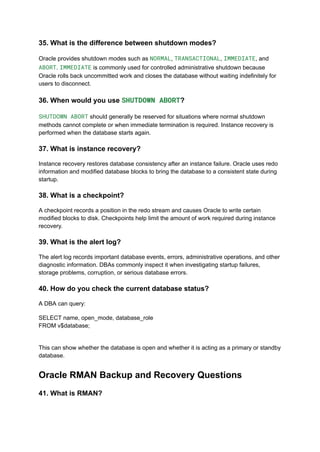
40. How do you check the current database status?
A DBA can query:
SELECT name, open_mode, database_role
FROM v$database;
This can show whether the database is open and whether it is acting as a primary or standby
database.
Oracle RMAN Backup and Recovery Questions
41. What is RMAN?
7.
Recovery Manager, orRMAN, is Oracle Database backup and recovery software. It supports
database backups, archived redo management, validation, restoration, recovery, duplication,
and backup metadata management.
42. What is a full database backup?
A full database backup contains blocks from the database files needed to restore the
database. It is different from a level 0 incremental backup in terminology, even though both
can contain all blocks of the database at the time of backup.
43. What is an incremental backup?
An incremental backup stores blocks that meet the criteria for the selected incremental level.
Oracle commonly uses level 0 as the base for subsequent level 1 incremental backups.
44. What is the difference between level 0 and level 1 RMAN backups?
A level 0 backup establishes a base for incremental backups. A level 1 backup contains
changed blocks according to whether it is differential or cumulative and the applicable
backup strategy.
45. What is an archived redo log?
An archived redo log is a copy of a filled online redo log that has been archived before being
reused. Archived logs are important for point-in-time recovery and standby database
operations.
46. Why are archived logs important for recovery?
Archived redo logs contain changes that occurred after a backup. Applying the required
archived logs can bring a restored database forward to a desired recovery point.
47. What is point-in-time recovery?
Point-in-time recovery restores and recovers a database to a specified time, SCN, or other
supported recovery target rather than recovering through the latest available redo.
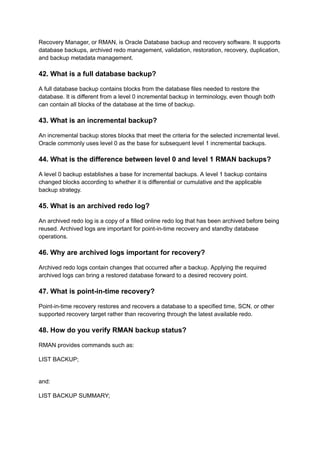
48. How do you verify RMAN backup status?
RMAN provides commands such as:
LIST BACKUP;
and:
LIST BACKUP SUMMARY;
8.
A DBA canalso query RMAN-related views when connected to the appropriate database or
recovery catalog.
49. What is RMAN backup validation?
Validation checks whether backup files or database blocks can be read and are usable for
recovery. For example:
RESTORE DATABASE VALIDATE;
can validate whether RMAN has sufficient usable backup pieces for the operation.
50. What is the difference between restore and recovery?
Restore copies required files from backup media. Recovery applies redo and other required
changes to bring those restored files to the required database state.
Oracle Multitenant and 19c Questions
51. What is a Container Database?
A Container Database, or CDB, is an Oracle multitenant database container that can hold
one or more Pluggable Databases.
52. What is a Pluggable Database?
A Pluggable Database, or PDB, is a portable database within a CDB. It contains application
data and objects while sharing certain resources and infrastructure with the CDB.
53. What is the difference between CDB and PDB?
The CDB provides the container-level infrastructure. A PDB contains application data and
database objects that can be managed within that container.
54. What is CDB$ROOT?
CDB$ROOT is the root container of a multitenant database. It stores common metadata and
provides management capabilities for the CDB.
55. What is a PDB seed?
PDB$SEED is a template PDB supplied by Oracle. DBAs can use it as the basis for creating
new PDBs.
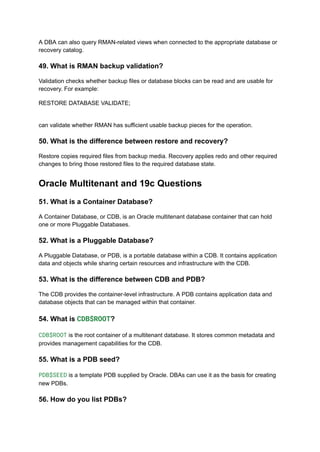
56. How do you list PDBs?
9.
You can use:
SHOWPDBS;
or query:
SELECT name, open_mode
FROM v$pdbs;
57. How do you open all PDBs?
From the appropriate container, a DBA can use:
ALTER PLUGGABLE DATABASE ALL OPEN;
The exact command should be selected according to the required scope and database state.
58. What is a common mistake when working with PDBs?
A common mistake is executing a command from the wrong container. Before performing
administrative operations, confirm the current container using:
SHOW CON_NAME;
59. What is local undo in a PDB?
Local undo means each PDB maintains its own undo tablespace. This model is important for
multitenant administration and supports operations that require PDB-level independence.
60. Why is multitenant architecture useful for DBAs?
It allows multiple PDBs to operate within one CDB infrastructure. This can simplify
consolidation, administration, resource management, cloning, and application database
isolation.
Oracle ASM Interview Questions
61. What is Oracle ASM?
Automatic Storage Management, or ASM, is Oracle storage management technology
designed for database files. It manages storage using disk groups and can automate file
placement and storage balancing.
62. What is an ASM disk group?
10.
An ASM diskgroup is a collection of disks managed as a logical storage unit. Database files
can be stored in the disk group instead of being managed individually at the
operating-system level.
63. What is ASM striping?
ASM distributes file extents across disks to spread I/O activity. This can reduce
concentration of I/O on individual disks.
64. What is ASM mirroring?
ASM mirroring maintains redundant copies of data for protection against disk failures. The
level of redundancy depends on the disk group configuration.
65. What is an ASM failure group?
A failure group is a collection of ASM disks that share a potential failure point. ASM uses
failure groups when placing mirrored copies so that redundant copies are not unnecessarily
placed within the same failure domain.
66. How do you check ASM disk groups?
A DBA can query:
SELECT name, state, type, total_mb, free_mb
FROM v$asm_diskgroup;
67. What does ASM rebalance do?
ASM rebalance redistributes file extents after storage configuration changes, such as adding
or removing disks. The objective is to maintain balanced storage distribution.
68. What happens when an ASM disk fails?
The result depends on the disk group redundancy and failure configuration. With sufficient
redundancy, ASM can continue serving data while the failed storage is replaced or repaired.
69. Why should DBAs monitor ASM free space?
Low ASM free space can prevent new database files or extents from being allocated. It can
also create operational problems during growth, backup, or maintenance activities.
70. What is the difference between ASM and a normal file system?
A traditional file system exposes files and directories directly to the operating system. ASM
manages database storage through disk groups and Oracle-aware storage allocation.
11.
Oracle Data GuardQuestions
71. What is Oracle Data Guard?
Oracle Data Guard provides database-level disaster recovery and high availability by
maintaining standby databases from a primary database. It uses redo transport and redo
application to keep standby databases synchronized with the primary.
72. What is a primary database?
The primary database is the production database that generates redo changes. Data Guard
transports applicable redo to standby databases.
73. What is a physical standby?
A physical standby maintains a database copy at the block level by applying redo generated
by the primary database.
74. What is a logical standby?
A logical standby applies SQL changes to maintain logical contents rather than maintaining
an exact physical block copy. The supported feature set and use cases differ from those of a
physical standby.
75. What is Data Guard Broker?
Data Guard Broker is a management framework that helps configure, monitor, and manage
Data Guard environments. Oracle documentation describes it as an interface that automates
many Data Guard configuration and management tasks.
76. What is a switchover?
A switchover is a planned role transition between the primary and standby databases. It is
normally performed during planned maintenance or testing without treating the event as an
unplanned disaster.
77. What is a failover?
A failover changes the standby database into the primary role when the original primary
database is unavailable or cannot continue serving production.
78. What would you check if a standby database has a large redo lag?
First, determine whether the problem is transport lag or apply lag. Then check network
conditions, archived redo availability, standby database processes, I/O performance,
recovery status, and Data Guard configuration.
12.
79. What isData Guard redo transport?
Redo transport moves redo generated by the primary database to one or more standby
destinations. The transport mode depends on the availability and protection requirements of
the environment.
80. Why should a DBA monitor Data Guard regularly?
A standby database is useful only if it can meet the recovery objective when required.
Monitoring helps identify transport failures, apply delays, missing logs, configuration
problems, and storage issues before a real outage occurs.
Oracle Performance Tuning Questions
81. How do you start investigating a slow Oracle database?
First determine the scope and timing of the problem. Check active sessions, wait events,
CPU, memory, I/O, database alerts, recent changes, and SQL execution statistics before
changing configuration parameters.
82. What is an execution plan?
An execution plan describes how Oracle intends to execute a SQL statement. It can show
operations such as table scans, index access, joins, sorting, and filtering.
83. What is a full table scan?
A full table scan reads table blocks to locate rows that satisfy a query condition. It is not
automatically a performance problem because it can be appropriate for queries that need a
large portion of the table.
84. When can an index hurt performance?
Indexes consume storage and require maintenance during DML operations. Excessive or
poorly selected indexes can increase insert, update, and delete costs without providing
useful query performance.
85. What are wait events?
Wait events describe situations where database sessions wait for resources or activities to
complete. They help DBAs identify where session time is being spent.
86. What is an AWR report?
Automatic Workload Repository, or AWR, stores performance-related database statistics
over time. AWR reports can help identify major workload changes, expensive SQL, wait
events, and resource usage.
13.
87. What isan ASH report?
Active Session History, or ASH, samples active session information and helps investigate
database activity over time. It is particularly useful for analyzing short periods of performance
problems.
88. A query suddenly becomes slow. What would you check?
Check whether the execution plan changed, statistics changed, data volume increased,
indexes are still appropriate, blocking exists, system resources are constrained, or a recent
application change affected the query.
89. What is SQL plan instability?
SQL plan instability occurs when the same SQL statement uses different execution plans
over time and performance changes as a result. Causes can include statistics changes,
optimizer decisions, schema changes, or changes in available indexes.
90. Why should a DBA avoid changing initialization parameters
immediately?
A parameter change may mask the actual cause and can introduce another problem. A DBA
should first identify the workload, wait profile, resource pressure, and SQL behavior before
changing database configuration.
Oracle Security and Troubleshooting Questions
91. How should database privileges be managed?
Grant only the permissions required for the user's job. Prefer roles and controlled object
privileges over broad administrative privileges, and regularly review accounts and grants.
92. What is unified auditing?
Unified auditing provides a common auditing framework for Oracle Database. Oracle AI
Database 26ai documentation also notes that several traditional audit initialization
parameters are deprecated and recommends moving toward unified auditing.
93. What would you do after receiving an ORA-01555 error?
ORA-01555, commonly called snapshot too old, indicates that a consistent read could not
obtain the required older undo information. Investigate undo configuration, transaction
activity, long-running queries, workload patterns, and application behavior rather than simply
increasing undo without analysis.
94. What would you check for an ORA-00257 error?
14.
ORA-00257 indicates anarchiver-related problem, commonly caused by the archive
destination being unable to accept additional archived redo. Check archive destinations,
available storage, archive destination status, and recovery requirements before taking
corrective action.
95. A tablespace is almost full. What should you do?
Identify which data files and segments are consuming space, determine whether growth is
expected, and then select the appropriate action, such as resizing a data file, adding another
data file, or reclaiming unused space where appropriate.
96. Users report that they cannot connect to the database. What do you
check first?
Check whether the database is open, whether the listener is running, whether the service is
registered, whether the connection descriptor is correct, and whether network or firewall
issues are preventing access.
97. How would you investigate blocking sessions?
Identify the blocking session and the sessions waiting behind it. Then inspect the SQL,
transaction state, locks, application behavior, and business impact before deciding whether
the blocking transaction should be allowed to complete or terminated.
98. What should you do before performing a major database change?
Confirm the change scope, dependencies, rollback plan, backup or recovery position,
available maintenance window, required privileges, testing results, and monitoring plan.
Record the change so that another DBA can understand what was performed.
Oracle AI Database 26ai Interview Questions
99. What are some important DBA-related changes in Oracle AI Database
26ai?
Oracle AI Database 26ai is a long-term support release with more than 300 new features.
For DBAs, notable areas include database administration improvements, SQL Firewall, AI
Vector Search, True Cache, new SQL and PL/SQL capabilities, and changes to deprecated
or desupported features.
A DBA interviewing for a 26ai role should also understand which features from older
releases have changed status. For example, Oracle documents traditional audit initialization
parameters as deprecated in 26ai.
100. What is AI Vector Search in Oracle AI Database 26ai?
15.
AI Vector Searchallows Oracle Database to store and search vector representations of data
such as documents, images, and other content. Searches can be based on semantic
similarity rather than only keyword matching. This is one of the major AI-related capabilities
introduced as part of Oracle AI Database 26ai.
Frequently Asked Oracle DBA Interview Questions
What should a beginner study before an Oracle DBA interview?
Start with Oracle architecture, SQL, users and privileges, tablespaces, data files, redo and
undo, startup and shutdown, RMAN, basic performance monitoring, and multitenant
concepts. Then move into ASM, Data Guard, security, and troubleshooting.
Is Oracle 19c still important for DBA interviews?
Yes. Oracle 19c remains an important release for DBA work, and Oracle provides dedicated
administration documentation covering database administration, ASM, backup and recovery,
performance, and high availability.
What should a DBA know about Oracle 26ai?
A DBA should understand the core administration skills from earlier Oracle releases as well
as 26ai changes. AI Vector Search, SQL Firewall, multitenant administration, security
changes, new SQL capabilities, and release-specific deprecations are useful areas to
prepare.
What practical skills help most in an Oracle DBA interview?
Hands-on experience with database startup and shutdown, user administration, tablespace
management, RMAN backup and recovery, ASM, Data Guard monitoring, SQL
troubleshooting, alert-log analysis, and performance investigation is particularly useful.
Conclusion
A good Oracle DBA interview tests whether you understand why a database behaves a
certain way, not only whether you remember commands. For 19c roles, focus on
architecture, RMAN, ASM, multitenant databases, Data Guard, security, and performance.
For 26ai roles, add the release-specific changes and newer capabilities such as AI Vector
Search, SQL Firewall, and updated administration features.
The best preparation is to reproduce common production situations in a lab: create and
manage PDBs, recover a database with RMAN, troubleshoot a full tablespace, investigate
blocking sessions, review performance reports, and examine Data Guard health. Oracle
maintains separate 19c administration documentation and a current 26ai Database
Administrator's Guide, making these useful primary references when preparing for technical
interviews.
16.
References
● DBMS InterviewQuestions and Answers
● Oracle Database 19c Administration Documentation
● Oracle Integration Cloud
● Oracle AI Database 26ai Database Administrator's Guide
● Oracle AI Database 26ai New Features