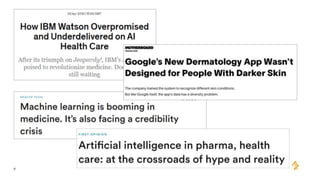
(Are there?)
Opportunities for AI in
drug development
Paul Agapow (BioNTech)
London, December 2024
paul@agapow.net
Introduction & disclaimer
● Have been a biochemist, immunologist, molecular
evolutionist, evolutionary biologist, bioinformatician,
database manager, analyst, data scientist,
epi-informatician, “computer guy” ...
● Now I crunch numbers in drug development for big
pharma
● Nothing in this presentation implies the existence of any
project or policy at any company
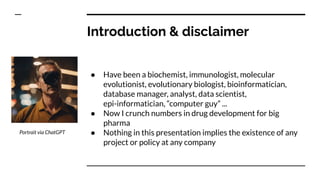
Portrait via ChatGPT
Aims & agenda
● What’s the context (problem)?
● Where might AI work?
● Where are there problems?
● Illustrated with drug repurposing
● Given the above, what should we do?
To make a drug, we have to
know everything about
everything
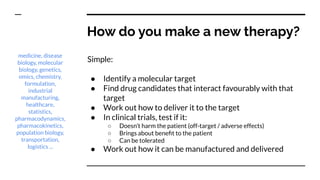
How do you make a new therapy?
Simple:
● Identify a molecular target
● Find drug candidates that interact favourably with that
target
● Work out how to deliver it to the target
● In clinical trials, test if it:
○ Doesn’t harm the patient (off-target / adverse effects)
○ Brings about benefit to the patient
○ Can be tolerated
● Work out how it can be manufactured and delivered
medicine, disease
biology, molecular
biology, genetics,
omics, chemistry,
formulation,
industrial
manufacturing,
healthcare,
statistics,
pharmacodynamics,
pharmacokinetics,
population biology,
transportation,
logistics ...
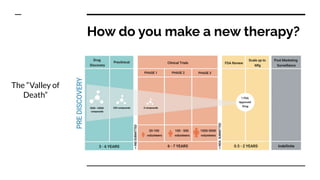
How do you make a new therapy?
The “Valley of
Death”
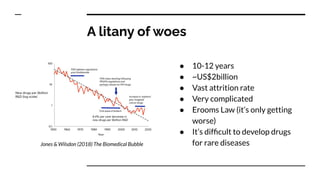
A litany of woes
● 10-12 years
● ~US$2billion
● Vast attrition rate
● Very complicated
● Erooms Law (it’s only getting
worse)
● It’s difficult to develop drugs
for rare diseases
Jones & Wilsdon (2018) The Biomedical Bubble
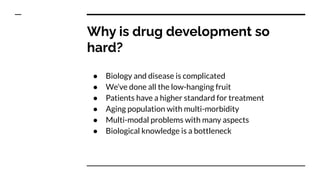
Why is drug development so
hard?
● Biology and disease is complicated
● We’ve done all the low-hanging fruit
● Patients have a higher standard for treatment
● Aging population with multi-morbidity
● Multi-modal problems with many aspects
● Biological knowledge is a bottleneck
Can AI help us?
What works?
● No one knows
AI as a promising solution
● Drug development is data-centric
● Lots of data-rich processes to be optimised
○ Many that are searching a space
○ AI offers a scalable solution
● Doesn’t have to be perfect, just better than SoTA
○ Smart best
○ Making development even slightly fast / more effective / more
efficient could have great savings
● Maybe save us from complicated / ethically tricky
experiments or trials
● AI very successful in other domains
Case study: COVID predictive
models
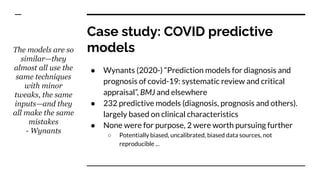
● Wynants (2020-) “Prediction models for diagnosis and
prognosis of covid-19: systematic review and critical
appraisal”, BMJ and elsewhere
● 232 predictive models (diagnosis, prognosis and others).
largely based on clinical characteristics
● None were for purpose, 2 were worth pursuing further
○ Potentially biased, uncalibrated, biased data sources, not
reproducible ...
The models are so
similar—they
almost all use the
same techniques
with minor
tweaks, the same
inputs—and they
all make the same
mistakes
- Wynants
Case study: COVID diagnosis
from medical images
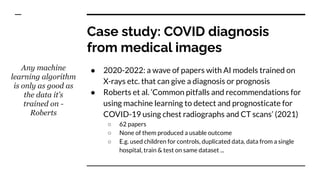
● 2020-2022: a wave of papers with AI models trained on
X-rays etc. that can give a diagnosis or prognosis
● Roberts et al. ‘Common pitfalls and recommendations for
using machine learning to detect and prognosticate for
COVID-19 using chest radiographs and CT scans’ (2021)
○ 62 papers
○ None of them produced a usable outcome
○ E.g. used children for controls, duplicated data, data from a single
hospital, train & test on same dataset ...
Any machine
learning algorithm
is only as good as
the data it’s
trained on -
Roberts
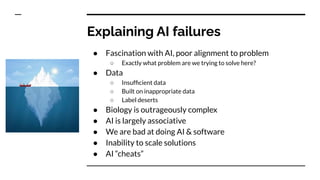
Explaining AI failures
● Fascination with AI, poor alignment to problem
○ Exactly what problem are we trying to solve here?
● Data
○ Insufficient data
○ Built on inappropriate data
○ Label deserts
● Biology is outrageously complex
● AI is largely associative
● We are bad at doing AI & software
● Inability to scale solutions
● AI “cheats”
Case study:
Drug repurposing
What is drug repurposing?
● A variety of definitions
● A.k.a. Repositioning, reprofiling
● Using an existing drug or drug candidate for a new
treatment indication
● Has been in clinical development for one indication, now
in clinical development for a distinct indication
● Excludes off-label use
Why should it work?
● A working drug has many qualities:
○ Can be synthesized, is stable
○ Can be tolerated by a patient
○ Does something
○ May have data associated with it
○ May have passed some regulatory hurdles
● Islands in “drug space”
● 60% of drugs are studied in 2+ diseases
● Diseases can share targets
● Making off-target effects on target
● Change formulation & delivery for new target
● Backlog of abandoned drugs
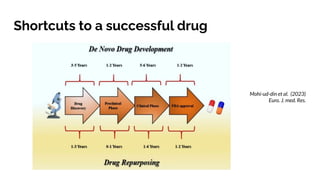
Shortcuts to a successful drug
Mohi-ud-din et al. (2023)
Euro. J. med. Res.
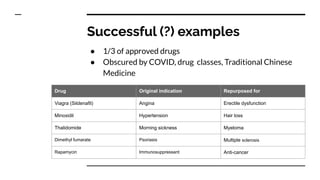
Successful (?) examples
● 1/3 of approved drugs
● Obscured by COVID, drug classes, Traditional Chinese
Medicine
Drug Original indication Repurposed for
Viagra (Sildenafil) Angina Erectile dysfunction
Minoxidil Hypertension Hair loss
Thalidomide Morning sickness Myeloma
Dimethyl fumarate Psoriasis Multiple sclerosis
Rapamycin Immunosuppressant Anti-cancer
Can AI help us
systematically find drugs
for repurposing?
What works?
● We don’t know
● Thanks to COVID, we now know even less
● Few measures of success
● Most don’t go to trial
○ And we don’t know why
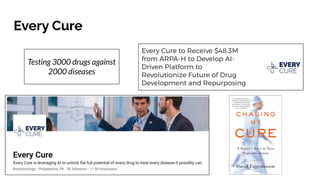
Every Cure
Testing 3000 drugs against
2000 diseases
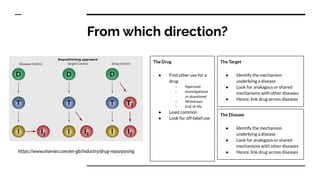
From which direction?
The Drug
● Find other use for a
drug
○ Approved
○ Investigational
or abandoned
○ Withdrawn
○ End-of-life
● Least common
● Look for off-label use
The Disease
● Identify the mechanism
underlying a disease
● Look for analogous or shared
mechanisms with other diseases
● Hence, link drug across diseases
The Target
● Identify the mechanism
underlying a disease
● Look for analogous or shared
mechanisms with other diseases
● Hence, link drug across diseases
https://www.elsevier.com/en-gb/industry/drug-repurposing
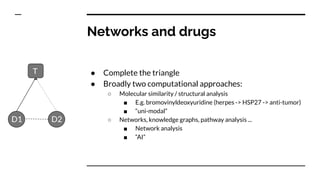
Networks and drugs
● Complete the triangle
● Broadly two computational approaches:
○ Molecular similarity / structural analysis
■ E.g. bromovinyldeoxyuridine (herpes -> HSP27 -> anti-tumor)
■ “uni-modal”
○ Networks, knowledge graphs, pathway analysis ...
■ Network analysis
■ “AI”
D1 D2
T
Why use AI?
● Deploy at scale
● Bring a more systematic approach
● Integrate multimodal and complex data
● Interested here more in identification than screening for
validation
● What can we learn if we survey AI-mediated repurposing
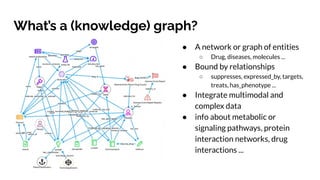
What’s a (knowledge) graph?
● A network or graph of entities
○ Drug, diseases, molecules ...
● Bound by relationships
○ suppresses, expressed_by, targets,
treats, has_phenotype ...
● Integrate multimodal and
complex data
● info about metabolic or
signaling pathways, protein
interaction networks, drug
interactions ...
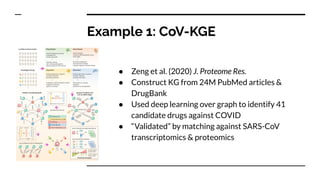
Example 1: CoV-KGE
● Zeng et al. (2020) J. Proteome Res.
● Construct KG from 24M PubMed articles &
DrugBank
● Used deep learning over graph to identify 41
candidate drugs against COVID
● “Validated” by matching against SARS-CoV
transcriptomics & proteomics
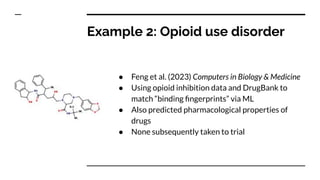
Example 2: Opioid use disorder
● Feng et al. (2023) Computers in Biology & Medicine
● Using opioid inhibition data and DrugBank to
match “binding fingerprints” via ML
● Also predicted pharmacological properties of
drugs
● None subsequently taken to trial
Data sources
● Uses a variety of data sources & types
○ Make comparison difficult
● But usually lean on a few common sources
○ Mostly Drugbank
○ Good but still limited size
○ Most of the usual data type suspects
● Desk drawer problem?
● TA problem - infectious disease outweighs all
Biological knowledge is a
bottleneck
● If you’re looking for a drug that treats disease X,
what if X doesn’t exist as a single coherent
disease?
○ E.g. various complex & contested diseases
● Biological knowledge is unevenly distributed
○ E.g. our neurological or cancer knowledge is incomplete
● You can’t use “all the information”
● You can’t test “all the candidates”
Measures of success
● Few
● Poor and varied use of validation
○ Some validate in biology
○ Some validate in literature
○ Some only validate internally
○ Some don’t validate at all
● Most don’t go to trial
○ And those that do appear to succeed no better than de novo drugs
Final thoughts
There’s plenty of unsexy but
useful problems to solve
● We are often distracted by flashy or easy or interesting
problems, away from useful ones
● Examples:
○ Processing free text: patient reported outcomes, adverse reactions,
contracts, understanding literature
○ Logistics & supply optimization, supply & demand prediction
○ Finding patient subtypes
○ Mapping chemical space
○ Predicting clinical trials
○ Labelling pathology slides ...
Summary
● Drug development is a complex and inefficient process,
rich with data
● Therefore, AI seems like a good solution
● But:
○ Data is still a problem
○ Our limited biological knowledge is an issue
○ We are bad at making good AI models
● There is still a lot of scope for AI
● Be sceptical but hopeful