Ensuring competency for
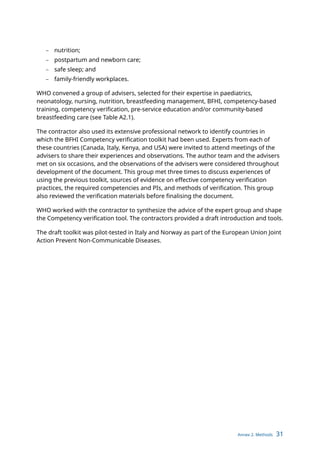
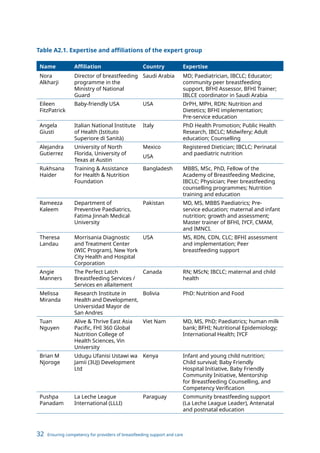
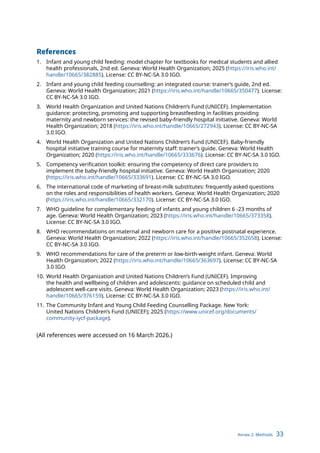
providers of breastfeeding
support and care
Competency verification toolkit
Ensuring competency for
providers of breastfeeding
support and care
Competency verification toolkit
Ensuring competency for
providers of breastfeeding
support and care
Competency verification toolkit
Ensuring competency for providers of breastfeeding support and care
(Competency verification toolkit)
ISBN 978-92-4-012210-9 (electronic version)
ISBN 978-92-4-012211-6 (print version)
© World Health Organization 2026
Some rights reserved. This work is available under the Creative Commons Attribution-
NonCommercial-ShareAlike 3.0 IGO licence (CC BY-NC-SA 3.0 IGO; https://creativecommons.
org/licenses/by-nc-sa/3.0/igo).
Under the terms of this licence, you may copy, redistribute and adapt the work for non-
commercial purposes, provided the work is appropriately cited, as indicated below. In any use
of this work, there should be no suggestion that WHO endorses any specific organization,
products or services. The use of the WHO logo is not permitted. If you adapt the work, then you
must license your work under the same or equivalent Creative Commons licence. If you create
a translation of this work, you should add the following disclaimer along with the suggested
citation: “This translation was not created by the World Health Organization (WHO). WHO is not
responsible for the content or accuracy of this translation. The original English edition shall be
the binding and authentic edition”.
Any mediation relating to disputes arising under the licence shall be conducted in accordance
with the mediation rules of the World Intellectual Property Organization (http://www.wipo.
int/amc/en/mediation/rules/).
Suggested citation. Ensuring competency for providers of breastfeeding support and
care. Geneva: World Health Organization; 2026 (Competency verification toolkit). Licence:
CC BY-NC-SA 3.0 IGO.
Cataloguing-in-Publication (CIP) data. CIP data are available at https://iris.who.int/.
Sales, rights and licensing. To purchase WHO publications, see https://www.who.int/
publications/book-orders. To submit requests for commercial use and queries on rights and
licensing, see https://www.who.int/copyright.
Third-party materials. If you wish to reuse material from this work that is attributed to a
third party, such as tables, figures or images, it is your responsibility to determine whether
permission is needed for that reuse and to obtain permission from the copyright holder. The
risk of claims resulting from infringement of any third-party-owned component in the work
rests solely with the user.
General disclaimers. The designations employed and the presentation of the material in
this publication do not imply the expression of any opinion whatsoever on the part of WHO
concerning the legal status of any country, territory, city or area or of its authorities, or
concerning the delimitation of its frontiers or boundaries. Dotted and dashed lines on maps
represent approximate border lines for which there may not yet be full agreement.
The mention of specific companies or of certain manufacturers’ products does not imply that
they are endorsed or recommended by WHO in preference to others of a similar nature that
are not mentioned. Errors and omissions excepted, the names of proprietary products are
distinguished by initial capital letters.
All reasonable precautions have been taken by WHO to verify the information contained in this
publication. However, the published material is being distributed without warranty of any kind,
either expressed or implied. The responsibility for the interpretation and use of the material
lies with the reader. In no event shall WHO be liable for damages arising from its use.
Design and layout by Inis Communication
iii
Contents
Acknowledgements iv
Abbreviations v
Glossary vi
1 Introduction 1
2 Verifying competencies 3
2.1 Competence and competencies 3
2.2 Breastfeeding support and care competencies 5
2.3 Performance indicators 7
2.4 Measuring competencies 14
2.5 When to verify competencies 14
2.6 Examiners 15
3 The toolkit 16
3.1 The Examiner’s resource 16
3.2 Observation tools  17
3.3 Case discussion tool 24
3.4 Knowledge assessment tool 25
4 Country adaptation 26
References 27
Annex 1. Competency verification tools 29
Annex 2. Methods 30
References  33
iv
Acknowledgements
WHO gratefully acknowledges the many individuals who contributed to the development
of this toolkit. The toolkit was prepared under the overall coordination and technical
guidance of Lawrence Grummer Strawn, WHO Department of Nutrition and Food Safety
(Switzerland) and Nina Chad, WHO Department of Nutrition and Food Safety (Australia).
Nina Chad was the lead author and technical editor.
The tools were developed by a working group of the BFHI Network, Inc. (Canada),
(in alphabetical order) Elise M. Chapin, Chao-Huei Chen, Louise Dumas, Trish MacEnroe
and Linda J. Smith.
Special thanks are due to the experts who provided technical support and feedback
on early drafts of this document (in alphabetical order) Nora Alkharji (Kingdom of
Saudi Arabia), Angela Giusti (Italy), Alejandra Gutierrez (Mexico), Rukhsana Haider
(Bangladesh), Rameeza Kaleem (Pakistan), Theresa Landau (USA), Angie Manners
(Canada), Melissa Miranda (USA), Tuan Nguyen (Viet Nam), Brian Njoroge (Kenya) and
Pushpa Panadam (Paraguay) and to Eileen FitzPatrick (USA), Angela Giusti (Italy) and
Brian Njoroge (Kenya), who provided country experiences.
Thanks are also due to Angela Giusti (Italy), Francesca Zambri (Italy), Anne Baerug
(Norway), Gry Hay (Norway), and colleagues, who conducted pilot testing and to the
team from the Italian National Institute of Health, Angela Giusti, Flavia Splendore,
Vincenza Di Stefano, Paola Scardetta, Francesca Zambri, Annachiara Di Nolfi for their
work translating and refining multiple-choice questions.
WHO gratefully acknowledges the financial support provided by the Bill and Melinda
Gates Foundation for the development and publication of this toolkit. Donors do not
fund specific products and did not participate in any decision related to the development
of this toolkit.
v
Abbreviations
CMF Commercial milk formula
BFHI Baby-friendly Hospital Initiative
DHM Donor human milk
EBM Expressed breast milk
IBCLC International Board Certified Lactation Consultant
IBLCE International Board of Lactation Consultant
Examiners
ISS Istituto Superiore di Sanità
IYCF infant and young child feeding
MCQ multiple-choice question
MOM mother’s own milk
PI performance indicator
UNICEF United Nations Children’s Fund
WHO World Health Organization
vi
Glossary
Additional responses: Responses that
can be expected from a competent
person during competency verification in
addition to mandatory responses. Lists of
additional responses are not exhaustive.
Alveoli: Small sacs of cells in the breast
that produce and secrete milk (1).
Antenatal period: Period between
conception and birth; pregnancy.
Anticipatory guidance: Information and
education given to prepare parents and
caregivers for predictable or anticipated
events, such as occur in the usual course
of pregnancy, childbirth, lactation, infant
and child development, or the life course
of parents and caregivers.
Areola: The pigmented area surrounding
the nipple that contains Montgomery’s
glands, which secrete lubricating and
protective fluid (1).
Attitude: A person’s feelings, values and
beliefs, which influence their behaviour
and the performance of tasks (2).
Bed-sharing: The act of a mother sharing
sleep surface with her infant (3).
Behaviour: Observable conduct towards
other people or tasks. Behaviours are
measurable in the performance of
tasks (2).
Bottle-feeding: Feeding an infant from a
bottle with a teat or nipple (4).
Breastfeeding: Feeding an infant breast
milk from any source – directly at the
breast or expressed, coming from the
mother herself (mother’s own milk)
or another mother (a donor or a wet
nurse) (4).
Breast-milk substitute: Any milks (or
products that could be used to replace
milk, such as fortified soy milk), in
either liquid or powdered form, that are
specifically marketed for feeding infants
and young children up to the age of 3
years (including follow-up formula and
growing-up milks) (5).
Caregiver: A person who cares for an
infant or young child, usually in place of,
or in addition to, a parent.
Colostrum: The first milk produced in
the breasts, beginning during pregnancy,
which is rich in proteins and antibodies,
and low in water and fat (1).
Commercial milk formula: Any milks (or
products that could be used to replace
milk, such as fortified soy milk), in
either liquid or powdered form, that are
specifically marketed for feeding infants
and young children up to the age of 3
years (including follow-up formula and
growing-up milks) (5).
Competencies: The abilities of a person to
integrate knowledge, skills and attitudes
in their performance of tasks in a given
context. Competencies are durable,
trainable and, through the expression of
behaviours, measurable (2).
vii
Competency framework: An organized
and structured representation of a
set of interrelated and purposeful
competencies (2).
Competent: The state of proficiency
of a person to perform the required
practice activities to the defined standard.
This incorporates having the requisite
competencies to do this in a given context.
Competence is multidimensional and
dynamic. It changes with time, experience
and setting (2). Competence includes
responsibility and autonomy required
for competent performance in the
workplace (7).
Complementary feeding: The process of
providing foods in addition to milk when
breast milk or milk formula alone are
no longer adequate to meet an infant’s
nutritional requirements. Complementary
feeding starts at age 6 months and
continues up to 23 months of age (4).
Community service organisation: An
organisation (usually non-profit) that
provides services or carries out activities
that support the welfare of members of
a community. A community is a group of
people with common interests that may
arise from geography, nationality, age,
culture or other shared characteristics.
Donor human milk: human milk collected
from donors and dispensed by a donor
human milk bank (8).
Effective listening, learning and
communication skills: Foundational skills
required to deliver effective breastfeeding
support and care. These are generalisable
skills that may be used to deliver any brief
person-centred behavioural counselling.
Foundational skills are required to build
and maintain rapport, express empathy,
elicit information, provide reassurance,
listening actively, checking your own
understanding, building motivation and
planning future behaviours (9).
Engage in a conversation: The
process of establishing a constructive
working relationship with a mother
or pregnant woman and her support
person(s). Characterised by the use
of open questions to establish and
maintain collaborative relationships with
mothers / pregnant women and their
families and listen carefully to develop
a comprehensive understanding of the
breastfeeding situation and the mother/
pregnant woman and family members’
perspectives and ideas about feeding
baby (10).
Examiner: A person responsible for
verifying or assessing the competency of
others. Examiners must themselves be
able to demonstrate competencies under
examination as well as competencies
required to verify competence.
Expected responses: Response expected
from a competent person during
competency verification. Examiners must
observe several expected responses,
usually more than once, in order to be
satisfied that a PI has been demonstrated.
viii
Exclusive breastfeeding: Feeding an
infant less than six months of age breast
milk and no other liquids or solids, not
even water. Drops or syrups consisting
of vitamins, mineral supplements or
medicines, including oral rehydration
solution, may be given when medically
indicated (4).
Foundational skills: Communication and
counselling skills necessary for providing
breastfeeding support care (11).
Health service: A service or organisation
that provides medical treatment to people
within an area or a country.
Healthcare facilities: Places that provide
health and medical services. They include
hospitals, clinics, outpatient care centres,
specialized care centres, community
health centres and public health centres.
Healthcare professional: A person with
formal training and skills in a medical
or allied health field such as medicine,
midwifery or nursing.
Infant: A person less than 12 months of
age.
Infant formula: A commercial breast milk
substitute that conforms to the Codex
Alimentarius Standard for infant formulas
and formulas for special medical purposes
intended for infants (CXS 72–181) and may
be used as a partial or total replacement
for breast milk in the diet of an infant less
than six months.
International Code of Marketing
of Breast-milk Substitutes: A set of
recommendations for regulating the
marketing of breast-milk substitutes,
feeding bottles and teats with the aim
of contributing to the provision of safe
and adequate nutrition for infants, that
was first adopted by the World Health
Assembly in 1981 (WHA34.22) and includes
subsequent relevant resolutions (12).
Kangaroo Mother Care: Care of preterm
and low-birth-weight newborns in
prolonged (as close as possible to 24
hours a day, with a minimum of eight
hours a day) skin-to-skin contact initiated
as soon as possible after birth, with
exclusive breast milk feeding (13).
Knowledge: The theoretical or practical
understanding of a subject required to
perform a role effectively gained through
formal education or practical experience.
Knowledge includes the recall of specifics
and universals, the recall of methods and
processes, and/or the recall of a pattern,
structure, setting (7).
Lactation: The physiological process of
producing and secreting milk from the
mammary glands (1).
Latch: The positioning of the baby’s
mouth on the breast. Good latch is
essential for effective milk transfer and
comfort.
Let-down reflex: A reflex, triggered by the
release of oxytocin, in response to nipple
stimulation or another stimulus, that
causes milk to be pushed from the alveoli
through the ducts towards the nipple. Also
known as ‘milk ejection reflex’ (MER) (1).
Mandatory responses: Responses that
must be demonstrated in order to verify
competency. Mandatory responses
should be demonstrated across a variety
of situations and contexts to establish
stability.
Milk ejection reflex: see let-down-reflex.
ix
Milk transfer: The process by which milk
is moved from the breast to the baby,
often assessed by observing swallowing
and feeding patterns (1).
Mother’s own milk: Milk expressed by
an infant’s mother for feeding to her
infant (1).
Neonatal period: The period between
birth and 28 completed days of life.
Newborn: An infant less than 28
completed days of age.
Non-nutritive sucking: Suckling at the
breast that does not result in the infant
transferring a significant quantity of
milk from the breast, either because the
infant is incapable of doing so or because
most of the milk has been removed by
another means immediately prior to the
suckling (8).
Nutritive sucking: Suckling at the breast
that results in the infant transferring
a significant quantity of milk from the
breast (8).
Nurturing care: Giving young children
opportunities for early learning, through
interactions that are responsive and
emotionally supportive (14). Responsive
feeding and caregiving are key aspects of
nurturing care (15).
Oxytocin: A hormone released in
response to nipple stimulation or
other stimuli (such as seeing, hearing
or smelling her infant) that stimulates
milk ejection during breastfeeding and
promotes bonding between mother and
infant (1).
Performance indicator: Concrete actions
a competent person should be able to
perform. Each performance indicator
describes a single, discrete action.
Together, performance indicators describe
competencies.
Perinatal period: The period commencing
at 22 completed weeks (154 days) of
gestation and ending seven completed
days after birth.
Positioning: How the baby is held at
the breast; proper positioning supports
effective attachment and milk transfer (1).
Postnatal period: The first six weeks after
birth.
Prelacteal feeds: Any food or liquid given
to an infant before breastfeeding starts (4).
Pre-term infant: An infant born before 37
weeks completed gestation (8).
Prolactin: A hormone that stimulates milk
production, particularly in response to
nipple stimulation (1).
Provider: A person who provides
education, evaluation, support,
intervention, assistance and/or
follow-up with regards to infant feeding
in a healthcare facility or community
service. Providers may be health
care professionals, non-health care
professionals such as trained IYCF
counsellors or trained peer supporters.
Providers may be staff or volunteers.
Responses of concern: Behaviours
that are not usually expected from
a competent person. A person who
demonstrates one or more responses
of concern may not have acquired
knowledge, developed a skill or skills, or
aligned attitudes required to achieve an
acceptable standard of competency.
Responsive feeding: Feeding practices
that encourage infants and young children
x
to eat in response to physiological and
developmental needs to foster the
development of autonomous feeding.
Responsive feeding practices include
recognising and responding to hunger
and satiety cues (15) rather than
scheduling feeding times or durations and
offering older infants and young children
foods they can feed themselves (16). Also
known as “demand feeding,” “unrestricted
feeding,” or “baby-led feeding” when
referring to feeding infants less than
6 months of age.
Rooming-in: Ensuring that mothers and
infants are accommodated in the same
room after birth and not separated during
inpatient care in a maternity facility (17).
Service: A health service or community
service organisation.
Skill: The ability, developed over time and
with practice, to perform a task, activity or
action effectively. Skills include cognitive,
communication, interpersonal and
problem-solving techniques (2).
Skin-to-skin: Placing an infant in a prone
position on the chest of family member
or support person with no clothing
separating them (13).
Sucking: Using negative pressure to take
something into the mouth.
Suckling: The action by which an infant
removes milk from the breast (1).
Support person: A person selected by
the mother to support her during her
pregnancy, birth and beyond. This may
include being involved in breastfeeding
support and care. A support person
may be the mother’s husband or civil
partner, the infant’s father or parent or
grandparent, another relative or friend
and may or may not be a member of the
mother’s household. A mother may wish
to involve more than one support person
in her care.
Unconditional positive regard: An
attitude of respect, caring and support
for a person, regardless of what that
person says or does; accepting, and
valuing a person without judgment that
is crucial for fostering self-efficacy and
independence (10).
Young child: a child less than 3 years
of age.
1
1
1 Introduction
1
Use of the words “woman” and “mother”’ is not intended to imply that breastfeeding support and care should not be provided to parents
who do not identify as women or mothers. WHO affirms the legitimacy of diverse genders and family configurations. We acknowledge
that an infant may have one or more parents that do not identify as women or mothers and that health and community services should
be designed to prioritize safety for all those who use them. We have attempted to avoid the use of gender-exclusive terms where gender
is not relevant and doing so does not compromise clarity, readability or translatability.
While breastfeeding is the most natural means for nourishing and nurturing an infant, it
often requires development of new skills by both the mother1
and her infant. In addition
to social support from relatives, friends and other members of the community, learning
to breastfeed often requires ongoing support from competent health workers and
counsellors. Health and community services have a duty to ensure that health workers
and counsellors have the necessary competency to provide breastfeeding support,
counselling and care (18).
Competency is the state of proficiency in performing the required practice or tasks to a
defined standard. Competency is multidimensional and dynamic, changing with time,
experience and setting. Competency is the ability of a person to use knowledge, skills
and attitudes in their performance of tasks in a given context. Competency is durable,
trainable and, by observation of behaviour, measurable (2).
Competency-based training and assessment (verification) represent a paradigm shift
from requiring completion of a specified number of hours of training (without regard to
the outcomes of that training) to requiring that learners demonstrate the competency
required to provide ethical, safe, effective, evidence-based, compassionate care. This
does not mean that training and education are no longer necessary. Rather, it means
that teaching and learning must be flexible enough to meet the diverse needs of
individual learners. The focus thus shifts from time spent in learning environments
to learning activities that effectively foster the development of competency (skills,
knowledge and attitudes).
Competency verification is recommended for medical staff who work in facilities that
provide maternal and newborn services as one of two critical management procedures
to support breastfeeding included in the Ten Steps to Successful Breastfeeding (18). In
2020, WHO issued a competency verification toolkit to ensure the competency of direct
care providers in implementing the Baby-friendly Hospital Initiative (BFHI) (19).
WHO guidelines on counselling of women to improve breastfeeding practices (20, 21)
recommend that every woman be provided with breastfeeding counselling at least six
times and additionally as necessary, starting during pregnancy and continuing up to two
years or longer by appropriately trained health-care professionals and community lay or
peer breastfeeding counsellors.
2 Ensuring competency for providers of breastfeeding support and care
This Competency Verification Toolkit includes four tools that can be used to ensure that
any person whose role or responsibilities include providing breastfeeding support and
care is equipped with the knowledge, skills and attitudes required to do so effectively.
Links to these tools are provided in Annex 1. The tools include:
1. Examiner’s resource – a reference for examiners that contains detailed descriptions of
the behaviours a competent provider can be expected to demonstrate;
2. Observation tools – a set of checklists that can be used to record examiners’
observation of providers’ behaviours;
3. Case discussion guides – a set of breastfeeding support and care scenarios that may
be used to stimulate discussion or role-play simulations during which providers may
demonstrate some of the components of the competencies; and
4. Knowledge assessment tool – a set of multiple choice questions (MCQs), including an
answer key, that can be used to examine some of the knowledge components of the
competencies.
This Competency verification toolkit is intended to assist countries, health-care systems
and community organizations to ensure that anyone who provides breastfeeding care
and support is equipped with the knowledge, skills and attitudes necessary to do so
effectively, ethically and compassionately. It describes what it means for health workers,
including health professionals, allied health professionals, community health workers
and others who provide breastfeeding support and care to families to be “appropriately
trained”.
This updated toolkit is based on development and implementation of the BFHI
Competency Verification Toolkit (19) and extends it to support providers of breastfeeding
care and support for families of infants and young children up to two years of age. The
toolkit also draws on the competencies described in the WHO publication Infant and
young child counselling: an integrated course (11). The development of this toolkit is
described in Annex 2.
Section 2 describes the competency framework for providers of breastfeeding support
and care and detailed information on the principle and process of competency
verification and the competencies required of examiners.
Section 3 describes the tools provided for competency verification, including the
Examiner’s resource, Knowledge assessment, case-based discussion guides, and
observation tools for verifying competencies.
Section 4 discusses opportunities for adapting the tools in this Toolkit to country
contexts.
3
2 Verifying competencies
This document presents a toolkit for verifying competencies amongst providers of
evidence-based breastfeeding support and care.
Breastfeeding support and care may be provided by a variety of personnel, including
volunteers, with diverse educational backgrounds, qualifications and roles. These may
include, but are not limited to, health care professionals, allied health care professionals,
community health workers, and dedicated breastfeeding counsellors.
2.1 Competence and competencies
Competence is the ability of a person to integrate knowledge, skills and attitudes to
perform certain tasks in a given context, to a specified standard (2). Competent providers
of breastfeeding support and care can demonstrate that they have the knowledge,
skills and attitudes necessary to safely and compassionately deliver breastfeeding care
and support for infants and young children up to two years and beyond. Competence
requires knowledge, skills and attitudes (Box 1).
Competencies describe the skills, knowledge and behaviours needed to perform a work
function or task successfully. For example, a doctor who provides patients with quality
health care may be described as competent. However, the competencies required to
provide that care include clinical knowledge, technical skills, communication skills, inter-
professional collaboration skills, problem-solving skills, attitudes such as personal and
professional integrity, ethical judgement and empathy. Well-constructed competencies
define what learners need to know (knowledge), what they need to be able to do (skills)
and how they apply their knowledge and skills to achieve desirable outcomes (attitudes
and behaviours) (22).
Box 1. Knowledge, skills and attitudes
Knowledge The theoretical or practical understanding of a subject necessary to
perform a role effectively, gained through formal education or practical
experience.
Skills Abilities, developed over time and with practice, to perform a task,
activity or action effectively. Skills include cognitive, communication,
interpersonal and problem-solving techniques.
Attitudes Stable, long-lasting, learnt predisposition to respond to certain events
in certain ways. Attitudes are a combination of beliefs, feelings,
intentions and attitudes that drive behaviour.
4 Ensuring competency for providers of breastfeeding support and care
Knowledge
Providers must apply knowledge about breastfeeding to deliver breastfeeding
support and care effectively. Knowledge can be demonstrated simultaneously
with skills and attitudes. Neither a written nor an oral examination is required
to verify knowledge, because essential knowledge is required to perform skills
and attitudes. A written or oral examination may, however, be useful when a
competency includes application of knowledge about a variety of topics to the
performance of a transferrable set of skills (for example, providing counselling
to resolve a variety of challenges). If a written or oral examination is used to
verify knowledge, the questions should be carefully constructed and presented
so as not to lead to an answer. Closed questions, such as multiple choice or
short-answer questions can be useful for verifying knowledge when used in
conjunction with other strategies, such as observation. A set of multiple-choice
questions (MCQs) is provided in the Knowledge assessment tool, with answers
and explanations.
Skills
Providers must guide and support mothers and other caregivers to make
informed decisions about the nutrition and well-being of an infant or young
child. These decisions are more complex than choosing what a child will eat
because they are embedded in nested biological, social, psychological and
economic systems. Providers of breastfeeding care and support in communities
actively participate in providing enabling environments for breastfeeding
in which all mothers receive the evidence-based, individualized and
compassionate care they deserve from skilled providers.
Attitudes
Although more difficult to measure than knowledge or skills and therefore easy
to overlook, attitudes are critical components of competence. Providers are
expected to approach all pregnant women and mothers with an unconditional
positive regard (23). This attitude enables providers to foster therapeutic
relationships in which women and mothers feel valued and respected, where
their values, beliefs, concerns and difficulties are important, where they feel
safe to share their struggles and trust the provider can and will help them find
solutions that work for them and their families.
2 Verifying competencies 5
2.2 Breastfeeding support and care competencies
The eleven competencies for providing effective, ethical, compassionate breastfeeding
care and support described below in Table 1 are based on the competencies described in
WHO IYCF counselling: an integrated course (11) and the BFHI Competency verification
toolkit (19). This toolkit provides an entry-level set of competencies that provides a
foundation for further development. With experience, practice, feedback, reflection and
further learning, effective providers will develop their knowledge, skills and attitudes and
therefore more advanced, sophisticated competency.
Competency 1. Apply requirements of the International Code of Marketing of
Breastmilk Substitutes in practice.
Competency 1 describes the knowledge, skills and attitudes that a provider needs to
apply the requirements of the International Code of Marketing of Breast Milk Substitutes
when providing breastfeeding support and care. Providers must be equipped to provide
breastfeeding support and care that is free from the influence of companies that
market infant feeding products and to protect families from inappropriate marketing of
products that fall within the scope of the Code.
Competency 2. Interpret and apply IYCF policies in practice.
Competency 2 describes the knowledge, skills and attitudes that providers need
to interpret and apply IYCF policies in practice. Providers must understand how
workplace policies protect and support their work as providers and be able to provide
breastfeeding support and care that is consistent with those policies.
Competency 3. Use effective listening, learning and communication skills to
provide breastfeeding support and care.
Competency 3 describes the knowledge, skills and attitudes providers need to be able
to use effective listening, learning and communication skills to provide breastfeeding
support and care. Providers must be able to communicate effectively to provide
breastfeeding support and care. Therefore, Competency 3 can be considered a
foundational competency because satisfactory performance of Competencies 04
through 11 require the application of this competency. This competency must be evident
whenever a provider is observed interacting with a woman or her support person(s)
about any infant feeding matter. A provider who simply provides information, education
or communications (messages) about infant feeding but does not listen effectively, learn
about the feeding situation, or communicate effectively is not a competent provider of
breastfeeding support and care, regardless of how knowledgeable they are.
Competency 4. Apply breastfeeding knowledge to assess and support
breastfeeding.
Competency 4 describes the knowledge, skills and attitudes providers need to be able
to apply breastfeeding knowledge to assess and support breastfeeding. Breastfeeding
knowledge alone does not equip a provider to assess and support breastfeeding.
6 Ensuring competency for providers of breastfeeding support and care
A competent provider must be able to use their knowledge to gather information,
analyse the situation with that knowledge, communicate relevant portions of that
information to help a mother understand how breastfeeding works and give appropriate
guidance or suggestions.
Competency 5. Provide antenatal and postnatal breastfeeding support and care.
Competency 5 describes the knowledge, skills and attitudes that providers require to
demonstrate that they can provide antenatal and postnatal breastfeeding support and
care. Providing breastfeeding support and care requires providers to be able to do
more than simply conveying information or delivering messages about breastfeeding.
Providers must be equipped to discuss common IYCF topics with pregnant women and
mothers in a manner that engages and empowers them, leaving them feeling more
confident and capable than when they arrived.
Competency 6. Support initiation of breastfeeding within the first hour after birth.
Competency 6 describes the knowledge, skills and attitudes providers require to
demonstrate that they can support initiation of breastfeeding within the first hour
after birth. Providers must be equipped to prepare and support families to initiate
breastfeeding immediately after birth. Providers who do not work in perinatal care may
not be required to demonstrate PIs 35 and 36.
Competency 7. Provide support for expressing, storing and feeding breastmilk
when infants and young children are not feeding exclusively at the breast.
Competency 7 describes the knowledge, skills and attitudes providers require to
demonstrate that they can provide support for expressing, storing and feeding
expressed breast milk when infants and young children are not feeding exclusively at the
breast. Providers must be able to equip mothers with the skills and knowledge they need
to establish and maintain lactation so that they can provide breast milk for their babies,
even when they are not fed at the breast.
Competency 8. Identify, prevent and support resolution of common breastfeeding
challenges.
Competency 8 describes the knowledge, skills and attitudes that providers require
to demonstrate that they can identify, prevent and support resolution of common
breastfeeding challenges. Providers must be able to use their knowledge about
breastfeeding to help pregnant women and mothers to prevent common breastfeeding
challenges, recognise them when they occur and equip them to resolve those
challenges.
Competency 9. Support feeding of small, sick and/or preterm infants.
Competency 9 describes the knowledge, skills and attitudes that providers require to
demonstrate that they can support feeding of small, sick and/or preterm infants. These
infants and young children are at risk of poor growth and development. All providers
2 Verifying competencies 7
will encounter such infants and young children in the course of their work and must be
equipped to provide breastfeeding support and care to these infants and their families.
Competency 9 is relevant beyond the neonatal period and will be required to provide
breastfeeding support and care for older infants and young children who require
inpatient care or whose illness interferes with their capacity to breastfeed effectively.
Competencies 7, 9 and 10 are complementary, because small, sick and preterm
infants sometimes require supplementary milk and may not be able to feed at the
breast initially.
Competency 10. Protect and support breastfeeding when an infant needs
supplementary milk feeding.
Competency 10 describes the knowledge, skills and attitudes that providers require to
demonstrate that they can protect and support breastfeeding when an infant needs
supplementary milk feeding. This includes supporting mothers of infants with growth
problems when supplementary milk feeding is necessary. Protecting breastfeeding when
supplementary milk feeding is necessary also requires Competency 7.
Competency 11. Coordinate and facilitate continuity of care for breastfeeding
mothers and infants.
Competency 11 describes the knowledge, skills and attitudes providers need to
coordinate and facilitate continuity of care for breastfeeding mothers and infants.
Providing breastfeeding care and support requires the ability to identify appropriate
referral pathways and to equip mothers to seek help appropriately.
2.3 Performance indicators
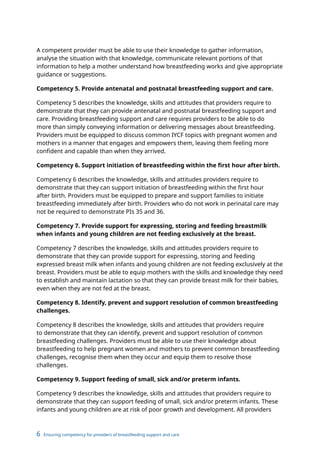
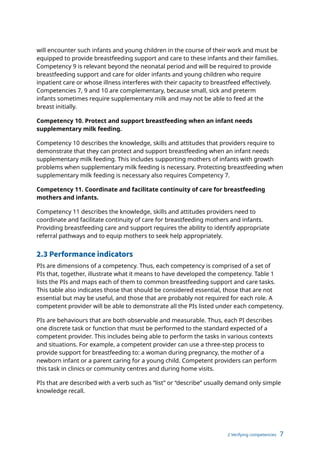
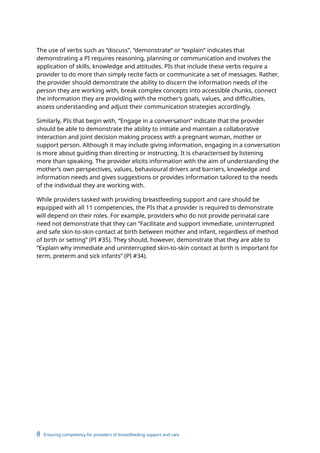
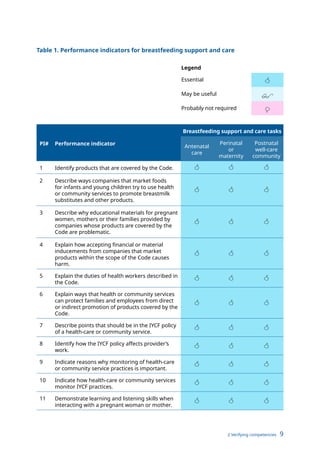
PIs are dimensions of a competency. Thus, each competency is comprised of a set of
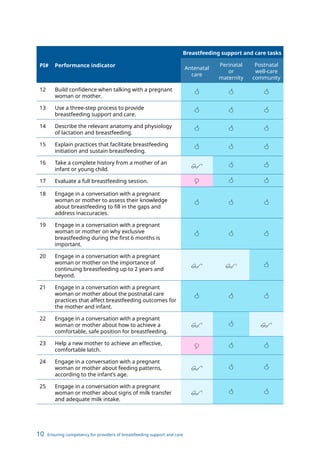
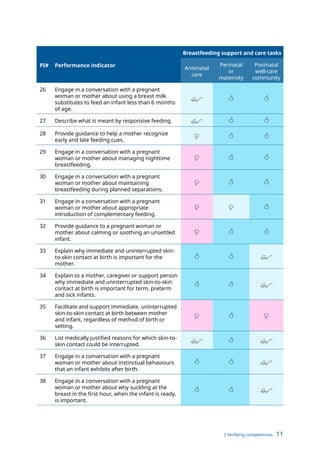
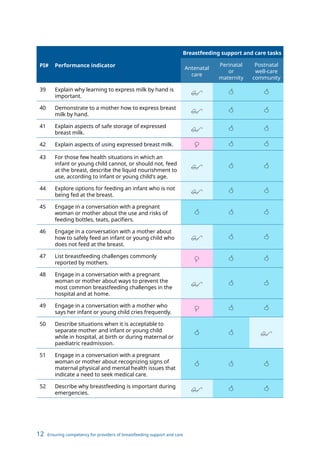
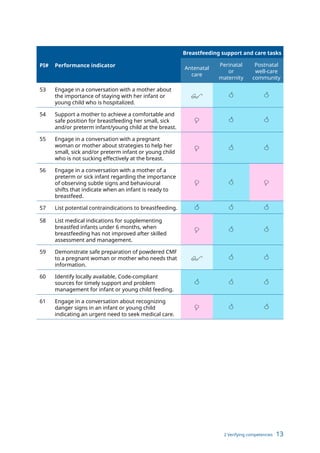
PIs that, together, illustrate what it means to have developed the competency. Table 1
lists the PIs and maps each of them to common breastfeeding support and care tasks.
This table also indicates those that should be considered essential, those that are not
essential but may be useful, and those that are probably not required for each role. A
competent provider will be able to demonstrate all the PIs listed under each competency.
PIs are behaviours that are both observable and measurable. Thus, each PI describes
one discrete task or function that must be performed to the standard expected of a
competent provider. This includes being able to perform the tasks in various contexts
and situations. For example, a competent provider can use a three-step process to
provide support for breastfeeding to: a woman during pregnancy, the mother of a
newborn infant or a parent caring for a young child. Competent providers can perform
this task in clinics or community centres and during home visits.
PIs that are described with a verb such as “list” or “describe” usually demand only simple
knowledge recall.
8 Ensuring competency for providers of breastfeeding support and care
The use of verbs such as “discuss”, “demonstrate” or “explain” indicates that
demonstrating a PI requires reasoning, planning or communication and involves the
application of skills, knowledge and attitudes. PIs that include these verbs require a
provider to do more than simply recite facts or communicate a set of messages. Rather,
the provider should demonstrate the ability to discern the information needs of the
person they are working with, break complex concepts into accessible chunks, connect
the information they are providing with the mother’s goals, values, and difficulties,
assess understanding and adjust their communication strategies accordingly.
Similarly, PIs that begin with, “Engage in a conversation” indicate that the provider
should be able to demonstrate the ability to initiate and maintain a collaborative
interaction and joint decision making process with a pregnant woman, mother or
support person. Although it may include giving information, engaging in a conversation
is more about guiding than directing or instructing. It is characterised by listening
more than speaking. The provider elicits information with the aim of understanding the
mother’s own perspectives, values, behavioural drivers and barriers, knowledge and
information needs and gives suggestions or provides information tailored to the needs
of the individual they are working with.
While providers tasked with providing breastfeeding support and care should be
equipped with all 11 competencies, the PIs that a provider is required to demonstrate
will depend on their roles. For example, providers who do not provide perinatal care
need not demonstrate that they can “Facilitate and support immediate, uninterrupted
and safe skin-to-skin contact at birth between mother and infant, regardless of method
of birth or setting” (PI #35). They should, however, demonstrate that they are able to
“Explain why immediate and uninterrupted skin-to-skin contact at birth is important for
term, preterm and sick infants” (PI #34).
2 Verifying competencies 9
Table 1. Performance indicators for breastfeeding support and care
Legend
Essential 
May be useful $
Probably not required =
PI# Performance indicator
Breastfeeding support and care tasks
Antenatal
care
Perinatal
or
maternity
Postnatal
well-care
community
1 Identify products that are covered by the Code.   
2 Describe ways companies that market foods
for infants and young children try to use health
or community services to promote breastmilk
substitutes and other products.
  
3 Describe why educational materials for pregnant
women, mothers or their families provided by
companies whose products are covered by the
Code are problematic.
  
4 Explain how accepting financial or material
inducements from companies that market
products within the scope of the Code causes
harm.
  
5 Explain the duties of health workers described in
the Code.
  
6 Explain ways that health or community services
can protect families and employees from direct
or indirect promotion of products covered by the
Code.
  
7 Describe points that should be in the IYCF policy
of a health-care or community service.
  
8 Identify how the IYCF policy affects provider’s
work.
  
9 Indicate reasons why monitoring of health-care
or community service practices is important.
  
10 Indicate how health-care or community services
monitor IYCF practices.
  
11 Demonstrate learning and listening skills when
interacting with a pregnant woman or mother.
10 Ensuring competency for providers of breastfeeding support and care
PI# Performance indicator
Breastfeeding support and care tasks
Antenatal
care
Perinatal
or
maternity
Postnatal
well-care
community
12 Build confidence when talking with a pregnant
woman or mother.
  
13 Use a three-step process to provide
breastfeeding support and care.
  
14 Describe the relevant anatomy and physiology
of lactation and breastfeeding.
  
15 Explain practices that facilitate breastfeeding
initiation and sustain breastfeeding.
  
16 Take a complete history from a mother of an
infant or young child.
$  
17 Evaluate a full breastfeeding session. =  
18 Engage in a conversation with a pregnant
woman or mother to assess their knowledge
about breastfeeding to fill in the gaps and
address inaccuracies.
  
19 Engage in a conversation with a pregnant
woman or mother on why exclusive
breastfeeding during the first 6 months is
important.
  
20 Engage in a conversation with a pregnant
woman or mother on the importance of
continuing breastfeeding up to 2 years and
beyond.
$ $ 
21 Engage in a conversation with a pregnant
woman or mother about the postnatal care
practices that affect breastfeeding outcomes for
the mother and infant.
  
22 Engage in a conversation with a pregnant
woman or mother about how to achieve a
comfortable, safe position for breastfeeding.
$  $
23 Help a new mother to achieve an effective,
comfortable latch.
=  
24 Engage in a conversation with a pregnant
woman or mother about feeding patterns,
according to the infant’s age.
$  
25 Engage in a conversation with a pregnant
woman or mother about signs of milk transfer
and adequate milk intake.
$
2 Verifying competencies 11
PI# Performance indicator
Breastfeeding support and care tasks
Antenatal
care
Perinatal
or
maternity
Postnatal
well-care
community
26 Engage in a conversation with a pregnant
woman or mother about using a breast milk
substitutes to feed an infant less than 6 months
of age.
$  
27 Describe what is meant by responsive feeding. $  
28 Provide guidance to help a mother recognize
early and late feeding cues.
=  
29 Engage in a conversation with a pregnant
woman or mother about managing nighttime
breastfeeding.
=  
30 Engage in a conversation with a pregnant
woman or mother about maintaining
breastfeeding during planned separations.
=  
31 Engage in a conversation with a pregnant
woman or mother about appropriate
introduction of complementary feeding.
= = 
32 Provide guidance to a pregnant woman or
mother about calming or soothing an unsettled
infant.
=  
33 Explain why immediate and uninterrupted skin-
to-skin contact at birth is important for the
mother.
  $
34 Explain to a mother, caregiver or support person
why immediate and uninterrupted skin-to-skin
contact at birth is important for term, preterm
and sick infants.
  $
35 Facilitate and support immediate, uninterrupted
skin-to-skin contact at birth between mother
and infant, regardless of method of birth or
setting.
=  =
36 List medically justified reasons for which skin-to-
skin contact could be interrupted.
$  $
37 Engage in a conversation with a pregnant
woman or mother about instinctual behaviours
that an infant exhibits after birth.
  $
38 Engage in a conversation with a pregnant
woman or mother about why suckling at the
breast in the first hour, when the infant is ready,
is important.
  $
12 Ensuring competency for providers of breastfeeding support and care
PI# Performance indicator
Breastfeeding support and care tasks
Antenatal
care
Perinatal
or
maternity
Postnatal
well-care
community
39 Explain why learning to express milk by hand is
important.
$  
40 Demonstrate to a mother how to express breast
milk by hand.
$  
41 Explain aspects of safe storage of expressed
breast milk.
$  
42 Explain aspects of using expressed breast milk. =  
43 For those few health situations in which an
infant or young child cannot, or should not, feed
at the breast, describe the liquid nourishment to
use, according to infant or young child's age.
$  
44 Explore options for feeding an infant who is not
being fed at the breast.
$  
45 Engage in a conversation with a pregnant
woman or mother about the use and risks of
feeding bottles, teats, pacifiers.
  
46 Engage in a conversation with a mother about
how to safely feed an infant or young child who
does not feed at the breast.
$  
47 List breastfeeding challenges commonly
reported by mothers.
=  
48 Engage in a conversation with a pregnant
woman or mother about ways to prevent the
most common breastfeeding challenges in the
hospital and at home.
$  
49 Engage in a conversation with a mother who
says her infant or young child cries frequently.
=  
50 Describe situations when it is acceptable to
separate mother and infant or young child
while in hospital, at birth or during maternal or
paediatric readmission.
  $
51 Engage in a conversation with a pregnant
woman or mother about recognizing signs of
maternal physical and mental health issues that
indicate a need to seek medical care.
  
52 Describe why breastfeeding is important during
emergencies.
$
2 Verifying competencies 13
PI# Performance indicator
Breastfeeding support and care tasks
Antenatal
care
Perinatal
or
maternity
Postnatal
well-care
community
53 Engage in a conversation with a mother about
the importance of staying with her infant or
young child who is hospitalized.
$  
54 Support a mother to achieve a comfortable and
safe position for breastfeeding her small, sick
and/or preterm infant/young child at the breast.
=  
55 Engage in a conversation with a pregnant
woman or mother about strategies to help her
small, sick and/or preterm infant or young child
who is not sucking effectively at the breast.
=  
56 Engage in a conversation with a mother of a
preterm or sick infant regarding the importance
of observing subtle signs and behavioural
shifts that indicate when an infant is ready to
breastfeed.
=  =
57 List potential contraindications to breastfeeding.   
58 List medical indications for supplementing
breastfed infants under 6 months, when
breastfeeding has not improved after skilled
assessment and management.
=  
59 Demonstrate safe preparation of powdered CMF
to a pregnant woman or mother who needs that
information.
$  
60 Identify locally available, Code-compliant
sources for timely support and problem
management for infant or young child feeding.
  
61 Engage in a conversation about recognizing
danger signs in an infant or young child
indicating an urgent need to seek medical care.
=
14 Ensuring competency for providers of breastfeeding support and care
2.4 Measuring competencies
Competencies must be demonstrated for, and observed by, an examiner. Therefore,
they cannot be examined with written or verbal examinations alone and they should be
examined repeatedly during the course of competency verification. Effective competency
verification requires the use of several assessment strategies applied on several
occasions. Competencies must be demonstrated in a variety of situations to verify that
knowledge, skills and attitudes can be applied consistently.
Assessment strategies may include written and oral examinations, case discussions,
simulations or role-play. They must include direct workplace observation, as competency
cannot be demonstrated or assessed by written or oral examination (questions or
discussions) alone. Because competency comprises integration of knowledge, skills and
attitudes, competency verification requires observation of performance. Competency
can be assessed definitively only by direct observation of the provision of breastfeeding
care and support. Pre-service competency verification may be conducted towards the
end of a period of supervised practice or mentoring (with the permission of the mother
or caregiver).
If opportunities for direct observation in a workplace are not available or would not
be safe, simulation or role play may be used. A more advanced student or trainer can
be recruited to perform the role of a pregnant woman or mother, or actors may be
engaged. In some contexts, mothers may volunteer to perform this role. The person
recruited for the role should be given a detailed briefing, including a description of
the breastfeeding situation and a detailed feeding and lactation history. Simulations
should replicate actual workplace environments as closely as possible to ensure
that competencies can be performed in real-world conditions. Ideally, inexperienced
providers who have demonstrated competencies only in simulations will also be given
supervised practice, feedback and reflection before working independently.
2.5 When to verify competencies
Ideally, providers of breastfeeding support and care have pre-service training and
competency verification provided by nationally recognised and/or accredited vocational
or tertiary education services. Pre-service training should include periods of vocational
experience, mentoring, observation and supervised practice, culminating in direct
observation to verify competencies. Alternatively, community breastfeeding support
services may recruit and train new providers and then conduct competency verification
to ensure that they meet competency standards required for independent practice.
Competency verification may also be used to monitor service quality and inform
the design of continuing professional development. In such cases, the outcomes of
competency verification conducted with all providers during a defined period may be
used to form the basis of a team review.
Individual providers may use all or some of the competency verification tools to perform
a self-assessment and, if necessary, initiate a programme of personal professional
2 Verifying competencies 15
development to consolidate or improve the quality of breastfeeding support and care
they provide. Similarly, team leaders (supervisors) may use the toolkit to identify training
needs and mentoring opportunities amongst their teams or to facilitate discussion of
annual performance development plans.
In pre-service training, knowledge might be assessed with written tests, simulations
or role play before allowing a learner to engage in supervised practice and workplace
observations conducted at the conclusion of a period of supervised practice to assess
readiness for independent practice. Service providers may use workplace observations
to identify opportunities for improving service quality and may use written or oral
assessments to identify knowledge gaps.
2.6 Examiners
Examiners responsible for verifying the competency of others must hold vocational
competency. That is, they must be able to demonstrate the competencies themselves.
As examining the competencies of others is a task that itself demands specific
competencies, examiners should ideally also have received training and assessment in
competency-based vocational training and assessment.
Examiners may be pre-service educators with vocational experience or experienced
providers of breastfeeding support and care with additional competencies in training
and assessment. Examiners must be experienced providers, whose own vocational
competence enables them to recognise competence in others. They must have
adequate, appropriate interviewing, critical thinking and observation skills. They
should receive training to familiarise them with the tools they will use to conduct the
assessment. They must be objective in collecting data and capable of probing the
provider without influencing the results. All examiners must pay attention to detail to
ensure accuracy and completeness in recording responses. Examiners should compare
a sample of their assessments and discuss them with others to ensure that they share
a consistent understanding of the behaviour that must be demonstrated and the
standards required for competency verification.
All examiners must avoid conflicts of interest, particularly with companies that produce
and/or market foods for infants and young children or feeding bottles and teats and
from their parent or subsidiary companies (24). This is imperative to protect both
providers and families from commercial pressure.
16
3 The toolkit
The tools that comprise this toolkit have been designed to support countries and the
health or community services in countries to ensure that their staff are equipped with
the essential knowledge, skills and attitudes required to provide breastfeeding care
and support at a consistent standard. Using standardised assessment tools provides
some assurance that the outcomes of competency verification conducted by different
examiners is consistent.
3.1 The Examiner’s resource
The Examiner’s resource is intended to guide examiners undertaking competency
verification. It lists expected responses and responses of concern for each of the PIs,
the standard of performance that must be met for each PI and resources that may be
used for further learning. The expected responses and responses of concern describe
the behaviours that examiners should look for during competency verification. They may
be used to give feedback to providers or aspiring providers who have not yet developed
the knowledge, skills and/or attitudes they need to become competent. They may also
be used to inform development of pre-service or in-service/continuing education. It is
the “answer key” that quantifies (and simplifies) the examiner’s work and can be used to
support decisions about whether the provider has demonstrated a competency or needs
to improve their proficiency in certain PIs.
The Examiner’s resource contains the following for each competency and its PIs:
• tools that may be used to verify the performance indicator
• expected responses – behaviours or responses necessary for each competency;
• responses of concern – behaviours or responses that indicate a need for further
development of knowledge, skills, attitudes or a combination;
• recommended resources for further learning.
Examiners must observe all the required responses in order to declare a provider is
competent. Providers who do not demonstrate required responses or do not give
correct written or verbal responses to knowledge assessments are not yet competent.
A provider who demonstrates any of the responses of concern may not be competent,
even if they have demonstrated all the required responses. Any response of concern
should trigger further discussion to determine whether and what remediation or further
education and training are required.
3 The toolkit 17
3.2 Observation tools
Observation tools are provided to facilitate observation and documentation of
performance outcomes. True competence is the ability to apply knowledge, skills and
attitudes to novel situations and circumstances to perform tasks and achieve outcomes.
Competency verification therefore requires observation of the provider in a variety
of vocationally relevant settings and diverse breastfeeding situations. Observation in
actual or simulated situations allows providers to demonstrate their competencies by
carrying out the care practices in related PIs. Simulations or role play may be used for
competency verification when access to supervised practice is limited. Table 2 maps
the PIs that may be examined with each observation tool. Every observation checklist
includes a reminder effective listening, learning and communication skills should be
evident during every interaction between a provider and a pregnant woman or mother.
Table 2. Observation tools mapped to PIs
Observation tool PIs
Checklist 1. Communicate and share knowledge 11, 12, 13, 15, 16
Checklist 2. Ante- and postnatal breastfeeding support
and care
11, 12, 13, 18, 19, 20, 21, 24, 25, 26, 32
Checklist 3. Breastfeeding initiation 11,12, 13, 33, 34, 35, 37, 38
Checklist 4. Positioning and attachment 11, 12, 13, 17, 22, 23, 24, 26
Checklist 5. Feeding baby when separated 11, 12, 13, 26, 30
Checklist 6. Expressing, storing and feeding EBM 11, 12, 39, 40, 41, 42
Checklist 7. Recognising danger signs and seeking
help
11, 51, 61
Checklist 8. Feeding non-breastfed infants 11, 12, 13, 43, 44, 45, 46
Checklist 9. Supplementary feeding 11, 12, 13, 26, 59
Checklist 10. Crying baby 11, 12, 13, 48, 49
Checklist 11. Preterm infant 11, 12, 13, 53, 54, 55, 56
Checklist 12. Responsive feeding 11, 12, 13, 27, 28, 29, 31
Each observation tool includes the PIs that may be demonstrated during an observation
task. Several interactions should be observed to ensure that competencies can be
applied consistently to perform tasks to the required standard. Examiners should use the
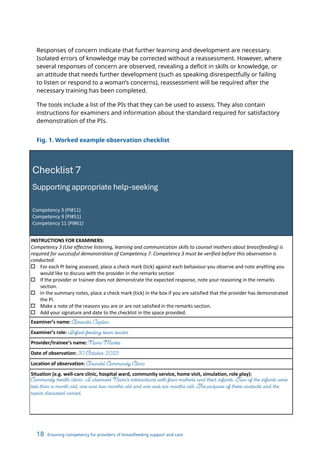
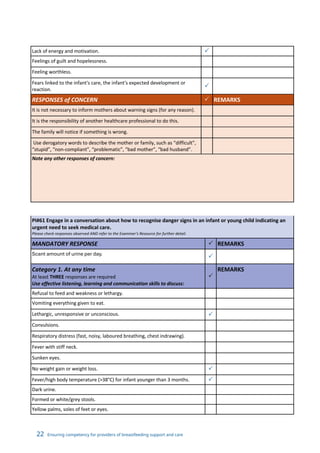
observation tools (see worked example in Fig. 1) to record their observations, indicating
whether the PIs have been demonstrated and providing supportive, meaningful feedback.
Examiners should record the behaviours performed during an observation with the key
provided. Any responses of concern should be recorded and discussed with the provider.
18 Ensuring competency for providers of breastfeeding support and care
Responses of concern indicate that further learning and development are necessary.
Isolated errors of knowledge may be corrected without a reassessment. However, where
several responses of concern are observed, revealing a deficit in skills or knowledge, or
an attitude that needs further development (such as speaking disrespectfully or failing
to listen or respond to a woman’s concerns), reassessment will be required after the
necessary training has been completed.
The tools include a list of the PIs that they can be used to assess. They also contain
instructions for examiners and information about the standard required for satisfactory
demonstration of the PIs.
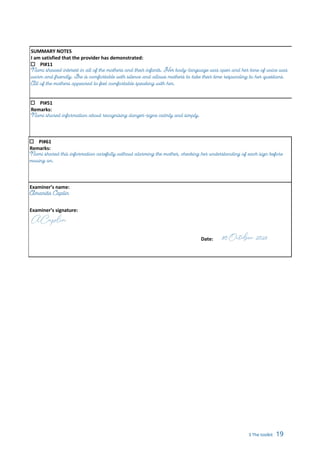
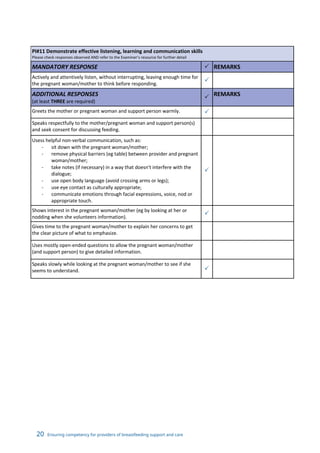
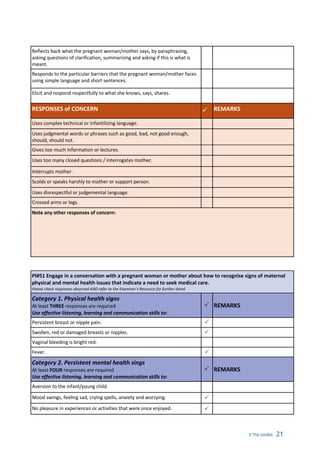
Fig. 1. Worked example observation checklist
Checklist 7
Supporting appropriate help-seeking
Competency 3 (PI#11)
Competency 9 (PI#51)
Competency 11 (PI#61)
INSTRUCTIONS FOR EXAMINERS:
Competency 3 (Use effective listening, learning and communication skills to counsel mothers about breastfeeding) is
required for successful demonstration of Competency 7. Competency 3 must be verified before this observation is
conducted.
o For each PI being assessed, place a check mark (tick) against each behaviour you observe and note anything you
would like to discuss with the provider in the remarks section
o If the provider or trainee does not demonstrate the expected response, note your reasoning in the remarks
section.
o In the summary notes, place a check mark (tick) in the box if you are satisfied that the provider has demonstrated
the PI.
o Make a note of the reasons you are or are not satisfied in the remarks section.
o Add your signature and date to the checklist in the space provided.
Examiner’s name: Amanita Caplan
Examiner’s role: Infant feeding team leader
Provider/trainee’s name: Nomi Marks
Date of observation: 30 October 2025
Location of observation: Arundel Community Clinic
Situation (e.g. well-care clinic, hospital ward, community service, home visit, simulation, role play):
Community health clinic. I observed Nomi’s interactions with four mothers and their infants. Two of the infants were
less than a month old, one was two months old and one was six months old. The purpose of these contacts and the
topics discussed varied.
SUMMARY NOTES
I am satisfied that the provider has demonstrated:
o PI#11
Nomi showed interest in all of the mothers and their infants. Her body-language was open and her tone of voice was
warm and friendly. She is comfortable with silence and allows mothers to take their time responding to her questions.
3 The toolkit 19
Situation (e.g. well-care clinic, hospital ward, community service, home visit, simulation, role play):
Community health clinic. I observed Nomi’s interactions with four mothers and their infants. Two of the infants were
less than a month old, one was two months old and one was six months old. The purpose of these contacts and the
topics discussed varied.
SUMMARY NOTES
I am satisfied that the provider has demonstrated:
o PI#11
Nomi showed interest in all of the mothers and their infants. Her body-language was open and her tone of voice was
warm and friendly. She is comfortable with silence and allows mothers to take their time responding to her questions.
All of the mothers appeared to feel comfortable speaking with her.
o PI#51
Remarks:
Nomi shared information about recognising danger-signs calmly and simply.
o PI#61
Remarks:
Nomi shared this information carefully without alarming the mother, checking her understanding of each sign before
moving on.
Examiner’s name:
Amanita Caplin
Examiner’s signature:
ACaplin
Date: 30October2025
PI#11 Demonstrate effective listening, learning and communication skills
Please check responses observed AND refer to the Examiner’s resource for further detail
MANDATORY RESPONSE P REMARKS
Actively and attentively listen, without interrupting, leaving enough time for
the pregnant woman/mother to think before responding.
P
ADDITIONAL RESPONSES
(at least THREE are required)
P REMARKS
Greets the mother or pregnant woman and support person warmly. P
Speaks respectfully to the mother/pregnant woman and support person(s)
and seek consent for discussing feeding.
Usess helpful non-verbal communication, such as:
- sit down with the pregnant woman/mother;
- remove physical barriers (eg table) between provider and pregnant
woman/mother;
- take notes (if necessary) in a way that doesn't interfere with the
dialogue;
- use open body language (avoid crossing arms or legs);
- use eye contact as culturally appropriate;
- communicate emotions through facial expressions, voice, nod or
appropriate touch.
P
Shows interest in the pregnant woman/mother (eg by looking at her or
nodding when she volunteers information).
P
Gives time to the pregnant woman/mother to explain her concerns to get
20 Ensuring competency for providers of breastfeeding support and care
Date: 30October2025
PI#11 Demonstrate effective listening, learning and communication skills
Please check responses observed AND refer to the Examiner’s resource for further detail
MANDATORY RESPONSE P REMARKS
Actively and attentively listen, without interrupting, leaving enough time for
the pregnant woman/mother to think before responding.
P
ADDITIONAL RESPONSES
(at least THREE are required)
P REMARKS
Greets the mother or pregnant woman and support person warmly. P
Speaks respectfully to the mother/pregnant woman and support person(s)
and seek consent for discussing feeding.
Usess helpful non-verbal communication, such as:
- sit down with the pregnant woman/mother;
- remove physical barriers (eg table) between provider and pregnant
woman/mother;
- take notes (if necessary) in a way that doesn't interfere with the
dialogue;
- use open body language (avoid crossing arms or legs);
- use eye contact as culturally appropriate;
- communicate emotions through facial expressions, voice, nod or
appropriate touch.
P
Shows interest in the pregnant woman/mother (eg by looking at her or
nodding when she volunteers information).
P
Gives time to the pregnant woman/mother to explain her concerns to get
the clear picture of what to emphasize.
Uses mostly open-ended questions to allow the pregnant woman/mother
(and support person) to give detailed information.
Speaks slowly while looking at the pregnant woman/mother to see if she
seems to understand. P
3 The toolkit 21
Reflects back what the pregnant woman/mother says, by paraphrasing,
asking questions of clarification, summarizing and asking if this is what is
meant.
Responds to the particular barriers that the pregnant woman/mother faces
using simple language and short sentences.
Elicit and respond respectfully to what she knows, says, shares.
RESPONSES of CONCERN P
P REMARKS
Uses complex technical or infantilizing language.
Uses judgmental words or phrases such as good, bad, not good enough,
should, should not.
Gives too much information or lectures.
Uses too many closed questions / interrogates mother.
Interrupts mother.
Scolds or speaks harshly to mother or support person.
Uses disrespectful or judgemental language.
Crossed arms or legs.
Note any other responses of concern:
PI#51 Engage in a conversation with a pregnant woman or mother about how to recognise signs of maternal
physical and mental health issues that indicate a need to seek medical care.
Please check responses observed AND refer to the Examiner’s Resource for further detail
Category 1. Physical health signs
At least THREE responses are required
Use effective listening, learning and communication skills to:
P REMARKS
Persistent breast or nipple pain. P
Swollen, red or damaged breasts or nipples. P
Vaginal bleeding is bright red.
Fever. P
Category 2. Persistent mental health sings
At least FOUR responses are required
Use effective listening, learning and communication skills to:
P REMARKS
Aversion to the infant/young child.
Mood swings, feeling sad, crying spells, anxiety and worrying. P
No pleasure in experiences or activities that were once enjoyed. P
22 Ensuring competency for providers of breastfeeding support and care
Lack of energy and motivation. P
Feelings of guilt and hopelessness.
Feeling worthless.
Fears linked to the infant's care, the infant's expected development or
reaction.
P
RESPONSES of CONCERN P REMARKS
It is not necessary to inform mothers about warning signs (for any reason).
It is the responsibility of another healthcare professional to do this.
The family will notice if something is wrong.
Use derogatory words to describe the mother or family, such as “difficult”,
“stupid”, “non-compliant”, “problematic”, “bad mother”, “bad husband”.
Note any other responses of concern:
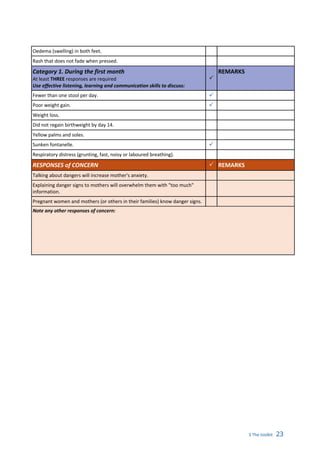
PI#61 Engage in a conversation about how to recognise danger signs in an infant or young child indicating an
urgent need to seek medical care.
Please check responses observed AND refer to the Examiner’s Resource for further detail.
MANDATORY RESPONSE P REMARKS
Scant amount of urine per day.
P
Category 1. At any time
At least THREE responses are required
Use effective listening, learning and communication skills to discuss:
P
REMARKS
Refusal to feed and weakness or lethargy.
Vomiting everything given to eat.
Lethargic, unresponsive or unconscious. P
Convulsions.
Respiratory distress (fast, noisy, laboured breathing, chest indrawing).
Fever with stiff neck.
Sunken eyes.
No weight gain or weight loss. P
Fever/high body temperature (38°C) for infant younger than 3 months. P
Dark urine.
Formed or white/grey stools.
Yellow palms, soles of feet or eyes.
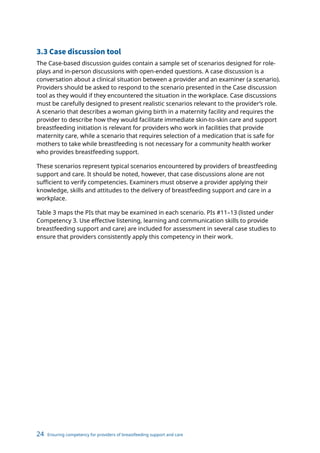
3 The toolkit 23
Oedema (swelling) in both feet.
Rash that does not fade when pressed.
Category 1. During the first month
At least THREE responses are required
Use effective listening, learning and communication skills to discuss:
P
REMARKS
Fewer than one stool per day. P
Poor weight gain. P
Weight loss.
Did not regain birthweight by day 14.
Yellow palms and soles.
Sunken fontanelle. P
Respiratory distress (grunting, fast, noisy or laboured breathing).
RESPONSES of CONCERN P REMARKS
Talking about dangers will increase mother's anxiety.
Explaining danger signs to mothers will overwhelm them with too much
information.
Pregnant women and mothers (or others in their families) know danger signs.
Note any other responses of concern:
24 Ensuring competency for providers of breastfeeding support and care
3.3 Case discussion tool
The Case-based discussion guides contain a sample set of scenarios designed for role-
plays and in-person discussions with open-ended questions. A case discussion is a
conversation about a clinical situation between a provider and an examiner (a scenario).
Providers should be asked to respond to the scenario presented in the Case discussion
tool as they would if they encountered the situation in the workplace. Case discussions
must be carefully designed to present realistic scenarios relevant to the provider’s role.
A scenario that describes a woman giving birth in a maternity facility and requires the
provider to describe how they would facilitate immediate skin-to-skin care and support
breastfeeding initiation is relevant for providers who work in facilities that provide
maternity care, while a scenario that requires selection of a medication that is safe for
mothers to take while breastfeeding is not necessary for a community health worker
who provides breastfeeding support.
These scenarios represent typical scenarios encountered by providers of breastfeeding
support and care. It should be noted, however, that case discussions alone are not
sufficient to verify competencies. Examiners must observe a provider applying their
knowledge, skills and attitudes to the delivery of breastfeeding support and care in a
workplace.
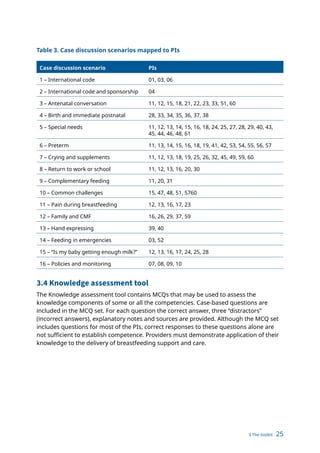
Table 3 maps the PIs that may be examined in each scenario. PIs #11–13 (listed under
Competency 3. Use effective listening, learning and communication skills to provide
breastfeeding support and care) are included for assessment in several case studies to
ensure that providers consistently apply this competency in their work.
3 The toolkit 25
Table 3. Case discussion scenarios mapped to PIs
Case discussion scenario PIs
1 – International code 01, 03, 06
2 – International code and sponsorship 04
3 – Antenatal conversation 11, 12, 15, 18, 21, 22, 23, 33, 51, 60
4 – Birth and immediate postnatal 28, 33, 34, 35, 36, 37, 38
5 – Special needs 11, 12, 13, 14, 15, 16, 18, 24, 25, 27, 28, 29, 40, 43,
45, 44, 46, 48, 61
6 – Preterm 11, 13, 14, 15, 16, 18, 19, 41, 42, 53, 54, 55, 56, 57
7 – Crying and supplements 11, 12, 13, 18, 19, 25, 26, 32, 45, 49, 59, 60
8 – Return to work or school 11, 12, 13, 16, 20, 30
9 – Complementary feeding 11, 20, 31
10 – Common challenges 15, 47, 48, 51, 5760
11 – Pain during breastfeeding 12, 13, 16, 17, 23
12 – Family and CMF 16, 26, 29, 37, 59
13 – Hand expressing 39, 40
14 – Feeding in emergencies 03, 52
15 – “Is my baby getting enough milk?” 12, 13, 16, 17, 24, 25, 28
16 – Policies and monitoring 07, 08, 09, 10
3.4 Knowledge assessment tool
The Knowledge assessment tool contains MCQs that may be used to assess the
knowledge components of some or all the competencies. Case-based questions are
included in the MCQ set. For each question the correct answer, three “distractors”
(incorrect answers), explanatory notes and sources are provided. Although the MCQ set
includes questions for most of the PIs, correct responses to these questions alone are
not sufficient to establish competence. Providers must demonstrate application of their
knowledge to the delivery of breastfeeding support and care.
26
4 Country adaptation
The competencies described in this toolkit should be considered a minimum set of
the knowledge, skills and attitudes that providers must have to adequately protect,
promote and support breastfeeding in maternity facilities and the community. Additional
competencies may be required in some contexts, and these should be added.
The PIs and tools presented here should be modified as necessary to ensure that they
reflect the needs of those who provide care and the needs of the population they serve.
Countries may create additional PIs or adapt existing PIs to their context by adding
to or modifying the expected or concerning responses (see Examiner’s resource and
Observation tools).
The expected responses and those of concern listed in the Examiner’s resource and
Observation tools might have to be adapted to ensure that they reflect the legal, ethical
and organisational responsibilities of those who provide breastfeeding support and care
in each country. Similarly, some modifications may be necessary to the case studies to
reflect local cultural beliefs, attitudes and expectations about infant feeding, especially
when providers must be equipped to support evidence-based feeding practices that are
not yet widely accepted in their communities.
Adaptation of these tools should be based on a thorough analysis of the breastfeeding
care and support tasks that a provider is likely to perform. This information can then be
used to create additional PIs and, if necessary, additional competencies.
Breastfeeding support and care competencies can be assessed with a variety of
strategies. Countries, health systems or community services may develop additional
assessment strategies and tools based on this toolkit. For example, countries may
integrate knowledge assessment into observation-based assessments by requiring
providers to demonstrate breastfeeding support and care skills in various situations and
contexts. Similarly, context-specific scenarios may be developed for use in case-based
discussions of situations commonly encountered by experienced providers.
The tools in this toolkit may also be used as templates for developing tools for assessing
additional competencies that have been identified as necessary for the performance of
required tasks. Some may be found in WHO’s Infant and young child feeding counselling:
an integrated course (11) or in the UNICEF Community infant and young child feeding
counselling package (26).
27
References
1. Infant and young child feeding: model chapter for textbooks for medical students and allied
health professionals, 2nd ed. Geneva: World Health Organization; 2025 (https://iris.who.int/
handle/10665/382885). License: CC BY-NC-SA 3.0 IGO.
2. Global competency framework for universal health coverage. Geneva: World Health
Organization; 2022 (https://iris.who.int/handle/10665/352710). License: CC BY-NC-SA 3.0 IGO.
3. James J. McKenna, Sarah S. Mosko, Christopher A. Richard; Bedsharing Promotes
Breastfeeding. Pediatrics; August 1997: 100 (2): 214–219 (https://doi.org/10.1542/
peds.100.2.214).
4. World Health Organization  United Nations Children’s Fund (UNICEF). Indicators for
assessing infant and young child feeding practices: definitions and measurement methods.
World Health Organization; 2021 (https://iris.who.int/handle/10665/340706). License: CC
BY-NC-SA 3.0 IGO.
5. Guidance on ending the inappropriate promotion of foods for infants and young
children: implementation manual. World Health Organization; 2017 (https://iris.who.int/
handle/10665/260137). License: CC BY-NC-SA 3.0 IGO.
6. Breastfeeding: achieving the new normal. The Lancet (British Edition); 2016: 387(10017), 404–
404 (https://doi.org/10.1016/S0140–6736(16)00210–5).
7. TVETipedia Glossary [online database]. Germany: UNESCO-UNEVOC International centre for
technical and vocational education and training; 2026 (https://unevoc.unesco.org/home/
TVETipedia+Glossary/lang=e/show=term/term=competence).
8. WHO recommendations for care of the preterm or low-birth-weight infant. Geneva: World
Health Organization; 2022 (https://www.who.int/publications/i/item/9789240058262). License:
CC BY-NC-SA 3.0 IGO.
9. Behavioural Counselling (eCourse). WHO Academy; 2025 (https://whoacademy.org/
coursewares/course-v1:WHOA+0020_BC_EN+2024?source=edX).
10. Rollnick, S.  Gobat, N. Motivational Interviewing: the four key stages. In BMJ Careers
[website]. BMJ Publishing Group; 2023 (https://www.bmj.com/careers/article/
motivational-interviewing-the-four-key-stages).
11. Infant and young child feeding counselling: an integrated course: trainer’s guide. 2nd ed.
Geneva: World Health Organization; 2020 (https://iris.who.int/handle/10665/350477). License:
CC BY-NC-SA 3.0 IGO.
12. Code and subsequent resolutions. In World Health Organization [website]. Geneva:
World Health Organization; 2023 (https://www.who.int/teams/nutrition-and-food-safety/
food-and-nutrition-actions-in-health-systems/code-and-subsequent-resolutions).
13. Kangaroo mother care: a clinical practice guide. Geneva: World Health Organization; 2025
(https://iris.who.int/handle/10665/382962). License: CC BY-NC-SA 3.0 IGO.
14. Nurturing care for early childhood development: a framework for helping children survive and
thrive to transform health and human potential. Geneva: World Health Organization; 2018
(https://iris.who.int/handle/10665/272603). License: CC BY-NC-SA 3.0 IGO.
15. World Health Organization  United Nations Children’s Fund (UNICEF). Nurturing care for
every newborn: thematic brief. Geneva: World Health Organization; 2021 (https://iris.who.int/
handle/10665/345297). License: CC BY-NC-SA 3.0 IGO.
28 Ensuring competency for providers of breastfeeding support and care
16. United Nations Children’s Fund (UNICEF) and World Health Organization. Nurturing care
practice guide: strengthening nurturing care through health and nutrition services. Geneva:
World Health Organization; 2022 (https://nurturing-care.org/practiceguide/). License: CC
BY-NC-SA 3.0 IGO.
17. United Nations Children’s Fund (UNICEF) and World Health Organization. Protecting,
promoting and supporting breastfeeding in facilities providing maternity and newborn
services – The Baby-friendly Hospital Initiative: Monitoring manual. Geneva: World Health
Organization; 2025 (https://knowledge.unicef.org/resource/baby-friendly-hospital-initiative-
monitoring-manual). License: CC BY-NC-SA 3.0 IGO.
18. WHO guideline: protecting, promoting and supporting breastfeeding in facilities providing
maternity and newborn services. Geneva: World Health Organization; 2017 (https://iris.who.
int/handle/10665/259386). License: CC BY-NC-SA 3.0 IGO.
19. Competency verification toolkit: ensuring the competency of direct care providers to
implement the baby-friendly hospital initiative. Geneva: World Health Organization; 2020
(https://iris.who.int/handle/10665/333691). License: CC BY-NC-SA 3.0 IGO.
20. Counselling of women to improve breastfeeding practices. Geneva: World Health
Organization; 2018 (https://iris.who.int/handle/10665/280133). License: CC BY-NC-SA 3.0 IGO.
21. United Nations Children’s Fund (UNICEF) and World Health Organization (2021).
Implementation guidance on counselling women to improve breastfeeding practices. New
York: UNICEF; 2021 (https://iris.who.int/handle/10665/382155). License: CC BY-NC-SA 3.0 IGO.
22. Framework for action on interprofessional education and collaborative practice. Geneva:
World Health Organization; 2010 (https://iris.who.int/handle/10665/70185).
23. Rogers C. Client centered therapy (new ed). London: Hachette UK Ltd; 2012 (https://www.
hachette.co.uk/titles/carl-rogers/client-centered-therapy-new-ed/9781780337067/).
24. The international code of marketing of breast-milk substitutes: frequently asked questions
on the roles and responsibilities of health workers. Geneva: World Health Organization; 2020
(https://iris.who.int/handle/10665/332170). License: CC BY-NC-SA 3.0 IGO.
25. JAPreventNCD. Joint Action Prevent Non-Communicable Diseases and Cancer.
Brussels: European Commission, Directorate-General for Health and Food
Safety; 2024 (https://health.ec.europa.eu/non-communicable-diseases/cancer/
europes-beating-cancer-plan-eu4health-financed-projects/projects/ja-preventncd_en).
26. The community infant and young child feeding counselling package. New York; UNICEF; 2024
(https://www.unicef.org/documents/community-iycf-package).
(All references were accessed on 16 March 2026.)
29
Annex 1. Competency
verification tools
1. Competency verification toolkit examiners’ resource – a reference for examiners
that contains detailed descriptions of the behaviours a competent provider can be
expected to demonstrate; https://iris.who.int/handle/10665/385331
2. Competency verification toolkit observation tools – a set of checklists that can be
used to record examiners’ observation of providers’ behaviours; https://iris.who.int/
handle/10665/385330
3. Competency verification toolkit case-based discussion guide – a set of breastfeeding
support and care scenarios that may be used to stimulate discussion or role-play
simulations during which providers may demonstrate some of the components of the
competencies; https://iris.who.int/handle/10665/385333
4. Competency verification toolkit knowledge assessment tool – a set of multiple
choice questions (MCQs), including an answer key, that can be used to examine
some of the knowledge components of the competencies. https://iris.who.int/
handle/10665/385332
30
Annex 2. Methods
The BFHI Network, Inc., under contract with WHO, reviewed WHO and United Nations
Children’s Fund (UNICEF) policies, communications and training materials pertaining to
the breastfeeding knowledge and skills of health-care providers. The sources included:
– IYCF: model chapter for textbooks for medical students and allied health
professionals second edition (1);
– IYCF counselling: an integrated course second edition (2);
– Baby-friendly Hospital Initiative training course for maternity staff (3);
– Implementation guidance on counselling women to improve breastfeeding
practices (4);
– Competency verification toolkit: ensuring competency of direct care providers to
implement the Baby-friendly Hospital Initiative (5);
– The International Code of Marketing of Breast-milk Substitutes: Frequently asked
questions on the roles and responsibilities of health workers (6);
– WHO Guideline for complementary feeding of infants and young children 6–23
months of age (7);
– WHO recommendations on maternal and newborn care for a positive pregnancy
experience (8);
– WHO recommendations for care of the preterm or low birth weight infant (9);
– Improving the health and wellbeing of children and adolescents: guidance on
scheduled child and adolescent well-care visits (10); and
– UNICEF Community IYCF counselling package (11).
In addition, a search was conducted for other WHO and UNICEF documents that
addressed the following topics:
– antenatal period and childbirth;
– competencies, training;
– counselling;
– emergencies, humanitarian settings;
– preparation, storage and handling of infant formula;
– health-care or hospital care
– International code of marketing of breast milk substitutes;
– Kangaroo care, care of the preterm infant;
– monitoring;
– mortality: infant and maternal;
Annex 2. Methods 31
– nutrition;
– postpartum and newborn care;
– safe sleep; and
– family-friendly workplaces.
WHO convened a group of advisers, selected for their expertise in paediatrics,
neonatology, nursing, nutrition, breastfeeding management, BFHI, competency-based
training, competency verification, pre-service education and/or community-based
breastfeeding care (see Table A2.1).
The contractor also used its extensive professional network to identify countries in
which the BFHI Competency verification toolkit had been used. Experts from each of
these countries (Canada, Italy, Kenya, and USA) were invited to attend meetings of the
advisers to share their experiences and observations. The author team and the advisers
met on six occasions, and the observations of the advisers were considered throughout
development of the document. This group met three times to discuss experiences of
using the previous toolkit, sources of evidence on effective competency verification
practices, the required competencies and PIs, and methods of verification. This group
also reviewed the verification materials before finalising the document.
WHO worked with the contractor to synthesize the advice of the expert group and shape
the Competency verification tool. The contractors provided a draft introduction and tools.
The draft toolkit was pilot-tested in Italy and Norway as part of the European Union Joint
Action Prevent Non-Communicable Diseases.
32 Ensuring competency for providers of breastfeeding support and care
Table A2.1. Expertise and affiliations of the expert group
Name Affiliation Country Expertise
Nora
Alkharji
Director of breastfeeding
programme in the
Ministry of National
Guard
Saudi Arabia MD; Paediatrician, IBCLC; Educator;
community peer breastfeeding
support, BFHI Assessor, BFHI Trainer;
IBLCE coordinator in Saudi Arabia
Eileen
FitzPatrick
Baby-friendly USA USA DrPH, MPH, RDN: Nutrition and
Dietetics; BFHI implementation;
Pre-service education
Angela
Giusti
Italian National Institute
of Health (Istituto
Superiore di Sanità)
Italy PhD Health Promotion; Public Health
Research, IBCLC; Midwifery; Adult
education; Counselling
Alejandra
Gutierrez
University of North
Florida, University of
Texas at Austin
Mexico
USA
Registered Dietician; IBCLC; Perinatal
and paediatric nutrition
Rukhsana
Haider
Training  Assistance
for Health  Nutrition
Foundation
Bangladesh MBBS, MSc, PhD, Fellow of the
Academy of Breastfeeding Medicine,
IBCLC; Physician; Peer breastfeeding
counselling programmes; Nutrition
training and education
Rameeza
Kaleem
Department of
Preventive Paediatrics,
Fatima Jinnah Medical
University
Pakistan MD, MS, MBBS Paediatrics; Pre-
service education; maternal and infant
nutrition; growth and assessment;
Master trainer of BFHI, IYCF, CMAM,
and IMNCI.
Theresa
Landau
Morrisania Diagnostic
and Treatment Center
(WIC Program), New York
City Health and Hospital
Corporation
USA MS, RDN, CDN, CLC; BFHI assessment
and implementation; Peer
breastfeeding support
Angie
Manners
The Perfect Latch
Breastfeeding Services /
Services en allaitement
Canada RN; MScN; IBCLC; maternal and child
health
Melissa
Miranda
Research Institute in
Health and Development,
Universidad Mayor de
San Andres
Bolivia PhD: Nutrition and Food
Tuan
Nguyen
Alive  Thrive East Asia
Pacific, FHI 360 Global
Nutrition College of
Health Sciences, Vin
University
Viet Nam MD, MS, PhD; Paediatrics; human milk
bank; BFHI; Nutritional Epidemiology;
International Health; IYCF
Brian M
Njoroge
Udugu Ufanisi Ustawi wa
Jamii (3UJ) Development
Ltd
Kenya Infant and young child nutrition;
Child survival; Baby Friendly
Hospital Initiative, Baby Friendly
Community Initiative, Mentorship
for Breastfeeding Counselling, and
Competency Verification
Pushpa
Panadam
La Leche League
International (LLLI)
Paraguay Community breastfeeding support
(La Leche League Leader), Antenatal
and postnatal education
Annex 2. Methods 33
References
1. Infant and young child feeding: model chapter for textbooks for medical students and allied
health professionals, 2nd ed. Geneva: World Health Organization; 2025 (https://iris.who.int/
handle/10665/382885). License: CC BY-NC-SA 3.0 IGO.
2. Infant and young child feeding counselling: an integrated course: trainer’s guide, 2nd ed.
Geneva: World Health Organization; 2021 (https://iris.who.int/handle/10665/350477). License:
CC BY-NC-SA 3.0 IGO.
3. World Health Organization and United Nations Children’s Fund (UNICEF). Implementation
guidance: protecting, promoting and supporting breastfeeding in facilities providing
maternity and newborn services: the revised baby-friendly hospital initiative. Geneva: World
Health Organization; 2018 (https://iris.who.int/handle/10665/272943). License: CC BY-NC-SA
3.0 IGO.
4. World Health Organization and United Nations Children’s Fund (UNICEF). Baby-friendly
hospital initiative training course for maternity staff: trainer’s guide. Geneva: World Health
Organization; 2020 (https://iris.who.int/handle/10665/333676). License: CC BY-NC-SA 3.0 IGO.
5. Competency verification toolkit: ensuring the competency of direct care providers to
implement the baby-friendly hospital initiative. Geneva: World Health Organization; 2020
(https://iris.who.int/handle/10665/333691). License: CC BY-NC-SA 3.0 IGO.
6. The international code of marketing of breast-milk substitutes: frequently asked questions
on the roles and responsibilities of health workers. Geneva: World Health Organization; 2020
(https://iris.who.int/handle/10665/332170). License: CC BY-NC-SA 3.0 IGO.
7. WHO guideline for complementary feeding of infants and young children 6 -23 months of
age. Geneva: World Health Organization; 2023 (https://iris.who.int/handle/10665/373358).
License: CC BY-NC-SA 3.0 IGO.
8. WHO recommendations on maternal and newborn care for a positive postnatal experience.
Geneva: World Health Organization; 2022 (https://iris.who.int/handle/10665/352658). License:
CC BY-NC-SA 3.0 IGO.
9. WHO recommendations for care of the preterm or low-birth-weight infant. Geneva: World
Health Organization; 2022 (https://iris.who.int/handle/10665/363697). License: CC BY-NC-SA
3.0 IGO.
10. World Health Organization and United Nations Children’s Fund (UNICEF). Improving
the health and wellbeing of children and adolescents: guidance on scheduled child and
adolescent well-care visits. Geneva: World Health Organization; 2023 (https://iris.who.int/
handle/10665/376159). License: CC BY-NC-SA 3.0 IGO.
11. The Community Infant and Young Child Feeding Counselling Package. New York:
United Nations Children’s Fund (UNICEF); 2025 (https://www.unicef.org/documents/
community-iycf-package).
(All references were accessed on 16 March 2026.)
For more information, please contact:
Department of Nutrition and Food Safety
World Health Organization
Avenue Appia 20
1211 Geneva 27
Switzerland