Information
Technology
Exploring the role and
significance in modern society.
This presentation delves into the definition,
importance, and key components of Information
Technology in contemporary settings.
Introduction
Overview
01
Definition of Information Technology
Information Technology (IT) refers to the use of computers,
networks, and software to manage data, information, and
communication systems. It encompasses a wide array of
technologies, including hardware, software, and services that
facilitate the processing, storage, and dissemination of
information.
Importance in today's world
In today's fast-paced environment, Information Technology plays a
crucial role in enhancing efficiency, productivity, and
communication. Organizations leverage IT to streamline
operations, improve customer experiences, and foster innovation,
making it an essential component for success in various industries.
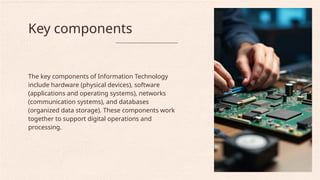
The key components of Information Technology
include hardware (physical devices), software
(applications and operating systems), networks
(communication systems), and databases
(organized data storage). These components work
together to support digital operations and
processing.
Key components
Applications
02
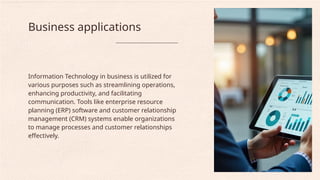
Information Technology in business is utilized for
various purposes such as streamlining operations,
enhancing productivity, and facilitating
communication. Tools like enterprise resource
planning (ERP) software and customer relationship
management (CRM) systems enable organizations
to manage processes and customer relationships
effectively.
Business applications
Healthcare innovations
In healthcare, IT solutions such as electronic health records (EHR),
telemedicine, and health informatics have transformed patient
care. These technologies improve efficiency, enhance patient
outcomes, and enable better data management, thus allowing
healthcare professionals to make informed decisions.
Education technology
Education technology (EdTech) leverages IT to enhance teaching
and learning experiences. Tools such as learning management
systems (LMS), online courses, and digital collaboration platforms
facilitate interactive learning, allowing students to access
resources anytime and anywhere, fostering a more engaging
educational environment.
Conclusions
In conclusion, Information Technology is a pivotal force driving
innovation and efficiency across various sectors. Its application in
business, healthcare, and education highlights the transformative
impact of IT, emphasizing the necessity for ongoing adaptation
and integration of new technologies.
CREDITS: This presentation template was created
by Slidesgo, and includes icons, infographics &
images by Freepik
Thank you!
Do you have any questions?