A detailed fill-in-the-blank question bank covering nursing research concepts, methodologies, ethics, data analysis, and statistics essential for nursing education and evidence-based practice.
Nursing Research &Statistics
Fill-in-the-Blank Question Bank
1. Research is a __________ scientific investigation.
Ans: Systematic
2. The first step of the research process is identification of the research __________.
Ans: Problem
3. The last step of the research process is reporting of __________.
Ans: Findings
4. A good research problem should be clear, specific and __________.
Ans: Feasible
5. A research study should follow ethical __________.
Ans: Principles
6. Evidence-Based Practice combines research evidence, clinical expertise and patient __________.
Ans: Values
7. The first step of Evidence-Based Practice is asking a clinical __________.
Ans: Question
8. Informed __________ is taken from research participants.
Ans: Consent
9. A research problem should be __________ and feasible.
Ans: Researchable
10. A tentative answer to a research problem is called a __________.
Ans: Hypothesis
11. A hypothesis that states no relationship between variables is called a __________ hypothesis.
Ans: Null
12. A hypothesis predicting a relationship between variables is called a __________ hypothesis.
Ans: Research
13. A good hypothesis should be __________.
Ans: Testable
14. Research objectives describe what the researcher wants to __________.
Ans: Achieve
15. Research objectives should be specific and __________.
Ans: Measurable
16. A research problem should contribute to new __________.
Ans: Knowledge
17. A gap in existing knowledge helps identify a research __________.
Ans: Problem
18. A critical summary of previously conducted studies on a chosen topic is called __________ of literature.
Ans: Review
19. Reviewing literature helps the researcher avoid unnecessary __________ of a study already done.
Ans: Duplication
2.
20. CINHAL standsfor Cumulative Index to Nursing and Allied __________ Literature.
Ans: Health
21. The Cochrane Library is mainly used to access __________ reviews in health care.
Ans: Systematic
22. A rigorous, structured synthesis of all available evidence on a specific research question is called a __________
review.
Ans: Systematic
23. Reviewing literature helps identify the __________ gap that justifies the need for a new study.
Ans: Knowledge
24. A brief descriptive and evaluative summary written for each source in a reference list is called an __________.
Ans: Annotation
25. A bibliography that includes a short summary of each source is called an __________ bibliography.
Ans: Annotated
26. Unpublished sources such as theses, dissertations and conference proceedings are called __________ literature.
Ans: Grey
27. The scope of literature review includes theoretical, conceptual and __________ literature.
Ans: Empirical
28. The place where research literature is physically or electronically located is called the __________ of the review.
Ans: Location
29. A research approach that studies past events using documents and records is called __________ research.
Ans: Historical
30. A research approach that collects data from a large sample using questionnaires or interviews is called
__________ research.
Ans: Survey
31. A research approach involving manipulation of the independent variable to test cause-effect relationships is
called __________ research.
Ans: Experimental
32. A qualitative design exploring the lived experience of individuals is called __________ research.
Ans: Phenomenological
33. A qualitative design describing the culture and patterns of a specific group is called __________ research.
Ans: Ethnographic
34. A qualitative approach that develops theory directly from the data collected is called __________ theory.
Ans: Grounded
35. An in-depth, detailed study of a single individual, group, institution or event is called a __________ study.
Ans: Case
36. A true experimental design requires manipulation, control group and __________.
Ans: Randomization
37. A design where the researcher manipulates the independent variable without full randomization or control is
called __________ experimental design.
Ans: Quasi
38. A design that does not involve manipulation of the independent variable is called __________ research design.
Ans: Non-experimental
3.
39. A researchdesign that describes variables as they exist without manipulation is called __________ research
design.
Ans: Descriptive
40. A design that examines the relationship between two or more variables without manipulation is called
__________ research design.
Ans: Correlational
41. A design in which data are collected from subjects at a single point in time is called a __________ study.
Ans: Cross-sectional
42. A design in which the same subjects are studied repeatedly over a period of time is called a __________ study.
Ans: Longitudinal
43. A design that compares two or more groups on one or more variables is called __________ research design.
Ans: Comparative
44. The theoretical structure that links the concepts and variables of a study is called the __________ framework.
Ans: Conceptual
45. A small-scale trial run of the study conducted before the main study is called a __________ study.
Ans: Pilot
46. The main purpose of a pilot study is to test the __________ of the research design and tools.
Ans: Feasibility
47. Data from a pilot study are generally __________ included in the final analysis of the main study.
Ans: Not
48. The population to which the researcher wants to generalize findings is called the __________.
Ans: Target population
49. The list of all eligible subjects is called the sampling __________.
Ans: Frame
50. Criteria specifying who can participate are __________ criteria.
Ans: Inclusion
51. Criteria specifying who cannot participate are __________ criteria.
Ans: Exclusion
52. Sampling techniques are broadly classified into __________ and non-probability sampling.
Ans: Probability
53. The most basic probability sampling is __________ random sampling.
Ans: Simple
54. Selecting every nth subject is __________ sampling.
Ans: Systematic
55. Dividing the population into homogeneous groups is __________ sampling.
Ans: Stratified
56. Selecting entire groups is __________ sampling.
Ans: Cluster
57. Sampling carried out in stages is __________ sampling.
Ans: Multistage
58. Selecting participants by judgment is __________ sampling.
Ans: Purposive
4.
59. Selecting easilyavailable participants is __________ sampling.
Ans: Convenience
60. Selecting all eligible accessible subjects is __________ sampling.
Ans: Consecutive
61. Selecting according to fixed proportions is __________ sampling.
Ans: Quota
62. Sampling used for hidden populations is __________ sampling.
Ans: Snowball
63. Snowball sampling is also called __________ referral sampling.
Ans: Chain
64. A good sampling technique minimizes __________ error.
Ans: Sampling
65. Drawing conclusions about a population from a sample is called __________.
Ans: Generalization
66. The ability of an instrument to measure what it intends to measure is __________.
Ans: Validity
67. The consistency of an instrument is __________.
Ans: Reliability
68. Validity evaluated by experts is __________ validity.
Ans: Content
69. Validity based on appearance is __________ validity.
Ans: Face
70. Measuring the theoretical concept is __________ validity.
Ans: Construct
71. Validity compared with a gold standard is __________ validity.
Ans: Criterion
72. Reliability measured by repeating the same test is __________ reliability.
Ans: Test-retest
73. Reliability between two observers is __________ reliability.
Ans: Inter-rater
74. Internal consistency is measured using __________ alpha.
Ans: Cronbach's
75. Keeping participants' information private is __________.
Ans: Confidentiality
76. Doing good is called __________.
Ans: Beneficence
77. Avoiding harm is called __________.
Ans: Non-maleficence
78. Fair treatment of participants is called __________.
Ans: Justice
79. Participants may __________ from the study at any time.
5.
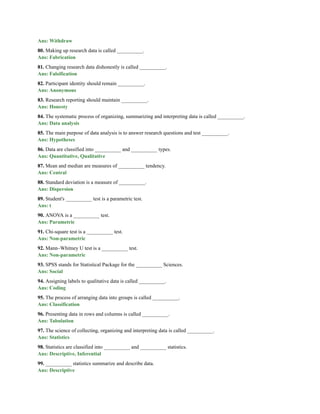
Ans: Withdraw
80. Makingup research data is called __________.
Ans: Fabrication
81. Changing research data dishonestly is called __________.
Ans: Falsification
82. Participant identity should remain __________.
Ans: Anonymous
83. Research reporting should maintain __________.
Ans: Honesty
84. The systematic process of organizing, summarizing and interpreting data is called __________.
Ans: Data analysis
85. The main purpose of data analysis is to answer research questions and test __________.
Ans: Hypotheses
86. Data are classified into __________ and __________ types.
Ans: Quantitative, Qualitative
87. Mean and median are measures of __________ tendency.
Ans: Central
88. Standard deviation is a measure of __________.
Ans: Dispersion
89. Student's __________ test is a parametric test.
Ans: t
90. ANOVA is a __________ test.
Ans: Parametric
91. Chi-square test is a __________ test.
Ans: Non-parametric
92. Mann–Whitney U test is a __________ test.
Ans: Non-parametric
93. SPSS stands for Statistical Package for the __________ Sciences.
Ans: Social
94. Assigning labels to qualitative data is called __________.
Ans: Coding
95. The process of arranging data into groups is called __________.
Ans: Classification
96. Presenting data in rows and columns is called __________.
Ans: Tabulation
97. The science of collecting, organizing and interpreting data is called __________.
Ans: Statistics
98. Statistics are classified into __________ and __________ statistics.
Ans: Descriptive, Inferential
99. __________ statistics summarize and describe data.
Ans: Descriptive
6.
100. __________ statisticsdraw conclusions from sample data.
Ans: Inferential
101. The four scales of measurement are Nominal, Ordinal, Interval and __________.
Ans: Ratio
102. Data classified into categories without any order are measured on the __________ scale.
Ans: Nominal
103. Data ranked or ordered but without equal intervals are measured on the __________ scale.
Ans: Ordinal
104. The __________ scale has equal intervals but no true zero.
Ans: Interval
105. The __________ scale has equal intervals with a true zero.
Ans: Ratio
106. The statistical measure of relationship between two variables is called __________.
Ans: Correlation
107. The value indicating the strength of correlation is the correlation __________.
Ans: Coefficient
108. A graph showing the relationship between two variables is called a __________ diagram.
Ans: Scatter
109. A p-value less than 0.05 is generally considered __________.
Ans: Significant
110. Sharing research findings with others is called __________.
Ans: Dissemination
111. Applying research findings in practice is called research __________.
Ans: Utilization
112. A brief summary of a research report is called an __________.
Ans: Abstract
113. The standard format of a research article is called __________.
Ans: IMRAD
114. Evaluation of a manuscript by experts is called __________ review.
Ans: Peer
115. A research paper submitted to a journal is called a __________.
Ans: Manuscript
116. Using another person's work without acknowledgment is called __________.
Ans: Plagiarism
117. Vancouver and APA are __________ styles.
Ans: Referencing
118. A written plan for conducting research is called a research __________.
Ans: Proposal
119. Research utilization improves __________-based practice.
Ans: Evidence
120. Research findings are presented in the __________ section.
7.
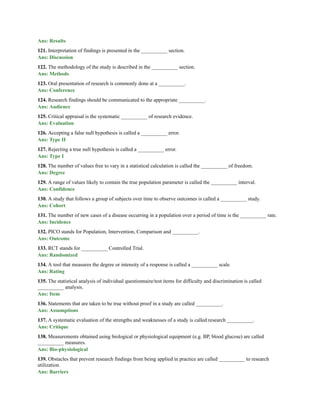
Ans: Results
121. Interpretationof findings is presented in the __________ section.
Ans: Discussion
122. The methodology of the study is described in the __________ section.
Ans: Methods
123. Oral presentation of research is commonly done at a __________.
Ans: Conference
124. Research findings should be communicated to the appropriate __________.
Ans: Audience
125. Critical appraisal is the systematic __________ of research evidence.
Ans: Evaluation
126. Accepting a false null hypothesis is called a __________ error.
Ans: Type II
127. Rejecting a true null hypothesis is called a __________ error.
Ans: Type I
128. The number of values free to vary in a statistical calculation is called the __________ of freedom.
Ans: Degree
129. A range of values likely to contain the true population parameter is called the __________ interval.
Ans: Confidence
130. A study that follows a group of subjects over time to observe outcomes is called a __________ study.
Ans: Cohort
131. The number of new cases of a disease occurring in a population over a period of time is the __________ rate.
Ans: Incidence
132. PICO stands for Population, Intervention, Comparison and __________.
Ans: Outcome
133. RCT stands for __________ Controlled Trial.
Ans: Randomized
134. A tool that measures the degree or intensity of a response is called a __________ scale.
Ans: Rating
135. The statistical analysis of individual questionnaire/test items for difficulty and discrimination is called
__________ analysis.
Ans: Item
136. Statements that are taken to be true without proof in a study are called __________.
Ans: Assumptions
137. A systematic evaluation of the strengths and weaknesses of a study is called research __________.
Ans: Critique
138. Measurements obtained using biological or physiological equipment (e.g. BP, blood glucose) are called
__________ measures.
Ans: Bio-physiological
139. Obstacles that prevent research findings from being applied in practice are called __________ to research
utilization.
Ans: Barriers
8.
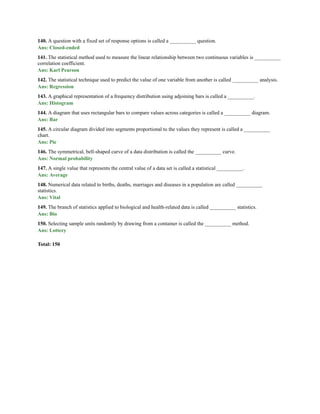
140. A questionwith a fixed set of response options is called a __________ question.
Ans: Closed-ended
141. The statistical method used to measure the linear relationship between two continuous variables is __________
correlation coefficient.
Ans: Karl Pearson
142. The statistical technique used to predict the value of one variable from another is called __________ analysis.
Ans: Regression
143. A graphical representation of a frequency distribution using adjoining bars is called a __________.
Ans: Histogram
144. A diagram that uses rectangular bars to compare values across categories is called a __________ diagram.
Ans: Bar
145. A circular diagram divided into segments proportional to the values they represent is called a __________
chart.
Ans: Pie
146. The symmetrical, bell-shaped curve of a data distribution is called the __________ curve.
Ans: Normal probability
147. A single value that represents the central value of a data set is called a statistical __________.
Ans: Average
148. Numerical data related to births, deaths, marriages and diseases in a population are called __________
statistics.
Ans: Vital
149. The branch of statistics applied to biological and health-related data is called __________ statistics.
Ans: Bio
150. Selecting sample units randomly by drawing from a container is called the __________ method.
Ans: Lottery
Total: 150