PREPARED BY
Prof. ASHISH N. UMALE
M. PHARM IN PHARMACOLOGY
ASSISTANT PROFESSOR
SHRADDHA INSTITUTE OF PHARMACY, WASHIM-
444505
PHARMACOLOGY-I
Neurohumoral Transmission in CNS
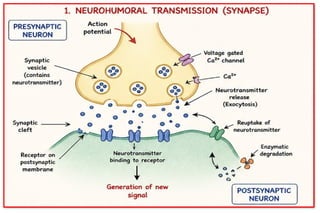
Neurohumoral transmission is the process by which nerve cells
(neurons) communicate with each other using chemical substances called
neurotransmitters.
In the central nervous system (CNS), this communication takes place at
specialized junctions known as synapses.
In simple terms, when a neuron wants to send a message, it converts an
electrical signal into a chemical signal.
This chemical signal crosses a small gap between neurons and then
again becomes an electrical signal in the next neuron, producing a
response.
Steps of Neurotransmission
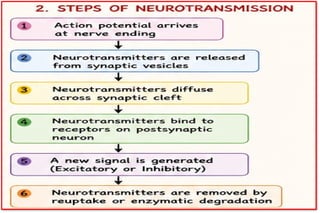
When an electrical signal, called an action potential, reaches the nerve
terminal, it triggers the release of neurotransmitters stored in synaptic
vesicles.
These neurotransmitters are released into the synaptic cleft (the gap
between two neurons).
They then diffuse across this gap and bind to specific receptors present
on the postsynaptic neuron.
This binding leads to the generation of a new electrical signal, which
can either stimulate (excitatory) or suppress (inhibitory) the activity of
the next neuron.
Finally, the neurotransmitters are removed from the synaptic cleft
either by reuptake into the presynaptic neuron or by enzymatic
degradation.
This step is important to terminate the signal and maintain proper
balance in the CNS.
Types of Neurotransmitters in CNS
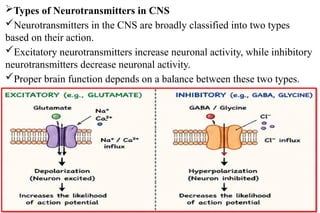
Neurotransmitters in the CNS are broadly classified into two types
based on their action.
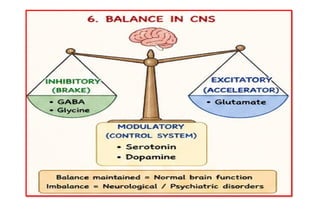
Excitatory neurotransmitters increase neuronal activity, while inhibitory
neurotransmitters decrease neuronal activity.
Proper brain function depends on a balance between these two types.
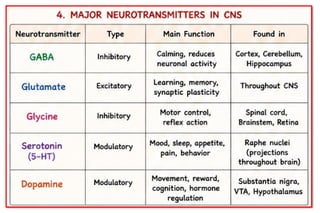
1. GABA (Gamma-Aminobutyric Acid)
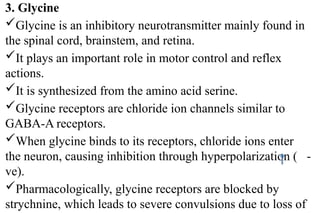
GABA is the major inhibitory neurotransmitter in the CNS and is
widely distributed in areas such as the cerebral cortex, cerebellum,
and hippocampus.
Its main function is to reduce excessive neuronal activity and
maintain a calming effect on the brain.
GABA is synthesized from glutamate by the enzyme glutamic
acid decarboxylase (GAD) in the presence of vitamin B6.
A deficiency of vitamin B6 can reduce GABA synthesis and may
lead to seizures.
GABA acts through two types of receptors:
GABA-A and GABA-B.
The GABA-A receptor is ionotropic and produces fast inhibition
by allowing chloride ions to enter the neuron.
The GABA-B receptor is metabotropic and produces slower,
prolonged inhibitory effects by affecting potassium and calcium
channels.
When GABA binds to its receptor, chloride ions enter the
neuron, causing hyperpolarization.
This makes the neuron less likely to generate an action
potential.
Pharmacologically, GABA is very important.
Drugs like benzodiazepines (e.g., diazepam) and barbiturates
enhance GABA activity and are used in anxiety, epilepsy,
insomnia, and muscle spasms.
Reduced GABA levels are associated with conditions like
anxiety and epilepsy.
2. Glutamate
Glutamate is the principal excitatory neurotransmitter in the CNS and
plays a major role in learning, memory, and synaptic plasticity.
It is synthesized from glucose metabolism or from glutamine by the
enzyme glutaminase.
Glutamate acts on both ionotropic receptors (Faster) (NMDA, AMPA,
and kainate) and metabotropic receptors (Slower)
When glutamate binds to its receptors, it causes the influx of sodium and
calcium ions into the neuron, leading to depolarization and excitation.
Glutamate has important pharmacological roles.
NMDA receptor antagonists such as ketamine and memantine are used in
anesthesia and in conditions like Alzheimer’s disease.
However, excessive glutamate activity can lead to excitotoxicity, where
excessive calcium entry damages neurons.
This is commonly seen in stroke, epilepsy, and neurodegenerative
diseases.
3. Glycine
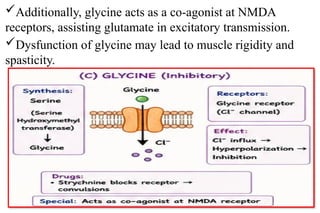
Glycine is an inhibitory neurotransmitter mainly found in
the spinal cord, brainstem, and retina.
It plays an important role in motor control and reflex
actions.
It is synthesized from the amino acid serine.
Glycine receptors are chloride ion channels similar to
GABA-A receptors.
When glycine binds to its receptors, chloride ions enter
the neuron, causing inhibition through hyperpolarization ( -
ve).
Pharmacologically, glycine receptors are blocked by
strychnine, which leads to severe convulsions due to loss of
Additionally, glycine acts as a co-agonist at NMDA
receptors, assisting glutamate in excitatory transmission.
Dysfunction of glycine may lead to muscle rigidity and
spasticity.
4. Serotonin (5-HT)
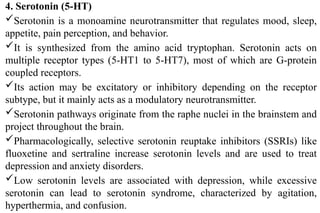
Serotonin is a monoamine neurotransmitter that regulates mood, sleep,
appetite, pain perception, and behavior.
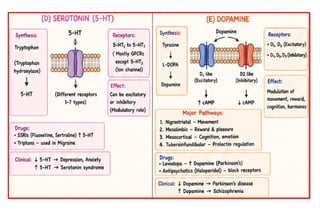
It is synthesized from the amino acid tryptophan. Serotonin acts on
multiple receptor types (5-HT1 to 5-HT7), most of which are G-protein
coupled receptors.
Its action may be excitatory or inhibitory depending on the receptor
subtype, but it mainly acts as a modulatory neurotransmitter.
Serotonin pathways originate from the raphe nuclei in the brainstem and
project throughout the brain.
Pharmacologically, selective serotonin reuptake inhibitors (SSRIs) like
fluoxetine and sertraline increase serotonin levels and are used to treat
depression and anxiety disorders.
Low serotonin levels are associated with depression, while excessive
serotonin can lead to serotonin syndrome, characterized by agitation,
hyperthermia, and confusion.
5. Dopamine
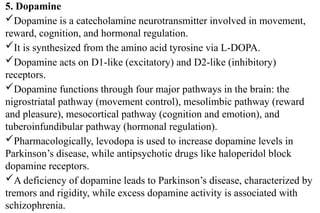
Dopamine is a catecholamine neurotransmitter involved in movement,
reward, cognition, and hormonal regulation.
It is synthesized from the amino acid tyrosine via L-DOPA.
Dopamine acts on D1-like (excitatory) and D2-like (inhibitory)
receptors.

Dopamine functions through four major pathways in the brain: the
nigrostriatal pathway (movement control), mesolimbic pathway (reward
and pleasure), mesocortical pathway (cognition and emotion), and
tuberoinfundibular pathway (hormonal regulation).
Pharmacologically, levodopa is used to increase dopamine levels in
Parkinson’s disease, while antipsychotic drugs like haloperidol block
dopamine receptors.
A deficiency of dopamine leads to Parkinson’s disease, characterized by
tremors and rigidity, while excess dopamine activity is associated with
schizophrenia.
Nurohumoral Transmission in the CNS.pptx