Numerical Analysis and Design of Vehicle Chassis and Frames in Mechanical Engineering
Detailed numerical problems on vehicle frame load calculations, stress analysis, material selection, and fuel efficiency improvements for mechanical engineering students.
This presentation covers the solved problems for practicing on automobile chassis and frames.
Numerical Analysis and Design of Vehicle Chassis and Frames in Mechanical Engineering
1.
Sanjivani Rural EducationSociety’s
Sanjivani College of Engineering, Kopargaon-423603
(An Autonomous Institute Affiliated to Savitribai Phule Pune University, Pune)
NAAC ‘A’ Grade Accredited, ISO 9001:2015 Certified
Department of Mechanical Engineering
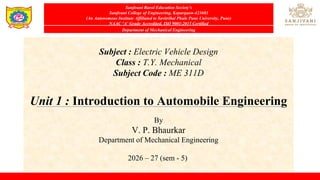
Subject : Electric Vehicle Design
Class : T.Y. Mechanical
Subject Code : ME 311D
Unit 1 : Introduction to Automobile Engineering
By
V. P. Bhaurkar
Department of Mechanical Engineering
2026 – 27 (sem - 5)
2.
V. P. BhaurkarAI and ML (T. Y. Mechanical)
Numerical Treatment on Chassis and Frame
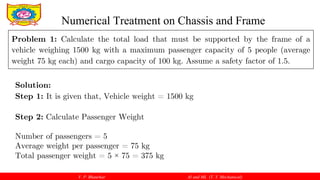
Problem 1: Calculate the total load that must be supported by the frame of a
vehicle weighing 1500 kg with a maximum passenger capacity of 5 people (average
weight 75 kg each) and cargo capacity of 100 kg. Assume a safety factor of 1.5.
Solution:
Step 1: It is given that, Vehicle weight = 1500 kg
Step 2: Calculate Passenger Weight
Number of passengers = 5
Average weight per passenger = 75 kg
Total passenger weight = 5 × 75 = 375 kg
3.
V. P. BhaurkarAI and ML (T. Y. Mechanical)
Numerical Treatment on Chassis and Frame
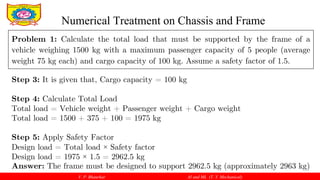
Step 3: It is given that, Cargo capacity = 100 kg
Step 4: Calculate Total Load
Total load = Vehicle weight + Passenger weight + Cargo weight
Total load = 1500 + 375 + 100 = 1975 kg
Step 5: Apply Safety Factor
Design load = Total load × Safety factor
Design load = 1975 × 1.5 = 2962.5 kg
Answer: The frame must be designed to support 2962.5 kg (approximately 2963 kg)
Problem 1: Calculate the total load that must be supported by the frame of a
vehicle weighing 1500 kg with a maximum passenger capacity of 5 people (average
weight 75 kg each) and cargo capacity of 100 kg. Assume a safety factor of 1.5.
4.
V. P. BhaurkarAI and ML (T. Y. Mechanical)
Numerical Treatment on Chassis and Frame
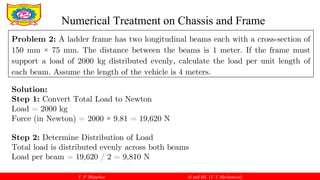
Solution:
Step 1: Convert Total Load to Newton
Load = 2000 kg
Force (in Newton) = 2000 × 9.81 = 19,620 N
Step 2: Determine Distribution of Load
Total load is distributed evenly across both beams
Load per beam = 19,620 / 2 = 9,810 N
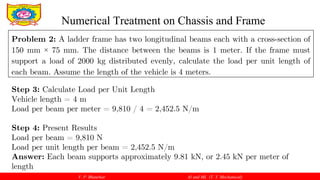
Problem 2: A ladder frame has two longitudinal beams each with a cross-section of
150 mm × 75 mm. The distance between the beams is 1 meter. If the frame must
support a load of 2000 kg distributed evenly, calculate the load per unit length of
each beam. Assume the length of the vehicle is 4 meters.
5.
V. P. BhaurkarAI and ML (T. Y. Mechanical)
Numerical Treatment on Chassis and Frame
Step 3: Calculate Load per Unit Length
Vehicle length = 4 m
Load per beam per meter = 9,810 / 4 = 2,452.5 N/m
Step 4: Present Results
Load per beam = 9,810 N
Load per unit length per beam = 2,452.5 N/m
Answer: Each beam supports approximately 9.81 kN, or 2.45 kN per meter of
length
Problem 2: A ladder frame has two longitudinal beams each with a cross-section of
150 mm × 75 mm. The distance between the beams is 1 meter. If the frame must
support a load of 2000 kg distributed evenly, calculate the load per unit length of
each beam. Assume the length of the vehicle is 4 meters.
6.
V. P. BhaurkarAI and ML (T. Y. Mechanical)
Numerical Treatment on Chassis and Frame
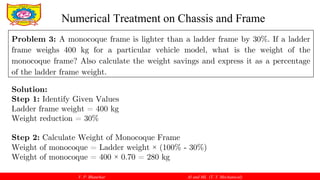
Solution:
Step 1: Identify Given Values
Ladder frame weight = 400 kg
Weight reduction = 30%
Step 2: Calculate Weight of Monocoque Frame
Weight of monocoque = Ladder weight × (100% - 30%)
Weight of monocoque = 400 × 0.70 = 280 kg
Problem 3: A monocoque frame is lighter than a ladder frame by 30%. If a ladder
frame weighs 400 kg for a particular vehicle model, what is the weight of the
monocoque frame? Also calculate the weight savings and express it as a percentage
of the ladder frame weight.
7.
V. P. BhaurkarAI and ML (T. Y. Mechanical)
Numerical Treatment on Chassis and Frame
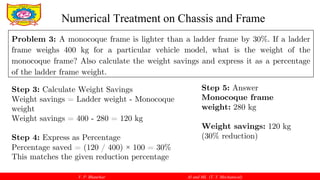
Step 3: Calculate Weight Savings
Weight savings = Ladder weight - Monocoque
weight
Weight savings = 400 - 280 = 120 kg
Step 4: Express as Percentage
Percentage saved = (120 / 400) × 100 = 30%
This matches the given reduction percentage
Problem 3: A monocoque frame is lighter than a ladder frame by 30%. If a ladder
frame weighs 400 kg for a particular vehicle model, what is the weight of the
monocoque frame? Also calculate the weight savings and express it as a percentage
of the ladder frame weight.
Step 5: Answer
Monocoque frame
weight: 280 kg
Weight savings: 120 kg
(30% reduction)
8.
V. P. BhaurkarAI and ML (T. Y. Mechanical)
Numerical Treatment on Chassis and Frame
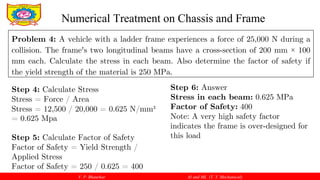
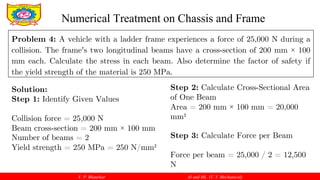
Solution:
Step 1: Identify Given Values
Collision force = 25,000 N
Beam cross-section = 200 mm × 100 mm
Number of beams = 2
Yield strength = 250 MPa = 250 N/mm²
Problem 4: A vehicle with a ladder frame experiences a force of 25,000 N during a
collision. The frame's two longitudinal beams have a cross-section of 200 mm × 100
mm each. Calculate the stress in each beam. Also determine the factor of safety if
the yield strength of the material is 250 MPa.
Step 2: Calculate Cross-Sectional Area
of One Beam
Area = 200 mm × 100 mm = 20,000
mm²
Step 3: Calculate Force per Beam
Force per beam = 25,000 / 2 = 12,500
N
9.
V. P. BhaurkarAI and ML (T. Y. Mechanical)
Numerical Treatment on Chassis and Frame
Step 4: Calculate Stress
Stress = Force / Area
Stress = 12,500 / 20,000 = 0.625 N/mm²
= 0.625 Mpa
Step 5: Calculate Factor of Safety
Factor of Safety = Yield Strength /
Applied Stress
Factor of Safety = 250 / 0.625 = 400
Problem 4: A vehicle with a ladder frame experiences a force of 25,000 N during a
collision. The frame's two longitudinal beams have a cross-section of 200 mm × 100
mm each. Calculate the stress in each beam. Also determine the factor of safety if
the yield strength of the material is 250 MPa.
Step 6: Answer
Stress in each beam: 0.625 MPa
Factor of Safety: 400
Note: A very high safety factor
indicates the frame is over-designed for
this load
10.
V. P. BhaurkarAI and ML (T. Y. Mechanical)
Numerical Treatment on Chassis and Frame
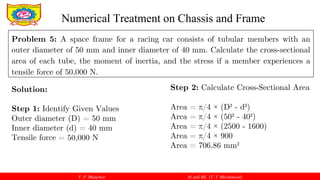
Solution:
Step 1: Identify Given Values
Outer diameter (D) = 50 mm
Inner diameter (d) = 40 mm
Tensile force = 50,000 N
Problem 5: A space frame for a racing car consists of tubular members with an
outer diameter of 50 mm and inner diameter of 40 mm. Calculate the cross-sectional
area of each tube, the moment of inertia, and the stress if a member experiences a
tensile force of 50,000 N.
Step 2: Calculate Cross-Sectional Area
Area = π/4 × (D² - d²)
Area = π/4 × (50² - 40²)
Area = π/4 × (2500 - 1600)
Area = π/4 × 900
Area = 706.86 mm²
11.
V. P. BhaurkarAI and ML (T. Y. Mechanical)
Numerical Treatment on Chassis and Frame
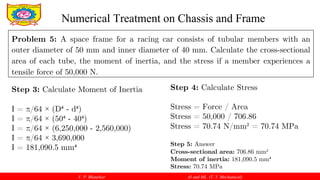
Step 3: Calculate Moment of Inertia
I = π/64 × (D⁴ - d⁴)
I = π/64 × (50⁴ - 40⁴)
I = π/64 × (6,250,000 - 2,560,000)
I = π/64 × 3,690,000
I = 181,090.5 mm⁴
Problem 5: A space frame for a racing car consists of tubular members with an
outer diameter of 50 mm and inner diameter of 40 mm. Calculate the cross-sectional
area of each tube, the moment of inertia, and the stress if a member experiences a
tensile force of 50,000 N.
Step 4: Calculate Stress
Stress = Force / Area
Stress = 50,000 / 706.86
Stress = 70.74 N/mm² = 70.74 MPa
Step 5: Answer
Cross-sectional area: 706.86 mm²
Moment of inertia: 181,090.5 mm⁴
Stress: 70.74 MPa
12.
V. P. BhaurkarAI and ML (T. Y. Mechanical)
Numerical Treatment on Chassis and Frame
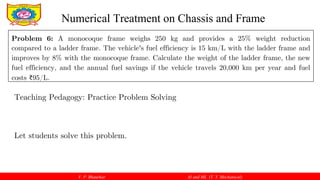
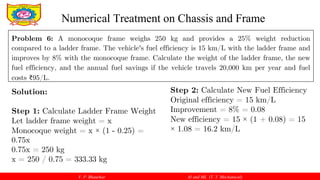
Problem 6: A monocoque frame weighs 250 kg and provides a 25% weight reduction
compared to a ladder frame. The vehicle's fuel efficiency is 15 km/L with the ladder frame and
improves by 8% with the monocoque frame. Calculate the weight of the ladder frame, the new
fuel efficiency, and the annual fuel savings if the vehicle travels 20,000 km per year and fuel
costs ₹95/L.
Teaching Pedagogy: Practice Problem Solving
Let students solve this problem.
13.
V. P. BhaurkarAI and ML (T. Y. Mechanical)
Numerical Treatment on Chassis and Frame
Solution:
Step 1: Calculate Ladder Frame Weight
Let ladder frame weight = x
Monocoque weight = x × (1 - 0.25) =
0.75x
0.75x = 250 kg
x = 250 / 0.75 = 333.33 kg
Problem 6: A monocoque frame weighs 250 kg and provides a 25% weight reduction
compared to a ladder frame. The vehicle's fuel efficiency is 15 km/L with the ladder frame and
improves by 8% with the monocoque frame. Calculate the weight of the ladder frame, the new
fuel efficiency, and the annual fuel savings if the vehicle travels 20,000 km per year and fuel
costs ₹95/L.
Step 2: Calculate New Fuel Efficiency
Original efficiency = 15 km/L
Improvement = 8% = 0.08
New efficiency = 15 × (1 + 0.08) = 15
× 1.08 = 16.2 km/L
14.
V. P. BhaurkarAI and ML (T. Y. Mechanical)
Numerical Treatment on Chassis and Frame
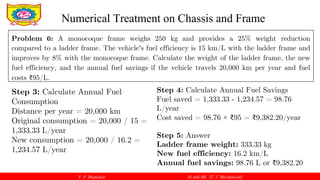
Step 3: Calculate Annual Fuel
Consumption
Distance per year = 20,000 km
Original consumption = 20,000 / 15 =
1,333.33 L/year
New consumption = 20,000 / 16.2 =
1,234.57 L/year
Problem 6: A monocoque frame weighs 250 kg and provides a 25% weight reduction
compared to a ladder frame. The vehicle's fuel efficiency is 15 km/L with the ladder frame and
improves by 8% with the monocoque frame. Calculate the weight of the ladder frame, the new
fuel efficiency, and the annual fuel savings if the vehicle travels 20,000 km per year and fuel
costs ₹95/L.
Step 4: Calculate Annual Fuel Savings
Fuel saved = 1,333.33 - 1,234.57 = 98.76
L/year
Cost saved = 98.76 × ₹95 = ₹9,382.20/year
Step 5: Answer
Ladder frame weight: 333.33 kg
New fuel efficiency: 16.2 km/L
Annual fuel savings: 98.76 L or ₹9,382.20
15.
V. P. BhaurkarAI and ML (T. Y. Mechanical)
Numerical Treatment on Chassis and Frame
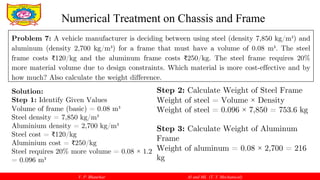
Solution:
Step 1: Identify Given Values
Volume of frame (basic) = 0.08 m³
Steel density = 7,850 kg/m³
Aluminium density = 2,700 kg/m³
Steel cost = ₹120/kg
Aluminium cost = ₹250/kg
Steel requires 20% more volume = 0.08 × 1.2
= 0.096 m³
Problem 7: A vehicle manufacturer is deciding between using steel (density 7,850 kg/m³) and
aluminum (density 2,700 kg/m³) for a frame that must have a volume of 0.08 m³. The steel
frame costs ₹120/kg and the aluminum frame costs ₹250/kg. The steel frame requires 20%
more material volume due to design constraints. Which material is more cost-effective and by
how much? Also calculate the weight difference.
Step 2: Calculate Weight of Steel Frame
Weight of steel = Volume × Density
Weight of steel = 0.096 × 7,850 = 753.6 kg
Step 3: Calculate Weight of Aluminum
Frame
Weight of aluminum = 0.08 × 2,700 = 216
kg
16.
V. P. BhaurkarAI and ML (T. Y. Mechanical)
Numerical Treatment on Chassis and Frame
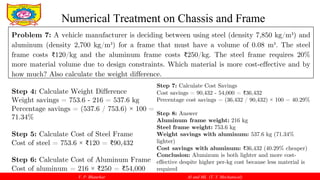
Step 4: Calculate Weight Difference
Weight savings = 753.6 - 216 = 537.6 kg
Percentage savings = (537.6 / 753.6) × 100 =
71.34%
Step 5: Calculate Cost of Steel Frame
Cost of steel = 753.6 × ₹120 = ₹90,432
Step 6: Calculate Cost of Aluminum Frame
Cost of aluminum = 216 × ₹250 = ₹54,000
Problem 7: A vehicle manufacturer is deciding between using steel (density 7,850 kg/m³) and
aluminum (density 2,700 kg/m³) for a frame that must have a volume of 0.08 m³. The steel
frame costs ₹120/kg and the aluminum frame costs ₹250/kg. The steel frame requires 20%
more material volume due to design constraints. Which material is more cost-effective and by
how much? Also calculate the weight difference.
Step 7: Calculate Cost Savings
Cost savings = 90,432 - 54,000 = ₹36,432
Percentage cost savings = (36,432 / 90,432) × 100 = 40.29%
Step 8: Answer
Aluminum frame weight: 216 kg
Steel frame weight: 753.6 kg
Weight savings with aluminum: 537.6 kg (71.34%
lighter)
Cost savings with aluminum: ₹36,432 (40.29% cheaper)
Conclusion: Aluminum is both lighter and more cost-
effective despite higher per-kg cost because less material is
required
17.
V. P. BhaurkarAI and ML (T. Y. Mechanical)
Numerical Treatment on Chassis and Frame
Solution:
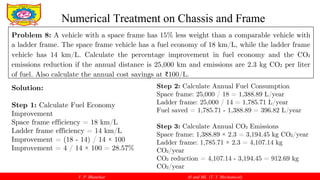
Step 1: Calculate Fuel Economy
Improvement
Space frame efficiency = 18 km/L
Ladder frame efficiency = 14 km/L
Improvement = (18 - 14) / 14 × 100
Improvement = 4 / 14 × 100 = 28.57%
Problem 8: A vehicle with a space frame has 15% less weight than a comparable vehicle with
a ladder frame. The space frame vehicle has a fuel economy of 18 km/L, while the ladder frame
vehicle has 14 km/L. Calculate the percentage improvement in fuel economy and the CO₂
emissions reduction if the annual distance is 25,000 km and emissions are 2.3 kg CO₂ per liter
of fuel. Also calculate the annual cost savings at ₹100/L.
Step 2: Calculate Annual Fuel Consumption
Space frame: 25,000 / 18 = 1,388.89 L/year
Ladder frame: 25,000 / 14 = 1,785.71 L/year
Fuel saved = 1,785.71 - 1,388.89 = 396.82 L/year
Step 3: Calculate Annual CO₂ Emissions
Space frame: 1,388.89 × 2.3 = 3,194.45 kg CO₂/year
Ladder frame: 1,785.71 × 2.3 = 4,107.14 kg
CO₂/year
CO₂ reduction = 4,107.14 - 3,194.45 = 912.69 kg
CO₂/year
18.
V. P. BhaurkarAI and ML (T. Y. Mechanical)
Numerical Treatment on Chassis and Frame
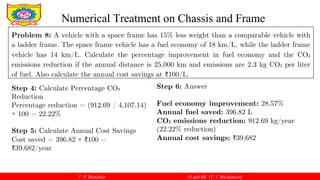
Step 4: Calculate Percentage CO₂
Reduction
Percentage reduction = (912.69 / 4,107.14)
× 100 = 22.22%
Step 5: Calculate Annual Cost Savings
Cost saved = 396.82 × ₹100 =
₹39,682/year
Problem 8: A vehicle with a space frame has 15% less weight than a comparable vehicle with
a ladder frame. The space frame vehicle has a fuel economy of 18 km/L, while the ladder frame
vehicle has 14 km/L. Calculate the percentage improvement in fuel economy and the CO₂
emissions reduction if the annual distance is 25,000 km and emissions are 2.3 kg CO₂ per liter
of fuel. Also calculate the annual cost savings at ₹100/L.
Step 6: Answer
Fuel economy improvement: 28.57%
Annual fuel saved: 396.82 L
CO₂ emissions reduction: 912.69 kg/year
(22.22% reduction)
Annual cost savings: ₹39,682
19.
V. P. BhaurkarAI and ML (T. Y. Mechanical)
Numerical Treatment on Chassis and Frame
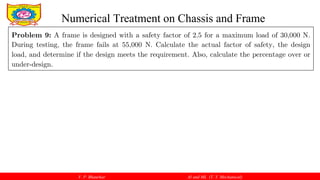
Problem 9: A frame is designed with a safety factor of 2.5 for a maximum load of 30,000 N.
During testing, the frame fails at 55,000 N. Calculate the actual factor of safety, the design
load, and determine if the design meets the requirement. Also, calculate the percentage over or
under-design.
20.
V. P. BhaurkarAI and ML (T. Y. Mechanical)
Numerical Treatment on Chassis and Frame
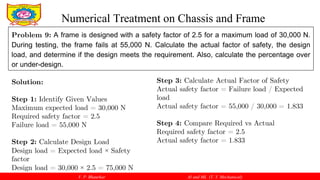
Solution:
Step 1: Identify Given Values
Maximum expected load = 30,000 N
Required safety factor = 2.5
Failure load = 55,000 N
Step 2: Calculate Design Load
Design load = Expected load × Safety
factor
Design load = 30,000 × 2.5 = 75,000 N
Problem 9: A frame is designed with a safety factor of 2.5 for a maximum load of 30,000 N.
During testing, the frame fails at 55,000 N. Calculate the actual factor of safety, the design
load, and determine if the design meets the requirement. Also, calculate the percentage over
or under-design.
Step 3: Calculate Actual Factor of Safety
Actual safety factor = Failure load / Expected
load
Actual safety factor = 55,000 / 30,000 = 1.833
Step 4: Compare Required vs Actual
Required safety factor = 2.5
Actual safety factor = 1.833
 Most read
 Most read
 Most read