North Carolina's 2 Million by 2030: Workforce Credentials and Educational Attainment Strategy
Overview of North Carolina's plan to meet 2030 educational goals through unified workforce credential lists, employer validation, and funding alignment to close skill gaps and boost non-degree and degree attainment.
North Carolina's 2 Million by 2030: Workforce Credentials and Educational Attainment Strategy
1.
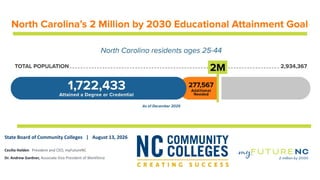
North Carolina’s 2Million by 2030 Educational Attainment Goal
State Board of Community Colleges | August 13, 2026
Cecilia Holden President and CEO, myFutureNC
Dr. Andrew Gardner, Associate Vice President of Workforce
2.
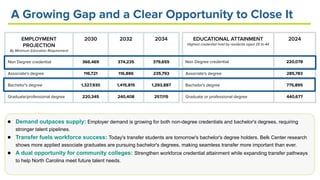
A Growing Gapand a Clear Opportunity to Close It
EMPLOYMENT
PROJECTION
By Minimum Education Requirement
2030 2032 2034
Non Degree credential 366,469 374,235 379,655
Associate's degree 116,721 116,886 235,793
Bachelor's degree 1,327,930 1,415,815 1,293,887
Graduate/professional degree 220,345 240,408 257,115
EDUCATIONAL ATTAINMENT
Highest credential hold by residents aged 25 to 44
2024
Non Degree credential 220,078
Associate's degree 285,783
Bachelor's degree 775,895
Graduate or professional degree 440,677
● Demand outpaces supply: Employer demand is growing for both non-degree credentials and bachelor's degrees, requiring
stronger talent pipelines.
● Transfer fuels workforce success: Today's transfer students are tomorrow's bachelor's degree holders. Belk Center research
shows more applied associate graduates are pursuing bachelor's degrees, making seamless transfer more important than ever.
● A dual opportunity for community colleges: Strengthen workforce credential attainment while expanding transfer pathways
to help North Carolina meet future talent needs.
3.
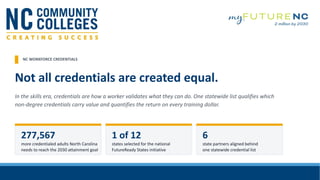
NC WORKFORCE CREDENTIALS
Notall credentials are created equal.
In the skills era, credentials are how a worker validates what they can do. One statewide list qualifies which
non-degree credentials carry value and quantifies the return on every training dollar.
277,567
more credentialed adults North Carolina
needs to reach the 2030 attainment goal
1 of 12
states selected for the national
FutureReady States initiative
6
state partners aligned behind
one statewide credential list
4.
NC Workforce Credentials| State Board | August 13, 2026
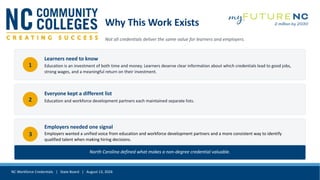
Why This Work Exists
Not all credentials deliver the same value for learners and employers.
1
Learners need to know
Education is an investment of both time and money. Learners deserve clear information about which credentials lead to good jobs,
strong wages, and a meaningful return on their investment.
2
Everyone kept a different list
Education and workforce development partners each maintained separate lists.
3
Employers needed one signal
Employers wanted a unified voice from education and workforce development partners and a more consistent way to identify
qualified talent when making hiring decisions.
North Carolina defined what makes a non-degree credential valuable.
5.
NC Workforce Credentials| State Board | August 13, 2026
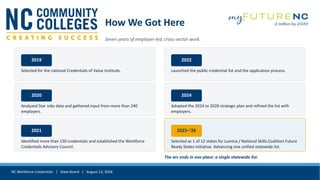
How We Got Here
Seven years of employer-led, cross-sector work.
2019
Selected for the national Credentials of Value Institute.
2020
Analyzed Star Jobs data and gathered input from more than 240
employers.
2021
Identified more than 150 credentials and established the Workforce
Credentials Advisory Council.
2022
Launched the public credential list and the application process.
2024
Adopted the 2024 to 2028 strategic plan and refined the list with
employers.
2025–’26
Selected as 1 of 12 states for Lumina / National Skills Coalition Future
Ready States Initiative. Advancing one unified statewide list.
The arc ends in one place: a single statewide list.
6.
NC Workforce Credentials| State Board | August 13, 2026
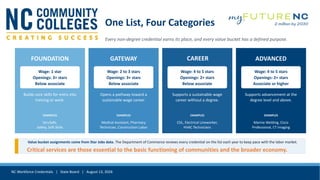
One List, Four Categories
Every non-degree credential earns its place, and every value bucket has a defined purpose.
FOUNDATION
Wage: 1 star
Openings: 3+ stars
Below associate
Builds core skills for entry into
training or work.
EXAMPLES
ServSafe,
Safety, Soft Skills
GATEWAY
Wage: 2 to 3 stars
Openings: 3+ stars
Below associate
Opens a pathway toward a
sustainable wage career.
EXAMPLES
Medical Assistant, Pharmacy
Technician, Construction Labor
CAREER
Wage: 4 to 5 stars
Openings: 2+ stars
Below associate
Supports a sustainable wage
career without a degree.
EXAMPLES
CDL, Electrical Lineworker,
HVAC Technicians
ADVANCED
Wage: 4 to 5 stars
Openings: 2+ stars
Associate or higher
Supports advancement at the
degree level and above.
EXAMPLES
Marine Welding, Cisco
Professional, CT Imaging
Value bucket assignments come from Star Jobs data. The Department of Commerce reviews every credential on the list each year to keep pace with the labor market.
Critical services are those essential to the basic functioning of communities and the broader economy.
7.
NC Workforce Credentials| State Board | August 13, 2026
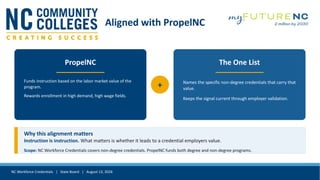
Aligned with PropelNC
PropelNC
Funds instruction based on the labor market value of the
program.
Rewards enrollment in high demand, high wage fields.
+
The One List
Names the specific non-degree credentials that carry that
value.
Keeps the signal current through employer validation.
Why this alignment matters
Instruction is instruction. What matters is whether it leads to a credential employers value.
Scope: NC Workforce Credentials covers non-degree credentials. PropelNC funds both degree and non-degree programs.
8.
NC Workforce Credentials| State Board | August 13, 2026
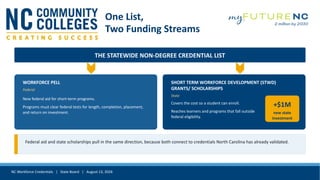
One List,
Two Funding Streams
THE STATEWIDE NON-DEGREE CREDENTIAL LIST
WORKFORCE PELL
Federal
New federal aid for short-term programs.
Programs must clear federal tests for length, completion, placement,
and return on investment.
SHORT TERM WORKFORCE DEVELOPMENT (STWD)
GRANTS/ SCHOLARSHIPS
State
Covers the cost so a student can enroll.
Reaches learners and programs that fall outside
federal eligibility.
+$1M
new state
investment
Federal aid and state scholarships pull in the same direction, because both connect to credentials North Carolina has already validated.
9.
NC Workforce Credentials| State Board | August 13, 2026
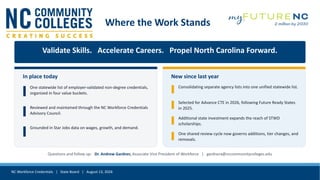
Where the Work Stands
Validate Skills. Accelerate Careers. Propel North Carolina Forward.
In place today
One statewide list of employer-validated non-degree credentials,
organized in four value buckets.
Reviewed and maintained through the NC Workforce Credentials
Advisory Council.
Grounded in Star Jobs data on wages, growth, and demand.
New since last year
Consolidating separate agency lists into one unified statewide list.
Selected for Advance CTE in 2026, following Future Ready States
in 2025.
Additional state investment expands the reach of STWD
scholarships.
One shared review cycle now governs additions, tier changes, and
removals.
Questions and follow up: Dr. Andrew Gardner, Associate Vice President of Workforce | gardnera@nccommunitycolleges.edu