New Beginnings: Cities and
States
This presentation explores the Second Urbanisation of India, examining the rise
of janapadas and mahjanapadas as crucial developments in India's early
history.
by sandeep swamy
The Second Urbanisation
Urban Revival
The emergence of new cities after
the decline of the Indus Valley
Civilization.
Historical Timeline
Occurred approximately between
600-200 BCE in the Gangetic plains.
New Settlements
Formation of organized urban
centers with political and economic
significance.
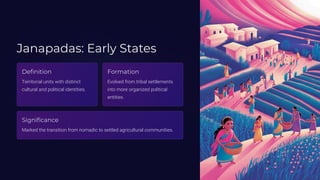
Janapadas: Early States
Definition
Territorial units with distinct
cultural and political identities.
Formation
Evolved from tribal settlements
into more organized political
entities.
Significance
Marked the transition from nomadic to settled agricultural communities.
Mahjanapadas: Great States
Political Evolution
Larger kingdoms formed through
conquest and alliance of smaller
janapadas.
Social Structure
Complex hierarchical society with
specialized occupations.
Economic Growth
Development of trade networks and
early monetary systems.
Cultural Centers
Hubs of religious and philosophical
developments.
The Sixteen Mahjanapadas
The Buddhist and Jain texts mention sixteen major mahjanapadas that dominated northern India. Each had unique geographical
features and resources.
Magadha: The Powerful Kingdom
Strategic Location
Situated in modern-day Bihar with natural
defenses of hills and rivers.
Access to iron ore deposits gave military
advantage.
Capital Cities
Rjagr#iha (Rajgir) served as the initial
capital.
Later shifted to Pt #aliputra (modern
Patna).
Ruins of a major structure at Rjagr#iha,
the early capital of Magadha.

Systems of Governance
Monarchies
Hereditary kingship with centralized authority.
Ga_a-Sa_ghas
Oligarchic republics governed by assemblies of elite families.
Administrative Systems
Development of bureaucracy, taxation, and judicial processes.
Kauilya's Ideal Kingdom
Security
Fortified capital and frontier towns for protection.
Resources
Cultivable land, mines, forests, and pastures.
Infrastructure
Good roads, waterways, and water management systems.
Economy
Productive economy with diverse commodities.
Urban Planning
Site Selection
Based on natural defenses, water sources, and trade routes.
Layout Design
Grid patterns with designated areas for different functions.
Fortification
Construction of walls, moats, and watchtowers.
Water Management
Reservoirs, wells, and drainage systems.
Economic Foundations
Agriculture
Advanced farming techniques supporting urban populations.
Crafts Production
Specialized artisans creating goods for trade.
Trade Networks
Extensive commercial connections between regions.
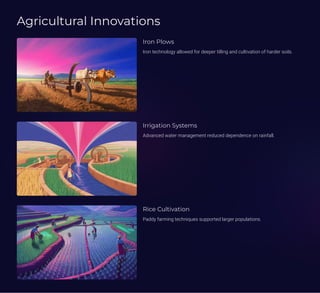
Agricultural Innovations
Iron Plows
Iron technology allowed for deeper tilling and cultivation of harder soils.
Irrigation Systems
Advanced water management reduced dependence on rainfall.
Rice Cultivation
Paddy farming techniques supported larger populations.
Trade and Commerce
Luxury Goods
Precious stones, fine textiles, and
spices.
Animal Trade
Horses, elephants, and other valuable
animals.
Everyday Items
Pottery, tools, and household goods.
Agricultural Products
Grains, cotton, and other farm produce.
Monetary Systems
500
BCE
Approximate date of earliest punch-
marked coins in India.
16
Mahjanapadas
Many issued their own distinctive
coinage.
11
Metals
Different metals used including silver,
copper, and gold.
Social Stratification
0
20
40
60
Brahmins Kshatriyas Vaishyas Shudras
The varna system became more rigid during this period. Social mobility decreased as occupations became more hereditary and
specialized.
Religious Developments
Vedic Traditions
Established rituals and
practices continued but
faced challenges.
Buddhism
Founded by Siddhartha
Gautama, questioning
social hierarchies.
Jainism
Led by Mahavira,
emphasizing non-
violence and
asceticism.
Ajivika
Fatalistic philosophy
founded by Makkhali
Gosala.
Intellectual Ferment
Philosophical Debates
Various schools of thought emerged questioning traditional beliefs.
Educational Centers
Institutions like Taxila became hubs of learning and intellectual
exchange.
Literary Developments
Composition of important texts in philosophy, politics, and
medicine.
Artha[hstra: Political
Science
Author Kaut #ilya (also known as
Chanakya)
Period Around 4th century BCE
Content Statecraft, economic policy,
military strategy
Significance One of the earliest comprehensive
treatises on governance
Defensive Architecture
City Walls
Massive fortifications protected urban
centers from invasion.
Fortified Gates
Controlled access points with multiple
security features.
Moats
Water barriers provided additional
protection against attackers.
Archaeological Evidence
Urban Remains
Excavations reveal city planning with
fortifications and drainage systems.
Sites like Ujjain, Kaushambi, and Rajgir
show sophisticated urban layouts.
Material Culture
Northern Black Polished Ware pottery
marks this period.
Iron implements, coins, and seals provide
insights into daily life.
Ongoing excavations continue to reveal
new aspects of urban centers from this
period.
Legacy and Significance
Political Foundations
Established governance systems that influenced later Indian states.
Economic Networks
Created trade routes and commercial patterns lasting centuries.
Cultural Developments
Fostered religious and philosophical traditions still relevant today.
Urban Traditions
Established patterns of city planning that influenced later
developments.