An in-depth exploration of natural farming in India covering its concepts, historical background, government and ICAR initiatives, success stories, challenges, and comparative analysis with conventional farming.
INDIRA GANDHI KRISHIVISHWAVIDHYALAYA
College of Agriculture Raipur (C. G.)
SESSION – 2024-25
Topic – Natural Farming in Indian agriculture and it’s
advantages and disadvantages
DOCTORAL SEMINAR - I
COURSE No. – AGRON-691
PRESENTED TO –
Dr. G. P. Pali
Department of Agronomy
PRESENTED BY
NEHA NEVENDRA
PhD 1st
year 1st
sem.
Department of Agronomy
2.
List of thecontents
• Natural Farming
• Concept of Natural Farming
• Historical background
• Organic farming v/s Natural Farming
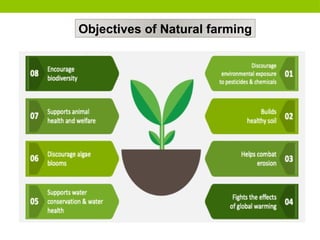
• Objectives of natural farming
• Principles of natural farming
• Current scenario of Natural Farming in India
• Government initiatives
• ICAR initiatives
• Success stories
• Case study
• challenges of natural farming
• Advantages and disadvantages of natural farming
• Conclusion
• References
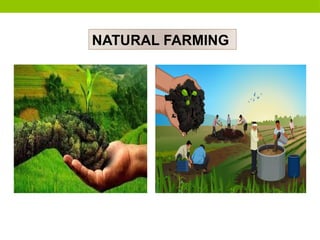
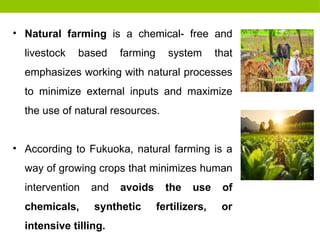
• Natural farmingis a chemical- free and
livestock based farming system that
emphasizes working with natural processes
to minimize external inputs and maximize
the use of natural resources.
• According to Fukuoka, natural farming is a
way of growing crops that minimizes human
intervention and avoids the use of
chemicals, synthetic fertilizers, or
intensive tilling.
5.
• Natural farmingalso called as Do-nothing farming or
No-till farming.
Concept of Natural Farming
Farming is a natural process, rooted in traditional
practices.
Natural Farming focuses on building natural or
ecological conditions that exist in or around the farms. It
based on concept of working with nature rather than
against it.
6.
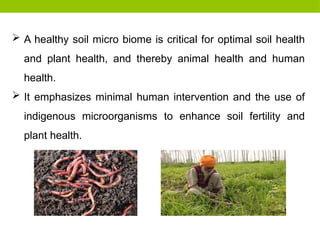
A healthysoil micro biome is critical for optimal soil health
and plant health, and thereby animal health and human
health.
It emphasizes minimal human intervention and the use of
indigenous microorganisms to enhance soil fertility and
plant health.
7.
Historical Background
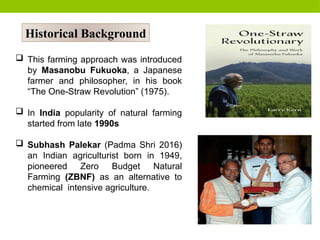
Thisfarming approach was introduced
by Masanobu Fukuoka, a Japanese
farmer and philosopher, in his book
“The One-Straw Revolution” (1975).
In India popularity of natural farming
started from late 1990s
Subhash Palekar (Padma Shri 2016)
an Indian agriculturist born in 1949,
pioneered Zero Budget Natural
Farming (ZBNF) as an alternative to
chemical intensive agriculture.
9.
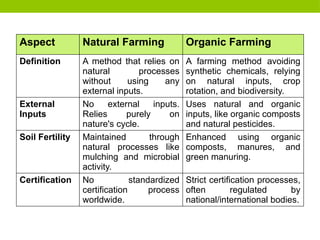
Aspect Natural FarmingOrganic Farming
Definition A method that relies on
natural processes
without using any
external inputs.
A farming method avoiding
synthetic chemicals, relying
on natural inputs, crop
rotation, and biodiversity.
External
Inputs
No external inputs.
Relies purely on
nature's cycle.
Uses natural and organic
inputs, like organic composts
and natural pesticides.
Soil Fertility Maintained through
natural processes like
mulching and microbial
activity.
Enhanced using organic
composts, manures, and
green manuring.
Certification No standardized
certification process
worldwide.
Strict certification processes,
often regulated by
national/international bodies.
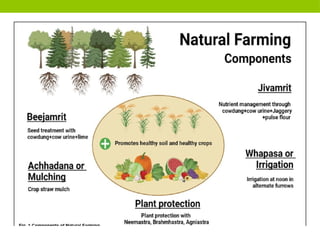
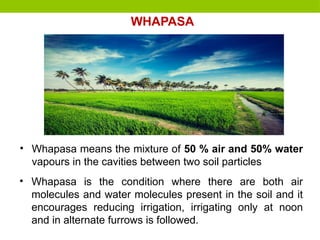
• Whapasa isthe condition where there are both air
molecules and water molecules present in the soil and it
encourages reducing irrigation, irrigating only at noon
and in alternate furrows is followed.
WHAPASA
• Whapasa means the mixture of 50 % air and 50% water
vapours in the cavities between two soil particles
15.
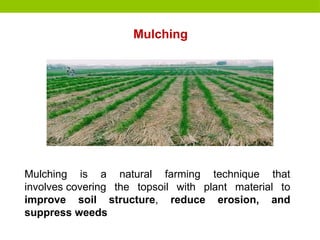
Mulching is anatural farming technique that
involves covering the topsoil with plant material to
improve soil structure, reduce erosion, and
suppress weeds
Mulching
Principles of NaturalFarming
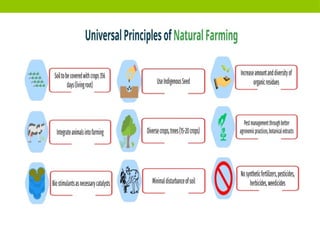
• No-till farming
• Local seeds (use of local varieties)
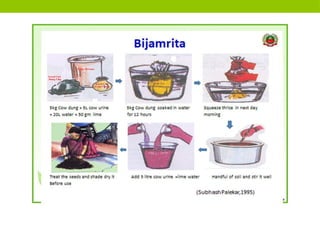
• On-farm produced microbial formulation for seed
treatment (such as bijamrita)
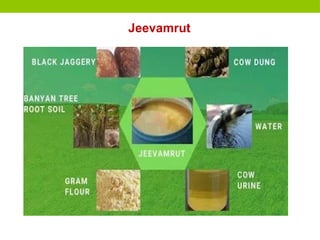
• On-farm made microbial inoculants (Jivamrita) for soil
enrichment
• Cover crops and mulching with green and dry organic
matter for nutrient recycling and for creating a suitable
micro-climate for maximum beneficial microbial activity in
soil.
18.
• Mixed cropping,managing diversity on farm through
integration of trees
• Management of pests through diversity and local on-farm
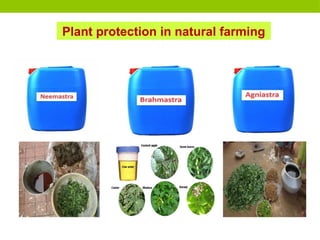
made botanical concoctions (such as neemastra,
agniastra, neem ark, dashparni ark etc);
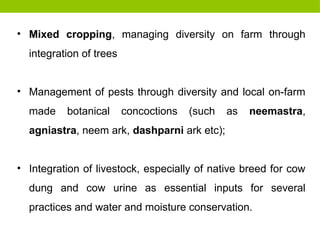
• Integration of livestock, especially of native breed for cow
dung and cow urine as essential inputs for several
practices and water and moisture conservation.
20.
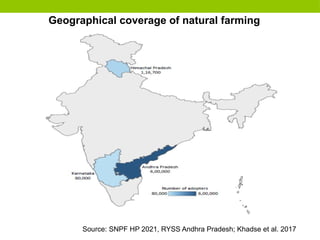
Current Scenario ofNatural Farming in India
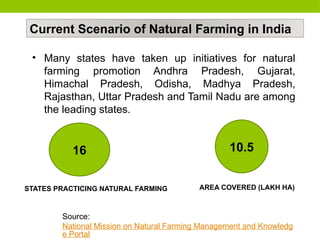
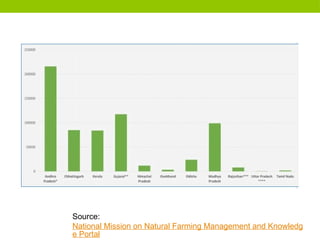
• Many states have taken up initiatives for natural
farming promotion Andhra Pradesh, Gujarat,
Himachal Pradesh, Odisha, Madhya Pradesh,
Rajasthan, Uttar Pradesh and Tamil Nadu are among
the leading states.
16 10.5
STATES PRACTICING NATURAL FARMING AREA COVERED (LAKH HA)
Source:
National Mission on Natural Farming Management and Knowledg
e Portal
Geographical coverage ofnatural farming
Source: SNPF HP 2021, RYSS Andhra Pradesh; Khadse et al. 2017
23.
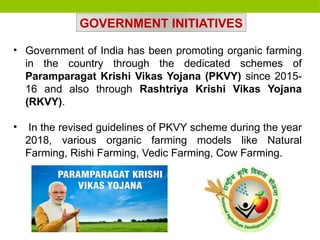
• Government ofIndia has been promoting organic farming
in the country through the dedicated schemes of
Paramparagat Krishi Vikas Yojana (PKVY) since 2015-
16 and also through Rashtriya Krishi Vikas Yojana
(RKVY).
• In the revised guidelines of PKVY scheme during the year
2018, various organic farming models like Natural
Farming, Rishi Farming, Vedic Farming, Cow Farming.
GOVERNMENT INITIATIVES
24.
• Under theRKVY scheme, organic farming/ natural farming
project components are considered by the respective
State Level Sanctioning Committee (SLSC) according to
their priority/ choice.
• The Union Budget 2024-25 envisioned that “In the next
two years, 1crore farmers across the country will be
initiated into natural farming supported by certification and
branding.
Implementation will be through scientific institutions
and willing gram panchayats. 10,000 need-based bio-input
resource centres (BRC) will be established”.
25.
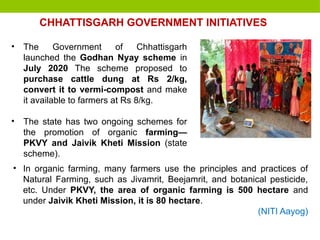
• The Governmentof Chhattisgarh
launched the Godhan Nyay scheme in
July 2020 The scheme proposed to
purchase cattle dung at Rs 2/kg,
convert it to vermi-compost and make
it available to farmers at Rs 8/kg.
• The state has two ongoing schemes for
the promotion of organic farming—
PKVY and Jaivik Kheti Mission (state
scheme).
CHHATTISGARH GOVERNMENT INITIATIVES
• In organic farming, many farmers use the principles and practices of
Natural Farming, such as Jivamrit, Beejamrit, and botanical pesticide,
etc. Under PKVY, the area of organic farming is 500 hectare and
under Jaivik Kheti Mission, it is 80 hectare.
(NITI Aayog)
26.
Project- May, 2020.NAARM-CRIDA Collaborative Project
on Adoption of Natural Farming and Its Effect on Crop Yield
and Farmers’ Livelihood In India.(Sponsored by NITI Aayog)
Objective - to understand the farmers' perception about NF
for different crops and its implication on crop yield and
farmers' income
ICAR initiative
27.
Quick observations –
•Primary survey and soil sampling in Karnataka, Andhra
Pradesh and Maharashtra (April to June 2019), covering
295 NF practicing and 170 non- practicing farmers
• Only few farmers are practicing NF in Karnataka,
whereas in AP almost all farmers in selected villages are
practicing NF
• In Maharashtra farmers reported similar crop yield,
however produce quality was bit inferior.
• Overall mixed effect on yield but fetching premium price
ICAR-NAARM April-June 19, Newsletter
29.
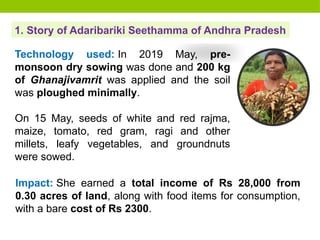
1. Story ofAdaribariki Seethamma of Andhra Pradesh
Technology used: In 2019 May, pre-
monsoon dry sowing was done and 200 kg
of Ghanajivamrit was applied and the soil
was ploughed minimally.
On 15 May, seeds of white and red rajma,
maize, tomato, red gram, ragi and other
millets, leafy vegetables, and groundnuts
were sowed.
Impact: She earned a total income of Rs 28,000 from
0.30 acres of land, along with food items for consumption,
with a bare cost of Rs 2300.
30.
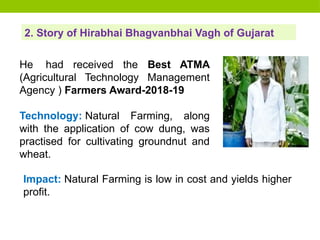
He had receivedthe Best ATMA
(Agricultural Technology Management
Agency ) Farmers Award-2018-19
Technology: Natural Farming, along
with the application of cow dung, was
practised for cultivating groundnut and
wheat.
2. Story of Hirabhai Bhagvanbhai Vagh of Gujarat
Impact: Natural Farming is low in cost and yields higher
profit.
31.
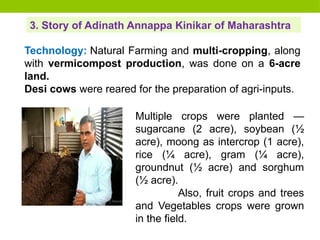
3. Story ofAdinath Annappa Kinikar of Maharashtra
Technology: Natural Farming and multi-cropping, along
with vermicompost production, was done on a 6-acre
land.
Desi cows were reared for the preparation of agri-inputs.
Multiple crops were planted —
sugarcane (2 acre), soybean (½
acre), moong as intercrop (1 acre),
rice (¼ acre), gram (¼ acre),
groundnut (½ acre) and sorghum
(½ acre).
Also, fruit crops and trees
and Vegetables crops were grown
in the field.
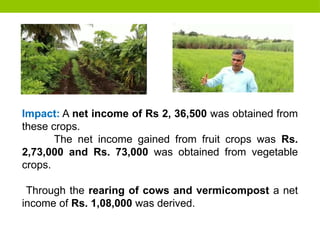
32.
Impact: A netincome of Rs 2, 36,500 was obtained from
these crops.
The net income gained from fruit crops was Rs.
2,73,000 and Rs. 73,000 was obtained from vegetable
crops.
Through the rearing of cows and vermicompost a net
income of Rs. 1,08,000 was derived.
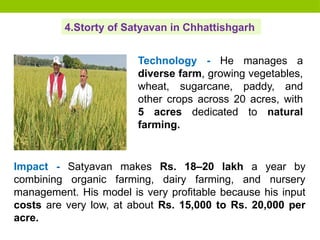
33.
4.Storty of Satyavanin Chhattishgarh
Technology - He manages a
diverse farm, growing vegetables,
wheat, sugarcane, paddy, and
other crops across 20 acres, with
5 acres dedicated to natural
farming.
Impact - Satyavan makes Rs. 18–20 lakh a year by
combining organic farming, dairy farming, and nursery
management. His model is very profitable because his input
costs are very low, at about Rs. 15,000 to Rs. 20,000 per
acre.
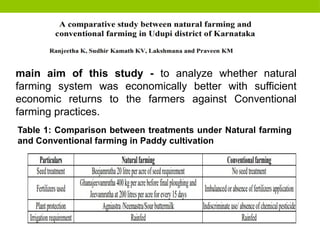
35.
main aim ofthis study - to analyze whether natural
farming system was economically better with sufficient
economic returns to the farmers against Conventional
farming practices.
Table 1: Comparison between treatments under Natural farming
and Conventional farming in Paddy cultivation
36.
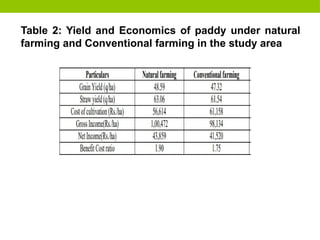
Table 2: Yieldand Economics of paddy under natural
farming and Conventional farming in the study area
37.
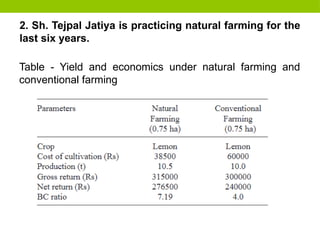
2. Sh. TejpalJatiya is practicing natural farming for the
last six years.
Table - Yield and economics under natural farming and
conventional farming
38.
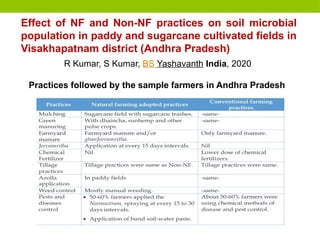
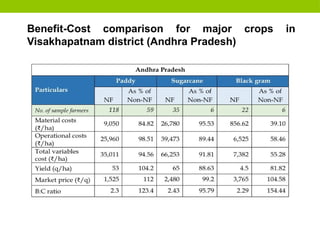
Effect of NFand Non-NF practices on soil microbial
population in paddy and sugarcane cultivated fields in
Visakhapatnam district (Andhra Pradesh)
R Kumar, S Kumar, BS Yashavanth India, 2020
Practices followed by the sample farmers in Andhra Pradesh
39.
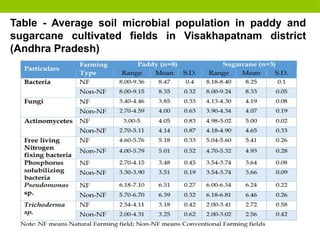
Table - Averagesoil microbial population in paddy and
sugarcane cultivated fields in Visakhapatnam district
(Andhra Pradesh)
40.
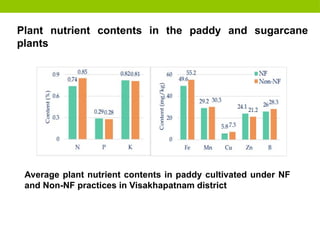
Plant nutrient contentsin the paddy and sugarcane
plants
Average plant nutrient contents in paddy cultivated under NF
and Non-NF practices in Visakhapatnam district
41.
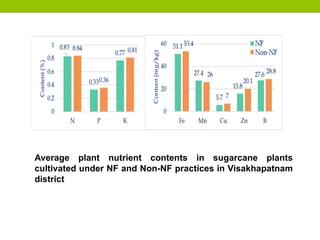
Average plant nutrientcontents in sugarcane plants
cultivated under NF and Non-NF practices in Visakhapatnam
district
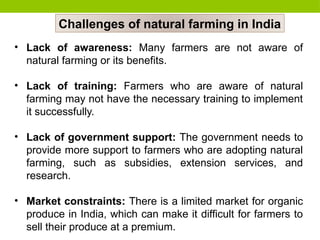
• Lack ofawareness: Many farmers are not aware of
natural farming or its benefits.
• Lack of training: Farmers who are aware of natural
farming may not have the necessary training to implement
it successfully.
• Lack of government support: The government needs to
provide more support to farmers who are adopting natural
farming, such as subsidies, extension services, and
research.
• Market constraints: There is a limited market for organic
produce in India, which can make it difficult for farmers to
sell their produce at a premium.
Challenges of natural farming in India
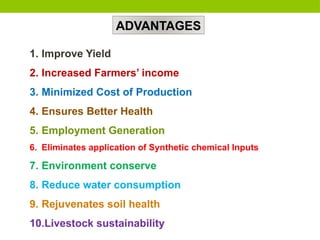
ADVANTAGES
1. Improve Yield
2.Increased Farmers’ income
3. Minimized Cost of Production
4. Ensures Better Health
5. Employment Generation
6. Eliminates application of Synthetic chemical Inputs
7. Environment conserve
8. Reduce water consumption
9. Rejuvenates soil health
10.Livestock sustainability
46.
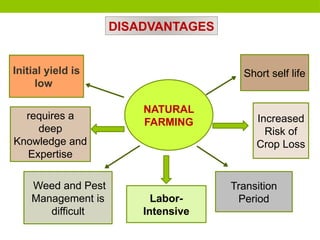
• Improved soilhealth: Natural farming helps to improve
soil health by increasing organic matter content,
reducing soil erosion, and improving water infiltration. This
leads to healthier plants and higher crop yields.
• Increased crop yields: Natural farming can lead to
increased crop yields, as healthy soil is better able to
support plant growth. Studies have shown that natural
farming can increase crop yields by up to 30%.
• Reduced input costs: Natural farming can help to reduce
input costs, as farmers do not need to purchase synthetic
fertilizers, pesticides, or herbicides. This can save farmers
a significant amount of money, especially for small
farmers.
47.
• Improved farmerlivelihoods: Natural farming can help
to improve farmer livelihoods, as it can lead to increased
crop yields, reduced input costs, and improved soil
health. This can lead to higher incomes for farmers, and
it can also help to reduce their dependence on debt.
• Environmental benefits: Natural farming has a number
of environmental benefits, such as reducing water
pollution, soil erosion, and greenhouse gas emissions.
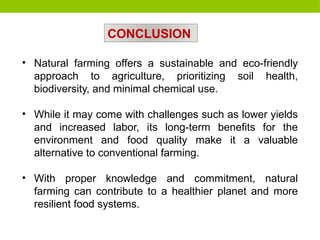
• Natural farmingoffers a sustainable and eco-friendly
approach to agriculture, prioritizing soil health,
biodiversity, and minimal chemical use.
• While it may come with challenges such as lower yields
and increased labor, its long-term benefits for the
environment and food quality make it a valuable
alternative to conventional farming.
• With proper knowledge and commitment, natural
farming can contribute to a healthier planet and more
resilient food systems.
CONCLUSION
50.
• Anonymous(2024), NaturalFarming NITI Aayog.
https://naturalfarming.niti.gov.in
• Darshan, kadam. (2019, sep .8). Natural farming – Zero Budget Natural
farming. Side share.
• Fukuoka, Masanobu. (1978).The One-Straw Revolution: An Introduction to
Natural Farming. New York.
• Kumar, R., Kumar, S., Yashavanth, B.S., Meena, P.C., Indoria, A.K., Kundu,
S. and Manjunath, M., 2020. Adoption of natural farming and its effect on
crop yield and farmers’ livelihood in India. ICAR-National Academy of
Agricultural Research Management, Hyderabad, India, 130.
• Sharma, S.K., Ravisankar, N., Jain, N.K. and Sarangi, S.K., 2023. Natural
farming: current status, research and case studies. Indian Council of
Agricultural Research, New Delhi–110, 12.
References