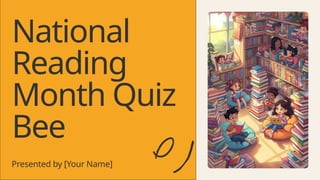
National Reading Month Quiz Bee: Engaging Literacy Challenge for Students
A quiz bee covering reading comprehension, literary terms, story elements, and poetry to celebrate National Reading Month and promote literacy skills among students.
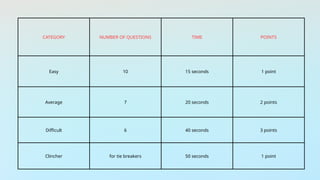
CATEGORY NUMBER OFQUESTIONS TIME POINTS
Easy 10 15 seconds 1 point
Average 7 20 seconds 2 points
Difficult 6 40 seconds 3 points
Clincher for tie breakers 50 seconds 1 point
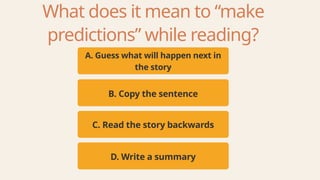
What does itmean to “make
predictions” while reading?
A. Guess what will happen next in
the story
B. Copy the sentence
C. Read the story backwards
D. Write a summary
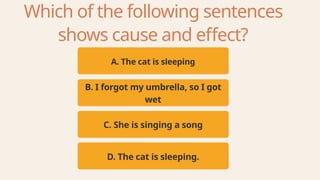
Which of thefollowing sentences
shows cause and effect?
A. The cat is sleeping
B. I forgot my umbrella, so I got
wet
C. She is singing a song
D. The cat is sleeping.
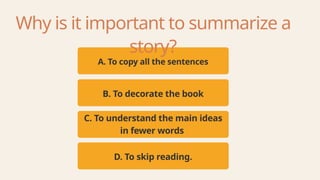
Why is itimportant to summarize a
story?
A. To copy all the sentences
B. To decorate the book
C. To understand the main ideas
in fewer words
D. To skip reading.
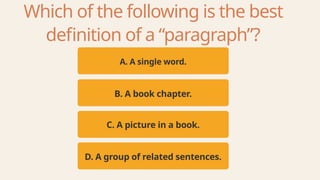
Which of thefollowing is the best
definition of a “paragraph”?
A. A single word.
B. A book chapter.
C. A picture in a book.
D. A group of related sentences.
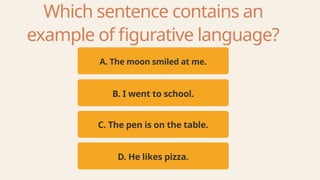
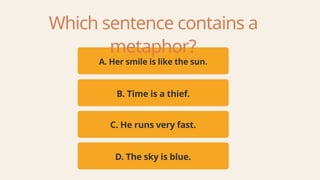
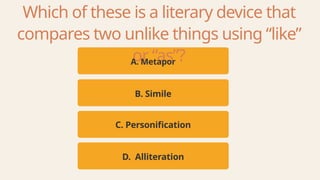
Which sentence containsan
example of figurative language?
A. The moon smiled at me.
B. I went to school.
C. The pen is on the table.
D. He likes pizza.
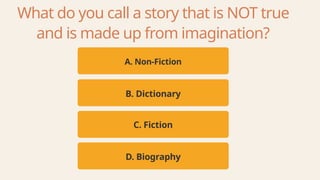
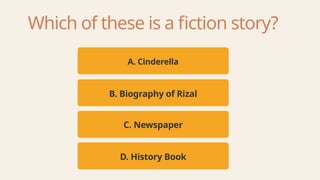
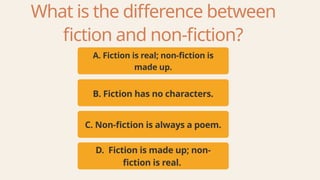
What is thedifference between
fiction and non-fiction?
A. Fiction is real; non-fiction is
made up.
B. Fiction has no characters.
C. Non-fiction is always a poem.
D. Fiction is made up; non-
fiction is real.
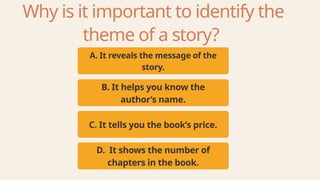
Why is itimportant to identify the
theme of a story?
A. It reveals the message of the
story.
B. It helps you know the
author’s name.
C. It tells you the book’s price.
D. It shows the number of
chapters in the book.
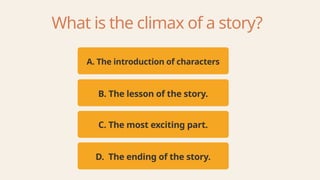
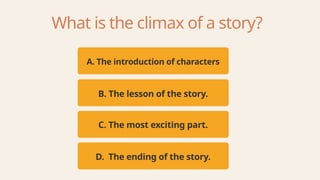
What is theclimax of a story?
A. The introduction of characters
B. The lesson of the story.
C. The most exciting part.
D. The ending of the story.
52.
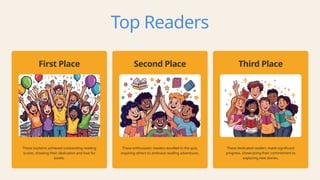
These students achievedoutstanding reading
scores, showing their dedication and love for
books.
First Place
These enthusiastic readers excelled in the quiz,
inspiring others to embrace reading adventures.
Second Place
These dedicated readers made significant
progress, showcasing their commitment to
exploring new stories.
Third Place
Top Readers