
Multiple Choice Questions on Heat Treatment Processes and Hardenability Testing
Detailed multiple-choice questions covering heat treatment methods, microstructures, surface hardening techniques, and the principles of hardenability in steels.
Multiple Choice Questions on Heat Treatment Processes and Hardenability Testing
1.
Page 1 of15
Multiple Choice Questions
Heat Treatment Processes and Hardenability Test:
1. Heat treatment is defined as:
A) Heating a metal only
B) Controlled heating and cooling of metals to obtain desired properties
C) Melting a metal
D) Welding two metals together
Answer: B
Reason: Heat treatment involves controlled heating and cooling without changing the
shape of the material to obtain desired mechanical and physical properties.
2. The primary objective of heat treatment is to:
A) Increase weight
B) Improve mechanical properties
C) Reduce the size of the material
D) Change the chemical composition completely
Answer: B
Reason: Heat treatment improves hardness, strength, toughness, ductility, machinability,
and wear resistance.
3. Which of the following is NOT a heat treatment process?
A) Annealing
B) Normalizing
C) Hardening
D) Sand casting
Answer: D
Reason: Sand casting is a manufacturing process, whereas the others are heat treatment
processes.
4. Heat treatment generally changes the:
A) Shape of the material
B) Microstructure of the material
C) Chemical composition completely
D) Dimensions significantly
Answer: B
Reason: Heat treatment modifies the microstructure, leading to changes in properties.
5. Annealing is mainly carried out to:
A) Increase hardness
B) Relieve internal stresses and improve ductility
C) Increase brittleness
D) Increase wear resistance only
Answer: B
Reason: Annealing softens the material, improves machinability, and relieves residual
stresses.
2.
Page 2 of15
6. Which heat treatment process produces the softest steel?
A) Hardening
B) Annealing
C) Tempering
D) Case hardening
Answer: B
Reason: Annealing produces maximum softness and ductility.
7. During annealing, the cooling method is:
A) Water quenching
B) Oil quenching
C) Furnace cooling
D) Air cooling
Answer: C
Reason: Slow furnace cooling allows coarse pearlite formation, resulting in a soft
structure.
8. Normalizing differs from annealing because it involves:
A) Water cooling
B) Furnace cooling
C) Air cooling
D) Oil cooling
Answer: C
Reason: In normalizing, steel is cooled in still air, producing a finer grain structure.
9. The main purpose of normalizing is to:
A) Increase ductility only
B) Refine grain structure
C) Melt the material
D) Reduce carbon content
Answer: B
Reason: Normalizing refines grains and improves strength and toughness.
10. Which heat treatment process produces finer grains?
A) Annealing
B) Normalizing
C) Casting
D) Forging
Answer: B
Reason: Air cooling during normalizing results in finer grains than furnace cooling.
11. Hardening is achieved by:
A) Slow cooling
B) Furnace cooling
C) Rapid quenching from the austenitic region
D) Air cooling
Answer: C
Reason: Rapid cooling transforms austenite into hard martensite.
3.
Page 3 of15
12. The purpose of hardening is to increase:
A) Ductility
B) Hardness and strength
C) Electrical conductivity
D) Thermal expansion
Answer: B
Reason: Hardening significantly increases hardness and wear resistance.
13. Which microstructure is formed after hardening?
A) Ferrite
B) Pearlite
C) Martensite
D) Austenite
Answer: C
Reason: Rapid quenching transforms austenite into martensite.
14. Martensite is:
A) Soft and ductile
B) Hard and brittle
C) Liquid
D) Non-metallic
Answer: B
Reason: Martensite possesses high hardness but low toughness.
15. Tempering is carried out after:
A) Annealing
B) Normalizing
C) Hardening
D) Casting
Answer: C
Reason: Tempering reduces brittleness while retaining useful hardness.
16. The main purpose of tempering is to:
A) Increase brittleness
B) Reduce brittleness and improve toughness
C) Increase carbon content
D) Melt the steel
Answer: B
Reason: Tempering improves toughness by relieving stresses in martensite.
17. During tempering, hardened steel is heated:
A) Above the melting point
B) Below the lower critical temperature (A₁)
C) Above the upper critical temperature
D) To room temperature
Answer: B
Reason: Tempering is performed below the lower critical temperature so that austenite
does not reform.
4.
Page 4 of15
18. Which heat treatment process produces the highest hardness?
A) Annealing
B) Normalizing
C) Hardening
D) Tempering
Answer: C
Reason: Hardening produces martensite, the hardest microstructure in steel.
19. Which process improves machinability?
A) Annealing
B) Hardening
C) Carburizing
D) Nitriding
Answer: A
Reason: Annealing softens steel and improves machinability.
20. Which heat treatment process is generally performed before machining?
A) Annealing
B) Hardening
C) Flame hardening
D) Induction hardening
Answer: A
Reason: Soft materials are easier to machine.
21. Case hardening produces:
A) Hard surface with soft core
B) Soft surface with hard core
C) Uniform hardness throughout
D) No change in hardness
Answer: A
Reason: Only the outer layer is hardened, while the core remains tough.
22. Carburizing is mainly applied to:
A) High-carbon steel
B) Low-carbon steel
C) Cast iron
D) Copper
Answer: B
Reason: Carbon is added to the surface of low-carbon steel.
23. Nitriding introduces ______ into the surface.
A) Carbon
B) Nitrogen
C) Oxygen
D) Hydrogen
Answer: B
Reason: Nitrogen diffuses into the steel surface, forming hard nitrides.
5.
Page 5 of15
24. Which surface hardening process does NOT require quenching?
A) Carburizing
B) Cyaniding
C) Nitriding
D) Flame hardening
Answer: C
Reason: Nitriding forms hard nitrides during heating and cooling without quenching.
25. Hardenability is the ability of steel to:
A) Resist corrosion
B) Form martensite to a certain depth during quenching
C) Increase ductility
D) Resist oxidation
Answer: B
Reason: Hardenability indicates the depth to which steel can be hardened, not the
maximum hardness it can attain.
26. Case hardening is also known as:
A) Surface hardening
B) Through hardening
C) Tempering
D) Annealing
Answer: A
Reason: Case hardening hardens only the surface while maintaining a tough core.
27. Which heat treatment process increases the carbon content only at the surface?
A) Annealing
B) Normalizing
C) Carburizing
D) Tempering
Answer: C
Reason: Carburizing diffuses carbon into the surface of low-carbon steel.
28. Carburizing is generally carried out at a temperature range of:
A) 200–300°C
B) 350–500°C
C) 850–950°C
D) 1200–1300°C
Answer: C
Reason: Carburizing is performed above the austenitizing temperature, typically between
850°C and 950°C.
29. Which material is most suitable for carburizing?
A) High-carbon steel
B) Medium-carbon steel
C) Low-carbon steel
D) Cast iron
Answer: C
Reason: Low-carbon steel develops a hard case while retaining a tough core.
6.
Page 6 of15
30. The main objective of carburizing is to obtain:
A) Soft surface
B) Hard surface with a tough core
C) Uniform hardness
D) Improved electrical conductivity
Answer: B
Reason: Surface carbon enrichment followed by quenching produces a hard wear-
resistant case.
31. In pack carburizing, the carbon source is usually:
A) Charcoal
B) Sulphur
C) Lime
D) Graphite electrode
Answer: A
Reason: Charcoal is commonly used as the carbon-rich medium in pack carburizing.
32. Which of the following is NOT a carburizing method?
A) Pack carburizing
B) Gas carburizing
C) Liquid carburizing
D) Vacuum annealing
Answer: D
Reason: Vacuum annealing is not a carburizing process.
33. After carburizing, steel is generally:
A) Air cooled
B) Furnace cooled
C) Quenched
D) Slowly cooled in sand
Answer: C
Reason: Quenching transforms the carbon-rich surface into hard martensite.
34. Nitriding is carried out in an atmosphere containing:
A) Oxygen
B) Ammonia
C) Nitrogen gas only
D) Carbon dioxide
Answer: B
Reason: Ammonia decomposes to release nitrogen, which diffuses into the steel.
35. Nitriding is generally performed at:
A) 150–250°C
B) 450–550°C
C) 800–900°C
D) 1100–1200°C
Answer: B
Reason: Nitriding is usually carried out at about 500°C.
7.
Page 7 of15
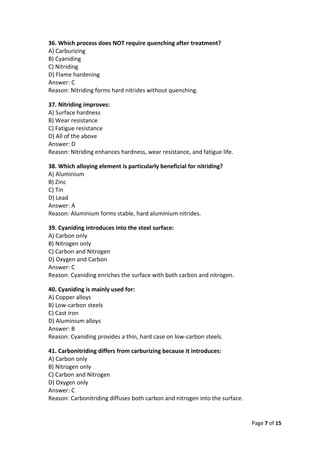
36. Which process does NOT require quenching after treatment?
A) Carburizing
B) Cyaniding
C) Nitriding
D) Flame hardening
Answer: C
Reason: Nitriding forms hard nitrides without quenching.
37. Nitriding improves:
A) Surface hardness
B) Wear resistance
C) Fatigue resistance
D) All of the above
Answer: D
Reason: Nitriding enhances hardness, wear resistance, and fatigue life.
38. Which alloying element is particularly beneficial for nitriding?
A) Aluminium
B) Zinc
C) Tin
D) Lead
Answer: A
Reason: Aluminium forms stable, hard aluminium nitrides.
39. Cyaniding introduces into the steel surface:
A) Carbon only
B) Nitrogen only
C) Carbon and Nitrogen
D) Oxygen and Carbon
Answer: C
Reason: Cyaniding enriches the surface with both carbon and nitrogen.
40. Cyaniding is mainly used for:
A) Copper alloys
B) Low-carbon steels
C) Cast iron
D) Aluminium alloys
Answer: B
Reason: Cyaniding provides a thin, hard case on low-carbon steels.
41. Carbonitriding differs from carburizing because it introduces:
A) Carbon only
B) Nitrogen only
C) Carbon and Nitrogen
D) Oxygen only
Answer: C
Reason: Carbonitriding diffuses both carbon and nitrogen into the surface.
8.
Page 8 of15
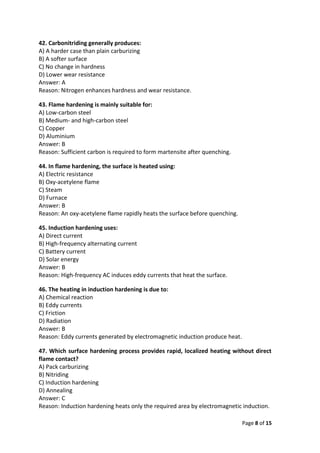
42. Carbonitriding generally produces:
A) A harder case than plain carburizing
B) A softer surface
C) No change in hardness
D) Lower wear resistance
Answer: A
Reason: Nitrogen enhances hardness and wear resistance.
43. Flame hardening is mainly suitable for:
A) Low-carbon steel
B) Medium- and high-carbon steel
C) Copper
D) Aluminium
Answer: B
Reason: Sufficient carbon is required to form martensite after quenching.
44. In flame hardening, the surface is heated using:
A) Electric resistance
B) Oxy-acetylene flame
C) Steam
D) Furnace
Answer: B
Reason: An oxy-acetylene flame rapidly heats the surface before quenching.
45. Induction hardening uses:
A) Direct current
B) High-frequency alternating current
C) Battery current
D) Solar energy
Answer: B
Reason: High-frequency AC induces eddy currents that heat the surface.
46. The heating in induction hardening is due to:
A) Chemical reaction
B) Eddy currents
C) Friction
D) Radiation
Answer: B
Reason: Eddy currents generated by electromagnetic induction produce heat.
47. Which surface hardening process provides rapid, localized heating without direct
flame contact?
A) Pack carburizing
B) Nitriding
C) Induction hardening
D) Annealing
Answer: C
Reason: Induction hardening heats only the required area by electromagnetic induction.
9.
Page 9 of15
48. Which heat treatment process is commonly used for gear teeth and crankshafts?
A) Annealing
B) Tempering
C) Induction hardening
D) Normalizing
Answer: C
Reason: Induction hardening provides a hard, wear-resistant surface while maintaining a
tough core.
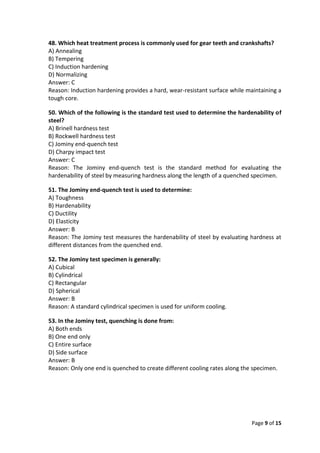
50. Which of the following is the standard test used to determine the hardenability of
steel?
A) Brinell hardness test
B) Rockwell hardness test
C) Jominy end-quench test
D) Charpy impact test
Answer: C
Reason: The Jominy end-quench test is the standard method for evaluating the
hardenability of steel by measuring hardness along the length of a quenched specimen.
51. The Jominy end-quench test is used to determine:
A) Toughness
B) Hardenability
C) Ductility
D) Elasticity
Answer: B
Reason: The Jominy test measures the hardenability of steel by evaluating hardness at
different distances from the quenched end.
52. The Jominy test specimen is generally:
A) Cubical
B) Cylindrical
C) Rectangular
D) Spherical
Answer: B
Reason: A standard cylindrical specimen is used for uniform cooling.
53. In the Jominy test, quenching is done from:
A) Both ends
B) One end only
C) Entire surface
D) Side surface
Answer: B
Reason: Only one end is quenched to create different cooling rates along the specimen.
10.
Page 10 of15
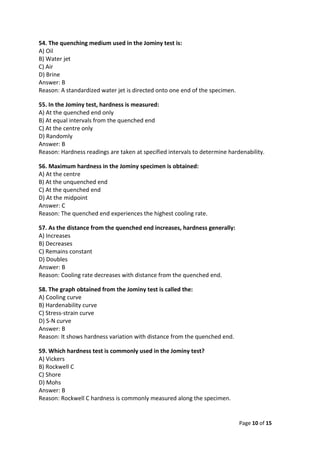
54. The quenching medium used in the Jominy test is:
A) Oil
B) Water jet
C) Air
D) Brine
Answer: B
Reason: A standardized water jet is directed onto one end of the specimen.
55. In the Jominy test, hardness is measured:
A) At the quenched end only
B) At equal intervals from the quenched end
C) At the centre only
D) Randomly
Answer: B
Reason: Hardness readings are taken at specified intervals to determine hardenability.
56. Maximum hardness in the Jominy specimen is obtained:
A) At the centre
B) At the unquenched end
C) At the quenched end
D) At the midpoint
Answer: C
Reason: The quenched end experiences the highest cooling rate.
57. As the distance from the quenched end increases, hardness generally:
A) Increases
B) Decreases
C) Remains constant
D) Doubles
Answer: B
Reason: Cooling rate decreases with distance from the quenched end.
58. The graph obtained from the Jominy test is called the:
A) Cooling curve
B) Hardenability curve
C) Stress-strain curve
D) S-N curve
Answer: B
Reason: It shows hardness variation with distance from the quenched end.
59. Which hardness test is commonly used in the Jominy test?
A) Vickers
B) Rockwell C
C) Shore
D) Mohs
Answer: B
Reason: Rockwell C hardness is commonly measured along the specimen.
11.
Page 11 of15
60. The Jominy test compares steels based on:
A) Maximum hardness
B) Depth of hardening
C) Density
D) Thermal conductivity
Answer: B
Reason: Hardenability refers to the depth to which hardness is developed.
61. Which factor has the greatest influence on hardenability?
A) Alloying elements
B) Colour
C) Density
D) Surface finish
Answer: A
Reason: Alloying elements delay transformation and increase hardenability.
62. Which alloying element greatly improves hardenability?
A) Chromium
B) Zinc
C) Lead
D) Tin
Answer: A
Reason: Chromium delays pearlite formation and promotes deeper hardening.
63. Increasing carbon content generally:
A) Increases hardenability up to a certain level
B) Decreases hardenability
C) Has no effect
D) Reduces hardness
Answer: A
Reason: Carbon increases the ability to form martensite.
64. Which grain size provides greater hardenability?
A) Fine grain
B) Coarse grain
C) Equal grain
D) Nano grain only
Answer: B
Reason: Coarse grains reduce nucleation sites for pearlite, increasing hardenability.
65. Which alloying element is most effective in increasing hardenability in small
quantities?
A) Boron
B) Copper
C) Aluminium
D) Magnesium
Answer: A
Reason: Very small additions of boron significantly improve hardenability.
12.
Page 12 of15
66. Which quenching medium provides the fastest cooling rate?
A) Air
B) Oil
C) Water
D) Furnace
Answer: C
Reason: Water cools faster than oil and air.
67. Which quenching medium provides slower cooling than water?
A) Oil
B) Brine
C) Ice
D) Liquid nitrogen
Answer: A
Reason: Oil reduces the risk of cracking compared to water.
68. Which quenching medium provides the slowest cooling?
A) Brine
B) Water
C) Oil
D) Air
Answer: D
Reason: Air cooling is the slowest among common quenching media.
69. Brine is preferred when:
A) Maximum cooling rate is required
B) Slow cooling is required
C) Annealing is performed
D) Tempering is carried out
Answer: A
Reason: Brine cools faster than water by minimizing vapor blanket formation.
70. Which defect is most likely to occur due to excessively rapid quenching?
A) Improved machinability
B) Cracking
C) Increased ductility
D) Grain refinement only
Answer: B
Reason: High thermal stresses during rapid cooling may cause cracks.
71. Austempering produces:
A) Martensite
B) Bainite
C) Ferrite
D) Cementite
Answer: B
Reason: Austempering results in a bainitic microstructure.
13.
Page 13 of15
72. Martempering is mainly used to:
A) Reduce distortion and cracking
B) Increase carbon content
C) Remove scale
D) Produce ferrite
Answer: A
Reason: Martempering minimizes thermal stresses during quenching.
73. Spheroidizing is mainly carried out to:
A) Increase hardness
B) Improve machinability
C) Increase brittleness
D) Increase wear resistance only
Answer: B
Reason: Spheroidized cementite improves machinability.
74. Patenting is mainly used for:
A) Tool steel
B) Steel wire production
C) Aluminium alloys
D) Copper alloys
Answer: B
Reason: Patenting improves the strength and ductility of steel wire.
75. Bainite has properties intermediate between:
A) Ferrite and cementite
B) Pearlite and martensite
C) Austenite and ferrite
D) Cementite and graphite
Answer: B
Reason: Bainite provides a combination of strength and toughness.
76. TTT stands for:
A) Time–Temperature–Transformation
B) Temperature–Time–Treatment
C) Thermal Testing Technique
D) Total Transformation Time
Answer: A
Reason: TTT diagrams show isothermal transformation behavior.
77. CCT stands for:
A) Continuous Cooling Transformation
B) Constant Cooling Temperature
C) Controlled Carbon Treatment
D) Continuous Carbon Transformation
Answer: A
Reason: CCT diagrams describe transformations during continuous cooling.
14.
Page 14 of15
78. TTT diagrams are mainly used for:
A) Isothermal transformations
B) Continuous cooling only
C) Casting
D) Welding
Answer: A
Reason: TTT diagrams represent transformations at constant temperatures.
79. CCT diagrams are more useful in practical heat treatment because cooling is:
A) Instantaneous
B) Continuous
C) Constant
D) Uniform only
Answer: B
Reason: Industrial heat treatment usually involves continuous cooling.
80. Which microstructure forms during very rapid cooling?
A) Ferrite
B) Pearlite
C) Martensite
D) Bainite
Answer: C
Reason: Rapid cooling suppresses diffusion, producing martensite.
81. During hardening, steel is heated to the ______ region before quenching.
A) Ferrite
B) Pearlite
C) Austenite
D) Bainite
Answer: C
Reason: Steel must be converted into austenite before quenching to obtain martensite.
82. Which heat treatment process is primarily used to relieve residual stresses without
significantly changing hardness?
A) Stress relieving
B) Hardening
C) Carburizing
D) Flame hardening
Answer: A
Reason: Stress relieving reduces internal stresses while causing minimal changes in
hardness and microstructure.
83. Which of the following is NOT a surface hardening process?
A) Carburizing
B) Nitriding
C) Cyaniding
D) Annealing
Answer: D
Reason: Annealing softens the entire material and is not a surface hardening process.
15.
Page 15 of15
84. The depth of hardness obtained after quenching mainly depends on:
A) Colour of steel
B) Hardenability of steel
C) Surface finish
D) Density
Answer: B
Reason: Hardenability determines how deeply martensite can form during quenching.
85. Which heat treatment process is most suitable for restoring toughness in hardened
tool steels?
A) Annealing
B) Tempering
C) Carburizing
D) Normalizing
Answer: B
Reason: Tempering reduces brittleness and restores toughness while retaining useful
hardness.