Multiple Choice Questions on Ferrous and Non-Ferrous Metals and Their Applications
Detailed multiple choice questions covering classification, properties, alloys, and applications of ferrous and non-ferrous metals including steel, cast iron, stainless steel, copper, brass, and bronze.
Multiple Choice Questions on Ferrous and Non-Ferrous Metals and Their Applications
1.
Page 1 of17
Multiple Choice Questions
Ferrous and Non-Ferrous Metals and Their Applications:
1. Metals are broadly classified into:
A) Hard and soft metals
B) Ferrous and non-ferrous metals
C) Heavy and light metals
D) Pure and impure metals
Answer: B
Reason: Metals are commonly classified as ferrous metals, which are iron-based, and non-
ferrous metals, which contain little or no iron.
2. The principal element in ferrous metals is:
A) Copper
B) Aluminium
C) Iron
D) Zinc
Answer: C
Reason: Ferrous metals are primarily based on iron.
3. Which of the following is a ferrous metal?
A) Aluminium
B) Copper
C) Mild steel
D) Brass
Answer: C
Reason: Mild steel is an iron-carbon alloy and is therefore ferrous.
4. Which of the following is a non-ferrous metal?
A) Cast iron
B) Steel
C) Copper
D) Wrought iron
Answer: C
Reason: Copper does not have iron as its principal constituent.
5. Which property is generally associated with ferrous metals?
A) High strength
B) Very low density
C) Complete corrosion resistance
D) Non-magnetic behaviour in all cases
Answer: A
Reason: Ferrous alloys generally offer high strength and good structural performance.
2.
Page 2 of17
6. A major advantage of non-ferrous metals is:
A) High iron content
B) Good corrosion resistance in many cases
C) High carbon content
D) Formation of cementite
Answer: B
Reason: Many non-ferrous metals, such as aluminium and copper, have excellent
corrosion resistance.
7. Which of the following is NOT a ferrous alloy?
A) Steel
B) Cast iron
C) Brass
D) Stainless steel
Answer: C
Reason: Brass is a copper-zinc non-ferrous alloy.
8. Which metal has the highest electrical conductivity among the following?
A) Copper
B) Steel
C) Cast iron
D) Titanium
Answer: A
Reason: Copper has excellent electrical conductivity.
9. Which metal is commonly selected where low density is important?
A) Lead
B) Aluminium
C) Cast iron
D) Steel
Answer: B
Reason: Aluminium has a low density compared with most engineering metals.
10. Which of the following is an important criterion for selecting an engineering metal?
A) Colour only
B) Application requirements
C) Name of the metal only
D) Melting point only
Answer: B
Reason: Material selection depends on strength, weight, corrosion resistance,
temperature, cost, manufacturability, and service conditions.
11. Pure iron has limited use in engineering because of its:
A) Very high hardness
B) Low strength
C) High brittleness
D) High carbon content
Answer: B
Reason: Pure iron is relatively soft and weak, so alloying is used to improve its properties.
3.
Page 3 of17
12. Steel is primarily an alloy of:
A) Iron and copper
B) Iron and carbon
C) Copper and zinc
D) Aluminium and silicon
Answer: B
Reason: Steel is primarily an iron-carbon alloy, with other alloying elements added as
required.
13. Carbon content in steel is generally up to approximately:
A) 0.02%
B) 2.11%
C) 4.3%
D) 6.67%
Answer: B
Reason: The conventional Fe–C diagram considers steels up to about 2.11% carbon.
14. Mild steel is also known as:
A) High-carbon steel
B) Low-carbon steel
C) Tool steel
D) High-speed steel
Answer: B
Reason: Mild steel has relatively low carbon content.
15. Mild steel is preferred for structural applications because of its:
A) High brittleness
B) Good ductility and weldability
C) Extremely high hardness
D) Poor machinability
Answer: B
Reason: Low-carbon steel has good ductility, weldability, and adequate strength.
16. Which steel generally has better weldability?
A) Low-carbon steel
B) High-carbon steel
C) Tool steel
D) High-speed steel
Answer: A
Reason: Low carbon content reduces the tendency for brittle structures to form during
welding.
17. Medium-carbon steel is commonly used for:
A) Shafts and axles
B) Electrical wires
C) Food cans
D) Window frames
Answer: A
Reason: Medium-carbon steels provide a useful combination of strength, hardness, and
toughness.
4.
Page 4 of17
18. High-carbon steel is commonly used for:
A) Cutting tools and springs
B) Electrical cables
C) Roofing sheets only
D) Cooking utensils only
Answer: A
Reason: High-carbon steels can achieve high hardness and wear resistance.
19. Which steel is commonly used for cutting tools?
A) Mild steel
B) Tool steel
C) Low-carbon steel
D) Wrought iron
Answer: B
Reason: Tool steels are designed for high hardness, wear resistance, and strength.
20. High-speed steel is mainly used for:
A) Cutting tools
B) Electrical conductors
C) Food containers
D) Building roofs
Answer: A
Reason: High-speed steel retains high hardness at elevated temperatures during cutting.
21. Cast iron generally contains carbon in the range:
A) Below 0.02%
B) 0.02–0.5%
C) 2.11–6.67%
D) Above 10%
Answer: C
Reason: Cast irons generally contain more than about 2.11% carbon.
22. Which cast iron has graphite in flake form?
A) Grey cast iron
B) White cast iron
C) Malleable cast iron
D) Alloy steel
Answer: A
Reason: Grey cast iron contains graphite flakes.
23. Grey cast iron is widely used for:
A) Engine blocks
B) Electrical wires
C) Aircraft skin
D) Food cans
Answer: A
Reason: Grey cast iron has good castability, damping capacity, and machinability.
5.
Page 5 of17
24. The graphite in grey cast iron provides good:
A) Electrical insulation
B) Vibration damping
C) Weldability
D) Ductility
Answer: B
Reason: Graphite flakes help absorb vibrations.
25. White cast iron contains carbon mainly in the form of:
A) Graphite
B) Cementite
C) Ferrite
D) Copper
Answer: B
Reason: Rapid solidification and composition promote carbon retention as cementite.
26. White cast iron is characterized by:
A) High ductility
B) High hardness and wear resistance
C) Excellent weldability
D) Very low hardness
Answer: B
Reason: Cementite makes white cast iron hard and wear resistant.
27. Malleable cast iron is produced by heat treating:
A) Grey cast iron
B) White cast iron
C) Stainless steel
D) Brass
Answer: B
Reason: White cast iron is heat treated to produce malleable cast iron.
28. Ductile cast iron contains graphite in:
A) Flake form
B) Nodular or spheroidal form
C) Plate form
D) Powder form
Answer: B
Reason: Magnesium or similar treatment produces spheroidal graphite.
29. Ductile cast iron has better ductility than:
A) Grey cast iron
B) Aluminium
C) Copper
D) Brass
Answer: A
Reason: Spheroidal graphite causes less stress concentration than graphite flakes.
6.
Page 6 of17
30. Cast iron is particularly suitable for:
A) Complex castings
B) Electrical wires
C) Aircraft cables
D) Spring wires
Answer: A
Reason: Cast irons generally have excellent castability and can produce complex shapes.
31. Chromium is added to steel mainly to improve:
A) Corrosion and oxidation resistance
B) Electrical conductivity
C) Density
D) Melting point only
Answer: A
Reason: Chromium promotes formation of a protective oxide film and improves corrosion
resistance.
32. Stainless steel must contain at least approximately:
A) 1% chromium
B) 5% chromium
C) 10.5% chromium
D) 25% carbon
Answer: C
Reason: A chromium content of approximately 10.5% or more provides stainless
behaviour.
33. Stainless steel is widely used in:
A) Chemical and food-processing equipment
B) Electrical transformers only
C) Railway tracks only
D) Concrete blocks
Answer: A
Reason: Its corrosion resistance makes it suitable for hygienic and corrosive
environments.
34. Nickel in steel generally improves:
A) Toughness and corrosion resistance
B) Brittleness only
C) Electrical insulation
D) Carbon content
Answer: A
Reason: Nickel improves toughness and contributes to corrosion resistance.
35. Manganese in steel is commonly used as:
A) A deoxidizer and alloying element
B) An electrical insulator
C) A coating material only
D) A ceramic additive
Answer: A
7.
Page 7 of17
Reason: Manganese combines with sulphur and also contributes to strength and
hardenability.
36. Molybdenum in steel is particularly useful for improving:
A) High-temperature strength and hardenability
B) Electrical insulation
C) Density reduction
D) Colour
Answer: A
Reason: Molybdenum improves high-temperature properties and hardenability.
37. Vanadium is commonly added to steel to:
A) Refine grains and improve strength
B) Reduce hardness
C) Increase corrosion only
D) Reduce melting point drastically
Answer: A
Reason: Vanadium forms carbides and promotes grain refinement.
38. Tungsten is an important alloying element in:
A) High-speed steel
B) Mild steel
C) Grey cast iron
D) Brass
Answer: A
Reason: Tungsten carbides help high-speed steel retain hardness at high temperatures.
39. Silicon is commonly used in electrical steels to improve:
A) Magnetic properties
B) Ductility only
C) Corrosion only
D) Density
Answer: A
Reason: Silicon reduces electrical losses and improves magnetic performance.
40. Tool steels are mainly selected for:
A) High hardness and wear resistance
B) Low strength
C) High electrical conductivity
D) Very low melting point
Answer: A
Reason: Tools require high hardness, wear resistance, and dimensional stability.
41. Copper is best known for its:
A) High electrical conductivity
B) Very high hardness
C) High carbon content
D) Low thermal conductivity
Answer: A
Reason: Copper has excellent electrical and thermal conductivity.
8.
Page 8 of17
42. Copper is commonly used for:
A) Electrical wires
B) Cutting tools
C) Railway wheels
D) Engine blocks
Answer: A
Reason: Its high electrical conductivity makes copper ideal for electrical conductors.
43. Brass is an alloy of:
A) Copper and tin
B) Copper and zinc
C) Copper and nickel
D) Copper and aluminium
Answer: B
Reason: Brass is primarily a copper-zinc alloy.
44. Bronze is traditionally an alloy of:
A) Copper and tin
B) Copper and zinc
C) Copper and nickel
D) Aluminium and copper
Answer: A
Reason: Traditional bronze is mainly copper and tin.
45. Brass is commonly used for:
A) Valves and fittings
B) Cutting inserts
C) Engine cylinder liners only
D) Aircraft turbine blades
Answer: A
Reason: Brass offers good corrosion resistance, machinability, and appearance.
46. Bronze is commonly used for:
A) Bearings and bushes
B) Electrical cables only
C) Structural beams
D) Cutting tools only
Answer: A
Reason: Bronze alloys have good wear and friction characteristics.
47. Cupronickel is an alloy of:
A) Copper and nickel
B) Copper and zinc
C) Copper and tin
D) Copper and aluminium
Answer: A
Reason: Cupronickel contains copper and nickel.
9.
Page 9 of17
48. Cupronickel is commonly used for:
A) Marine applications
B) Cutting tools
C) Railway rails
D) Engine blocks
Answer: A
Reason: Cupronickel has excellent resistance to seawater corrosion.
49. Aluminium bronze contains:
A) Aluminium as a major alloying element
B) Zinc as the only alloying element
C) Carbon as the major element
D) Nickel only
Answer: A
Reason: Aluminium bronze is primarily copper alloyed with aluminium.
50. Copper is preferred for heat exchangers mainly because of its:
A) High thermal conductivity
B) High hardness
C) Low ductility
D) High carbon content
Answer: A
Reason: Copper transfers heat efficiently because of its high thermal conductivity.
51. Aluminium is characterized by:
A) High density
B) Low density
C) Very high carbon content
D) Magnetic behaviour
Answer: B
Reason: Aluminium has a low density, making it useful for lightweight structures.
52. The major advantage of aluminium is its:
A) High strength-to-weight ratio
B) High density
C) High brittleness
D) Low corrosion resistance
Answer: A
Reason: Aluminium alloys provide useful strength at relatively low weight.
53. Aluminium develops corrosion resistance mainly because of:
A) Cementite formation
B) Protective oxide film
C) Graphite formation
D) Sulphide formation
Answer: B
Reason: Aluminium forms a thin, adherent oxide layer that protects the underlying metal.
10.
Page 10 of17
54. Aluminium is widely used in:
A) Aircraft structures
B) Railway rails
C) Cutting tools
D) Bearings only
Answer: A
Reason: Its low density and good strength-to-weight ratio make it useful in aerospace
structures.
55. Duralumin is primarily an alloy of:
A) Aluminium, copper, magnesium and manganese
B) Copper and zinc
C) Copper and tin
D) Iron and carbon
Answer: A
Reason: Duralumin is a high-strength aluminium alloy containing mainly copper with
magnesium and manganese.
56. Aluminium alloys are commonly used in automobile components because of their:
A) Low density
B) High carbon content
C) High magnetic permeability
D) Poor castability
Answer: A
Reason: Lightweight aluminium reduces vehicle weight and can improve fuel efficiency.
57. Aluminium is commonly used for:
A) Electrical transmission conductors
B) High-speed cutting tools
C) Railway rails
D) Dies only
Answer: A
Reason: Aluminium combines good electrical conductivity with low density.
58. Aluminium alloys are widely used in aircraft mainly to:
A) Increase weight
B) Reduce structural weight
C) Increase carbon content
D) Improve magnetism
Answer: B
Reason: Low density is a major advantage in aerospace applications.
59. Aluminium has good:
A) Corrosion resistance
B) Magnetic properties
C) High-temperature strength compared with superalloys
D) Wear resistance in all conditions
Answer: A
Reason: The protective oxide film gives aluminium good atmospheric corrosion
resistance.
11.
Page 11 of17
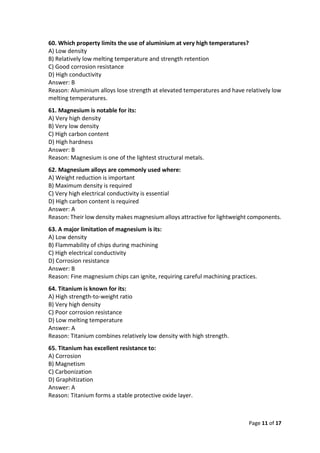
60. Which property limits the use of aluminium at very high temperatures?
A) Low density
B) Relatively low melting temperature and strength retention
C) Good corrosion resistance
D) High conductivity
Answer: B
Reason: Aluminium alloys lose strength at elevated temperatures and have relatively low
melting temperatures.
61. Magnesium is notable for its:
A) Very high density
B) Very low density
C) High carbon content
D) High hardness
Answer: B
Reason: Magnesium is one of the lightest structural metals.
62. Magnesium alloys are commonly used where:
A) Weight reduction is important
B) Maximum density is required
C) Very high electrical conductivity is essential
D) High carbon content is required
Answer: A
Reason: Their low density makes magnesium alloys attractive for lightweight components.
63. A major limitation of magnesium is its:
A) Low density
B) Flammability of chips during machining
C) High electrical conductivity
D) Corrosion resistance
Answer: B
Reason: Fine magnesium chips can ignite, requiring careful machining practices.
64. Titanium is known for its:
A) High strength-to-weight ratio
B) Very high density
C) Poor corrosion resistance
D) Low melting temperature
Answer: A
Reason: Titanium combines relatively low density with high strength.
65. Titanium has excellent resistance to:
A) Corrosion
B) Magnetism
C) Carbonization
D) Graphitization
Answer: A
Reason: Titanium forms a stable protective oxide layer.
12.
Page 12 of17
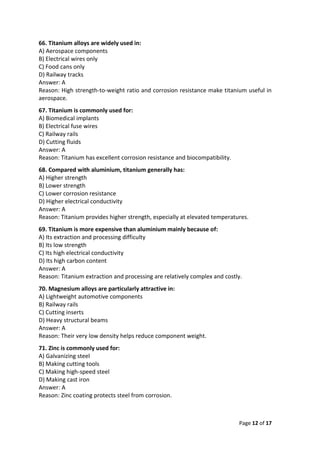
66. Titanium alloys are widely used in:
A) Aerospace components
B) Electrical wires only
C) Food cans only
D) Railway tracks
Answer: A
Reason: High strength-to-weight ratio and corrosion resistance make titanium useful in
aerospace.
67. Titanium is commonly used for:
A) Biomedical implants
B) Electrical fuse wires
C) Railway rails
D) Cutting fluids
Answer: A
Reason: Titanium has excellent corrosion resistance and biocompatibility.
68. Compared with aluminium, titanium generally has:
A) Higher strength
B) Lower strength
C) Lower corrosion resistance
D) Higher electrical conductivity
Answer: A
Reason: Titanium provides higher strength, especially at elevated temperatures.
69. Titanium is more expensive than aluminium mainly because of:
A) Its extraction and processing difficulty
B) Its low strength
C) Its high electrical conductivity
D) Its high carbon content
Answer: A
Reason: Titanium extraction and processing are relatively complex and costly.
70. Magnesium alloys are particularly attractive in:
A) Lightweight automotive components
B) Railway rails
C) Cutting inserts
D) Heavy structural beams
Answer: A
Reason: Their very low density helps reduce component weight.
71. Zinc is commonly used for:
A) Galvanizing steel
B) Making cutting tools
C) Making high-speed steel
D) Making cast iron
Answer: A
Reason: Zinc coating protects steel from corrosion.
13.
Page 13 of17
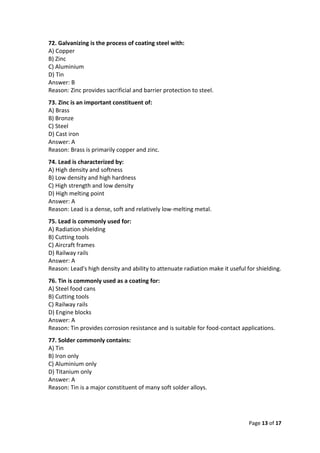
72. Galvanizing is the process of coating steel with:
A) Copper
B) Zinc
C) Aluminium
D) Tin
Answer: B
Reason: Zinc provides sacrificial and barrier protection to steel.
73. Zinc is an important constituent of:
A) Brass
B) Bronze
C) Steel
D) Cast iron
Answer: A
Reason: Brass is primarily copper and zinc.
74. Lead is characterized by:
A) High density and softness
B) Low density and high hardness
C) High strength and low density
D) High melting point
Answer: A
Reason: Lead is a dense, soft and relatively low-melting metal.
75. Lead is commonly used for:
A) Radiation shielding
B) Cutting tools
C) Aircraft frames
D) Railway rails
Answer: A
Reason: Lead's high density and ability to attenuate radiation make it useful for shielding.
76. Tin is commonly used as a coating for:
A) Steel food cans
B) Cutting tools
C) Railway rails
D) Engine blocks
Answer: A
Reason: Tin provides corrosion resistance and is suitable for food-contact applications.
77. Solder commonly contains:
A) Tin
B) Iron only
C) Aluminium only
D) Titanium only
Answer: A
Reason: Tin is a major constituent of many soft solder alloys.
14.
Page 14 of17
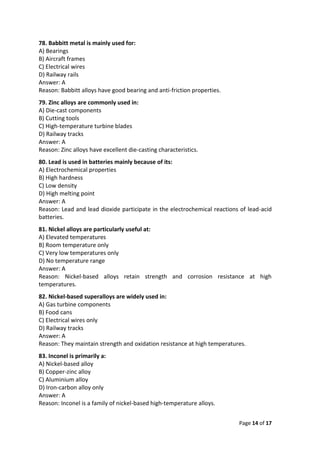
78. Babbitt metal is mainly used for:
A) Bearings
B) Aircraft frames
C) Electrical wires
D) Railway rails
Answer: A
Reason: Babbitt alloys have good bearing and anti-friction properties.
79. Zinc alloys are commonly used in:
A) Die-cast components
B) Cutting tools
C) High-temperature turbine blades
D) Railway tracks
Answer: A
Reason: Zinc alloys have excellent die-casting characteristics.
80. Lead is used in batteries mainly because of its:
A) Electrochemical properties
B) High hardness
C) Low density
D) High melting point
Answer: A
Reason: Lead and lead dioxide participate in the electrochemical reactions of lead-acid
batteries.
81. Nickel alloys are particularly useful at:
A) Elevated temperatures
B) Room temperature only
C) Very low temperatures only
D) No temperature range
Answer: A
Reason: Nickel-based alloys retain strength and corrosion resistance at high
temperatures.
82. Nickel-based superalloys are widely used in:
A) Gas turbine components
B) Food cans
C) Electrical wires only
D) Railway tracks
Answer: A
Reason: They maintain strength and oxidation resistance at high temperatures.
83. Inconel is primarily a:
A) Nickel-based alloy
B) Copper-zinc alloy
C) Aluminium alloy
D) Iron-carbon alloy only
Answer: A
Reason: Inconel is a family of nickel-based high-temperature alloys.
15.
Page 15 of17
84. Monel is primarily based on:
A) Nickel and copper
B) Copper and zinc
C) Aluminium and silicon
D) Iron and carbon
Answer: A
Reason: Monel alloys are mainly nickel-copper alloys with excellent corrosion resistance.
85. Nickel alloys are suitable for chemical processing because of their:
A) Corrosion resistance
B) Low strength
C) High carbon content
D) Poor thermal stability
Answer: A
Reason: Many nickel alloys resist severe chemical and high-temperature environments.
86. Which alloy is particularly suitable for seawater applications?
A) Cupronickel
B) Mild steel
C) Plain cast iron
D) High-carbon steel
Answer: A
Reason: Cupronickel has excellent seawater corrosion resistance.
87. Which non-ferrous metal is commonly used for aircraft structures?
A) Aluminium
B) Lead
C) Zinc
D) Tin
Answer: A
Reason: Aluminium alloys provide low weight and useful structural strength.
88. Which metal is most suitable for high-temperature turbine blades?
A) Nickel-based superalloy
B) Lead
C) Zinc
D) Pure aluminium
Answer: A
Reason: Nickel superalloys retain strength and resist oxidation at high temperatures.
89. Which alloy is commonly used for marine propellers?
A) Aluminium bronze
B) Mild steel
C) White cast iron
D) Tool steel
Answer: A
Reason: Aluminium bronze provides strength and good resistance to seawater corrosion.
16.
Page 16 of17
90. Which material is preferred for lightweight aerospace components?
A) Aluminium alloy
B) Lead
C) Grey cast iron
D) Plain carbon steel
Answer: A
Reason: Aluminium alloys provide a favourable strength-to-weight ratio.
91. A material is required for an electrical cable. Which is the most suitable?
A) Copper
B) Cast iron
C) Tool steel
D) Titanium
Answer: A
Reason: Copper has very high electrical conductivity.
92. A material is required for a railway rail. Which is most suitable?
A) Rail steel
B) Aluminium
C) Lead
D) Tin
Answer: A
Reason: Rail steel provides high strength, hardness, toughness and wear resistance.
93. An engine block requires good vibration damping and castability. Which material is
suitable?
A) Grey cast iron
B) Copper
C) Aluminium foil
D) Zinc
Answer: A
Reason: Grey cast iron has excellent castability and vibration damping capacity.
94. A component requires a hard wear-resistant surface and tough core. Which material
treatment is appropriate?
A) Case-hardened steel
B) Annealed copper
C) Pure aluminium
D) Lead
Answer: A
Reason: Case hardening produces a hard surface while retaining a relatively tough core.
95. A component operates in seawater and requires high corrosion resistance. Which
material is suitable?
A) Cupronickel
B) Plain carbon steel
C) Grey cast iron
D) Mild steel
Answer: A
Reason: Cupronickel has excellent resistance to seawater corrosion.
17.
Page 17 of17
96. A cutting tool requires high hardness and wear resistance. Which material is most
appropriate?
A) High-speed steel
B) Mild steel
C) Pure copper
D) Aluminium
Answer: A
Reason: High-speed steel maintains high hardness and wear resistance during cutting.
97. A component requires very low weight and good corrosion resistance. Which
material is a suitable choice?
A) Aluminium alloy
B) Cast iron
C) Lead
D) Plain carbon steel
Answer: A
Reason: Aluminium alloys offer low density and good corrosion resistance.
98. A medical implant requires corrosion resistance and biocompatibility. Which
material is most suitable?
A) Titanium alloy
B) Grey cast iron
C) Mild steel
D) Lead
Answer: A
Reason: Titanium alloys have excellent corrosion resistance and biocompatibility.
99. Which material is most appropriate for radiation shielding?
A) Lead
B) Aluminium
C) Copper
D) Magnesium
Answer: A
Reason: Lead's high density makes it highly effective for radiation attenuation.
100. The selection of ferrous or non-ferrous metals for an engineering application
should primarily depend on:
A) Colour of the metal
B) Required properties and service conditions
C) Availability of one metal only
D) Melting point alone
Answer: B
Reason: Engineering material selection must consider strength, weight, corrosion
resistance, temperature, wear, cost, manufacturability, and the actual service
environment.