Quaid-e-Azam Muhammad Ali Jinnah, 
Founder of Pakistan 
Posted in: People from Pakistan 
Mohammad Ali Jinnah (Urdu: ???? ??? ???? )December 25, 1876 – September 11, 1948) was a 
20th century lawyer, politician, statesman and the founder of Pakistan. He is popularly and 
officially known in Pakistan as Quaid-e-Azam (Urdu: ???? ???? — “Great Leader”) and Baba-e- 
Qaum (?????? ???) (“Father of the Nation”). 
Jinnah served as leader of the All-India Muslim League from 1913 till Pakistan’s independence 
on 14 August 1947 and Pakistan’s first Governor-General from 15 August 1947 till his death on 
11 September 1948. Jinnah rose to prominence in the Indian National Congress initially 
expounding ideas of Hindu-Muslim unity and helping shape the 1916 Lucknow Pact between the 
Muslim League and the Indian National Congress; he also became a key leader in the All India 
Home Rule League. He proposed a fourteen-point constitutional reform plan to safeguard the 
political rights of Muslims in a self-governing India. 
Jinnah, advocating the Two-Nation Theory, embraced the goal of creating a separate state for 
Muslims as per the Lahore Resolution. The League won most reserved Muslim seats in the 
elections of 1946. After the British and Congress backed out of the Cabinet Mission Plan Jinnah 
called for a Direct Action Day to achieve the formation of Pakistan. The direct action by the 
Muslim League and its Volunteer Corps, resulted in massive rioting in Calcutta between 
Muslims and Hindus/Sikhs. As the Indian National Congress and Muslim League failed to reach 
a power sharing formula for united India, it prompted both the parties and the British to agree to 
independence of Pakistan and India. As the first Governor-General of Pakistan, Jinnah led efforts 
to lay the foundations of the new state of Pakistan, frame national policies and rehabilitate 
millions of Muslim refugees who had migrated from India. He died in September 1948, just over 
a year after Pakistan gained independence from British India. 
EARLY LIFE 
Jinnah was born to Mahomed ali Jinnah bhai. in, some believe, Wazir Mansion, Karachi District, 
of lower Sindh. This is disputed as old textbooks mention Jhirk as his place of birth. Sindh had 
earlier been conquered by the British and was subsequently grouped with other conquered 
territories for administrative reasons to form the Bombay Presidency of British India. Although
his earliest school records state that he was born on October 20, 1875, Sarojini Naidu, the author 
of Jinnah’s first biography, gives the date as ”December 25, 1876”. 
Jinnah was the eldest of seven children born to Mithibai and Jinnah bhai Poonja. His father, 
Jinnahbhai (1857–1901), was a prosperous Gujarati merchant who had moved to Sindh from 
Kathiawar, Gujarat before Jinnah’s birth. His grandfather was Poonja Gokuldas Meghji, a Hindu 
Bhatia Rajput from Paneli village in Gondal state in Kathiawar. Jinnah’s ancestors were Hindu 
Rajput who converted to Islam. Jinnah’s family belonged to the Ismaili Khoja branch of Shi’a 
Islam,though Jinnah later converted to Twelver Shi’a Islam. 
The first-born Jinnah was soon joined by six siblings, brothers Ahmad Ali, Bunde Ali, and 
Rahmat Ali, and sisters Maryam, Fatima and Shireen. Their mother tongue was Gujarati; in time 
they also came to speak Kutchi, Sindhi and English. The proper Muslim names of Mr. Jinnah 
and his siblings, unlike those of his father and grandfather, are the consequence of the family’s 
immigration to the Muslim state of Sindh. 
Jinnah was a restless student, he studied at several schools: at the Sindh-Madrasa-tul-Islam in 
Karachi; briefly at the Gokal Das Tej Primary School in Bombay; and finally at the Christian 
Missionary Society High School in Karachi,where, at age sixteen, he passed the matriculation 
examination of the University of Bombay. 
YEARS IN ENGLAND 
In 1892, Jinnah was offered an apprenticeship at the London office of Graham’s Shipping and 
Trading Company, a business that had extensive dealings with Jinnah bhai Poonja’s firm in 
Karachi. Before he left for England, at his mother’s urging, he married his distant cousin – 
Emibai Jinnah &ndash: who was two years his junior;she died a few months later. During his 
sojourn in England, his mother too would pass away. In London, Jinnah soon left the 
apprenticeship to study law instead, by joining Lincoln’s Inn. It is said that the sole reason of 
Jinnah’s joining Lincoln’s Inn is that the welcome board of the Lincoln’s Inn had the names of 
the world’s all-time top-ten magistrates, and that this list was led by the name of Muhammad . 
In three years, at age 19, he became the youngest Indian to be called to the bar in England. 
During his student years in England, Jinnah came under the spell of 19th-century British 
liberalism, like many other future Indian independence leaders. This education included 
exposure to the idea of the democratic nation and progressive politics. He admired William 
Gladstone and John Morley, British Liberal statesmen. An admirer of the Indian political leaders 
Dadabhai Naoroji and Sir Pherozeshah Mehta, he worked with other Indian students on the 
former’s successful campaign for to become the first Indian to hold a seat in the British 
Parliament. 
By now, Jinnah had developed largely constitutionalist views on Indian self-government, and he 
condemned both the arrogance of British officials in India and the discrimination practiced by 
them against Indians. This idea of a nation legitimized by democratic principles and cultural
commonalities was antithetical to the genuine diversity that had generally characterized the 
subcontinent. As an Indian intellectual and political authority, Jinnah would find his commitment 
to the Western ideal of the nation-state: developed during his English education– and the reality 
of heterogeneous Indian society to be difficult to reconcile during his later political career. 
WESTERN INFLUENCES ON PERSONAL LIFE 
The Western world not only inspired Jinnah in his political life. England had greatly influenced 
his personal preferences, particularly when it came to dress. Jinnah donned Western style 
clothing and he pursued the fashion with fervor. It is said he owned over 200 hand-tailored suits 
which he wore with heavily starched shirts with detachable collars. It is also alleged that he 
never wore the same silk tie twice. M C Chagla, who was a close friend of Jinnah’s, has stated 
that Jinnah was fond of eating pork, an act which is forbidden is Islam. The historian Stanley 
Wolpert has also alleged this in a book about Jinnah. The Pakistan government has banned books 
(including Wolpert’s) which have mentioned this alleged dietary preference of Jinnah’s. It may 
be pertinent to mention that, historically, there is no evidence of this claim and Wolpert himself 
bases his claim on Chagla’s claim. Therefore, the one and only source of this claim was M.C. 
Chagla. 
RETURN TO INDIA 
During the final period of his stay in England, Jinnah came under considerable pressure to return 
home when his father’s business was ruined. In 1896 he returned to India and settled in Bombay. 
Jinnah built a house in Malabar Hill, later known as Jinnah House. He became a successful 
lawyer, gaining particular fame for his skilled handling of the “Caucus Case”. His reputation as a 
skilled lawyer prompted Indian leader Bal Gangadhar Tilak to hire him as defence counsel for 
his sedition trial in 1905. Jinnah argued that it was not sedition for an Indian to demand freedom 
and self-government in his own country, but Tilak received a rigorous term of imprisonment. 
When he returned to India his faith in liberalism and progressive politics was confirmed through 
his close association with three Indian National Congress stalwarts Gopal Krishna Gokhale, 
Pherozeshah Mehta and Surendranath Banerjee. These people had an influence in his early life in 
England and they would influence his later involvement in Indian politics. 
EARLY POLITICAL CAREER 
Muhammad Ali Jinnah, as a young lawyer, in 1896, Jinnah joined the Indian National Congress, 
which was the largest Indian political organisation. Like most of the Congress at the time, Jinnah 
did not favour outright independence, considering British influences on education, law, culture 
and industry as beneficial to India. Jinnah became a member on the sixty-member Imperial 
Legislative Council. The council had no real power or authority, and included a large number of 
un-elected pro-Raj loyalists and Europeans. Nevertheless, Jinnah was instrumental in the passing 
of the Child Marriages Restraint Act, the legitimization of the Muslim waqf (religious 
endowments) and was appointed to the Sandhurst committee, which helped establish the Indian
Military Academy at Dehra Dun. During World War I, Jinnah joined other Indian moderates in 
supporting the British war effort, hoping that Indians would be rewarded with political freedoms. 
Jinnah had initially avoided joining the All India Muslim League, founded in 1906, regarding it 
as too Muslim oriented. However he decided to provide leadership to the Muslim minority. 
Eventually, he joined the league in 1913 and became the president at the 1916 session in 
Lucknow. Jinnah was the architect of the 1916 Lucknow Pact between the Congress and the 
League, bringing them together on most issues regarding self-government and presenting a 
united front to the British. Jinnah also played an important role in the founding of the All India 
Home Rule League in 1916. Along with political leaders Annie Besant and Tilak, Jinnah 
demanded “home rule” for India—the status of a self-governing dominion in the Empire similar 
to Canada, New Zealand and Australia. He headed the League’s Bombay Presidency chapter. 
In 1918, Jinnah married his second wife Rattanbai Petit (“Ruttie”), twenty-four years his junior. 
She was the fashionable young daughter of his personal friend Sir Dinshaw Petit, of an elite Parsi 
family of Mumbai. Unexpectedly there was great opposition to the marriage from Rattanbai’s 
family and Parsi society, as well as orthodox Muslim leaders. Rattanbai defied her family and 
nominally converted to Islam, adopting (though never using) the name Maryam Jinnah, resulting 
in a permanent estrangement from her family and Parsi society. The couple resided in Mumbai, 
and frequently travelled across India and Europe. In 1919 she bore Jinnah his only child, 
daughter Dina Jinnah. 
In 1924 Jinnah reorganized the Muslim League, of which he had been president since 1919, and 
devoted the next seven years attempting to bring about unity among the disparate ranks of 
Muslims and to develop a rational formula to effect a Hindu Muslim settlement, which he 
considered the pre condition for Indian freedom. He attended several unity conferences, wrote 
the Delhi Muslim Proposals in 1927, pleaded for the incorporation of the basic Muslim demands 
in the Nehru report, and formulated the “Fourteen Points” 
FOURTEEN POINTS 
Jinnah broke with the Congress in 1920 when the Congress leader, Mohandas Gandhi, launched 
a law violating Non-Cooperation Movement against the British, which a temperamentally law 
abiding barrister Jinnah disapproved of. Unlike most Congress leaders, Gandhi did not wear 
western-style clothes, did his best to use an Indian language instead of English, and was deeply 
rooted to Indian culture. Gandhi’s local style of leadership gained great popularity with the 
Indian people. Jinnah criticised Gandhi’s support of the Khilafat Movement, which he saw as an 
endorsement of religious zealotry. By 1920, Jinnah resigned from the Congress, with a prophetic 
warning that Gandhi’s method of mass struggle would lead to divisions between Hindus and 
Muslims and within the two communities. Becoming president of the Muslim League, Jinnah 
was drawn into a conflict between a pro-Congress faction and a pro-British faction. 
In September 1923, Jinnah was elected as Muslim member for Bombay in the new Central 
Legislative Assembly. He showed great gifts as a parliamentarian, organized many Indian 
members to work with the Swaraj Party, and continued to press demands for full responsible 
government. He was so active on a wide range of subjects that in 1925 he was offered a
knighthood by Lord Reading when he retired as Viceroy and Governor General. Jinnah replied: 
“I prefer to be plain Mr. Jinnah”. 
In 1927, Jinnah entered negotiations with Muslim and Hindu leaders on the issue of a future 
constitution, during the struggle against the all-British Simon Commission. The League wanted 
separate electorates while the Nehru Report favoured joint electorates. Jinnah personally opposed 
separate electorates, but then drafted compromises and put forth demands that he thought would 
satisfy both. These became known as the 14 points of Mr. Jinnah. However, they were rejected 
by the Congress and other political parties. 
Jinnah’s personal life and especially his marriage suffered during this period due to his political 
work. Although they worked to save their marriage by travelling together to Europe when he was 
appointed to the Sandhurst committee, the couple separated in 1927. Jinnah was deeply saddened 
when Rattanbai died in 1929, after a serious illness. 
At the Round Table Conferences in London, Jinnah was disillusioned by the breakdown of talks. 
After the failure of the Round Table Conferences, Jinnah returned to London for a few years. In 
1936, he returned to India to re-organize Muslim League and contest the elections held under the 
provisions of the Act of 1935. 
Jinnah would receive personal care and support as he became more ill during this time from his 
sister Fatima Jinnah. She lived and travelled with him, as well as becoming a close advisor. She 
helped raise his daughter, who was educated in England and India. Jinnah later became estranged 
from his daughter, Dina Jinnah, after she decided to marry Parsi-born Christian businessman, 
Neville Wadia (even though he had faced the same issues when he married Rattanbai in 1918). 
Jinnah continued to correspond cordially with his daughter, but their personal relationship was 
strained. Dina continued to live in India with her family. 
LEADER OF THE MUSLIM LEAGUE 
Prominent Muslim leaders like the The Aga Khan, Choudhary Rahmat Ali and Sir Muhammad 
Iqbal made efforts to convince Jinnah to return from London (Where he had moved to in 1931 
and planned on permanently relocating in order to practice in the Privy Council Bar, to India and 
take charge of a now-reunited Muslim League. In 1934 Jinnah returned and began to re-organise 
the party, being closely assisted by Liaquat Ali Khan, who would act as his right-hand man. In 
the 1937 elections to the Central Legislative Assembly, the League emerged as a competent 
party, capturing a significant number of seats under the Muslim electorate, but lost in the 
Muslim-majority Punjab, Sindh and the North-West Frontier Province. Jinnah offered an alliance 
with the Congress – both bodies would face the British together, but the Congress had to share 
power, accept separate electorates and the League as the representative of India’s Muslims. The 
latter two terms were unacceptable to the Congress, which had its own national Muslim leaders 
and membership and adhered to secularism. Even as Jinnah held talks with Congress president 
Rajendra Prasad, Congress leaders suspected that Jinnah would use his position as a lever for 
exaggerated demands and obstruct government, and demanded that the League merge with the
Congress. The talks failed, and while Jinnah declared the resignation of all Congressmen from 
provincial and central offices in 1938 as a “Day of Deliverance” from Hindu domination, some 
historians assert that he remained hopeful for an agreement. 
In a speech to the League in 1930, Sir Muhammad Iqbal mooted an independent state for 
Muslims in “northwest India.” Choudhary Rahmat Ali published a pamphlet in 1933 advocating 
a state called “Pakistan”. Following the failure to work with the Congress, Jinnah, who had 
embraced separate electorates and the exclusive right of the League to represent Muslims, was 
converted to the idea that Muslims needed a separate state to protect their rights. Jinnah came to 
believe that Muslims and Hindus were distinct nations, with unbridgeable differences—a view 
later known as the Two Nation Theory. Jinnah declared that a united India would lead to the 
marginalization of Muslims, and eventually civil war between Hindus and Muslims. This change 
of view may have occurred through his correspondence with Iqbal, who was close to Jinnah.In 
the session in Lahore in 1940, the Pakistan resolution was adopted as the main goal of the party. 
The resolution was rejected outright by the Congress, and criticised by many Muslim leaders like 
Maulana Abul Kalam Azad, Khan Abdul Ghaffar Khan, Syed Ab’ul Ala Maududi and the 
Jamaat-e-Islami. On July 26, 1943, Jinnah was stabbed and wounded by a member of the 
extremist Khaksars in an attempted assassination. 
Muhammad Ali Jinnah founded Dawn in 1941, a major newspaper that helped him propagate the 
League’s point of views. During the mission of British minister Stafford Cripps, Jinnah 
demanded parity between the number of Congress and League ministers, the League’s exclusive 
right to appoint Muslims and a right for Muslim-majority provinces to secede, leading to the 
breakdown of talks. Jinnah supported the British effort in World War II, and opposed the Quit 
India movement. During this period, the League formed provincial governments and entered the 
central government. The League’s influence increased in the Punjab after the death of Unionist 
leader Sikander Hyat Khan in 1942. Gandhi held talks fourteen times with Jinnah in Bombay in 
1944, about a united front—while talks failed, Gandhi’s overtures to Jinnah increased the latter’s 
standing with Muslims. 
FOUNDING PAKISTAN 
Jinnah with Cabinet Mission 
A letter by Jinnah to Winston ChurchillIn the 1946 elections for the Constituent Assembly of 
India, the Congress won most of the elected seats, while the League won a large majority of 
Muslim electorate seats. The 1946 British Cabinet Mission to India released a plan on May 16, 
calling for a united Indian state comprising considerably autonomous provinces, and called for 
“groups” of provinces formed on the basis of religion. A second plan released on June 16, called 
for the separation of India along religious lines, with princely states to choose between accession 
to the dominion of their choice or independence. The Congress, fearing India’s fragmentation, 
criticised the May 16 proposal and rejected the June 16 plan. Jinnah gave the League’s assent to 
both plans, knowing that power would go only to the party that had supported a plan. After much 
debate and against Gandhi’s advice that both plans were divisive, the Congress accepted the May 
16 plan while condemning the grouping principle.[citation needed] Jinnah decried this 
acceptance as “dishonesty”, accused the British negotiators of “treachery”, and withdrew the
League’s approval of both plans. The League boycotted the assembly, leaving the Congress in 
charge of the government but denying it legitimacy in the eyes of many Muslims. 
Jinnah gave a precise definition of the term ‘Pakistan’ in 1941 at Lahore in which he stated: 
Some confusion prevails in the minds of some individuals in regard to the use of the work 
‘Pakistan’. This word has become synonymous with the Lahore resolution owing to the fact that 
it is a convenient and compendious method of describing [it]…. For this reason the British and 
Indian newspapers generally have adopted the word ‘Pakistan’ to describe the Moslem demand 
as embodied in the Lahore resolution. 
Jinnah issued a call for all Muslims to launch “Direct Action” on August 16 to “achieve 
Pakistan”. Strikes and protests were planned, but violence broke out all over India, especially in 
Calcutta and the district of Noakhali in Bengal, and more than 7,000 people were killed in Bihar. 
Although viceroy Lord Wavell asserted that there was “no satisfactory evidence to that effect”, 
League politicians were blamed by the Congress and the media for orchestrating the violence. 
Interim Government portfolios were announced on October 25, 1946. Muslim Leaguers were 
sworn in on October 26, 1946. The League entered the interim government, but Jinnah refrained 
from accepting office for himself. This was credited as a major victory for Jinnah, as the League 
entered government having rejected both plans, and was allowed to appoint an equal number of 
ministers despite being the minority party. The coalition was unable to work, resulting in a rising 
feeling within the Congress that independence of Pakistan was the only way of avoiding political 
chaos and possible civil war. The Congress agreed to the division of Punjab and Bengal along 
religious lines in late 1946. The new viceroy Lord Mountbatten of Burma and Indian civil 
servant V. P. Menon proposed a plan that would create a Muslim dominion in West Punjab, East 
Bengal, Baluchistan and Sindh. After heated and emotional debate, the Congress approved the 
plan. The North-West Frontier Province voted to join Pakistan in a referendum in July 1947. 
Jinnah asserted in a speech in Lahore on October 30, 1947 that the League had accepted 
independence of Pakistan because “the consequences of any other alternative would have been 
too disastrous to imagine.” 
The independent state of Pakistan, created on August 14, 1947, represented the outcome of a 
campaign on the part of the Indian Muslim community for a Muslim homeland which had been 
triggered by the British decision to consider transferring power to the people of India. 
JINNAH’S VISION FOR PAKISTAN 
Whilst giving an interview to American press representatives in July 1942, when asked by one of 
the journalists whether the Muslims were a nation or not, Jinnah replied: 
We are a nation with our own distinctive culture and civilization, language and literature, art and 
architecture, names and nomenclature, sense of values and proportion, legal laws and moral 
codes, customs and calendar, history and traditions, aptitudes and ambitions, in short, we have 
our own distinctive outlook on life and of life. By all cannons of international law we are a 
nation.
GOVERNOR-GENERAL 
Jinnah with Gandhi, 1944.Along with Liaquat Ali Khan and Abdur Rab Nishtar, Muhammad 
Ali Jinnah represented the League in the Division Council to appropriately divide public assets 
between India and Pakistan. The assembly members from the provinces that would comprise 
Pakistan formed the new state’s constituent assembly, and the Military of British India was 
divided between Muslim and non-Muslim units and officers. Indian leaders were angered at 
Jinnah’s courting the princes of Jodhpur, Bhopal and Indore to accede to Pakistan – these 
princely states were not geographically aligned with Pakistan, and each had a Hindu-majority 
population. 
Jinnah became the first Governor-General of Pakistan and president of its constituent assembly. 
Inaugurating the assembly on August 11, 1947, Jinnah spoke of an inclusive and pluralist 
democracy promising equal rights for all citizens regardless of religion, caste or creed. This 
address is a cause of much debate in Pakistan as, on its basis, many claim that Jinnah wanted a 
secular state while supporters of Islamic Pakistan assert that this speech is being taken out of 
context when compared to other speeches by him. 
On October 11, 1947, in an address to Civil, Naval, Military and Air Force Officers of Pakistan 
Government, Karachi, he said: 
We should have a State in which we could live and breathe as free men and which we could 
develop according to our own lights and culture and where principles of Islamic social justice 
could find free play. 
On February 21, 1948, in an address to the officers and men of the 5th Heavy Ack Ack and 6th 
Light Ack Ack Regiments in Malir, Karachi, he said: 
You have to stand guard over the development and maintenance of Islamic democracy, Islamic 
social justice and the equality of manhood in your own native soil. With faith, discipline and 
selfless devotion to duty, there is nothing worthwhile that you cannot achieve. 
The office of Governor-General was ceremonial, but Jinnah also assumed the lead of 
government. The first months of Pakistan’s independence were absorbed in ending the intense 
violence that had arisen in the wake of acrimony between Hindus and Muslims. Jinnah agreed 
with Indian leaders to organise a swift and secure exchange of populations in the Punjab and 
Bengal. He visited the border regions with Indian leaders to calm people and encourage peace, 
and organised large-scale refugee camps. Despite these efforts, estimates on the death toll vary 
from around two hundred thousand, to over a million people. The estimated number of refugees 
in both countries exceeds 15 million. The then capital city of Karachi saw an explosive increase 
in its population owing to the large encampments of refugees, which personally affected and 
depressed Jinnah. 
In his first visit to East Pakistan, under the advice of local party leaders, Jinnah stressed that 
Urdu alone should be the national language; a policy that was strongly opposed by the Bengali
people of East Pakistan (now Bangladesh). This opposition grew after he controversially 
described Bengali as the language of Hindus.[56][57] 
Jinnah authorised force to achieve the annexation of the princely state of Kalat and suppress the 
insurgency in Baluchistan. He controversially accepted the accession of Junagadh—a Hindu-majority 
state with a Muslim ruler located in the Saurashtra peninsula, some 400 kilometres (250 
mi) southeast of Pakistan—but this was annulled by Indian intervention. It is unclear if Jinnah 
planned or knew of the tribal invasion from Pakistan into the kingdom of Jammu and Kashmir in 
October 1947, but he did send his private secretary Khurshid Ahmed to observe developments in 
Kashmir. When informed of Kashmir’s accession to India, Jinnah deemed the accession 
illegitimate and ordered the Pakistani army to enter Kashmir. However, Gen. Auchinleck, the 
supreme commander of all British officers informed Jinnah that while India had the right to send 
troops to Kashmir, which had acceded to it, Pakistan did not. If Jinnah persisted, Auchinleck 
would remove all British officers from both sides. As Pakistan had a greater proportion of 
Britons holding senior command, Jinnah cancelled his order, but protested to the United Nations 
to intercede. 
ILLNESS AND DEATH 
The funeral of Jinnah in 1948. 
Tomb of M.A. Jinnah in Karachi, PakistanThrough the 1940s, Jinnah suffered from tuberculosis; 
only his sister and a few others close to him were aware of his condition. In 1948, Jinnah’s health 
began to falter, hindered further by the heavy workload that had fallen upon him following 
Pakistan’s independence from British Rule. Attempting to recuperate, he spent many months at 
his official retreat in Ziarat. According to his sister, he suffered a hemorrhage on September 1, 
1948; doctors said the altitude was not good for him and that he should be taken to Karachi. 
Jinnah was flown back to Karachi from Quetta. 
Jinnah died at 10:20 p.m. at the Governor-General’s House in Karachi on 11 September 1948, 
just over a year after Pakistan’s independence. 
It is said that when the then Viceroy of India, Lord Louis Mountbatten, learned of Jinnah’s 
ailment he said ‘had they known that Jinnah was about to die, they’d have postponed India’s 
independence by a few months as he was being inflexible on Pakistan’. 
Jinnah was buried in Karachi. His funeral was followed by the construction of a massive 
mausoleum— 
Dina Wadia remained in India after independence, before ultimately settling in New York City. 
Jinnah’s grandson, Nusli Wadia, is a prominent industrialist residing in Mumbai. In the 1963– 
1964 elections, Jinnah’s sister Fatima Jinnah, known as Madar-e-Millat (“Mother of the
Nation”), became the presidential candidate of a coalition of political parties that opposed the 
rule of President Ayub Khan, but lost the election. 
The Jinnah House in Malabar Hill, Bombay, is in the possession of the Government of India but 
the issue of its ownership has been disputed by the Government of Pakistan. Jinnah had 
personally requested Indian Prime Minister Jawaharlal Nehru to preserve the house and that one 
day he could return to Mumbai. There are proposals for the house be offered to the Government 
of Pakistan to establish a consulate in the city, as a goodwill gesture, but Dina Wadia has also 
laid claim to the property. Recently she has been involved in litigation regarding Jinnah House 
claiming that Hindu Law is applicable to Jinnah as he was a Khoja Shia. 
LEGACY 
Few individuals significantly alter the course of history. Fewer still modify the map of the world. 
Hardly anyone can be credited with creating a nation-state. Muhammad Ali Jinnah did all three. 
Pakistanis view Jinnah as their revered founding father, a man that was dedicated to safeguarding 
Muslim interests during the dying days of the British Raj.Despite any of a range of biases, it 
almost impossible to doubt, despite motive and manner, that there is any figure that had more 
influence and role in the creation of Pakistan than Jinnah. 
Jinnah is popularly and officially known in Pakistan as Quaid-e-Azam (Urdu: ???? ???? — 
“Great Leader”) and Baba-e-Qaum (?????? ???) (“Father of the Nation”). His birthday is a 
national holiday in Pakistan.
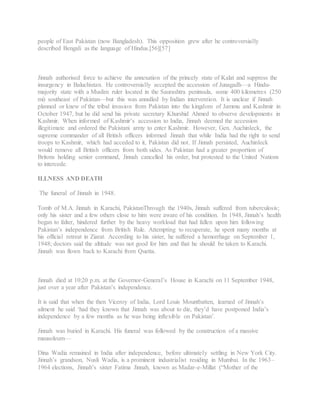
Quaid-i-Azam Muhammad Ali Jinnah 
by admin on Oct 26, 2013 
Pakistan, one of the largest Muslim states in the world, is a living and exemplary monument of 
Quaid-i-Azam Muhammad Ali Jinnah. With his untiring efforts, indomitable will, and dauntless 
courage, he united the Indian Muslims under the banner of the Muslim League and carved out a 
homeland for them, despite stiff opposition from the Hindu Congress and the British 
Government. 
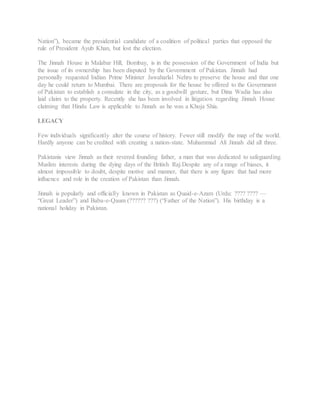
Muhammad Ali Jinnah was born in Karachi on December 25, 1876. His father Jinnah Poonja 
was an Ismaili Khoja of Kathiawar, a prosperous business community. Muhammad Ali received 
his early education at the Sindh Madrasa and later at the Mission School, Karachi. He went to 
England for further studies in 1892 at the age of 16. In 1896, Jinnah qualified for the Bar and 
was called to the Bar in 1897. 
Part-1 
Part-2 
Part-3 
Part-4 
Muhammad Ali Jinnah started his political career in 1906 when he attended the Calcutta session 
of the All India National Congress in the capacity of Private Secretary to the President of the 
Congress. In 1910, he was elected to the Imperial Legislative Council. He sponsored the Waqf 
Validating Bill, which brought him in touch with other Muslim leaders. In March 1913, Jinnah 
joined the All India Muslim League.
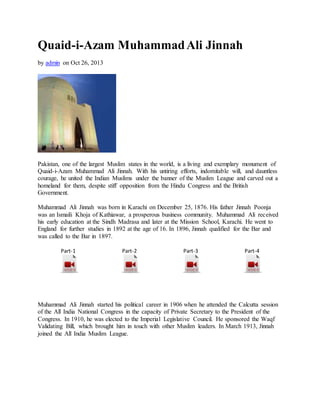
As a member of the Muslim League, Jinnah began to work for 
Hindu-Muslim unity. In 1917, the annual sessions of both the Congress and the League were 
held at Lucknow. The League session was presided over by Muhammad Ali Jinnah. It marked 
the culmination of his efforts towards Hindu-Muslim unity. Here, both the League and the 
Congress adopted a scheme of reforms known as the Lucknow Pact. 
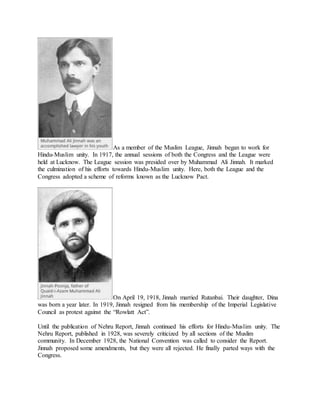
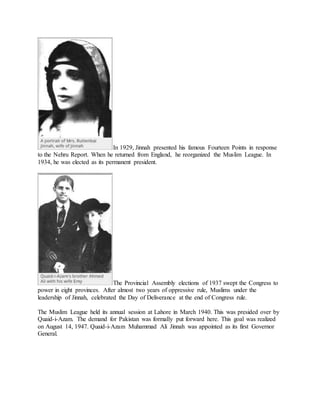
On April 19, 1918, Jinnah married Rutanbai. Their daughter, Dina 
was born a year later. In 1919, Jinnah resigned from his membership of the Imperial Legislative 
Council as protest against the “Rowlatt Act”. 
Until the publication of Nehru Report, Jinnah continued his efforts for Hindu-Muslim unity. The 
Nehru Report, published in 1928, was severely criticized by all sections of the Muslim 
community. In December 1928, the National Convention was called to consider the Report. 
Jinnah proposed some amendments, but they were all rejected. He finally parted ways with the 
Congress.
In 1929, Jinnah presented his famous Fourteen Points in response 
to the Nehru Report. When he returned from England, he reorganized the Muslim League. In 
1934, he was elected as its permanent president. 
The Provincial Assembly elections of 1937 swept the Congress to 
power in eight provinces. After almost two years of oppressive rule, Muslims under the 
leadership of Jinnah, celebrated the Day of Deliverance at the end of Congress rule. 
The Muslim League held its annual session at Lahore in March 1940. This was presided over by 
Quaid-i-Azam. The demand for Pakistan was formally put forward here. This goal was realized 
on August 14, 1947. Quaid-i-Azam Muhammad Ali Jinnah was appointed as its first Governor 
General.
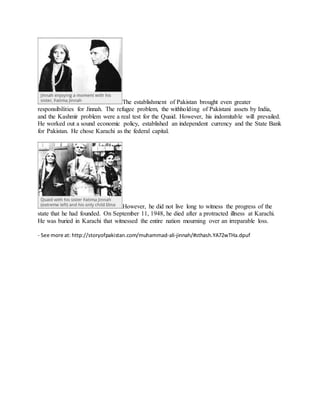
The establishment of Pakistan brought even greater 
responsibilities for Jinnah. The refugee problem, the withholding of Pakistani assets by India, 
and the Kashmir problem were a real test for the Quaid. However, his indomitable will prevailed. 
He worked out a sound economic policy, established an independent currency and the State Bank 
for Pakistan. He chose Karachi as the federal capital. 
However, he did not live long to witness the progress of the 
state that he had founded. On September 11, 1948, he died after a protracted illness at Karachi. 
He was buried in Karachi that witnessed the entire nation mourning over an irreparable loss. 
- See more at: http://storyofpakistan.com/muhammad-ali-jinnah/#sthash.YA72wTHa.dpuf