VIVEKANANDHA ARTS ANDSCIENCE
COLLEGE FOR WOMEN
Veerachipalayam – 637303,Sankagiri, Salem D.t, Tamilnadu, India.
Affiliated to Periyar University, Salem; Recognised Under section 2(f) & 12(B) of the UGC Act,
1956.
SUBJECT INCHARGE:
Dr R. Mythili ,
Head of the department ,
Department of Microbiology,
Vivekanandha arts and science College
for women.
SUBMITTED TO:
A. Vidhya ,
Department of Microbiology ,
Vivekanandha arts and science College
for women.
DEPARTMENT OF MICROBIOLOGY
SUBJECT: Molecular biology and rDNA technology
TOPIC: Monoclonal Antibodies in Therapy – vaccines
and their applications in animal infection
Synopsis:
Introduction
Whatare monoclonal Antibodies
History and development
Production of monoclonal Antibodies
Therapeutic applications
Role of mAbs in vaccine technology
Applications of mABs in animal infection
4.
Introduction:
Monoclonal antibodies (mAbs)are one of the most important
advances in modern biotechnology and immunotherapy. They are
laboratory-produced antibodies that are designed to bind specifically
to a single antigen or epitope. Because of their high specificity,
monoclonal antibodies are widely used in the treatment of cancers,
autoimmune diseases, infectious diseases, and are being increasingly
explored in veterinary medicine
Unlike conventional drugs, monoclonal antibodies target only
diseased cells or specific molecules, reducing damage to healthy
tissues.
5.
Objectives:
Understand the conceptof monoclonal antibodies.
Explain the production of monoclonal antibodies.
Describe the mechanism of action of mAbs.
Discuss therapeutic applications in animal infections.
Explain different types of veterinary vaccines.
Compare monoclonal antibodies with vaccines.
Explore future prospects in veterinary immunotherapy.
6.
History of monoclonalAntibodies
1975: Georges Köhler and César Milstein developed
Hybridoma Technology.
1984: Nobel Prize awarded.
1986: First therapeutic monoclonal antibody approved.
Today, monoclonal antibodies are widely used in human
medicine and are increasingly being developed for
veterinary applications.
7.
What are monoclonalAntibodies
Monoclonal antibodies are identical antibodies produced from a
single clone of B lymphocytes. They recognize one specific
antigenic epitope with high specificity.
Characteristics
Highly specific
Uniform structure
High affinity
Consistent quality
8.
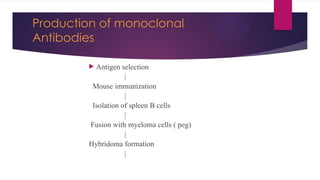
Production of monoclonal
Antibodies
Antigen selection
|
Mouse immunization
|
Isolation of spleen B cells
|
Fusion with myeloma cells ( peg)
|
Hybridoma formation
|
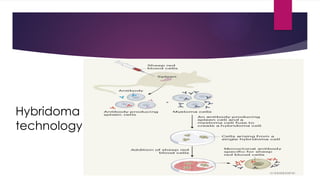
Hybridoma technology
Hybridomatechnology is a method used to produce
monoclonal antibodies (mAbs)—identical antibodies that
recognize a single specific antigen. It was developed by
Georges Köhler and César Milstein in 1975.
It was mainly used for production of monoclonal
Antibodies in Therapy
11.
Principle of hybridomatechnology
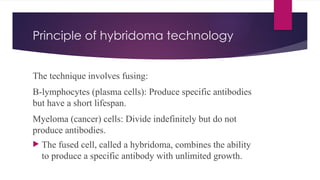
The technique involves fusing:
B-lymphocytes (plasma cells): Produce specific antibodies
but have a short lifespan.
Myeloma (cancer) cells: Divide indefinitely but do not
produce antibodies.
The fused cell, called a hybridoma, combines the ability
to produce a specific antibody with unlimited growth.
12.
Steps involved inhybridoma
technology
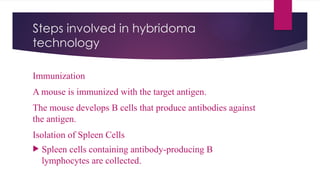
Immunization
A mouse is immunized with the target antigen.
The mouse develops B cells that produce antibodies against
the antigen.
Isolation of Spleen Cells
Spleen cells containing antibody-producing B
lymphocytes are collected.
13.
Fusion
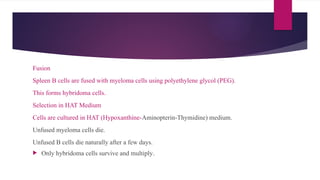
Spleen B cellsare fused with myeloma cells using polyethylene glycol (PEG).
This forms hybridoma cells.
Selection in HAT Medium
Cells are cultured in HAT (Hypoxanthine-Aminopterin-Thymidine) medium.
Unfused myeloma cells die.
Unfused B cells die naturally after a few days.
Only hybridoma cells survive and multiply.
14.
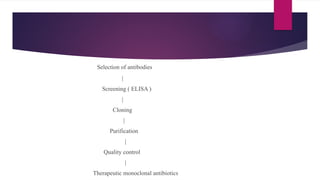
Screening
Hybridomas producing thedesired antibody are identified
using tests such as ELISA.
Cloning
The selected hybridoma is cloned (e.g., by limiting dilution)
to obtain a pure cell line.
Production and Purification
15.
Production and Purification
Hybridomacells are cultured in bioreactors (or historically
in mouse ascites).
Monoclonal antibodies are harvested and purified.
Types of monoclonalAntibodies
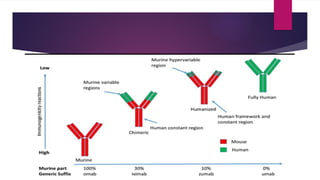
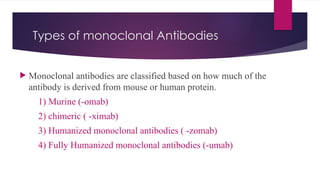
Monoclonal antibodies are classified based on how much of the
antibody is derived from mouse or human protein.
1) Murine (-omab)
2) chimeric ( -ximab)
3) Humanized monoclonal antibodies ( -zomab)
4) Fully Humanized monoclonal antibodies (-umab)
19.
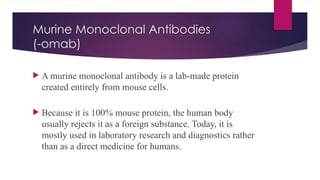
Murine Monoclonal Antibodies
(-omab)
A murine monoclonal antibody is a lab-made protein
created entirely from mouse cells.
Because it is 100% mouse protein, the human body
usually rejects it as a foreign substance. Today, it is
mostly used in laboratory research and diagnostics rather
than as a direct medicine for humans.
20.
Advantages:
Easy to produce.
Highaffinity for the target antigen.
Disadvantages:
Can trigger a human anti-mouse antibody (HAMA)
response.
Shorter half-life in humans.
Example: Muromonab-CD3 (OKT3).
21.
Chimeric monoclonal Antibodies(-Xiamb)
Chimeric monoclonal antibodies (mAbs) are genetically
engineered proteins developed to bridge the gap between
early rodent-derived antibodies and modern, fully human
therapeutics.
They combine genetic components from two different
species—typically a laboratory rodent and a human—to
create a functional treatment that is highly compatible with
the human body.
22.
Advantages:
Less immunogenic thanmurine antibodies.
Longer half-life.
Disadvantages:
Some immune reactions may still occur.
Examples:
Rituximab
Infliximab
23.
Humanized Monoclonal Antibodies
(-zumab)
Humanized monoclonal antibodies (mAbs) are
laboratory-engineered proteins designed to bind to
specific targets in the body, such as cancer cells or
viruses.
They are constructed by taking antibodies from a non-
human species (typically mice or rats) and altering their
protein sequences to closely match those found naturally
in humans.
Fully Human MonoclonalAntibodies
(-umab)
Fully human monoclonal antibodies (mAbs) represent the
peak of therapeutic antibody engineering.
Unlike humanized antibodies—which still retain tiny
fragments of mouse or rat gene sequences in their binding
loops—fully human antibodies contain 100% human
protein sequences.
26.
Advantages:
Lowest risk ofimmune reactions.
Long half-life.
Highly effective for long-term therapy.
Disadvantages:
Complex and costly production.
Examples:
Adalimumab
27.
Vaccines
Vaccines stimulatethe animal’s immune system to
produce active immunity and long-term immune memory,
whereas monoclonal antibodies provide immediate but
temporary protection. Together, they are valuable tools in
controlling animal diseases.
28.
Role ofMonoclonal Antibodies in Vaccines
Identify protective antigens for vaccine development.
Test vaccine quality and potency.
Study the immune response after vaccination.
Improve vaccine research and design.
Provide passive protection until vaccine-induced immunity develops.
29.
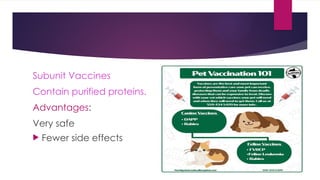
Types of vaccinesin veterinary
Live Attenuated Vaccines
Examples : Newcastle disease
PPR
Advantages:
Strong immunity
Long-lasting protection
Disadvantages:
Reference
Monoclonal AntibodyApplications in Travel
Medicine (2024)
Current Review of Monoclonal Antibody
Therapeutics in Small Animal Medicine (2025)
Kuby Immunology - Authors: Jenni Punt, Sharon
Stranford, Patricia Jones, Judy Owen
Cellular and molecular Immunology –
Immunological basis of Monoclonal Antibody