Make search work
Mobile-First Index:
A Data-Driven Analysis
& Discussion
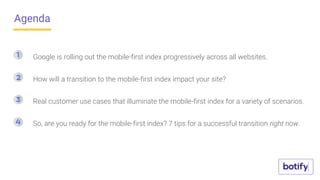
Agenda
Google is rolling out the mobile-first index progressively across all websites.
How will a transition to the mobile-first index impact your site?
Real customer use cases that illuminate the mobile-first index for a variety of scenarios.
So, are you ready for the mobile-first index? 7 tips for a successful transition right now.
First study of the mobile-
first index based
on real customer data.
INTRODUCTION
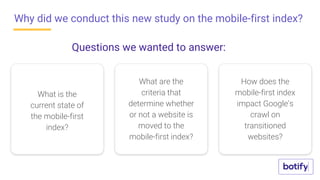
Why did we conduct this new study on the mobile-first index?
What is the
current state of
the mobile-first
index?
What are the
criteria that
determine whether
or not a website is
moved to the
mobile-first index?
How does the
mobile-first index
impact Google’s
crawl on
transitioned
websites?
Questions we wanted to answer:
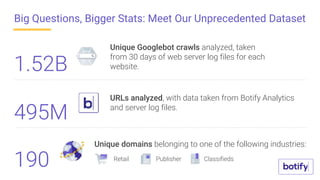
Big Questions, Bigger Stats: Meet Our Unprecedented Dataset
190
495M
1.52B
Unique domains belonging to one of the following industries:
Retail Publisher Classifieds
URLs analyzed, with data taken from Botify Analytics
and server log files.
Unique Googlebot crawls analyzed, taken
from 30 days of web server log files for each
website.
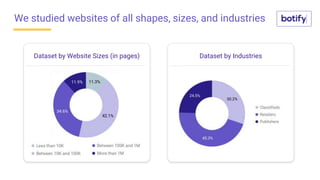
We studied websites of all shapes, sizes, and industries
Dataset by IndustriesDataset by Website Sizes (in pages)
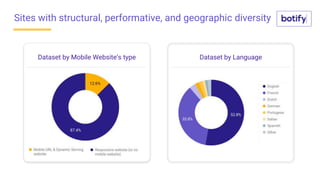
Sites with structural, performative, and geographic diversity
Dataset by Mobile Website’s type Dataset by Language
Google is rolling out
the mobile-first index
progressively across
all websites.
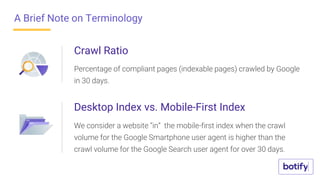
Percentage of compliant pages (indexable pages) crawled by Google
in 30 days.
Crawl Ratio
Desktop Index vs. Mobile-First Index
We consider a website “in” the mobile-first index when the crawl
volume for the Google Smartphone user agent is higher than the
crawl volume for the Google Search user agent for over 30 days.
A Brief Note on Terminology
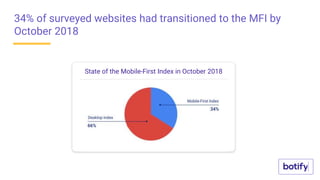
34% of surveyed websites had transitioned to the MFI by
October 2018
State of the Mobile-First Index in October 2018
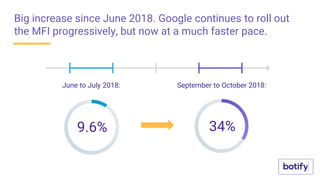
Big increase since June 2018. Google continues to roll out
the MFI progressively, but now at a much faster pace.
June to July 2018: September to October 2018:
9.6% 34%
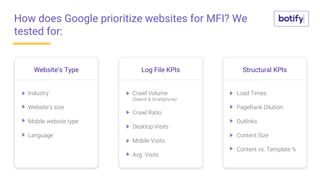
Website’s Type
Industry
Website’s size
Mobile website type
Language
Log File KPIs
Crawl Volume
(Search & Smartphone)
Crawl Ratio
Desktop Visits
Mobile Visits
Avg. Visits
Structural KPIs
Load Times
PageRank Dilution
Outlinks
Content Size
Content vs. Template %
How does Google prioritize websites for MFI? We
tested for:
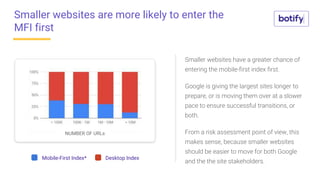
Smaller websites are more likely to enter the
MFI first
Smaller websites have a greater chance of
entering the mobile-first index first.
Google is giving the largest sites longer to
prepare, or is moving them over at a slower
pace to ensure successful transitions, or
both.
From a risk assessment point of view, this
makes sense, because smaller websites
should be easier to move for both Google
and the the site stakeholders.
NUMBER OF URLs
Mobile-First Index* Desktop Index
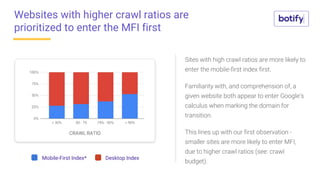
Websites with higher crawl ratios are
prioritized to enter the MFI first
Sites with high crawl ratios are more likely to
enter the mobile-first index first.
Familiarity with, and comprehension of, a
given website both appear to enter Google’s
calculus when marking the domain for
transition.
This lines up with our first observation -
smaller sites are more likely to enter MFI,
due to higher crawl ratios (see: crawl
budget).
CRAWL RATIO
Mobile-First Index* Desktop Index
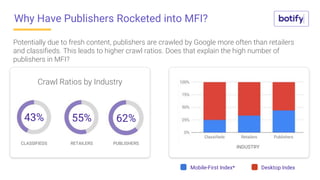
Why Have Publishers Rocketed into MFI?
Potentially due to fresh content, publishers are crawled by Google more often than retailers
and classifieds. This leads to higher crawl ratios. Does that explain the high number of
publishers in MFI?
Mobile-First Index* Desktop Index
43% 55% 62%
CLASSIFIEDS RETAILERS PUBLISHERS
Crawl Ratios by Industry
INDUSTRY
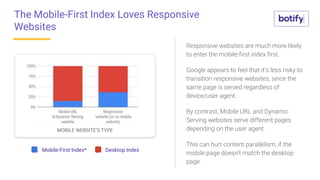
The Mobile-First Index Loves Responsive
Websites
Responsive websites are much more likely
to enter the mobile-first index first.
Google appears to feel that it’s less risky to
transition responsive websites, since the
same page is served regardless of
device/user agent.
By contrast, Mobile URL and Dynamic
Serving websites serve different pages
depending on the user agent.
This can hurt content parallelism, if the
mobile page doesn’t match the desktop
page.
Mobile-First Index* Desktop Index
MOBILE WEBSITE’S TYPE
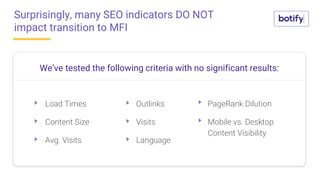
Surprisingly, many SEO indicators DO NOT
impact transition to MFI
We’ve tested the following criteria with no significant results:
Load Times
Content Size
Avg. Visits
PageRank Dilution
Mobile vs. Desktop
Content Visibility
Outlinks
Visits
Language
How will a transition to
the mobile-first index
impact your site?
CRAWL RATIO
& CRAWL VOLUME
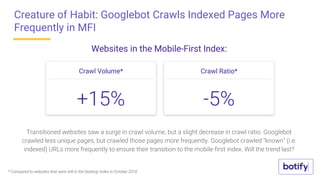
Creature of Habit: Googlebot Crawls Indexed Pages More
Frequently in MFI
Transitioned websites saw a surge in crawl volume, but a slight decrease in crawl ratio. Googlebot
crawled less unique pages, but crawled those pages more frequently. Googlebot crawled “known” (i.e.
indexed) URLs more frequently to ensure their transition to the mobile-first index. Will the trend last?
Websites in the Mobile-First Index:
* Compared to websites that were still in the Desktop Index in October 2018
Crawl Volume*
+15%
Crawl Ratio*
-5%
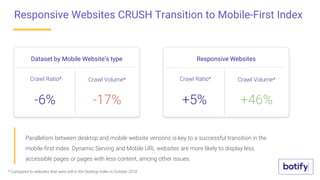
Responsive Websites CRUSH Transition to Mobile-First Index
Parallelism between desktop and mobile website versions is key to a successful transition in the
mobile-first index. Dynamic Serving and Mobile URL websites are more likely to display less
accessible pages or pages with less content, among other issues.
Dataset by Mobile Website’s type
Crawl Ratio* Crawl Volume*
-17%-6%
Responsive Websites
Crawl Ratio* Crawl Volume*
+46%+5%
* Compared to websites that were still in the Desktop Index in October 2018
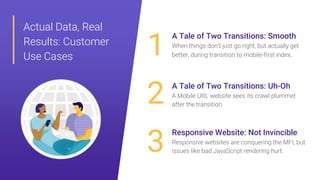
Actual Data, Real
Results: Customer
Use Cases
A Tale of Two Transitions: Smooth
When things don’t just go right, but actually get
better, during transition to mobile-first index.1
A Tale of Two Transitions: Uh-Oh
A Mobile URL website sees its crawl plummet
after the transition.2
Responsive Website: Not Invincible
Responsive websites are conquering the MFI, but
issues like bad JavaScript rendering hurt.3
1 A Tale of Two Transitions: Smooth
When things don’t just go right, but actually get better, during a
responsive site’s transition to the mobile-first index.
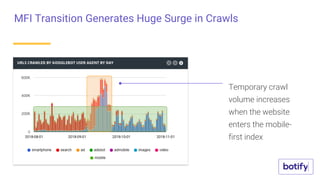
Temporary crawl
volume increases
when the website
enters the mobile-
first index
MFI Transition Generates Huge Surge in Crawls
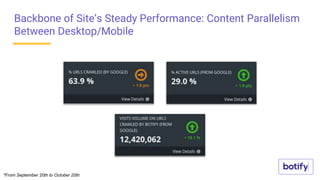
*From September 20th to October 20th
Backbone of Site’s Steady Performance: Content Parallelism
Between Desktop/Mobile
2 A Tale of Two Transitions: Uh-Oh
A Mobile URL website sees its crawl plummet after the
transition.
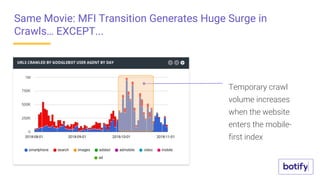
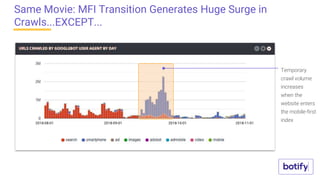
Same Movie: MFI Transition Generates Huge Surge in
Crawls… EXCEPT...
Temporary crawl
volume increases
when the website
enters the mobile-
first index
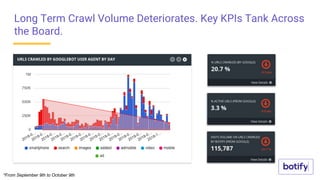
*From September 9th to October 9th
Long Term Crawl Volume Deteriorates. Key KPIs Tank Across
the Board.
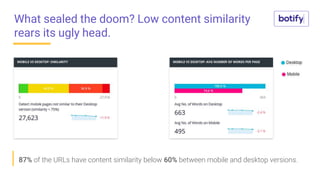
87% of the URLs have content similarity below 60% between mobile and desktop versions.
What sealed the doom? Low content similarity
rears its ugly head.
3 Responsive Website: Not Invincible
Responsive websites are conquering the MFI, but issues like
bad JavaScript rendering can really hurt.
Same Movie: MFI Transition Generates Huge Surge in
Crawls...EXCEPT...
Temporary
crawl volume
increases
when the
website enters
the mobile-first
index
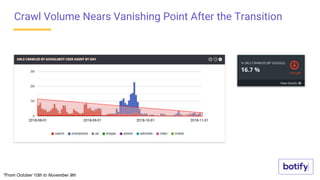
*From October 10th to November 9th
Crawl Volume Nears Vanishing Point After the Transition
*From October 10th to November 9th
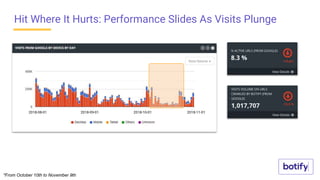
Hit Where It Hurts: Performance Slides As Visits Plunge
So, are you ready for the
Mobile-First Index?
7 tips for a successful
transition right now.
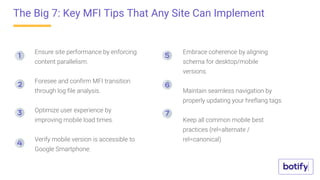
The Big 7: Key MFI Tips That Any Site Can Implement
Ensure site performance by enforcing
content parallelism.
Foresee and confirm MFI transition
through log file analysis.
Optimize user experience by
improving mobile load times.
Verify mobile version is accessible to
Google Smartphone.
Embrace coherence by aligning
schema for desktop/mobile
versions.
Maintain seamless navigation by
properly updating your hreflang tags.
Keep all common mobile best
practices (rel=alternate /
rel=canonical)
Request a customized demo of
your website to see how Botify
can help you succeed in the
mobile-first index !
Request a Demo