Mindfulness, Partnered Movement, and Strength Training for Well-being
Explore mindfulness practices, partnered movement exercises, and strength training techniques to enhance physical and mental well-being, including breathing exercises, meditation, and fitness coaching guidance.
Mindfulness, Partnered Movement, and Strength Training for Well-being
2.
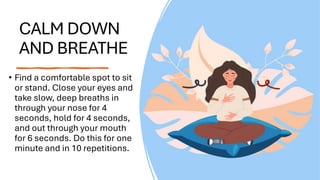
CALM DOWN
AND BREATHE
•Find a comfortable spot to sit
or stand. Close your eyes and
take slow, deep breaths in
through your nose for 4
seconds, hold for 4 seconds,
and out through your mouth
for 6 seconds. Do this for one
minute and in 10 repetitions.
3.
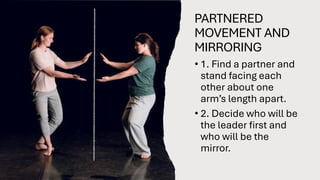
PARTNERED
MOVEMENT AND
MIRRORING
• 1.Find a partner and
stand facing each
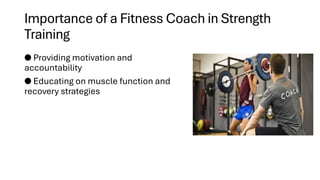
other about one
arm’s length apart.
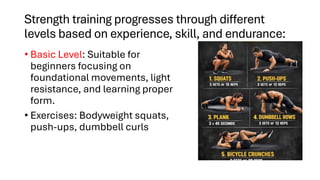
• 2. Decide who will be
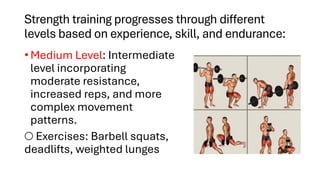
the leader first and
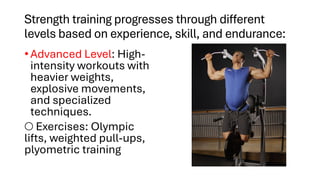
who will be the
mirror.
4.
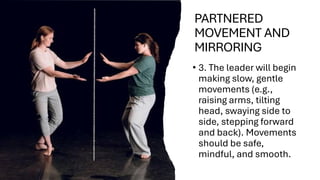
PARTNERED
MOVEMENT AND
MIRRORING
• 3.The leader will begin
making slow, gentle
movements (e.g.,
raising arms, tilting
head, swaying side to
side, stepping forward
and back). Movements
should be safe,
mindful, and smooth.
5.
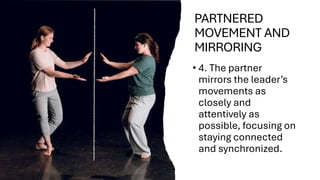
PARTNERED
MOVEMENT AND
MIRRORING
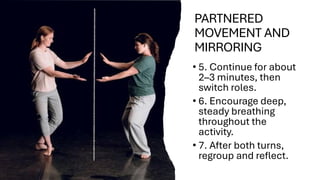
• 4.The partner
mirrors the leader’s
movements as
closely and
attentively as
possible, focusing on
staying connected
and synchronized.
6.
PARTNERED
MOVEMENT AND
MIRRORING
• 5.Continue for about
2–3 minutes, then
switch roles.
• 6. Encourage deep,
steady breathing
throughout the
activity.
• 7. After both turns,
regroup and reflect.
9.
PARTNERED MOVEMENT AND
MIRRORING
•How did it feel to be the leader and to
be the mirror? Which role was easier or
more challenging for you, and why?
• What did you notice about your focus
and body awareness during the
activity?
• How did this activity help you connect
with your partner without using words?
10.
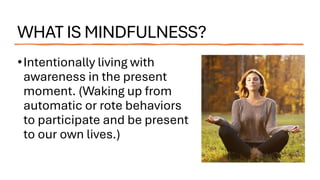
WHAT IS MINDFULNESS?
•Intentionallyliving with
awareness in the present
moment. (Waking up from
automatic or rote behaviors
to participate and be present
to our own lives.)
11.
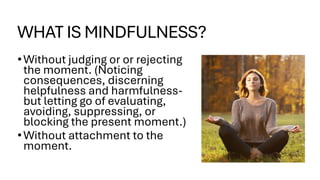
WHAT IS MINDFULNESS?
•Withoutjudging or or rejecting
the moment. (Noticing
consequences, discerning
helpfulness and harmfulness-
but letting go of evaluating,
avoiding, suppressing, or
blocking the present moment.)
•Without attachment to the
moment.
12.
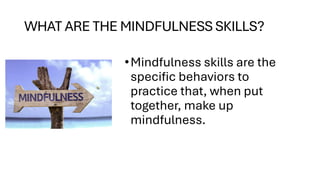
WHAT ARE THEMINDFULNESS SKILLS?
•Mindfulness skills are the
specific behaviors to
practice that, when put
together, make up
mindfulness.
13.
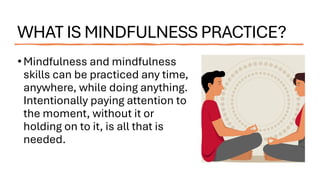
WHAT IS MINDFULNESSPRACTICE?
•Mindfulness and mindfulness
skills can be practiced any time,
anywhere, while doing anything.
Intentionally paying attention to
the moment, without it or
holding on to it, is all that is
needed.
14.
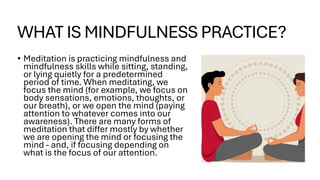
WHAT IS MINDFULNESSPRACTICE?
• Meditation is practicing mindfulness and
mindfulness skills while sitting, standing,
or lying quietly for a predetermined
period of time. When meditating, we
focus the mind (for example, we focus on
body sensations, emotions, thoughts, or
our breath), or we open the mind (paying
attention to whatever comes into our
awareness). There are many forms of
meditation that differ mostly by whether
we are opening the mind or focusing the
mind - and, if focusing depending on
what is the focus of our attention.
15.
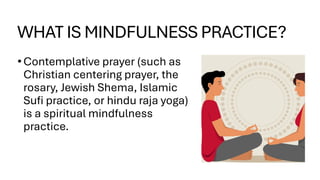
WHAT IS MINDFULNESSPRACTICE?
•Contemplative prayer (such as
Christian centering prayer, the
rosary, Jewish Shema, Islamic
Sufi practice, or hindu raja yoga)
is a spiritual mindfulness
practice.
16.
WHAT IS MINDFULNESSPRACTICE?
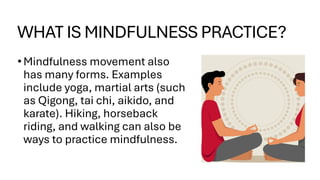
•Mindfulness movement also
has many forms. Examples
include yoga, martial arts (such
as Qigong, tai chi, aikido, and
karate). Hiking, horseback
riding, and walking can also be
ways to practice mindfulness.
17.
Enhancing Physiological Developmentand
Well-being
• Strength Training:
Exercises that improve
muscle strength (e.g.,
lifting weights, resistance
bands).
• Cardio: Activities that
increase heart rate and
endurance (e.g., running,
swimming).
18.
Enhancing Physiological Developmentand
Well-being
• Flexibility: Exercises that
enhance the range of
motion (e.g., stretching,
yoga).
• Balance: Activities that
improve stability and
coordination (e.g., balance
exercises, tai chi).
20.
Importance of aFitness Coach in Strength
Training
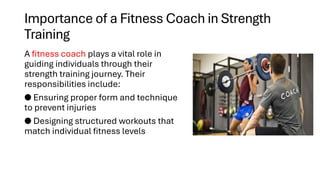
A fitness coach plays a vital role in
guiding individuals through their
strength training journey. Their
responsibilities include:
● Ensuring proper form and technique
to prevent injuries
● Designing structured workouts that
match individual fitness levels
21.
Importance of aFitness Coach in Strength
Training
● Providing motivation and
accountability
● Educating on muscle function and
recovery strategies
22.
Strength training progressesthrough different
levels based on experience, skill, and endurance:
• Basic Level: Suitable for
beginners focusing on
foundational movements, light
resistance, and learning proper
form.
• Exercises: Bodyweight squats,
push-ups, dumbbell curls
23.
Strength training progressesthrough different
levels based on experience, skill, and endurance:
• Medium Level: Intermediate
level incorporating
moderate resistance,
increased reps, and more
complex movement
patterns.
○ Exercises: Barbell squats,
deadlifts, weighted lunges
24.
Strength training progressesthrough different
levels based on experience, skill, and endurance:
• Advanced Level: High-
intensity workouts with
heavier weights,
explosive movements,
and specialized
techniques.
○ Exercises: Olympic
lifts, weighted pull-ups,
plyometric training