MICROENCAPSULATION
Novel Drug Delivery Systems (BP704T)
Presenter: Divyani Dutta, B.Pharm VII Semester
Submitted to: Dr. Sagar Trivedi
School of Pharmacy, G. H. Raisoni University, Saikheda
2026–2027
G. H. Raisoni University, Saikheda
Introduction & Definition
Microencapsulation is a core Novel Drug Delivery System (NDDS) technology involving the enclosure of drug particles
within a polymeric coating (1–1000 μm) to form microcapsules or microspheres.
Process: Drug (Core) →Polymer Selection →Microencapsulation →Microcapsules / Microspheres →Controlled Release
Importance of
Microencapsulation
Protection from moisture,
oxygen & light
Improved drug stability
Taste & odour masking
Controlled & sustained release
Reduced dosing frequency
Minimized toxicity
Improved patient compliance
Targeted drug delivery
Advantages & Disadvantages
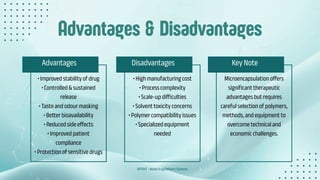
Advantages
• Improved stability of drug
• Controlled & sustained
release
• Taste and odour masking
• Better bioavailability
• Reduced side effects
• Improved patient
compliance
• Protection of sensitive drugs
Disadvantages
• High manufacturing cost
• Process complexity
• Scale-up difficulties
• Solvent toxicity concerns
• Polymer compatibility issues
• Specialized equipment
needed
Key Note
Microencapsulation offers
significant therapeutic
advantages but requires
careful selection of polymers,
methods, and equipment to
overcome technical and
economic challenges.
BP704T - Novel Drug Delivery Systems
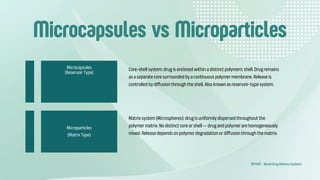
Microcapsules vs Microparticles
Microcapsules
(Reservoir Type)
Microparticles
(Matrix Type)
Core-shell system: drug is enclosed within a distinct polymeric shell. Drug remains
as a separate core surrounded by a continuous polymer membrane. Release is
controlled by diffusion through the shell. Also known as reservoir-type system.
Matrix system (Microspheres): drug is uniformly dispersed throughout the
polymer matrix. No distinct core or shell — drug and polymer are homogeneously
mixed. Release depends on polymer degradation or diffusion through the matrix.
BP704T – Novel Drug Delivery Systems
Methods of Microencapsulation
Physical Methods:
Pan Coating
Air Suspension
Spray Drying
Spray Congealing
Physicochemical Methods:
Coacervation-Phase Separation
Solvent Evaporation
Chemical Methods:
Interfacial Polymerization
In-situ Polymerization
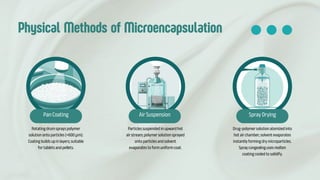
Physical Methods of Microencapsulation
Pan Coating Air Suspension Spray Drying
Rotating drum sprays polymer
solution onto particles (>600 μm).
Coating builds up in layers; suitable
for tablets and pellets.
Particles suspended in upward hot
air stream; polymer solution sprayed
onto particles and solvent
evaporates to form uniform coat.
Drug-polymer solution atomized into
hot air chamber; solvent evaporates
instantly forming dry microparticles.
Spray congealing uses molten
coating cooled to solidify.
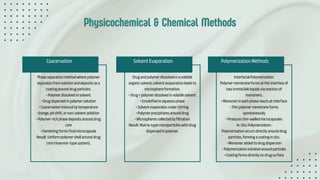
Physicochemical & Chemical Methods
Coacervation
Phase separation method where polymer
separates from solution and deposits as a
coating around drug particles.
• Polymer dissolved in solvent
• Drug dispersed in polymer solution
• Coacervation induced by temperature
change, pH shift, or non-solvent addition
• Polymer-rich phase deposits around drug
core
• Hardening forms final microcapsule
Result: Uniform polymer shell around drug
core (reservoir-type system).
Solvent Evaporation
Drug and polymer dissolved in a volatile
organic solvent; solvent evaporation leads to
microsphere formation.
• Drug + polymer dissolved in volatile solvent
• Emulsified in aqueous phase
• Solvent evaporates under stirring
• Polymer precipitates around drug
• Microspheres collected by filtration
Result: Matrix-type microparticles with drug
dispersed in polymer.
Polymerization Methods
Interfacial Polymerization:
Polymer membrane forms at the interface of
two immiscible liquids via reaction of
monomers.
• Monomer in each phase reacts at interface
• Thin polymer membrane forms
spontaneously
• Produces thin-walled microcapsules
In-Situ Polymerization:
Polymerization occurs directly around drug
particles, forming a coating in situ.
• Monomer added to drug dispersion
• Polymerization initiated around particles
• Coating forms directly on drug surface
Working
Mechanism
Drug Selection: Choose active pharmaceutical ingredient and determine desired
release profile.
Polymer Selection: Select appropriate wall material based on compatibility and
release requirements.
Drug-Polymer Mixture Preparation: Blend core material with chosen polymer in
suitable medium.
Encapsulation Method: Apply selected technique (pan coating, coacervation,
spray drying, etc.).
Coating Formation: Polymer deposits uniformly around drug particles forming
the membrane.
Drying/Hardening: Solvent removal and hardening of the polymeric coat for
stability.
Microcapsules: Final product with drug enclosed within polymeric shell (1–1000
μm).
Drug Release: Controlled/sustained release of drug at target site upon trigger.
School of Pharmacy, G. H. Raisoni University
Applications of
Microencapsulation
• Controlled drug delivery
• Sustained-release dosage forms
• Taste masking
• Targeted drug delivery
• Vaccine delivery
• Protein & peptide delivery
• Cancer therapy
• Cosmetic formulations
• Food industry applications
• Agricultural products
BP704T – Novel Drug Delivery Systems
References
1.Jain, N. K. Controlled and Novel Drug Delivery. CBS Publishers & Distributors, New
Delhi.
2.Chien, Y. W. Novel Drug Delivery Systems. Marcel Dekker, Inc., New York.
3.Vyas, S. P. & Khar, R. K. Targeted and Controlled Drug Delivery: Novel Carrier Systems.
CBS Publishers, New Delhi.
4.PCI B.Pharm BP704T Syllabus – Novel Drug Delivery Systems. Pharmacy Council of
India.
THANK YOU
Questions & Discussion | School of Pharmacy, G. H.
Raisoni University, Saikheda