INTRODUCTION
• The word"menopause" literally means the
"end of monthly cycles" from the Greek word
pausis (cessation) and the root men- (month),
Menopause is a normal condition naturally
occurring process, not a disease that all
women experience as they age.
3.
Introduction cont’d
• Theterm "menopause" is commonly used to
describe any of the changes a woman
experiences either just before or after she
stops menstruating, marking the end of her
reproductive period
4.
Introduction cont’d
• whenit occurs after the age of 40, is
considered natural and is a normal part of
aging and menopause that occurs before the
age of 40, regardless of the cause, is called
premature menopause (Eliopoulos, 2005).
Menopause is most easily understood as the
opposite process to menarch, the start of the
monthly period.
5.
Introduction cont’d
• Itnormally occurs between 45 and 55 years of
age with the mean age of 51 years
(Stellenberg and Bruce, 2007). An early
menopause can be related to cigarette
smoking, higher body mass index, racial and
ethnic factors, illnesses, chemotherapy,
radiation and the surgical removal of the
uterus and/or both ovaries.
6.
Introduction cont’d
• Thistransition has a variable degree of effects;
it can be a difficult time of life for some
women, less so for others. Effective
management of physical aspect of menopause
can enable women to experience this time of
life as positive passage rather than distressing
detour
7.
DEFINITION
• Menopause isthe permanent ceasation of
menses for at least one year (Eliopoulos,
2005). It can be officially declared (in an adult
woman who is not pregnant, is not lactating,
and who has an intact uterus).
8.
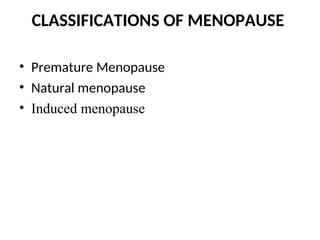
STAGES OF NATURALMENOPAUSE
• Perimenopause (climacteric).
• Menopause
• Postmenopause
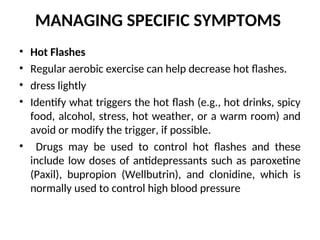
MANAGING SPECIFIC SYMPTOMS
•Hot Flashes
• Regular aerobic exercise can help decrease hot flashes.
• dress lightly
• Identify what triggers the hot flash (e.g., hot drinks, spicy
food, alcohol, stress, hot weather, or a warm room) and
avoid or modify the trigger, if possible.
• Drugs may be used to control hot flashes and these
include low doses of antidepressants such as paroxetine
(Paxil), bupropion (Wellbutrin), and clonidine, which is
normally used to control high blood pressure
13.
MANAGING SPECIFIC SYMPTOMS
cont’d
•Vaginal Dryness/Dyspareunia
• The loss of estrogen associated with
menopause causes changes in the vagina
• The vaginal lining may become thin and dry,
which can cause painful intercourse as well as
making the vagina more prone to infection.
Vaginal lubricants/moisturizers can make
intercourse more comfortable and regular sex
may help the vagina maintain its elasticity.
14.
• Estrogen ReplacementTherapy/Hormonal
Replacement Therapy, vaginal estrogen
creams, vaginal estrogen rings, and low-dose
oral contraceptives have been shown to help
moisten the vagina and decrease dyspareunia,
as well as decrease the incidence of UTIs. Soy
products may also be helpful for vaginal
dryness.
15.
CONTROLLING MENOPAUSE
SYMPTOMS
• Symptomscan reduce without taking
hormones
• Diet
• Food rich in plant estrogens such as
apples, carrots, nuts, seeds soy
products, wheat and whole grains.
• Food rich in boron to increase estrogen
retention such as cabbage, peaches
strawberry, tomatoes
16.
• Avoidance ofandrenal stimulating foods such
as caffeine, alcohol, and spicy foods, refined
carbohydrates, salt, and sugar
• Get adequate calcium and vitamin D in food or
supplements
• Drink plenty of water to stay hydration.
• Reduce foods high in fat.
17.
CONTROLLING MENOPAUSE
SYMPTOMS cont’d
•Exercises
• Get plenty of exercise
• Perform Kegel exercises daily to strengthen the
muscles of your vagina and pelvis
• Practice slow, deep breathing whenever a hot
flash starts to come on (try taking six breaths per
minute)
• Remain sexually active
• Aacupuncture
18.
CONTROLLING MENOPAUSE
SYMPTOMS cont’d
•Information Education and Communication is
a very important approach to management of
menopause and the following topics should be
included;
• Process of menopause
• The manifestation of menopause
• The management or approaches to
management
• complication
19.
CONTROLLING MENOPAUSE
SYMPTOMS cont’d
•Specific recommendations for use of :
• HT may be started in women who have recently
entered menopause.
• HT should not be used in women who started
menopause many years ago, except for an
exception is estrogen vaginal creams.
• The medicine should not be used for longer than
5 years.
• Should have a baseline low risk for stroke, heart
disease, blood clots, or breast cancer.
20.
Controlling symptoms
• Epidemiologicalstudies consistently find that
women using ERT/HRT have a 40-50% lower risk
• of dying of coronary heart disease than women
who do not take ERT/HRT. The apparent benefit
• is largely limited to current or recent use (Jacobs
Institute of Women's Health Expert Panel on
Menopause, 2000).
•
Conclusion
.
• Menopause isa special stage in women’s life
that all women experience as they grow older
and it is a normal part of aging though it may
come early in some circumstances.
23.
Conclusion cont’d
• Itmarks the end of a women’s reproductive
cycle, this means that after menopause a woman
is infertile. This period is known to be influenced
by low levels of hormones which bring several
physical and emotional effects on women during
this period.
• Though menopause occurs after 40 years in most
women worldwide, it is believed that
socio/cultural organization of the course of life in
specific geographical locations profoundly affects
the meanings and experience of menopause
24.
Conclusion cont’d
• Thequality of life or life style during this period
may be culturally-influenced such as diet,
smoking ,exercise, cultural attitudes towards and
expectations about the meanings assigned to
menopause, similarly if its recognized as natural
and normal, deviant, or as an illness
• This period can be managed reducing the
uncomfortable symptoms that a woman may
experience.
25.
Conclusion cont’d
• Thereforeit is important to educate the women
on the process of menopause and remedies that
prevent menopausal symptoms that they would
be able to manage themselves and understand
that it is a normal process.
• Complications that can occur with menopause
such as cardiovascular problems, osteoporosis,
and obesity can be managed and minimized if
women are well informed about menopause.
26.
• Lowdermilk L.and Perry S.,(2005) Maternity and
women’s health care, 6th
edition ,mosby, ,Missouri.
• Oxford journals medicine human reproductive
update volume 11,issue5 pp. 495-512 culture and
symptom reporting at menopause ( Accessed o3
January 2012).
•
• Stellenberg E. and Bruce J.( 2007), Nursing practice,
Medical surgical nursing for hospitals and community,
African edition, Elselvier, Churchill.