Megaprojects The Changing Politics Of Urban Public Investment Alan A Altshuler
Megaprojects The Changing Politics Of Urban Public Investment Alan A Altshuler
Megaprojects The Changing Politics Of Urban Public Investment Alan A Altshuler
Megaprojects The Changing Politics Of Urban Public Investment Alan A Altshuler
Megaprojects The Changing Politics Of Urban Public Investment Alan A Altshuler
1.
Megaprojects The ChangingPolitics Of Urban
Public Investment Alan A Altshuler download
https://ebookbell.com/product/megaprojects-the-changing-politics-
of-urban-public-investment-alan-a-altshuler-47499224
Explore and download more ebooks at ebookbell.com
2.
Here are somerecommended products that we believe you will be
interested in. You can click the link to download.
Project Execution Of Megaprojects For The Oil And Gas Industries
Anthreas
https://ebookbell.com/product/project-execution-of-megaprojects-for-
the-oil-and-gas-industries-anthreas-38513968
Mega Urban Projects In China The Case Of Hongqiao Yanpeng Jiang
https://ebookbell.com/product/mega-urban-projects-in-china-the-case-
of-hongqiao-yanpeng-jiang-47257424
The Alma Telescope The Story Of A Science Megaproject 1st Edition Paul
A Vanden Bout
https://ebookbell.com/product/the-alma-telescope-the-story-of-a-
science-megaproject-1st-edition-paul-a-vanden-bout-51487188
Agriculture Recreation Water Quality And Nature Protection In The Hula
Valley Israel 70 Years Of A Megaecological Project Moshe Gophen
https://ebookbell.com/product/agriculture-recreation-water-quality-
and-nature-protection-in-the-hula-valley-israel-70-years-of-a-
megaecological-project-moshe-gophen-49175996
3.
The React MegatutorialLearn Front End Development With React By
Building A Complete Project Stepbystep Grinberg
https://ebookbell.com/product/the-react-megatutorial-learn-front-end-
development-with-react-by-building-a-complete-project-stepbystep-
grinberg-232553244
The Essential Pine Book Includes 12 Projects Using This Versatile Wood
John Mcguane
https://ebookbell.com/product/the-essential-pine-book-
includes-12-projects-using-this-versatile-wood-john-mcguane-5687414
New Yorks New Edge Contemporary Art The High Line And Urban
Megaprojects On The Far West Side David Halle Elisabeth Tiso
https://ebookbell.com/product/new-yorks-new-edge-contemporary-art-the-
high-line-and-urban-megaprojects-on-the-far-west-side-david-halle-
elisabeth-tiso-51439400
Contemporary Megaprojects Organization Vision And Resistance In The
21st Century Seth Schindler Editor Simin Fadaee Editor Dan Brockington
Editor
https://ebookbell.com/product/contemporary-megaprojects-organization-
vision-and-resistance-in-the-21st-century-seth-schindler-editor-simin-
fadaee-editor-dan-brockington-editor-51749950
Contemporary Megaprojects Organization Vision And Resistance In The
21st Century 1st Edition Seth Schindler Editor
https://ebookbell.com/product/contemporary-megaprojects-organization-
vision-and-resistance-in-the-21st-century-1st-edition-seth-schindler-
editor-34810148
The Changing
Politics of
UrbanPublic
Investment
Alan Altshuler
David Luberoff
BROOKINGS INSTITUTION PRESS
Washington,D.C.
LINCOLN INSTITUTE OF LAND POLICY
Cambridge, Massachusetts
MEGA - PROJECTS
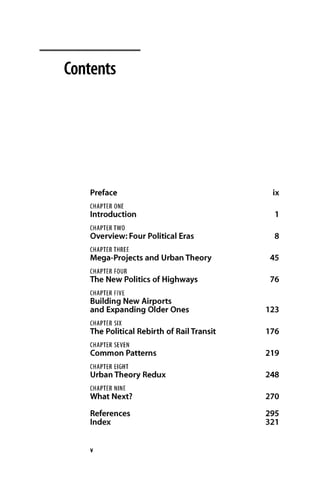
Contents
Preface ix
CHAPTER ONE
Introduction1
CHAPTER TWO
Overview: Four Political Eras 8
CHAPTER THREE
Mega-Projects and Urban Theory 45
CHAPTER FOUR
The New Politics of Highways 76
CHAPTER FIVE
Building New Airports
and Expanding Older Ones 123
CHAPTER SIX
The Political Rebirth of Rail Transit 176
CHAPTER SEVEN
Common Patterns 219
CHAPTER EIGHT
Urban Theory Redux 248
CHAPTER NINE
What Next? 270
References 295
Index 321
v
Preface
uringthe1980stherewasmuchtalkofanationalinfra-
structure crisis. Federaldata indicated that, whereas the per capita net
stock of state and local fixed capital had risen by an average of more than
4 percent annually during the middle and late 1960s, its rate of growth had
plummeted to zero from the late 1970s through the mid-1980s.1
Toward
the end of this period, as the nation's most prominent pending highway
project was cancelled (because of environmental restrictions and an inter-
state development conflict), Senator Daniel Patrick Moynihan (D-N.Y.)
observed: "There is a kind of stasis that is beginning to settle into our pub-
lic life. We cannot reach decisions. Central Park could not conceivably be
built today as it was when there was enough power in Tammany Hall to
make the decision."2
Just a few years later, however, striking changes were occurring. There
was a modest increase in capital infrastructure investment nationwide, suf-
1. SeeAltshuler and Gomez-Ibanez (1993, table 2-2).
2. Cited by Alan Finder, "Westway: A Road That Was Paved with Mixed Intentions,
Losing Confidence and Opportunities,"New York Times, September 22, 1985, sec. 4, p. 6.
One of the present authors, Altshuler, had expressed similar pessimism in a 1975 article
coauthored with Robert Curry, concluding that while the new constraintson development
had been beneficial in many respects, "a significant danger remains, however,and its name
is paralysis. The points of potential veto are proliferating at a remarkable rate . . . and
threaten nearly all projects that arouse any significant controversy with endless delay, if not
with definitive rejection. Our system of shared power, in short, threatensto becomea system
of shared impotence." SeeAltshuler and Curry (1975, p. 40); and see also Popper(1991).
vii
D
13.
viii PREFACE
ficientin magnitudeto be captured in national statistics. The per capita rate
of growth in state and local fixed capital increased from zero in 1980-84
to 0.9 percent and rising in 1985-89.3
Vastly expensive urban projects were
moving forward—including a new airport in Denver, a new subway in Los
Angeles, light rail lines in Los Angelesand numerous other cities, the depres-
sion and decking over of Boston's elevated Central Artery in concert with
the construction of a new expressway and tunnel to Logan Airport, the
multibillion-dollar (court-ordered) cleanup of Boston Harbor and its trib-
utary waterways, and the development of sports facilities and convention
centers in cities across the United States.
It gradually dawned on us that no other scholars had yet focused on the
(limited) revival of public capital spending in urban areas or on its impli-
cations for a deeper understanding of urban and intergovernmental politics.
Indeed, theorists of urban politics—while emphasizing its profound thrust
toward economic growth and development—were devoting scarcely any
attention to public capital investment as either a development instrument or
source of intense conflict in local affairs.
While pondering this theme, most notably in connection with our teach-
ing, we launched a study in the early 1990s of the political history of one
such undertaking, Boston's Central Artery/Tunnel project.4
Learning in
depth about the remarkable trajectory of this project—probably the largest
and most complex ever undertaken within a single urban core—we became
increasingly interested in the extent to which it reflected broader patterns,
and we began to conceive the present study. As our work progressed, its
scope vastly expanded—to encompass 50 years and more of history, a wide
range of project types (though still concentrated in transportation), a focus
on intergovernmental as well as local politics, and a serious effort to inte-
grate our work with more general recent efforts to theorize about urban and
intergovernmental politics.
This work has been a collaboration in the truest sense of the word. Each
of us was centrally engaged in the research and writing of every chapter, and
the book's central ideas are all products of this joint effort. Amid our mul-
tiple responsibilities, however, the completion of this effort has proven to be
the work of half a decade, and along the way we have accumulated debts
to many others as well. We are most grateful for financial support at criti-
cal moments from the Lincoln Institute of Land Policy, the U.S. Department
of Transportation's University Transportation Center Program, the Taub-
3. Altshuler and Gomez-Ibanez (1993, table 2-2).
4. See Luberoff and Altshuler (1996).
14.
PREFACE ix
man Centerfor State and Local Government of Harvard's John R Kennedy
School of Government, and the Massachusetts Executive Office of Trans-
portation (through two gubernatorial administrations that had little else in
common and under the leadership of three state secretaries of transporta-
tion: Fred Salvucci, Richard Taylor, and James Kerasiotis).
For advice and feedback, we are especially grateful to the following:
Steve Adams, Joachim Blatter, H. James Brown, Nancy Rutledge Connery,
Joseph Coughlin, Richard DeNeufville, Joseph DiMento, Jameson Doig,
Steven Erie, Charles Euchner, John Fischer, Kathryn Foster, Emil Frankel,
Bernard Frieden, Barbara Goldoftas, Jose Gomez-Ibanez, Mary Graham,
Arnold Howitt, Elizabeth Humphrey, Robert Levers, James Levitt, Peggy
Levitt, Judith Grant Long, Charles Magraw, Bill Manning, Steve Miller,
Eric Nass, Ken Orski, Bill Parent, David Perry, Paul E. Peterson, Alan Pis-
arski, Jonathan Richmond, Lynne Sagalyn, Heywood Sanders, Eric Segal,
Jefferey Sellers,Joe Sussman, Brian Taylor, Jay Walder, Allan Wallis, Melvin
Webber, Jack Wofford, and Paul Zigman.
We benefited as well from the contributions of a group of superb
research assistants: Mary Dunn, David Landau, David Greenberg, Melissa
Chan, Julia Koster, Tamar Shapiro, Meredith Rubin, James Ebenhoh, and
Stephanie Glazerman. We are also most grateful to Susan Bailey of the
Kennedy School Library, who was both ingenious and tireless in assisting
us to track down many fugitive sources and facts, and to Claire Brigandi,
Sandra Garron, Siobhan McLaughlin, Deborah Voutselas, Julie Zanotti,
Julie Farris, and Ryan Almstead, who all provided important logistical
support.
Our greatest debts of all, of course, are to our long-suffering families—
both to the youngest among them, who coped with our distraction and
arcane preoccupations for years, and to their elders, who encouraged and
supported us throughout. This book is dedicated by David to Jody, to their
daughters Rebecca and Anna, and to Ben and Neil Luberoff, who both
would have been proud. By Alan it is dedicated to Julie, their children (by
both birth and marriage), Jenny, David, Barry, and Jill, and their adored
grandchildren, Jacob, Ben, Evan, Zachary, and Jason.
CHAPTER ONE
Introduction
,
' iewedinternationally, American cities are unique—extra-
ordinarily self-reliant in relation to higher level governments, but also
extraordinarily dependent on private sector investment decisions. Providing
a wide array of essential services and exercising most land use authority
within their boundaries, they finance their activities mainly with revenue
that they raise themselves. When they do seek assistance from higher levels
of government, they engage vigorously as well in political mobilization.
Their physical and economic development has been driven overwhelmingly,
however, by private for-profit investment. In many respects, as a result,
local politics has always been an aspect of business—a way of bringing
government power to bear in support of private investment opportunities.
American cities are conspicuous for the emphasis they place on growth and
in the intensity with which they compete with one another for it. Higher-
level governments have rarely sought to curb this feature of the system,
doubtless because it greatly enhances investor influence and business lead-
ers passionately support it. These have been the fundamental attributes of
city politics throughout American history.
Within this framework, however, the system of urban governance has
continually adapted to changes in the broader society, economy, and
national polity of which it is a part. The focus of this book is on a series of
profound changes that occurred during the second half of the twentieth
century involving the politics of large-scale government investments in
V
1
17.
2 INTRODUCTION
physical capitalfacilities—mega-projects, we label them—to revitalizecities
and stimulate their economic growth.1
This was a period, particularly during the third quarter of the century,of
kaleidoscopic change, as governments first took on a substantially more
active role in promoting development and then pulled back in the face of
massive public backlash. It was also a period in which higher-levelgovern-
ments became far more engaged in assisting localities to realize their
development ambitions, and in which—during the late 1960s and early
1970s—ordinary citizens and ideologically driven associations were
empowered as never before to constrain development where it threatened
to disrupt valued elements of the existing urban fabric. Local governments
and their private constituencies for growth did not retreat—at least not in
general or for long—from their thoroughgoing commitment to economic
development, but they did adjust their tactics profoundly. Most notably,
they shifted tactics in seeking to lure major investors, relying more on fis-
cal and regulatory inducements, less on public infrastructure development;
and within the arena of public development they shifted tactics as well,
striving to reduce disruption and minimize citizen resistance.
The original research presented in this book focuses on transportation
mega-projects: highways, airports, and mass transit systems. More broadly,
however, drawing on the work of other scholars as well, we endeavor to
answer the following questions:
—Why did American governments undertake such ambitious, highly
disruptive activities as urban renewal and intraurban expressway con-
1. The term mega-project as employed in this book denotes initiatives that are physical, very
expensive, and public. More specifically, mega-projects involve the creation of structures,
equipment, prepared development sites, or some combination thereof. They cost at least $250
million in inflation-adjusted year 2002 dollars. (This is an approximate rather than a hard-and-
fast threshold, but most of the projects discussed in this book exceeded it by a very comfortable
margin.) Mega-projects are fundamentally an expression of public authority. The clearest indi-
cator of their public nature since about 1920 has been public financing, wholly or in large part.
Other indicators, some of which were even more significant during the nineteenth and early
twentieth centuries, include government-granted monopoly franchises, land grants, delegations
of eminent domain authority, loan guarantees, and access to the benefits of public debt financ-
ing (for example, via the issuance of privately guaranteed public revenue bonds).
The prefix mega to indicate "very large" became common in science and engineering dur-
ing the late nineteenth century. (See Chambers Dictionary of Etymology, 3d ed, s.v. "mega.")
The term mega-project itself dates to the late 1970s, when the Canadian government and the
Bechtel Corporation more or less simultaneously adopted it, the former to describe massive
energy development projects to which it had recently committed, the latter to describe its gen-
eral portfolio of very large-scale projects. (See Jeff Sallott, "Oil Sands Alberta's Wildcard in
Pricing Battle with Ottawa," Globe and Mail, November 7, 1979, p. P9; and Thomas Lueck,
"Bechtel and Its Link to Reagan," New York Times, December 5, 1980, p. Dl.)
18.
INTRODUCTION 3
struction duringthe 1950s and 1960s? Why did public investments of such
magnitude, involving large-scale displacement of current residents and
enterprises, become feasible for the first and only time during this period?
—What changed during the late 1960s and early 1970s, delaying or
derailing most urban mega-projects then in the pipeline and sowing wide-
spread doubt that their like would often prove feasible again?
—How, and to what extent, did the political impulses that generated
mega-projects in the 1950s and 1960s find expression in the remaining
three decades of the century? How did the strategies and tactics required to
carry out mega-projects change after 1970, and at what cost? Did these new
requirements entail a shift as well in the dominant mega-project types?
—Are the political forces that have generated urban mega-projects over
the past half century so irrepressible and adaptive that a continuing flow of
such investments in the decades ahead may be anticipated? Or have the con-
straints on such development become so burdensome, and so expensive to
overcome, that urban mega-projects are likely to be very rare in future?
Interjurisdictional Competition
What competition means for American local governments, above all, is
striving to make themselves attractive to private investors. In bedroom sub-
urbs, the investors of primary concern are homebuyers.2
In major
employment centers, though, competitive efforts focus mainly on business
investors—because the largest among them control very large sums indeed,
because they bargain hard, and because local companies that stand to profit
from growth tend to be better funded, better organized, and more highly
motivated than anyone else to engage in politics on an ongoing basis.
This is not to say that the dominance of local growth interests is invari-
ant across local policy arenas, over time, or across jurisdictions. Growth
elites care most about such issues as downtown revitalization and improv-
ing regional infrastructure. Other groups typically have other priorities—
for example, improving neighborhood services and schools, police-
community relations, or conditions of public employment. In certain peri-
ods, moreover, groups critical of growth initiatives become far more active
and better mobilized than usual, forcing growth elites to retreat or at least
to adapt their plans in significant ways. Such eruptions of antigrowth senti-
ment eventually run out of steam, but they may leave enduring legacies.
Finally, the balance among local interests varies from one jurisdiction to
2. SeeFischel (2001, pp. 14-16, 242-44); and Schneider (1989, pp. 39-40, 125-46).
19.
4 INTRODUCTION
another. Whilegrowth coalitions appear dominant in most cities, at least
when it comes to their highest priority issues, there are also conspicuous
exceptions: cities like San Francisco, California, and Cambridge, Massa-
chusetts, in which groups emphasizing the need to constrain investors have
dominated for considerable periods. Such jurisdictions are invariably pros-
perous nonetheless, because they are endowed with such assets as favorable
climate, historic character, or anchor employers with very little capacity to
move (for example, universities and medical centers), which ensure strong
investment demand almost regardless of what they do.3
The instruments available to cities in pursuing their growth objectives fall
into two broad categories: inducements to private investors and direct pub-
lic investments. The former include zoning concessions, tax abatements,
low-interest loans, and the use of eminent domain to assemble and prepare
large parcels of land, often overlaid on a general pattern of low taxation and
minimal business regulation. The latter are most commonly for purposes
that large segments of the business community view as vital to localcom-
petitiveness, but from which it is generally impossible to extract profits
directly. Mass transit and convention center investments, for example, tend
to be intrinsically unprofitable. Airports and highways could in theory be
profitable but regulatory uncertainties, federal aid rules, and the ubiquity of
publicly owned, underpriced alternatives render them, with rare exceptions,
unduly risky for private investors. The inducement-investment distinction
frequently blurs in specific cases—as when governments build stadiums to
attract sports franchises or undertake road improvements to clinch deals
with private factory and office developers—but it is clear and significant in
many others.
We have chosen to focus on public investment strategies primarily for
two reasons. First, efforts to realize large-scale investment projects often
provide an unusually revealing window on patterns of influence in urban
development politics. Such projects involve huge commitments of public
resources and often entail significant threats to some interests and values
even as they promise great benefits to others. Because the stakes are so
high, the struggles over project authorization, planning, and implementation
often draw in powerful actors whose activities are normally camouflaged or
who stay out of lesser political disputes, confident that others will ade-
quately protect their interests.
3. P. E. Peterson (1995, pp. 28-29). Clarence Stone emphasizes, on the other hand, that
cities blessed with very strong investor demand often choose nonetheless to impose few restric-
tions. Stone (1993, pp. 19-20).
20.
INTRODUCTION 5
Second, whilepolitical scientists concerned with urban politics have
recently been preoccupied with business influence and economic develop-
ment policy, they have devoted remarkably little attention to the politics of
direct public investment. The most obvious explanation, noted above, is
that during the final three decades of the twentieth century cities shifted
notably away from public investment toward monetary and regulatory
inducements in their efforts to attract investors. It is less obvious, though,
why this shift occurred. One possibility is that cities were simply respond-
ing to economic and technical changes. A service economy may require less
public infrastructurefor each unit of output, for example, than its industrial
predecessor. Another possibility is that certain forms of large-scale public
investment became vastly more expensive, time consuming, and politically
difficult after about 1970. We argue mainly in this book for the latter, polit-
ical, explanation. The reductions in new urban highway and airport
construction, for example, were both abrupt and long lasting, despite bur-
geoning motor vehicle and air travel demand. Even as governments turned
away from these project types, moreover, they turned toward others much
easier to site in the new political environment but with far weakereco-
nomic rationales: for example, rail transit systems, convention centers, and
stadiums for professional sports franchises.4
One might reasonably conclude, on reviewing the most influential recent
works on American urban politics, that both competitive strategies and the
distribution of influence in urban politics have been fundamentally con-
stant over the past half century—though with slight adjustments to reflect
such factors as the declining economic value of new highways (Paul Peter-
son), the growing minority share of the central-city electorate (Clarence
Stone), and the increasing importance of amenity as a competitive asset
(John R. Logan and Harvey Molotch).5
We concur in part with this view. There certainly has been continuity on
two dimensions: the central role of business-led growth coalitions in urban
development politics and the disposition of cities to compete proactively for
investment rather than merely encourage it by holding down their tax rates
and minimizing their regulatory demands.
4. Similar changes occurred within the highway and airport sectors—toward the improve-
ment of existing highways rather than the construction of new ones, and improvements to
airport terminals rather than runways. We do not argue, however, that these shifts entailed any
worsening of typical project benefit-cost ratios.
5. P.E. Peterson (1981, p. 135); Stone (1989, pp. 79-82); and Logan and Molotch (1987,
pp. 76-81,290-91).
21.
6 INTRODUCTION
But wedevelop three collateral arguments in this book as well: (1) the
capacity of local growth coalitions to impose disruption on other local inter-
ests sharply—and durably—declined in the late 1960s and early 1970s; (2) the
new constraints imposed in this period stimulated changes in the types of proj-
ects undertaken, required major alterations in design and mitigation
strategies, and greatly drove up project costs; and (3) these changes merit
recognition as significant alterations in the overall character of urban politics.
From the standpoint of local business and political leaders, the primary
effect of the changes noted above has been to require tactical adjustments—
they have by and large found new ways to pursue their traditional objectives
of growth and economic competitiveness. From the standpoint of ordinary
citizens, however, particularly in the categories most commonly victimized
by mega-projects in the 1950s and 1960s (low-income and minority residents
of older neighborhoods), their significance has been fundamental. The capac-
ity to defend one's home and immediate environment, and the power to
influence decisions about how to distribute the costs and benefits of gov-
ernment activities bearing on them, are not everything one might desire as a
citizen. But they are, for most urban residents, the most important stakes of
urban politics—and thus merit a prominent place in theories about it.
Plan of the Book
A generic problem in studies of this type is to find the right balance between
depth and breadth. To keep the focus sharp, we concentrate on three inter-
related mega-project types: highways, airports, and rail transit systems, the
largest categories of public mega-project spending in and around cities dur-
ing the second half of the twentieth century. We opt for breadth, however,
on four other dimensions. First, we integrate our findings with leading the-
ories of urban politics and with the empirical research of others on urban
renewal and its successors, particularly the recent investment booms in
downtown festival malls, sports facilities, and convention centers. Second,
we address national patterns. Though we make substantial use of case nar-
ratives, they are drawn from multiple cities, chosen to illustrate broad
themes, and interspersed with examinations of national developments.
Third, our focus is intergovernmental. Most urban mega-projects during the
latter half of the twentieth century were undertaken within contours of
opportunity defined by federal programs and with substantial, often pre-
dominant, federal financing. They were frequently carried out, moreover, by
state agencies and regional authorities, leaving just a minor role in the for-
22.
INTRODUCTION 7
mal sensefor local governments. We delineate the multilevel dynamics of
these cases while highlighting as well the key roles that local actors invari-
ably performed. Finally, whereas most in-depth studies of urban politics
focus on relatively brief time periods and portray apparently stable patterns
of influence, we examine developments over half a century, long enough for
considerable evolution to have occurred.
This is, for most of its length, a work of empirical narrative and analy-
sis, intended for readers with a serious interest in urban politics and public
policy but not necessarily in urban political theory. Even its most empirical
chapters are driven, though, by concerns arising from political science the-
ory, and we bring these concerns to the fore in two chapters, 3 and 8. In
these we ask:
—What light can leading contemporary theories of urban and American
politics shed on the politics of large-scale public investment and its place
within the broader framework of urban governance?
—How well does each theory explain the observed facts? The signifi-
cance of this question, of course, is that general theories must inevitably be
tested against particular observations. No single failure is fatal, but the
path to theory appraisal (and perhaps refinement) must consist of an accu-
mulation of specific tests.
Readers who wish can skip chapters 3 and 8 without missing any por-
tion of our empirical argument. It is these chapters, however, that most
explicitly address the place of mega-project politics within the overall con-
text of urban and American governance and examine broad controversies
about the forces that have shaped urban development policy over the past
half century, so we hope that most will be drawn in.
Chapter 2 provides an overview of urban mega-project politics through
the second half of the twentieth century. Chapter 3 examines leading theo-
ries in search of propositions—hypotheses, from our standpoint—that seem
pertinent to our investigation. Chapters 4, 5, and 6 focus on highway, air-
port, and rail transit mega-projects, respectively. Chapter 7 draws out
common themes from these mode-specific narratives. Chapter 8 revisits the
formal theories discussed in chapter 2, asking which accord best with our
empirical findings. Finally, in chapter 9 we review developments since the
turn of the twenty-first century—including the terrorist attacks of Septem-
ber 11, 2001, and their early aftermath—and speculate on the future of
urban mega-projects.
23.
CHAPTER TWO
Overview:
Four
Political Eras
e
fe identify four stages in the history of urban public invest-
ment over the past century:
—The pre-1950 era: Localities received little aid from higher levels of
government, had limited resources, were generally reactive in their capital
investment strategies, and almost never imposed significant disruption on
existing built-up precincts.
—The "great mega-project era" (1950-late 1960s): With unprecedented
infusions of federal aid, cities and states undertook massive investment pro-
grams—designed above all to retrofit cities for the technologies and
corporate preferences of the mid-twentieth century.
—The era of transition (mid-1960s-early 1970s): Community and envi-
ronmental impacts of these programs provoked intense citizen protests,
leading governments to adopt rules greatly constraining disruptive public
investment.
—The era of "do no harm" (mid-1970s-present): Public investment in
mega-projects remains substantial if more limited than during the great
mega-project era, and quite central to the development strategies of many
cities. The dominant project types and implementation strategies are quite
different, however, because it is now essential to avoid or fully mitigate any
significant disruption.
W
8
24.
OVERVIEW: FOUR POLITICALERAS 9
The Pre-1950Era
From the earliest days of the Republic, civic boosters have prodded gov-
ernments to participate in the development of large-scale physical
facilities—from canals and railroads in the nineteenth century to airports
and convention centers today—deemed essential by private investors but
beyond their own unaided capacity. And they have frequently succeeded.
Until the middle of the twentieth century, though, such projects rarely
involved significant disruption of the existing urban fabric, and they typi-
cally proceeded within a broader framework of minimalist government—
that is, one in which services were extremely limited by modern standards.
Governments appealed to investors primarily by offering low taxes and
negligible regulation.1
Until the final years of the nineteenth century, large infrastructure
improvements were undertaken far more commonly by private than public
entities. The role of government was to provide exclusive franchises, author-
izations to take property by eminent domain, grants of land, and, more
rarely, loan guarantees or direct equity (stock)investments. During the first
half of the nineteenth century, when urbanization was still in its infancy,
state governments played a leading role in such efforts, often with federal
assistance in the form of land grants.2
State and federal involvement dimin-
ished subsequently, but cities, which were growing rapidly and acquiring far
greater institutional capacity, became increasingly active.3
For political
machines, at their zenith in this period, capital projects offered uniquely
attractive opportunities for profit and patronage as well as for the cultiva-
tion of key constituencies.4
Machines did not require public ownership to
reap the political benefits of capital spending, however; it was sufficient to
grant the franchises and maintain some ongoing regulatory presence. An
additional advantage of private development was that it took the issue of
1. Works that have been helpful in considering the pre-1950 era include: Aldrich (1980,
pp. 32-48, 77-99); Goodrich (1965); Sbragia (1996, pp. 44-79, 102-34); Teaford (1984, pp.
217-306); Perry (1995, pp. 202-36); Melosi (2000, pp. 117-74); and Tarr (1984, pp. 21-43).
2. State aid contracted sharply after the depressions of 1837 and 1857. By the beginning
of the Civil War, local aid for infrastructure was roughly equal to that provided by the states.
Tarr (1984, p. 8).
3. The first census of local and state governmentswas conducted in 1902. Bythat timelocal-
ities were responsible for more than 80 percent of all public capital spending. Authors'
calculations from Bureau of the Census, Historical Statistics of the United States: Colonial
Times to 1970 (1975, series F 1-5, series Y 783-95).
4. See Shefter (1976); and Merton (1973).
25.
10 OVERVIEW: FOURPOLITICAL ERAS
taxation off the table. Investors were expected to draw their revenues from
customer payments, and consumers who felt aggrieved were expected to
address their complaints to the private operators. Thus as major new infra-
structure technologies emerged in the late nineteenth and early twentieth
centuries—rail transit, the telephone, and electric power, in particular—
cities brought them on-line primarily by franchising companies rather than
investing directly.5
Over time, as these entities grew far beyond local bound-
aries, the regulatory function was increasingly taken over by higher levels
of government, but telecommunications and electric power remain almost
completely private to the present day.
Cities did not rely entirely on franchising, however, to address their grow-
ing infrastructure needs. It was difficult or impossible, given the metering
technologies then available, for private operators to recoup the costs of cer-
tain types of infrastructure that nonetheless came to be viewed as essential
to public health and economic growth. The debates about whether to under-
take such improvements were typically intense and often inconclusive until
crises (such as epidemics) forced action, but they were increasingly resolved
in the affirmative.6
Most direct public investment during the late nineteenth and early twen-
tieth centuries was concentrated in four areas: education, water and sewage,
street improvements, and urban beautification. The school-building boom
was fueled by explosive urban population growth and substantial increases
in the percentage of school-age children who attended school.7
Water and
sewage investments were driven by growing public health knowledge, con-
tinually reinforced by outbreaks of fatal disease that ravaged rich as well as
poor (though not, to be sure, in equal measure, as the rich were less densely
packed and could often escape the city in periods of epidemic). Spending on
streets and roads, already the second largest item in most municipal budgets
by the late nineteenth century (trailing only education), increased sharply
during the 1910s and 1920s in response to surging motor vehicle usage.
Most investment in this domain consisted of paving existing streets, though
many cities also widened major streets within and on the approaches to
downtown and at times, if land were available, built landscaped boule-
5. SeeFogelson (1967, pp. 86-92); Bottles (1987, pp. 28-33); Barrett (1983, p. 12); and
Warner (1978, p. 60).
6. For a vivid account of the years of controversy (amid repeated devastatingplagues) that
preceded Chicago's decision in the 1890s to incur the cost of reliably separatingits sewage and
water systems, see D. L. Miller (1996, pp. 423-32).
7. Aldrich (1980, pp. 37-38).
26.
OVERVIEW: FOUR POLITICALERAS 11
vards.8
During the same period, finally, many cities invested heavily in pub-
lic buildings, often of a monumental character, and parks, particularly with
the aim of enhancing the attractiveness of their downtowns.
These efforts were generally promoted by leading local businessmen, and
indeed this was a period of unprecedented growth in formal business orga-
nizations. While their vision of the proper role of government remained
narrow by later standards, they had arrived at the view that key attributes
of a competitive city included a better-educated (and Americanized) work
force, freedom from waterborne plagues, modern streets, and a beautified
central area.9
It is impossible to gauge the precise magnitude of these efforts
before 1902, when the Bureau of the Census began keeping track. From
1902 to 1927, however, local capital expenditures nearly quintupled in real
terms and rose from 0.7 percent to 1.5 percent of gross domestic product.10
By and large, the revenue base for core water and sewage investments, arte-
rial road improvements, and downtown projects was the local property
tax. On the other hand, water and sewage connections to specific neigh-
borhoods and properties and street paving projects in residential areas were
often financed by special assessments after petition from the owners
involved. This fee-for-service approach led, of course, to sharp disparities in
service between more and less affluent areas.11
The results of these spending and taxing policies were dramatic. Toillus-
trate, while only 310,000 people had access to treated water in 1890, more
than 45 million did by 1930.12
Similarly,while total road and street mileage
increased only 3 percent between 1914 and 1929, paved mileage increased
by 157 percent.13
The Great Depression brought an abrupt end to this local investment
boom, and indeed numerous local governments defaulted on bonds that
8. By the late 1920s limited-accessparkways were under construction in a fewlocalities,
and many major urban areas were developingplans for even more downtown-oriented high-
speed roads. Seely (1987, pp. 149-54); and McShane (1994, pp. 203-28).
9. Tarr (1984, pp. 26-29); Teaford (1984, pp. 187-214); and Boyer (1983, pp. 63-70).
More broadly,this was an era marked by business-backed efforts to assert more control over
local government and, as Robert Putnam has noted, a particularlyvibrant time for the for-
mation of all types of voluntary associations. Putnam (2000, pp. 383-401).
10. Authors' calculations from Bureau of the Census, Historical Statistics of the United
States: Colonial Times to 1970 (1975, series F 1-5, series Y 783-95).
11. Sbragia (1996, pp. 75-76).
12. Tarr (1984, p. 24); and Dupuy and Tarr (1982, p. 337), as cited by Sbragia (1996, p.
70).
13. Rae (1971, p. 354).
27.
12 OVERVIEW: FOURPOLITICAL ERAS
they (or special districts they had set up) had issued in the booming 1920s.14
Local spending cuts were partially offset by federal aid, which became an
important factor for the first time since the early nineteenth century, but the
principal aim of such aid was to create jobs, not facilitate the realization of
ambitious local visions. So New Deal programs typically spread their
resources over very large numbers of projects—small, simple to design, and
labor intensive. The largest single source of funding, for example, the fed-
eral Works Progress Administration, had an official dollar ceiling of $25,000
a project—though larger projects were frequently subdivided into several
$25,000 components. As of June 1938 the program had helped finance the
construction or repair of more than 34,000 schools, 280,000 miles of streets
and roads, 2,700 new parks and playgrounds, 153 new airports, 280 miles
of new airport runway, and 250 docks, as well as the planting of 24 million
trees.15
Federal jobs programs were curtailed in the late 1930s and ended during
World War II.16
The federal government undertook numerous projects,
most notably airport improvements, during the war that later proved suit-
able for civilian use, but local capital spending plummeted—to a level, by
1944, lower than at any time since the Census Bureau had begun keeping
track in 1902.17
Nonetheless, during the latter years of the war many cities,
in cooperation with their leading business groups, developed ambitious
revitalization plans—calling for new expressways and airports, downtown
beautification projects, and (in many locales) programs to replace slums
with new commercial facilities and market-rate housing.18
For the time being, these remained statements of aspiration rather than
serious action plans. In the absence of aid from higher-level governments,
very few cities were in a position to undertake major new projects. But they
did respond with sharp increases in capital spending to improve their exist-
ing infrastructure which, after a decade and a half of neglect, was typically
in an advanced state of decay.19
In aggregate, local capital expenditures
rose sevenfold in real terms from 1944 to 1950—finally reaching their pre-
14. Sbragia (1996, pp. 128-29).
15. Couch and Shughart (1998, pp. 113-18).
16. See Gelfand (1975, pp. 45-46, 63-65, 82-98); and D. K. Goodwin (1994, pp. 481-83).
17. Authors' calculations from Bureau of the Census, Historical Statistics of the United
States: Colonial Times to 1970, (1975, series F 1-5, series Y 783-95).
18. Teaford (1990, pp. 83-121).
19. Teaford (1990, pp. 76-79).
28.
OVERVIEW: FOUR POLITICALERAS 13
Depression level in the latter year.20
The politics of local capital budgeting,
however, particularly where local legislatures were ward-based or bond
issues required direct voter approval, strongly favored the diffusion rather
than concentration of resources—that is, small projects spread widely across
the city.21
During this period new limited-access roads were built in several
cities (includingLos Angeles, Boston, New York, and Detroit), most com-
monly under state auspices.22
By and large, however, local mega-project
plans gathered dust.
The Great Mega-Project Era
As the nation emerged from World War II, there was great concern that the
economy would slide back into depression, and the idea—a New Deal
legacy—that government could stimulate a weak economy by financing
public works enjoyed broad support. This was a period, furthermore, in
which public confidence in government was unusually high. The private
economy had failed in the 1930s, forcing vast numbers of people to turn to
government for employment or relief. Large sectors of business as well had
turned to government for subsidies, contracts, and regulatory protection
(against price-cutters and new entrants). Then, in the pressure cooker of
world war, tens of millions of people had served in the military or worked
for military contractors. The outcomes had been total victory abroad and
full employment at home.
Against this backdrop a variety of national, business-ledcoalitions assem-
bled to spur ambitious peacetime investment programs, largely financed by
the federal government. Though unswerving in their commitment to capi-
talist organization of the economy, these groups now favored vigorous
government action to further growth as well—and not merely during emer-
gencies like war and depression, but on a regular basis. Their path was by
no means easy, because pressures for tax cuts and a return to prewar pat-
terns of governance remained very strong. But several of these coalitions did
bring about major new programs in the decade or so following World War
II, most notably in support of housing, highway, and airport development.
20. As of 1950 the local share of total capitalspendingwas 50 percent, down from 70 per-
cent just before the Great Depression. See Bureau of the Census, Historical Statistics of the
United States: Colonial Times to 1970 (1975, series F 1-5, series Y 783-95).
21. SeeSanders (1992a, 1992B); and Teaford (1990 pp. 67-81).
22. SeeTaylor(2000).
29.
14 OVERVIEW: FOURPOLITICAL ERAS
The housing and motor vehicle industries—together with their suppliers,
distributors, franchisees, contractors, and collateral service businesses—
were already among the nation's largest, while the commercial aviation
industry, though still in its infancy, was among the most rapidly growing.
Each of these coalitions credibly claimed to represent surging popular
demand as expressed in the marketplace, and each was a formidable pres-
ence in nearly every congressional district.
These were years of growth and prosperity nationally, but not in older
central cities, which were experiencing a severe loss of both residents and
employers to the suburbs. Their handicaps in competing with newly devel-
oping areas were legion, from their physical layout and decay to their large
numbers of low-income and minority residents. And even the advantage of
centrality itself appeared to be a rapidly diminishing asset. Whereas virtu-
ally all transit lines radiated out from downtown, urban area residents were
now abandoning mass transit for cars at an astonishing rate. And cars
worked least well in cities, with their high-density, often narrow streets and
very limited space for parking.
Thus central-city leaders experienced a growing sense of desperation. In
order to head off a death spiral, they came to believe, nothing short of rad-
ical surgery would do—to clear away slums, to assemble and write down
the cost of large development sites, to build expressways from the suburbs
and regional airports into downtown, and more generally to retrofit "obso-
lete" elements of the urban fabric for the dominant technologies and
corporate space demands of the second half of the twentieth century. The
cities were already under severe fiscal strain, however, and had never
financed projects of such magnitude. Nor were the states likely to provide
the lead. The national coalitions for new federal programs represented an
alluring opportunity, however. If central-city interests could gain inclusion
in these coalitions and share in their victories, perhaps the federal govern-
ment could be enlisted as a partner in revitalizingcentral-city economies.
In the event, these national coalitions proved open to their central-city
petitioners—even, on occasion, where this required stretching their core
rationales considerably. Consider the campaign for urban renewal, which
had to overcome two objections to its inclusion as a housing coalition pri-
ority. First, it was by no means obviously a housing program. Its aim was
to stimulate for-profit, mainly commercial, investment in central cities—
particularly in central business districts, where its principal advocates were
most heavily invested. Proponents were eager to clear away slums, but cer-
tainly not to redevelop the cleared areas with new housing for the poor. The
30.
OVERVIEW: FOUR POLITICALERAS 15
ingenious solution was to define slum clearance as itself a housing program,
whether or not the housing destroyed was replaced.23
Second, urban
renewal was to involve compulsory land taking from private property own-
ers, most frequently for resale at subsidized prices to other private owners.
Many people found this extremely hard to swallow, and some were sure the
courts would find it unconstitutional. A few years earlier, this would doubt-
less have been the case. Now, however, with broad support from the private
business community, it passed constitutional as well as congressional
muster—on the grounds that both slum clearance and urban revitalization
were legitimate aims of public action.24
In seeking to join the highway coalition, city interests faced two other
hurdles. First, federal highway aid (excluding some New Deal work relief
projects) had hitherto been reserved exclusively for the improvement of
rural roads. Second, the core argument for a new federalprogram to finance
a network of expressways connecting the nation's major urban areas did not
suggest any rationale for aiding expressway construction within cities.
Urban representatives countered that whereas motor vehicles had first
become critically important in rural areas, they now were so in urban areas
as well; that the scale of the proposed new program would be unprece-
dented, so the history of federal highway aid should not be decisive; and that
urban motorists would be paying most of the fuel and other motor vehicle
23. The 1949 Housing Act specified that all urban renewal projects had to be "predomi-
nantly residential" as thus generously defined. After localities complained that this was too
constraining, Congress in 1954 allowed 10 percent of grants to be used for nonresidentialproj-
ects. In subsequentacts it expanded this exception, ultimately(in 1965) to 35 percent. See Foard
and Fefferman (1966, pp. 104-13); and Frieden and Sagalyn (1989, pp. 23-24). It bears
emphasis that the housing coalition also includedgroups committed to federal aid for the pro-
duction of low- and moderate-income housing. They too obtained provisions in the 1949
Housing Act responsive to their demands, but the act did not connect its affordable housing
and urban renewal components. In practice, moreover, federal credit agencies refused to lend
in neighborhoods with significant numbers of multifamily housing units or nonwhite resi-
dents, and local resistance to the siting of public housing projects was generally fierce. As a
result, low-cost housing production lagged far behind government-financed slum clearance
throughout the life of the urban renewal program. See Von Hoffman (2000); B. Frieden and
Sagalyn (1989, pp. 22-37); Weiss (1985, pp. 153-276); Foard and Fefferman (1966); and
Gelfand (1975, pp. 136-56).
24. Courts in at least three states—Florida, Georgia, and South Carolina—did hold that
redevelopment was unconstitutional because the end product was commercial rather than
public. The great majority of state courts, however, accepted the argument that slum clearance
was a valid publicpurpose quite apart from the question of how the acquired sites were sub-
sequently redeveloped. SeeSogg and Wertheimer (1966, pp. 132, 147-48).
31.
16 OVERVIEW: FOURPOLITICAL ERAS
excise taxes expected to finance the interstate system.25
These arguments had
strong appeal in the suburbs as well as in the central cities, and to the major
industry groups in the highway coalition. The automobile and oil industries,
for example, earned most of their domestic revenue in urban areas, and if
traffic congestion was a threat to future sales, it was so primarily in urban
settings. Truckers and major shippers were as eager to improve travel times
within urban areas as between them. And highway construction interests
were eager to build wherever they could.26
The advocates of federal aid for urban airports also faced two critical
challenges. In collaboration with rural jurisdictions and corporate aviation
interests, they had first to overcome resistance to any federal aid for airports
at all. And then they had to struggle for a share of such aid consonant with
their share of the national air travel market. Since the 1920s the federal gov-
ernment had exercised broad responsibility for air traffic control, and it
had promoted airline industry development by subsidizing airmail services,
but it had also chosen explicitly not to become involved in civilian airport
development. The armed forces invested heavily in domestic airports dur-
ing World War II, however, and turned over many new or improved facilities
to civilian authorities in the early postwar years. Further, with wartime pro-
duction over, the airplane manufacturers were desperate to expand the
civilian market for their products, while the airlines and local boosters
everywhere maintained that improved airports were indispensable to future
prosperity. In this early glow of postwar enthusiasm, Congress enacted the
Federal Airport Act of 1946. It proved to be a hollow victory, though, for
champions of a major federal role in peacetime airport development. Appro-
priations to implement the act proved meager for many years, while its
distribution formulas powerfully favored general aviation and small-city
airports over the nation's major commercial airports. The aviation industry
continued to grow apace, however, and local business coalitions were eager
to accommodate it. Consequently, airport operators in most major cities
were able to finance ambitious projects without large-scale federal aid—
drawing initially on the authority of local governments to issue tax-exempt
25. The federal Bureau of Public Roads first proposed amending the federal highway pro-
gram to includeurban roads in its landmark 1939 report, Toll Roads and Free Roads, wherein
it observed that most traffic and most traffic problems were located in and near urban areas.
Public Roads Administration(1939, pp. 89-114); and Seely (1987, pp. 166-77). The program
was subsequentlyamended, in 1944, to make urban roads eligible for federal aid and also to
authorize establishment of an interstate highway system. Significant new funding, however,
with specific earmarkingfor the interstate system, did not follow until 1956.
26. For additional details and documentation on the highway program, see chapter 4.
32.
OVERVIEW: FOUR POLITICALERAS 17
bonds and provide modest direct subsidies but increasingly as well on rev-
enues from landing fees, terminal rentals, and concessions.27
Public spending for mass transit capital improvements first became sig-
nificant in the latter half of the 1960s, following a campaign that had begun
in several of the nation's largest cities at the end of the 1950s. Transit had
developed originally as a privately owned, though publicly regulated, indus-
try. Four of the nation's five rapid transit systems—in New York,
Philadelphia, Chicago, and Boston—fell into public ownership or receiver-
ship between the two world wars, but nearly all the rest of the industry
remained private until the mid-1960s. Transit ridership fell precipitously in
the decades following World War II, however, resulting in massive service
cutbacks, neglected maintenance and capital stock replacement, frequent
fare increases, and the disappearance of service in many areas.
During the late 1950s this downward spiral generated a significant polit-
ical reaction for the first time, largely provoked by two developments at the
federal level. The immediate trigger was a 1958 federal statute authorizing
the Interstate Commerce Commission to overrule state regulatory bodies
in cases where railroads proposed to terminate passenger service. For many
years the nation's railroads with significant passenger (includingcommuter
rail) services had been complaining of the massive deficits they were
required to incur by state regulators—who in turn were acutely sensitive to
the political agitation that invariably accompanied passenger fare increases
and service cutbacks. So long as the railroads could cross-subsidize pas-
senger services from freight profits, they were generally unable to obtain
relief. By the late 1950s, however, railroad profits were anemic overall (in
the face of intense competition from the trucking industry),and those rail-
roads with the largest passenger commitments were on the verge of
bankruptcy. Only five urban areas had commuter rail service, but they
were among the nation's largest, and the railroads affected were among the
nation's most important. Within months after the 1958 law took effect,
these railroads sought permission to abandon most of their commuter rail
service. Local officials of the areas most affected, led by their central-city
mayors, went to their state and national capitals in search of fiscal assis-
tance, and the transit lobby was born.
The other new development of this period, of course, was the dramatic
expansion of federal highway assistance—which both threatened mass tran-
sit and provided its advocates with an opportunity. The threat was obvious:
improved highways were likely to accelerate the shift toward private vehi-
27. For additional details and documentation on the airport program, see chapter 5.
33.
18 OVERVIEW: FOURPOLITICAL ERAS
cles in urban travel. The opportunity was to argue for greater "balance" in
public spending. If governments were going to invest heavily in urban trans-
portation, why shouldn't mass transit receive a healthy share?
The limited victories of transit advocates through the early 1960s were
mainly at the state level, involving subsidies to maintain existing service
rather than aid for new investment. In 1964, though, following years of
defeat at the national level, they finally secured enactment of a small federal
grant program authorizing $375 million for transit capital projects over
three years. The two great obstacles they faced in their quest for more "bal-
anced" federal funding were the lack of a user tax base comparable to that
which fueled the Highway Trust Fund and the very limited number of con-
gressional districts in which mass transit was a significant issue. Gradually,
however, the transit lobby extended its base to include those advocating for
new rail transit systems in such cities as Atlanta, Los Angeles, and Seattle;
bus systems nationally (including private operators hoping to be acquired
by local governments); and transit suppliers. During the later 1960s, more-
over, as a backlash against urban expressway construction gathered
momentum, increasing numbers of politicians and even highway user groups
found it convenient to argue that they favored transit as well as highway aid.
But large-scale increases in federal transit assistance were not to occur until
the 1970s.28
It was during the great mega-project era as well that cities began to invest
in tourist facilities: that is, physical spaces for activities deemed likely to
attract large numbers of nonresidents with a high propensity to spend
money while in the city. Such projects became increasingly central to local
growth strategies in subsequent decades.29
This represented a historic depar-
ture. As Peter Eisinger observes, while cities have always competed to attract
investment, they had traditionally directed their services—including such
recreational services as parks and civic auditoriums—toward local residents
and businesses. Today, by contrast, they are engaged in "the construction of
expensive entertainment amenities, often in partnership with private
investors, designed to appeal primarily to out-of-town visitors, including the
suburban middle classes. This is true even in the nation's poorest, most
decrepit cities, such as Detroit and Newark. . . . Increasingly, the urban
civic arena is preoccupied by a politics of bread and circuses."30
28. For additional details and documentation on the transit program, see chapter 6.
29. Fainstein and Judd (1999, pp. 261-72).
30. Eisinger (2000, p. 317). The best general overviews of the tourist phenomenon are
Fainstein and Judd (1999); Eisinger (2000); and Frieden and Sagalyn (1989).
34.
OVERVIEW: FOUR POLITICALERAS 19
Bernard Frieden and Lynne Sagalyn observe that the full set of tourist
facilities, as it emerged by the late 1980s, included convention centers, sta-
diums and arenas for professional sports teams, festival retail malls,
redeveloped waterfront areas, casinos, performing arts centers, museums,
and aquariums.31
We confine our attention here, though, to convention
centers, sports facilities, and (in a later section, since the first were built in
the 1970s) festival malls.
Cities had long invested in civic centers and auditoriums, but these had
been tiny facilities by comparison with those to come, conceived mainly as
amenities and symbols of civic greatness rather than as direct instruments
to lure dollars from afar. Before World War II, their primary function was
to accommodate such events as visits by renowned performing artists, ama-
teur sporting events, and local trade fairs. After the war, however, with
prosperity and the rapid growth of air travel, large business meetings came
into fashion, often drawing attendees from great distances, and local busi-
ness groups pressed for the construction of facilities to accommodate them.
But convention centers were never profitable in and of themselves, the con-
vention business was still young, and the cities were fiscally strapped.32
So
even though the number of large cities with convention facilities almost
doubled in the 1950s and then doubled again in the 1960s, the largest cen-
ters built in this period were very modest by comparison with what was to
come (seetable 2-1). When Chicago's McCormick Place opened in 1960, for
example, it was the nation's largest convention center, offering 320,000
square feet of exhibition space. Its expanded version of the late 1990s
offered 2.2 million square feet. Atlanta, which proudly opened its new con-
vention center in 1967 with 70,000 square feet of exhibition space, three
decades later had 950,000 square feet in an entirely new facility, 100,000
in a domed football stadium next door, and 700,000 more planned.33
As of 1950 no locality had constructed a stadium for a professional
sports team, though one major league baseball team and several football
teams were playing in public stadiums that had been built in connection
with bids for the Olympic games. Basketball and hockey teams more com-
monly played in public arenas, but these tended to be modest facilities that
also housed a wide variety of amateur sports events. Overall, the four main
31. SeeFrieden and Sagalyn (1989, pp. 259-85).
32. Another complication in some cities was opposition from the owners of privateexhi-
bition facilities. SeeBanfield (1961, pp. 193, 197, 225). There are still, it bearsmention,many
private exhibitionhalls, though they are not among the largestsuch facilities. E. S.Mills (1991,
p. 3).
33. Sanders (1998, pp. 58-59; 1992b).
35.
20 OVERVIEW: FOURPOLITICAL ERAS
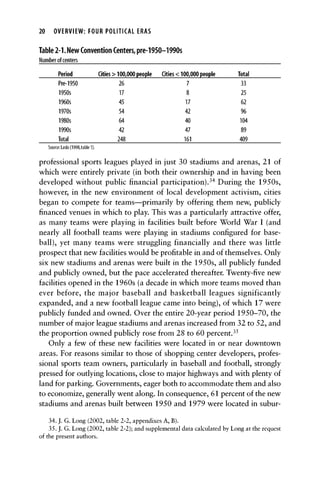
Table 2-1. New Convention Centers,pre-1950-1990s
Number of centers
Period Cities > 100,000 people Cities < 100,000 people Total
Pre-1950
1950s
1960s
1970s
1980s
1990s
Total
26
17
45
54
64
42
248
7
8
17
42
40
47
161
33
25
62
96
104
89
409
Source: Laslo (1998,table 1).
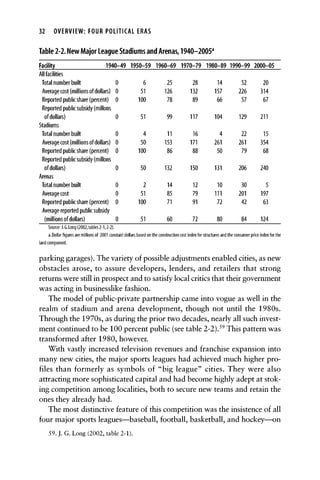
professional sports leagues played in just 30 stadiums and arenas, 21 of
which were entirely private (in both their ownership and in having been
developed without public financial participation).34
During the 1950s,
however, in the new environment of local development activism, cities
began to compete for teams—primarily by offering them new, publicly
financed venues in which to play. This was a particularly attractive offer,
as many teams were playing in facilities built before World War I (and
nearly all football teams were playing in stadiums configured for base-
ball), yet many teams were struggling financially and there was little
prospect that new facilities would be profitable in and of themselves. Only
six new stadiums and arenas were built in the 1950s, all publicly funded
and publicly owned, but the pace accelerated thereafter. Twenty-five new
facilities opened in the 1960s (a decade in which more teams moved than
ever before, the major baseball and basketball leagues significantly
expanded, and a new football league came into being), of which 17 were
publicly funded and owned. Over the entire 20-year period 1950-70, the
number of major league stadiums and arenas increased from 32 to 52, and
the proportion owned publicly rose from 28 to 60 percent.35
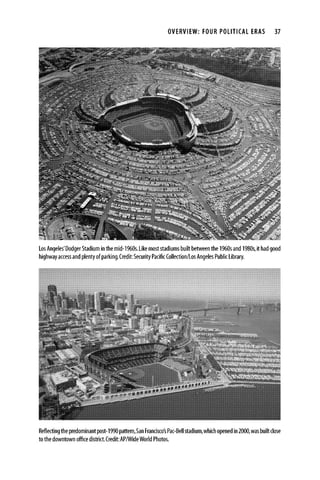
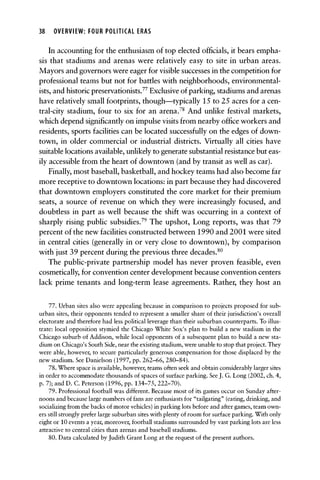
Only a few of these new facilities were located in or near downtown
areas. For reasons similar to those of shopping center developers, profes-
sional sports team owners, particularly in baseball and football, strongly
pressed for outlying locations, close to major highways and with plenty of
land for parking. Governments, eager both to accommodate them and also
to economize, generally went along. In consequence, 61 percent of the new
stadiums and arenas built between 1950 and 1979 were located in subur-
34. J. G. Long (2002, table 2-2, appendixes A,B).
35. J. G. Long (2002, table 2-2); and supplemental data calculated by Long at the request
of the present authors.
36.
OVERVIEW: FOUR POLITICALERAS 21
ban locations.36
The days of big television revenue and multimillion-dollar
player salaries were yet to come, however; the leagues had not yet perfected
their techniques for intensifyinglocal competition for teams; and localities
were still constrained in most cases by the need to secure voter approval for
general obligation bonds. So most of the facilities built were not lavish by
later standards. The new stadiums, for example, were generally intended for
dual baseball and football use,and no stadium had either luxury boxes or
a dome until 1965, when Houston's Astrodome opened with both.37
What is most striking in retrospect is the rapidity and lack of controversy
with which an activity viewed as mainly private through the first half of the
twentieth century—the construction of facilities for professional sports—
became mainly public during the 1950s and 1960s.38
There were, to be sure,
precedents for this in the history of urban infrastructure. Most early water-
works, mass transit systems, and airports were private, for example, and
subsequently became public. The professional sports teams did not become
public, however. Quite the contrary: while on the verge of their greatest
growth and prosperity as private business enterprises, they succeeded in shift-
ing an important element of their cost structure to the public sector.39
The Era of Transition
Through the 1950s and early 1960s urban renewal, highway construction,
and airport development appeared politically unassailable. All enjoyed near-
consensual business, labor, and media support in most cities—due in no
small part to the fact that, while generating much economic activity, they
absorbed little or no general tax revenue. Major highway projects were
funded entirely by higher levels of government; the local contributions to
urban renewal were mainly in kind; airport investments werefinancedpri-
marily by user fees along with small amounts of federal aid. Virtually no one
36. Data calculated by Judith Grant Long at the request of the present authors.
37. Danielson (1997, pp. 178-81,188-94, 222-27, 238-40).
38. The most conspicuous exception during this period—and indeed the only baseball sta-
dium built privately between 1950 and the late 1990s—was Los Angeles Dodger Stadium,
which opened in 1960.The team was given a 300-acre site valued at $18 million in the late
1950s, however, as well as nearly $5 millionin publicly financed infrastructure improvements
and sole ownership of the ballpark.Danielson (1997, p. 249).
39. One might say the same about airlines and airports, and indeed there are importantsim-
ilarities, but there are also two important differences. Few airlines ever developed or owned
airports, and airports are open to multipleusers, whereas stadiumsand arenas are built for one
or at most two prime tenants.
37.
22 OVERVIEW: FOURPOLITICAL ERAS
seemed to realize, or perhaps care about, the devastation such projects
might cause in older, densely settled, mainly low-income urban neighbor-
hoods. The dominant assumptions, rather, were that the projects were
required for the greater good and that the residents of such neighborhoods
would in most cases be better off for their demolition.40
There were con-
troversies, to be sure, but mainly within the business sector itself—about
whether, in some cities, to accept the urban renewal program's expanded
rationale for public takings of private property, about specific fiscal choices
(such as taking on long-term local debt and levying user fees to finance air-
port expansion), and about precisely where to site specific projects.
The programs operated, moreover, in relative secrecy, so that those
affected often learned of projects just before the bulldozers rolled. In the
early years there were no organized interest groups monitoring or learning
from these experiences, much less providing potential victims with tactical
assistance. Since their cause seemed hopeless, even those most adversely
affected generallygave in without a fight. This tendency was accentuated by
the fact that the victims were disproportionately poor and black. Slum clear-
ance, after all, was an explicit objective of the urban renewal program,
while highway planners were attracted to low-income corridors as both rel-
atively cheap and particularly defenseless. In some cases, moreover, highway
planners sited new highways with slum clearance as an explicit objective.41
The dominance of program advocates began to erode in the mid-1960s,
however, and within half a decade it was no more. How was such an abrupt
shift possible? Multiple factors appear to have contributed, some broadly
societal, some program-specific. The 1960s were a decade of citizenactivism
combined with spreading awareness of the disruption associated with urban
mega-projects. This activism found many outlets, but three are of particular
significance in the present context: the movements for civil rights, citizen
participation, and (toward the end of the decade), environmental protec-
tion. The civil rights movement mobilized African Americans against
"institutional" as well as personal discrimination: that is, patterns of dis-
crimination built into ostensibly race-neutral policies and norms, such as the
idea that the best way to deal with low-income neighborhoods (slums) is to
clear them. The movement for citizen participation was organized, above all,
around the premise that citizens had a right to be consulted in timely fash-
ion, and with access to all pertinent evidence, about government deliberations
that might profoundly affect them. The environmental movement took off
40. Caro (1974, pp. 854-55).
41. Mohl (1993); Keating (2001, pp. 91-95); and Altshuler (1965, pp. 49-51).
38.
OVERVIEW: FOUR POLITICALERAS 23
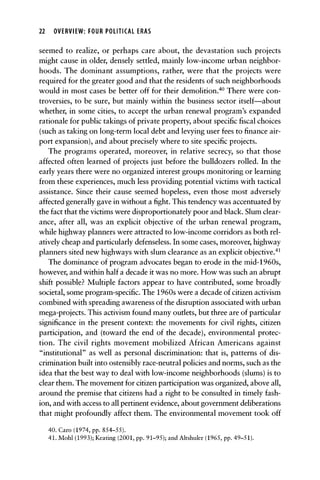
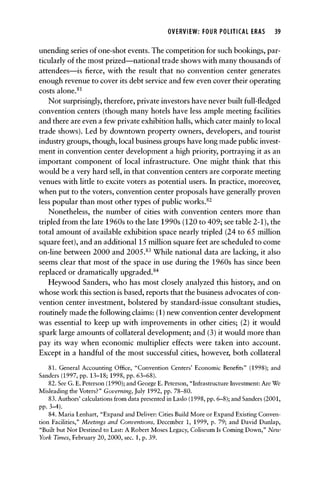
Boston's West End in the mid-1950s, a few years after city officials declaredthe neighborhood—home to about
7,000 people—a slum that should betorn down. (Froma booklet put together byWest Endresidentsaspart of their
unsuccessful efforts to stop the clearance plan.)
from the premise that human beings are biological organisms, to whom
nothing means more than the preservation of a healthy ecology. It seemed to
follow that a central responsibility of government was to avoid damaging the
environment with its own programs. Renewal, highway, and airport devel-
opment activities were each vulnerable to these new forces in somewhat
different ways, but we focus here primarily on renewal since the highway and
airport programs are treated at length in subsequent chapters.
At the beginning of the 1960s several well-researched critiques of urban
renewal, from opposite ends of the political spectrum, attracted widespread
attention. Martin Anderson attacked the program as an example of profli-
gate, bungling big government, emphasizing that many cleared renewal sites
had been sitting vacant for half a decade or more with no redevelopment in
prospect, and that even where redevelopment was occurring it was typically
with very high ratios of public to private investment.42
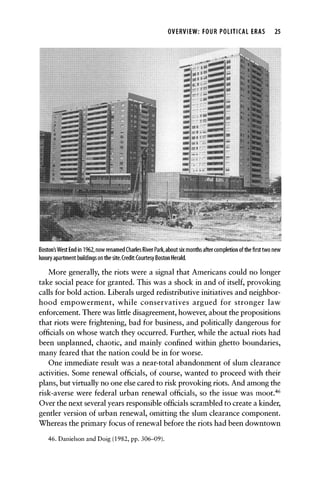
Herbert Cans doc-
umented the last days of Boston's West End, a working-class neighborhood
of extended families and other highly valued social networks. Its demise,
Cans argued, had nothing to do with the supposed social pathology of
42. SeeAnderson(1964).
39.
24 OVERVIEW: FOURPOLITICAL ERAS
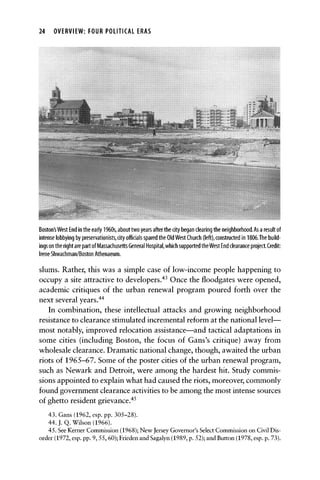
Boston's West Endin the early 1960s,about two yearsafter the city began clearing the neighborhood. Asa result of
intense lobbying by preservationists,city officials sparedthe OldWest Church(left),constructed in 1806.The build-
ings on the right arepart of Massachusetts GeneralHospital, which supported the West End clearance project. Credit:
Irene Shwachman/Boston Athenaeum.
slums. Rather, this was a simple case of low-income people happening to
occupy a site attractive to developers.43
Once the floodgates were opened,
academic critiques of the urban renewal program poured forth over the
next several years.44
In combination, these intellectual attacks and growing neighborhood
resistance to clearance stimulated incremental reform at the national level—
most notably, improved relocation assistance—and tactical adaptations in
some cities (including Boston, the focus of Gans's critique) away from
wholesale clearance. Dramatic national change, though, awaited the urban
riots of 1965-67. Some of the poster cities of the urban renewal program,
such as Newark and Detroit, were among the hardest hit. Study commis-
sions appointed to explain what had caused the riots, moreover, commonly
found government clearance activities to be among the most intense sources
of ghetto resident grievance.45
43. Cans (1962, esp. pp. 305-28).
44. J.Q.Wilson (1966).
45. SeeKerner Commission(1968);New JerseyGovernor's Select Commissionon Civil Dis-
order (1972, esp. pp. 9, 55, 60);Friedenand Sagalyn (1989, p. 52);and Button (1978, esp. p. 73).
40.
OVERVIEW: FOUR POLITICALERAS 25
Boston'sWest Endin 1962,now renamed Charles River Park,about six months after completion of the first two new
luxury apartment buildings on the site.Credit:Courtesy Boston Herald.
More generally, the riots were a signal that Americans could no longer
take social peace for granted. This was a shock in and of itself, provoking
calls for bold action. Liberals urged redistributive initiatives and neighbor-
hood empowerment, while conservatives argued for stronger law
enforcement. There was little disagreement, however, about the propositions
that riots were frightening, bad for business, and politically dangerous for
officials on whose watch they occurred. Further, while the actual riots had
been unplanned, chaotic, and mainly confined within ghetto boundaries,
many feared that the nation could be in for worse.
One immediate result was a near-total abandonment of slum clearance
activities. Some renewal officials, of course, wanted to proceed with their
plans, but virtuallyno one else cared to risk provoking riots. And among the
risk-averse were federal urban renewal officials, so the issue was moot.46
Over the next several years responsible officials scrambled to create a kinder,
gentler version of urban renewal, omitting the slum clearance component.
Whereas the primary focus of renewal before the riots had been downtown
46. Danielson and Doig (1982, pp. 306-09).
41.
26 OVERVIEW: FOURPOLITICAL ERAS
revival, moreover, many agencies now turned toward the neighborhoods—
seeking to work with existing residents, encourage the rehabilitation of
existing structures, and use clearance very selectivelyif at all.
Unfortunately, such activity was extremely time consuming, the invest-
ments stimulated were small, and constituency support was weak. The old
core renewal constituency, downtown business, had little enthusiasm for this
new mission. And the neighborhoods themselves were, in general, neither
united nor well mobilized politically.47
So urban renewal became a policy
backwater, fraught with far more local controversy than (to most political
leaders) it seemed worth. Years of controversy ensued about how, if at all,
it might be further adapted, until in 1974 it was terminated as a distinct pro-
gram. (To be more precise, it was consolidated along with 10 other
programs into the Community Development Block Grant Program.)48
The Interstate Highway Program proved more robust. It was, after all, a
truly national program, with most of its mileage in rural and exurban areas.
Its most expensive and disruptive segments, however, were in denselysettled
cities and inner suburbs, and most of those still incomplete encountered
severe resistance in the late 1960s and early 1970s. Though the highway
story differs in major respects from that of urban renewal, it is parallel in
at least two: (1) as the massive displacement effects of both programs
became widely understood, neighborhood resistance sharply intensified;
and (2) in each case a program that had enjoyed near-consensual support for
a dozen or so years after enactment suddenly became intensely controver-
sial, spurring major modifications, including the abandonment of many
long-planned projects.
Growing opposition to airport expansion reflected the introduction of jet
aircraft in the late 1950s (in combination with the broad societal factors
noted above). The new planes were extremely noisy, required substantially
longer runways, and attracted large amounts of additional patronage—all
of which intensified conflicts with nearby residential neighborhoods. Some
localities responded with efforts to construct new airports away from resi-
dential concentrations, but such facilities generally required sites of 10,000
acres or more; such large parcels of land could be assembled only at dis-
tances from the urban core that most airlines and local business groups
deemed unacceptable. On those rare occasions when sites both adequate in
scale and acceptable to business were identified, moreover, it was often
impossible to overcome environmental objections—as witness the failure of
47. Keyes (1969); and Sanders (1980, pp. 103-26).
48. Conlon (1988, pp. 44-63); and Frieden and Sagalyn (1989, pp. 49-53).
42.
OVERVIEW: FOUR POLITICALERAS 27
proposals for a new Miami airport adjacent to the Florida Everglades, a
fourth airport for the New York region in New Jersey's Great Swamp, and
a major expansion of John F. Kennedy Airport into New York City's
Jamaica Bay.
This was also a period, finally, in which the movement for mass transit
support came of age. The most critical reason appears to have been the
growth of antihighway sentiment. Finding it valuable to have a positive
program of their own, those fighting new highways hammered home the
argument that urban mobility needs could be met more effectively and equi-
tably by improving mass transit. Emboldened by this new support, the
coalition of local officials, transit operators and labor unions, transit sup-
pliers, and downtown business groups that had been seeking increased aid
for transit throughout the 1960s intensified its campaign.
This campaign began to bear fruit in the final years of the decade and
gathered much stronger momentum in the early 1970s as the national tran-
sit coalition found increasing numbers of allies in the highway camp. For
highway interests, the central issue was the growing vulnerability of their
own program. After rising sharply from the late 1950s through the mid-
1960s, federal highway aid declined by roughly a quarter in real terms from
1968 to 1973. Increasingly controversial, it had become a tempting program
for the president to cut, and a more difficult one for which to muster veto-
proof congressional majorities. The solution, urged by transit lobbyists,
was a highway-transit alliance. The resulting surface transportation coali-
tion survivesto the present day. The most notable of its early achievements
were a tenfold increase in federal transit aid in real terms from 1968 to
1980, the abatement of controversy surrounding the federal highway pro-
gram after about 1973, and a reversal of the downward trend in federal
highway expenditures in the mid-1970s.
The Era of"Do No Harm"
U.S. infrastructure investment declined sharply, in aggregate, through the
1970s and early 1980s,49
and doubtless more so in major cities, where sit-
ing disputes were most intense, than elsewhere. Local impulses toward
49. The net stock of fixed assets owned by U.S. state and local governments rose at an
annual rate of 4.5 percent from 1947 to 1973, but only 2.3 percent from 1973 to 1998. Dur-
ing the first half of the 1980s, the absolutetrough, it rose less than 1 percent a year absolutely,
and the stock actually declined slightly (.13 percent a year) in per capita terms. See Herman
(2000, p. 17); and Altshuler and Gomez-Ibanez (1993, table 2-2, p. 28).
43.
28 OVERVIEW: FOURPOLITICAL ERAS
economic development activism by no means withered away, however. Fac-
ing new constraints—stagflation, a shift in federal spending toward Social
Security and health programs, and intensified citizen resistance to both new
taxes and disruptive projects—local growth coalitions were required to
adapt. And adapt they did, with extraordinary success. In part they did so
by shifting toward greater reliance on inducement strategies (seechapter 1).
In part as well, however, their mode of adaptation was to identify new
investment strategies more suitable for an era in which large projects were
certain to be highly controversial and in which opponents were armed with
a variety of legal weapons unknown in the great mega-project era.
The most significantnew criterion that mega-project advocates now had
to satisfy was avoidance of disruptive side effects—on neighborhoods,
parks, natural species, historic sites, and a panoply of other valued com-
munity assets. This is not to say that every project was entirely
nondisruptive. Particularly where localities were competing to attract
large—or, as in the case of major league sports teams, symbolically impor-
tant—private corporations and intense competitive pressure was perceived,
significant amounts of dislocation still occurred at times. Detroit, for exam-
ple, in two separate episodes during the 1980s, displaced more than 1,800
households and 200 small businesses to clear sites for automobile assembly
plants (one for General Motors, the other for Chrysler).50
And more than
1,000 Chicago residents were displaced in 1989 to make way for the new
Chicago White Sox baseball stadium.51
Such disruption was unheard of,
though, where projects were entirely public, and was far less common than
it had been even when localities were striving to accommodate private
investors. Futhermore, localities were under increasing pressure to avoid
reliance on general tax revenues.
Striving to realize their aims within the framework of these constraints,
growth advocates shifted focus toward different types of projects, accepted
amenity-enhancing features that they would previously have found outra-
geously expensive, and devised ingenious financing schemes that did not
appear to burden local taxpayers. Clearance-based urban renewal, the con-
struction of new urban expressways, and the development of new airports
(or even new runways at old ones) became rare. Direct public investment in
rapid transit, festival retail markets, convention centers, sports facilities,
and airport terminals, on the other hand—all far easier to site and build
50. Jones and Bachelor (1993, chs. 6, 10); and Bachelor (1994, pp. 596-616).
51. The implementingagency in this case, recently established at the city's instigationby
the state of Illinois, was an authority rather than the city itself. Euchner (1993, pp. 150-56).
44.
OVERVIEW: FOUR POLITICALERAS 29
without substantial neighborhood or environmental disruption—ratcheted
up. These shifts, moreover, with the exception of that toward rapid transit,
were not significantly driven by federal aid policy.52
Indeed, the great major-
ity of retail, convention center, and sports facility projects occurred without
any direct federal aid (though most benefited from the ability of localities to
issue tax-exempt bonds). And even after federal highway and airport grants
increased (in real terms) during the mid-1980s and early 1990s, very few
recipient governments sought to build new facilities in areas already devel-
oped at urban densities. Chapters 4, 5, and 6 consider post-1970 highway,
airport, and rapid transit development in depth. Thus we focus here on
retail, sports facility, and convention center development.
The thrust toward publicly sponsored retail development got under way
in the early 1970s, though its heyday—chronicled most notably by Bernard
Frieden and Lynne Sagalyn—was the 1980s.53
Whereas traditional urban
renewal had focused on the development of high-end offices, hotels, and
housing, the view was now gaining favor that if downtowns were to thrive,
they also needed to be exciting retail environments. In practice, however, vir-
tually all new retail development since World War II had occurred in the
suburbs. And there was no reason to believethat this pattern would change
if left simply to the marketplace, given the high cost of land in downtown
areas, the difficulty of assembling large parcels, regulatory hurdles more
complex and unpredictable than in most suburbs, security concerns, and
traffic congestion. Finally, there was no recent experience of successful
downtown retail development from which prudent investors and lenders
could extrapolate.
Once several of the nation's leading shopping center developers led the
way, however, mayors, often spurred by local business groups, were eager
to work with them. When a few developments were in place and apparently
thriving, scores of cities and many other developers rushed in. The pattern
of action required to bring this about took off from the urban renewal
model, but with several critical differences.
It resembled urban renewal in that governments assembled the sites and
subsidized the projects, while leaving most elements with profit potential to
the private sector. Examining 39 projects in detail, Frieden and Sagalyn cal-
culated that the median public share of gross investment was 32 percent. As
in the case of renewal, moreover, the local shares were invariably well cam-
52. Even in the case of transit, moreover, investmentcontinued to rise after federal aid sta-
bilized in the 1980s.
53. Frieden and Sagalyn (1989).
45.
30 OVERVIEW: FOURPOLITICAL ERAS
ouflaged, enabling mayors to proclaim that these projects were essentially
free from the standpoint of local taxpayers.54
The availability of federal aid
was considerably less than during the great mega-project era,but severalof
the earliest projects did benefit from urban renewal assistance while many
of those built later drew upon federal Urban Development Action Grants
(until their termination in 1988).55
The primary sources of public revenue
were local, however, both traditional (such as allocations from existing pub-
lic works budgets) and new (such as tax-increment financing, public
construction of collateral projects, tax abatements, low-interest loans to
private developers, and new excise taxes—on hotel and restaurant bills, for
example—crafted to draw most of their revenue from visitors to the city
rather than residents).
To illustrate, during the mid-1970s, years before its downtown festival
mall (Horton Plaza) went into construction, San Diego placed its site within
a much larger tax-increment district, one in which large amounts of private,
fully taxpaying development were already scheduled. It also successfully
lobbied the federal government to lease its new federal courthouse within
the district from a private developer, who would pay full taxes. Within just
three years these projects were yielding tax increments in excess of $1 mil-
lion a year—none of which was attributable to the festival mall project and
all of which would otherwise have been available to support general city
services. The city turned over the festival mall site, which had cost it $18 mil-
lion, to the developer for $1 million. And it pledged to the developer that it
would build or otherwise assure the construction of a new convention cen-
ter in the immediate vicinity, several thousand parking spaces, 4,000 units
of housing, street improvements, and a new downtown marina.56
The most striking differences between traditional urban renewal and the
new downtown retail initiatives, however, were in the realms of siting, urban
design, and business-government relations. The sites were nonresidential
and, by mega-project standards, extremely small. The median project in a
sample of 71 analyzed by Frieden and Sagalyn occupied just 5.7 acres.
These were mainly areas of local embarrassment, moreover—a skid
54. Frieden and Sagalyn (1989, ch. 8).
55. Frieden and Sagalyn (1989, pp. 215-18, 308-09). See also Jacobs and Roistacher
(1980); and Gist (1980).
56. Friedenand Sagalyn (1989, pp. 138-39, 146-47,161-62). After the original agreement,
Proposition 13 severely reduced the city's fiscal capacitywhile also contributingto an increase
in property values and a reduction in the prospective taxes for which the developer would be
liable. In this context, the developer assumed responsibility for the parking component of the
project.
46.
OVERVIEW: FOUR POLITICALERAS 31
Baltimore's Inner Harborin 2002. Like many other cities,Baltimore focused its renewal efforts in the 1970s on draw-
ing people to the core—in this case,arevitalized waterfront—for shopping andother recreationalpurposes. Credit:
BillSwartwout/www.SouthBaltimore.com.
row/pornography district in San Diego, a long-cleared renewal site in St.
Paul that had never attracted a developer, historic but derelict market struc-
tures in Boston and Seattle. So there was little controversy about their
suitability for redevelopment. Additionally, the projects were low-rise—
never more than four or five stories—and designed to lure the public in
rather than (as typically in urban renewal) to wall it out.57
Finally, whereas the urban renewal model had been one of detailed pub-
lic planning without developer input (so as to avoid potential favoritism)
and binding developer competitions on the model of those for public works
contracts, the new model was one of public-private partnership from a very
early stage.58
Frieden and Sagalyn emphasize that the initial agreements
between cities and developers tended to be highly unstable, not as a result
of carelessness or bad faith but due to inevitablychanging circumstances. As
a result, the real agreement in every successful case they examine was to con-
tinually work the problem and rework the deal. Often, moreover, the deals
provided for governments, in partial return for their investments, to share
in mall revenues or to build collateral revenue-generating facilities (such as
57. Frieden and Sagalyn (1989, pp. 107, 115, 119, 123 [in reference to Boston, Seattle,St.
Paul, and San Diego, respectively], p. 134 [in reference to averageparcel size], pp. 199-203 [in
reference to mall design]).
58. The old model had almost never worked and was generallyconsidered responsiblein
later years for the vast number of failed urban renewal projects. The renewal agencies that
achieved greatest success, at least by the measuresof attracting large amounts of federal aid and
private investment, all seem to have worked closelywith developers in selecting sites as well
as developingplans for them. SeeDanielsonand Doig (1982, pp. 291-315); H. Kaplan (1963,
pp. 15-38); Caro (1974, pp. 979-83, 1005-23); and Frieden and Sagalyn (1989, pp. 43-44).
47.
parking garages). Thevariety of possible adjustments enabled cities, as new
obstacles arose, to assure developers, lenders, and retailers that strong
returns were still in prospect and to satisfy local critics that their government
was acting in businesslike fashion.
The model of public-private partnership came into vogue as well in the
realm of stadium and arena development, though not until the 1980s.
Through the 1970s, as during the prior two decades, nearly all such invest-
ment continued to be 100 percent public (seetable 2-2).59
This pattern was
transformed after 1980, however.
With vastly increased television revenues and franchise expansion into
many new cities, the major sports leagues had achieved much higher pro-
files than formerly as symbols of "big league" cities. They were also
attracting more sophisticated capital and had become highly adept at stok-
ing competition among localities, both to secure new teams and retain the
ones they already had.
The most distinctive feature of this competition was the insistence of all
four major sports leagues—baseball, football, basketball, and hockey—on
59. J.G.Long (2002, table 2-1).
Facility 1940-49
All facilities
Total number built 0
Average cost (millions of dollars) 0
Reported public share(percent) 0
Reported public subsidy (millons
ofdollars) 0
Stadiums
Total number built 0
Average cost (millions of dollars) 0
Reported public share(percent) 0
Reported public subsidy (millons
ofdollars) 0
Arenas
Total number built 0
Average cost 0
Reported public share(percent) 0
Average reported public subsidy
(millions of dollars) 0
Source: J.G.Long(2002, tables 2-1,2-2).
1950-59
6
51
100
51
4
50
100
50
2
51
100
51
1960-69
25
126
78
99
11
153
86
132
14
85
71
60
1970-79
28
132
89
117
16
171
88
150
12
79
91
72
1980-89
14
157
66
104
4
261
50
131
10
111
72
80
1990-99
52
226
57
129
22
261
79
206
30
201
42
84
2000-05
20
314
67
211
15
354
68
240
5
197
63
124
a.Dollarfigures are millions of 2001constantdollarsbasedon the construction cost index for structures and the consumer price index for the
land component.
32 OVERVIEW: FOUR POLITICALERAS
Table 2-2. New Major League Stadiums and Arenas, 1940-20053
48.
OVERVIEW: FOUR POLITICALERAS 33
better, more heavily subsidized facilities in which to perform. Baseball and
football teams were now insisting on separate stadiums, though purpose-
built stadiums for professional football teams, which play just eight regular
season home games a year, were unheard of till the 1970s. All of the leagues
now had size, design, amenity, and luxury box standards driving costs far
higher than they had been in prior decades. They increasingly made clear,
moreover, that cities wishing to attract teams, or even retain those they
already had, would do well to satisfy these demands. Thus St. Petersburg
and St. Louis each invested hundreds of millions of dollars in a new stadium
without having a team—just to improve their chances of attracting one. And
even the largest cities had learned that their teams might depart—either to
suburban locations (in football, for example, the New York Giants to the
New Jersey Meadowlands and the Los Angeles Rams to Anaheim) or other
urban areas entirely (the Rams, for example, in a second move, to St. Louis,
and the Raiders, first from Oakland to Los Angeles in the 1980s, then back
to Oakland in the 1990s).
It was virtually impossible to find an independent economist who viewed
sports facility subsidies as good investments in local economic growth.60
The
chief executives of most large American cities, however, urged on by local
business groups and the media, took this competition as one in which it was
urgent to succeed. It provided a highly visible indicator of mayoral success
or failure. The local support base included highly motivated fans as well as
the usual array of business and labor supporters for development projects.
The media, with their large commitments to sports coverage, were intensely
interested. And doubtless many public officials believed as well the con-
sultant reports—commissioned by teams—that promised large spin-off
economic benefits.
The advocates of sports facility investment faced a serious problem,
though. Even as the costs of accommodating new league and team demands
were sharply escalating, local voters were communicating far greater resis-
60. John Siegfried and Andrew Zimbalist note: "Few fields of empirical economicresearch
offer virtualunanimityof findings. Yet independentwork on the economic impact ofstadiums
and arenas has uniformly found that there is no statistically significant positivecorrelation
between sports facility construction and economic development." In support of this view,they
cite work by 10 different economists published in eight different pieces, most of them peer
reviewed. In a similar vein, Alan B. Krueger,an economist at Princeton University who edits
the Journal of Economic Perspectives, has contended: "Experience suggests that subsidies for
stadiums yield negligible economic benefits and expand the gap between the superrich and
everyone else." SeeSiegfried and Zimbalist (2000, esp. p. 103); and Alan B. Kreuger."Take Me
Out to the Ballgame but Don't Make Taxpayers Pay for the Park," New York Times,January
10, 2002, p. C2.
49.
34 OVERVIEW: FOURPOLITICAL ERAS
tance to property tax increases than a few years earlier, and also objecting
to public subsidies for private teams. Michael Danielson reports, for exam-
ple, that local electorates, when given a chance to express their views
directly, rejected 13 of 15 sports facility proposals during the 1970s and
1980s (versus only two of nine in the prior two decades) and that "poll after
poll underscores hostility to public financing of sports facilities."61
Such
resistance may help explain why the pace of development actually slowed
in the 1980s, when only 14 new facilities (of which 10 were publiclyowned)
were built (seetable 2-2).62
Sports facility coalitions reversed this negative trend in the 1990s, how-
ever, with a series of tactical adjustments.
—They turned to different sources of public revenue, less likely to trig-
ger voter ire or referendum requirements than broad-based taxes on host
city residents. The favored alternatives at the local level were visitor and
"sin" taxes (most commonly, on hotel, restaurant, bar, and auto rental ser-
vices) and regional sales taxes (which generated substantial revenues at very
low add-on rates). These sources financed just 8 percent of public expendi-
tures for new stadiums and arenas constructed before 1990, but 37 percent
from 1990 through 2005 (projected).63
—Additionally, they were far more successful in eliciting contributions
from state and county governments—particularly for new stadiums. States
provided only 9 percent of funding for stadiums built before 1990 but 19
percent thereafter,while the county share rose from 30 to 45 percent. Mean-
while, the average local share declined from 28 to 13 percent.64
State
involvement also enabled stadium and arena advocates in many cases to tap
new sources of revenue without referendum approval and to bypass normal
procedural constraints. The Maryland Stadium Authority, for example, was
empowered to select a stadium site, condemn property without negotia-
tion, and finance most of its activities by operating sports lotteries.65
—Particularly where referendum approval was required, they secured
much larger participation in the capital costs of facility development by the
teams and other private investors. Whereas teams bore just 11 percent of
61. Danielson (1997, pp. 269-74; the quotation is from p. 269); and Fort (1997, pp.
168-70).
62. J. G. Long (2002, table 2-2).
63. J. G. Long (2002, table 4-30).
64. J. G. Long (2002, table 4-27). The pre-1990 figures are for facilities still in use as of
2001. On state involvement more generally, see Danielson (1997, pp. 130-32); and Eisinger
(2000, pp. 324-25).
65.Euchner(1993,p. 121).
50.
OVERVIEW: FOUR POLITICALERAS 35
such costs in the 1970s, they contributed 34 percent in the 1980s and 43
percent in the 1990s (seetable 2-2).66
In several cases, particularly where ref-
erendums were required, teams eventually assumed the entire direct cost of
facility construction itself. The voters of San Francisco, for example, rejected
stadium proposals for the baseball Giants on four occasions during the late
1980s and early 1990s but finally approved a fifth in 1996, providing that
the stadium would be built with no public funding at all.67
In order to obtain these up-front, highly media-worthy commitments
from the teams, public authorities granted them compensating (and less
visible) concessions: sweeter lease terms, long-term maintenance commit-
ments, land contributions, collateral infrastructure investments, and
property tax exemptions.68
(The Giants received substantial public contri-
butions in the latter three of these categories.)69
After adjusting for these
factors, Long concludes, the actual trend in public subsidization was oppo-
site to that reported publicly. Whereas the reported public sector share of
new stadium and arena costs dropped from 66 percent before 1990 to 57
percent thereafter, the "real" public sector share rose from 69 percent to 80
percent.70
With these changes in place, most projects were able to go forward with-
out referendums, and when there were referendums, voters proved generally
more receptive. To illustrate, less than a quarter of the 57 stadiums and are-
nas built between 1990 and 2001 were approved in referendums.71
Whereas
only 13 percent of major league sports facility ballot propositions were
approved in the 1970s and 1980s, however, 71 percent were approved
between 1990 and 1996.72
It also bears mention that whereas referendum
approvals tended to be final, defeats were generally way stations, either to
66. The publicshare of arena costs has consistentlybeen lower than that for stadiums, and
it dropped sharplyin the 1990s. The reason is that arenas tend to be used far more intensively
than stadiums. The most economic ones house both a hockey and a basketball team and are
often used for other events such as rock concerts when the teams are not playing.The private
investment share of new arena costs, in consequence, rose from 19 percent before 1990 (for
facilities still in use as of 2001) to 58 percent thereafter. SeeJ. G. Long (2002, table 4-27).
67. Agostini, Quigley, and Smolensky(1997, pp. 385-426).
68. J. G. Long (2002, ch. 4); see also Danielson (1997, pp. 227-33).
69. Specifically, the city leased the land to the team for less than market value, exempted
both the land and stadium from property taxation, and committed to improvingtransitaccess.
See J. G. Long (2002, appendix C, table 2-1).
70. J. G. Long (2002, table 4-1[a]).
71. Data calculated by Judith Grant Long at the request of the present authors.
72. Danielson (1965, p. 271); and Fort (1997, p. 161).
51.
36 OVERVIEW: FOURPOLITICAL ERAS
revised ballot propositions (as in the San Francisco Giants case) or to new
arrangements eliminating the need for voter approval.73
In 1995, for exam-
ple, electorates (local in one case, statewide in the other) turned down
proposals for publicly funded baseball stadiums in both Seattle and Mil-
waukee. In the wake of these defeats, local officials and the teams quickly
obtained legislativeapproval for funding packages similar to those rejected
by the voters.74
The net result of these developments, in combination, has been a tremen-
dous stadium and arena building boom, with 52 new facilities opening in
the 1990s and another 20 scheduled to come on-line between 2000 and
2005. If all of the latter are in fact completed by 2005, more than seven of
every 10 major league stadiums and arenas will have opened since 1990.
This is all the more striking in that the new facilities are also far more
expensive than their predecessors. In constant 2001 dollars, the average
cost of new facilities rose from $51 million in the 1950s to $132 million in
the 1970s to $226 million in the 1990s; and those scheduled to open
between 2000 and 2005 are estimated to cost, on average, $314 million(see
table 2-2). Whereas fully two-thirds of stadiums built in the 1950s were for
joint baseball and football use, moreover, this was so of fewer than 10 per-
cent in the 1990s, and no more joint stadiums are anticipated. Cities
wanting football and baseball teams are now expected to finance, in whole
or major part, a stadium for each.75
The escalation in new sports facility costs was, it bears emphasis, not
solely attributable to new luxury features demanded by the teams. It also
reflected a shift toward in-town, more expensive locations. For reasons sim-
ilar to those of shopping center developers, professional sports team owners,
particularly in baseball and football, had strongly pressed for outlying loca-
tions during the period 1950-80, close to major highways and with plenty
of land for parking. Governments, eager to accommodate team preferences
and also to economize, had generally gone along. This pattern altered
markedly in the 1980s, however. Central cities, having identified recreation
as central to their downtown growth strategies, were now determined to
host these facilities.76
73. Danielson (1997, p. 274); and Fort (1997, pp. 163-70).
74. Fort (1997, pp. 168-70). (This source incorrectlystatesthat the Milwaukee referendum
occurred in 1994.)
75. J. G. Long (2002, table 2-1 and, more generally, ch. 2); and Siegfried and Zimbalist
(2000, tables 1, 2, pp. 96, 97). Arena costs have risen at a roughlycomparablerate, from $82
million on average during the period 1960-79 to approximately$200 million since 1990.
76. Danielson (1997, pp. 283-84).
52.
OVERVIEW: FOUR POLITICALERAS 37
Los Angeles'Dodger Stadium in the mid-1960s.Like most stadiums built between the 1960s and 1980s,it had good
highway access and plenty of parking. Credit:Security PacificCollection/Los AngelesPublic Library.
Reflecting the predominant post-1990 pattern,San Francisco's Pac-Bellstadium,which opened in 2000,wasbuiltclose
to the downtown office district.Credit:AP/WideWorld Photos.
53.
38 OVERVIEW: FOURPOLITICAL ERAS
In accounting for the enthusiasm of top elected officials, it bears empha-
sis that stadiums and arenas were relatively easy to site in urban areas.
Mayors and governors were eager for visiblesuccesses in the competition for
professional teams but not for battles with neighborhoods, environmental-
ists, and historic preservationists.77
Exclusive of parking, stadiums and arenas
have relatively small footprints, though—typically 15 to 25 acres for acen-
tral-city stadium, four to six for an arena.78
And unlike festival markets,
which depend significantlyon impulse visits from nearby office workers and
residents, sports facilities can be located successfully on the edges of down-
town, in older commercial or industrial districts. Virtually all cities have
suitable locations available, unlikely to generate substantial resistance but eas-
ily accessible from the heart of downtown (and by transit as well as car).
Finally, most baseball, basketball, and hockey teams had also become far
more receptive to downtown locations: in part because they had discovered
that downtown employers constituted the core market for their premium
seats, a source of revenue on which they were increasingly focused, and
doubtless in part as well because the shift was occurring in a context of
sharply rising public subsidies.79
The upshot, Long reports, was that 79
percent of the new facilities constructed between 1990 and 2001 were sited
in central cities (generally in or very close to downtown), by comparison
with just 39 percent during the previous three decades.80
The public-private partnership model has never proven feasible, even
cosmetically, for convention center development because convention centers
lack prime tenants and long-term lease agreements. Rather, they host an
77. Urban sites also were appealing because in comparison to projects proposed for sub-
urban sites, their opponents tended to represent a smaller share of their jurisdiction's overall
electorate and therefore had less political leveragethan their suburban counterparts. To illus-
trate: local opposition stymied the Chicago White Sox's plan to build a new stadium in the
Chicago suburb of Addison, while local opponents of a subsequent plan to build a newsta-
dium on Chicago's South Side,near the existing stadium, were unableto stop that project. They
were able, however, to secure particularlygenerous compensation for those displaced by the
new stadium. SeeDanielson (1997, pp. 262-66, 280-84).
78. Where space is available, however, teams often seek and obtain considerablylargersites
in order to accommodate thousands of spaces of surface parking. See J. G. Long (2002, ch. 4,
p. 7); and D. C. Peterson (1996, pp. 134-75, 222-70).
79. Professional football was different. Because most of its games occur on Sunday after-
noons and because large numbers of fans are enthusiastsfor "tailgating" (eating,drinking, and
socializing from the backs of motor vehicles) in parking lots before and after games, team own-
ers still strongly prefer large suburban sites with plenty of room for surface parking. With only
eight or 10 events a year, moreover, football stadiums surrounded by vast parking lots are less
attractive to central cities than arenas and baseball stadiums.
80. Data calculated by Judith Grant Long at the request of the present authors.
54.
OVERVIEW: FOUR POLITICALERAS 39
unending series of one-shot events. The competition for such bookings, par-
ticularly of the most prized—national trade shows with many thousands of
attendees—is fierce, with the result that no convention center generates
enough revenue to cover its debt service and few even cover their operating
costs alone.81
Not surprisingly, therefore, private investors have never built full-fledged
convention centers (though many hotels have less ample meeting facilities
and there are even a few private exhibition halls, which cater mainly to local
trade shows). Led by downtown property owners, developers, and tourist
industry groups, though, local business groups have long made public invest-
ment in convention center development a high priority, portraying it as an
important component of local infrastructure. One might think that this
would be a very hard sell, in that convention centers are corporate meeting
venues with little to excite voters as potential users. In practice, moreover,
when put to the voters, convention center proposals have generally proven
less popular than most other types of public works.82
Nonetheless, the number of cities with convention centers more than
tripled from the late 1960s to the late 1990s (120 to 409; seetable 2-1), the
total amount of available exhibition space nearly tripled (24 to 65 million
square feet), and an additional 15 million square feet are scheduled to come
on-line between 2000 and 2005.83
While national data are lacking, it also
seems clear that most of the space in use during the 1960s has since been
replaced or dramatically upgraded.84
Heywood Sanders, who has most closely analyzed this history, and on
whose work this section is based, reports that the business advocates of con-
vention center investment, bolstered by standard-issue consultant studies,
routinely made the following claims: (1) new convention center development
was essential to keep up with improvements in other cities; (2) it would
spark large amounts of collateral development; and (3) it would more than
pay its way when economic multiplier effects were taken into account.
Except in a handful of the most successful cities, however, both collateral
81. General Accounting Office, "Convention Centers' Economic Benefits" (1998); and
Sanders (1997, pp. 13-18; 1998, pp. 63-68).
82. SeeG. E. Peterson (1990);and George E. Peterson, "Infrastructure Investment:Are We
Misleading the Voters?" Governing, July 1992, pp. 78-80.
83. Authors' calculationsfrom data presented in Laslo (1998, pp. 6-8); and Sanders (2001,
PP. 3-4).
84. Maria Lenhart, "Expand and Deliver:Cities Build More or Expand Existing Conven-
tion Facilities," Meetings and Conventions, December 1, 1999, p. 79; and David Dunlap,
"Built but Not Destined to Last: A Robert Moses Legacy, ColiseumIs Coming Down," New
York Times, February 20, 2000, sec. 1, p. 39.
näkynyt ainoatakaan tähteä;taivaan peitti harmaa sumuverho. Hän
silmäsi taivaanrantaan, mutta sitäkään ei voinut erottaa; synkkä
pilvikerros ympäröi sitä joka taholta. Hän meni rantaan: ei
pienintäkään mainingin loisketta. Äänetön valtameri näytti lepäävän
kuolonuneen vaipuneena, se oli ikään kuin tylsässä horrostilassa.
Francisco pyyhkäisi hiukset kuumalta otsaltaan ja loi vielä
silmäyksen merelle, mutta hänen sydäntään kouristi sitä katsellessa
ja hän heittäytyi pitkäkseen hiekalle. Siinä hän lojui monta tuntia
hurjaa epätoivoa lähentelevässä mielentilassa. Vihdoin hän kuitenkin
tyyntyi, kohottautui polvilleen ja rukoili voimaa ja nöyryyttä
mukautua Jumalan tahtoon.
Noustuaan taas jaloilleen ja tarkastaessaan valtamerta hän
huomasi siinä paraikaa tapahtuvan oudon muutoksen. Synkkä
pilvikerros oli kohonnut taivaanrannalle, pimeys oli käynyt yhä
sakeammaksi; ilmasta kuului kumeaa kohinaa, aivan kuin tuuli olisi
puhaltanut, vaikka meri oli rasvatyyni kuin pieni lampi. Kaikista
merkeistä saattoi päätellä, että jotakin oli tulossa. Nuori mies odotti
odottamistaan. Nyt kohina kasvoi kovemmaksi, ankara tuulen puuska
hipaisi siellä täällä muutamassa kohden tyyntä vedenpintaa, mutta
lakkasi sitten yhtä nopeasti. Sitten kuului humisevia, valittavia ääniä
ja vihdoin kaukaisen ukkosen jyrinää, joka yltyi yhä kovemmaksi;
vedenpintaa näkyi lakaisevan musta juova, se läheni hirmuista
vauhtia ja yhtäkkiä puhkesi hurja rajumyrsky raivoamaan.
Ensimmäinen tuulispää tuli niin äkkiä ja odottamatta, että se
paiskasi Franciscon kumoon maahan, ja hän ymmärsi parhaaksi
pysyä paikallaan, sillä myrsky tuprutti irtonaista hiekkaa hänen
ympärilleen sellaista vauhtia, että se sokaisi silmät ja esti näkemästä
metrinkään päähän. Hän oli ajatellut ryömiä veneen alle suojaan,
57.
mutta ei tiennytmihin suuntaan oli mentävä. Kauan ei hietamyrskyä
kuitenkaan kestänyt, sillä vesi, jota myrskyn voimakkaat siivet
roiskuttivat korkealle rannalle, kostutti hiekan niin ettei se enää
pyrynnyt ilmassa.
Francisco huomasi kastuneensa läpimäräksi ja kohotti päätään.
Muuta ei voinut nähdä kuin taivaanlaen, joka oli kammottavan,
synkän pimeyden peitossa, ja meren, joka näytti äärettömältä,
maidonvalkoiselta vaahtoa kiehuvalta ja kuitenkin liikkumattomalta
kattilalta, ikään kuin raju tuuli olisi pakottanut sen pysymään
rajoissaan. Mutta vesi peitti jo toisen puolen hiekkasärkästä
vaahtopyörteiden ryöpytessä toisen puolen yli.
Ja nyt avautuivat taivaan ikkunat, sade ja myrskyn pärskyttämä
suolainen roiske hakkasivat ja valelivat nuorukaisparkaa, joka makasi
yhä siinä mihin oli heittäytynyt. Aalto, joka loiskahti äkkiä hänen
ylitseen, osoitti kuitenkin, ettei hän voinut kauemmin viipyä
paikallaan, meri nousi nopeasti, ja ennen kuin hän oli ehtinyt siirtyä
nelin kontin muutaman askelen eteenpäin, tuli toinen raivoisa aalto
antaen hänelle uuden varoituksen. Hänen täytyi nousta pystyyn ja
kiivetä hietasärkän korkeampaan osaan, jonne hän oli korjannut
veneensä ja tavaransa.
Sateen ja vaahdon sokaisemana hän ei nähnyt mitään. Äkkiä hän
kaatui: hän oli kompastunut vesilekkeriin ja iski päänsä
merimiesarkkuun. Mutta missä vene oli? Se oli poissa. Varmaankin
raivoava myrsky oli lakaissut sen mereen. Voi, kaikki toivo oli siis
mennyttä! Jolleivät hurjat aallot huuhtaisisi häntä mereen, hänellä ei
olisi muuta neuvoa kuin koettaa pidentää elämäänsä muutamia
päiviä ja sitten kuolla! Kolahdus, jonka hän kaatuessaan oli saanut
päähänsä, ja veneen katoamisesta johtuva mielenmasennus
58.
vaikuttivat häneen niinlamauttavasti, että hän meni hetkeksi
tiedottomaksi.
Kun Francisco jälleen virkosi, oli näky taas muuttunut. Häntä
ympäröivä laaja avaruus oli noussut rajuun, pelottavaan raivoon,
aallot ärjyivät kilpaa rajumyrskyn kanssa. Koko hietasärkkä,
lukuunottamatta sitä nyppylää missä hän nyt makasi, oli valkean
kuohun peitossa, ja hänenkin turvapaikkaansa loiskahti toisinaan
aalto, joka muita korkeampana ja voimakkaampana vyöryi melkein
hänen jalkoihinsa asti. Francisco valmistui kuolemaan.
Vähitellen pimeys kuitenkin hälveni; pilvikerros oli kadonnut
taivaanrannalta, ja Francisco toivoi — niin, mitä hän toivoi?
Pelastuvansa nyt uhkaavasta kuolemanvaarasta joutuakseen vielä
kauheamman kuoleman uhriksi; pelastuvansako raivoavilta
hyökyaalloilta, jotka nielisivät hänet ja muutamassa
silmänräpäyksessä vapauttaisivat kaikista tuskista ja kärsimyksistä,
nääntyäkseen nälkään paahtavan auringon paisteessa,
menehtyäkseen janoon? Francisco kätki kasvonsa käsiinsä ja rukoili:
— Jumala, tapahtukoon tahtosi, mutta salli armossasi meren nousta
yhä korkeammalle!
Mutta meri ei enää noussut; myrskyn ulvonta vaimeni vähitellen,
ja vaahtoavat aallot tottelivat Jumalan käskyä: särkän keskikohdalle
saakka ne olivat vyöryneet, mutta ei ylemmäksi.
Päivä koitti, taivas valkeni. Ensimmäinen punertava hohde, joka
ilmoitti valon ja lämmön palaavan, valaisi jo levotonta taivaanrantaa,
kun epätoivoisen nuorukaisen silmät äkkiä kiintyivät suureen,
tummaan esineeseen, joka kellui myrskyaalloilla. Siellä oli laiva, jossa
oli vain yksi masto pystyssä; se keikkui kovasti ja tuuli painoi sitä
suoraan särkkää kohti, jossa Francisco oli. Aluksen runko kohosi
59.
korkealle aallon harjalleja katosi taas tuokiossa hänen silmistään
kuohuvien hyökyjen väliin.
— Se menee palasiksi, ajatteli Francisco. Se on hukassa,
merimiehet eivät huomaa särkkää! Ja hetkeksi unohtaen oman
surkean asemansa hän olisi antanut laivalle varoitusmerkin, jos vain
olisi voinut.
Nuorukaisen odottaessa mitä tapahtuisi aurinko nousi kirkkaana ja
loistavana valaisemaan tuota edessä olevaa murhenäytelmää.
Laiva lensi eteenpäin myrskyn käsissä ja tuli yhä lähemmäksi
karia. Oli hirmuista nähdä ja tuskallista tietää sen kiitävän turmioon.
Vihdoin Francisco saattoi erottaa laivassaolijat. Hän huitoi
käsillänsä, mutta häntä ei huomattu; hän huusi ja kiljui, mutta hänen
äänensä hukkui myrskyn ulvontaan. Laiva tuli yhä lähemmäksi, ikään
kuin sen kohtalo olisi jo ollut ratkaistu. Kun se oli parin kaapelinmitan
päässä karista, huomattiin laivassa vihdoin vaara. Mutta se oli jo liian
myöhäistä! Laiva yritti kääntyä laitatuuleen, mutta aalto toisensa
perästä ajoi sitä särkkää kohti. Se karahti pohjaan, ainoa pystyssä
ollut masto romahti mereen, ja kohisevat aallot riensivät
täydentämään hävitystyötä.
60.
HAAKSIRIKKO
Franciscon silmät olivatkiintyneet laivaan, jonka yli aallot vyöryivät
kauhistavan rajuina. Kannella näkyi kahdeksan tai yhdeksän miestä
tuulenpuolen partaan suojassa. Jokainen aalto, joka murtui laivan
kylkeä vasten ja roiskautti vaahtoansa sen yli, työnsi laivaa
ylemmäksi karille, niin että runko nytkähti, kunnes se vihdoin oli niin
korkealla, että aaltojen raivo jo osaksi lannistui, ennen kuin ne
ryntäsivät aluksen kylkeen. Jos laiva olisi ollut vahva ja hyvin
rakennettu, se olisi luultavasti voinut kestää myrskyn raivon, kunnes
ilma olisi asettunut, ja laivaväki olisi kenties pelastanut henkensä
jäämällä laivaan. Mutta alus oli, kuten Francisco oikein arveli,
amerikkalainen priki; se oli hyvin kapea ja lisäksi heikonlaista tekoa.
Francisco ei hetkeksikään irrottanut katsettaan tuosta ainoasta
esineestä, joka nyt saattoi kiinnittää hänen huomiotaan — hän
katseli hievahtamatta ihmisten saapumista tälle autiolle paikalle ja
uhkaavaa vaaraa, johon he olivat joutuneet.
Hän huomasi kahden miehen menevän luukuille ja lykkäävän ne
tuulen alapuolelle; sitten he menivät alas, mutta vaikka aallot
vyöryivät laivan yli ja epäilemättä aika paljon vettä syöksyi avatuista
luukuista sisään, eivät kannella olijat kuitenkaan sulkeneet niitä.
61.
Mutta arvoitus saihetken kuluttua selityksen: ensin yksitellen, sitten
ryhminä kohosi laivanruumasta elävä lasti — ryöstettyjä Afrikan
neekereitä — koko kansi täyteen. Nuo onnettomat orjiksi aiotut
olivat kahden englantilaisen merimiehen hyväntahtoisuuden tähden
päässeet ulos ruumasta, jotta heillä olisi samanlainen tilaisuus
henkensä pelastamiseen kuin muillakin. Mutta kukaan ei
yrittänytkään lähteä laivasta. Tiheään pakkautuneina kuin
lammaslauma viipyivät kaikki, niin eurooppalaiset kuin neekeritkin,
laivassa, vaikka rajut hyökyaallot huuhtoivat sitä alinomaa, ja kun
alus tärisi ja kallisteli niiden raivokkaissa hyökkäyksissä, tarttuivat
laivassa olijat kiinni, mihin vain käsi osui.
Mutta pian tapahtui muutos. Laivan runko ei jaksanut kauemmin
kestää aaltojen raivoa, ja Francisco huomasi, miten se äkkiä katkesi
keskeltä kahtia ja kumpikin puolisko kaatui. Nyt alkoi taistelu
elämästä ja kuolemasta, ja valtameren valkoinen vaahto oli täynnä
mustia neekerinpäitä, jotka pyrkivät hietasärkkää kohti.
Ykskaks hirveä aalto viskasi uijat laakealle rannalle, seuraavassa
tuokiossa sama aalto imaisi heidät mukaansa takaisin syvyyteen.
Niistä, jotka laivan särkyessä olivat joutuneet aaltojen varaan, oli jo
puolet kadonnut ainaiseksi. Francisco näki mielenkiihkon vallassa,
kuinka haaksirikkoisten lukumäärä alinomaa väheni, kukaan ei ollut
vielä päässyt rantaan. Vihdoin hän tempasi ainoan purjenuoran ja
riensi rantaan auttaakseen hätään joutuneita, eivätkä hänen
ponnistuksensa menneetkään hukkaan.
Kun aallot paiskasivat noita näköjään hengettömiä ruumiita
rannalle temmatakseen ne taas mukaansa ja jatkaakseen sitten yhä
julmaa leikkiään, Francisco tarttui hukkuviin ja laahasi heitä särkän
turvallisempiin osiin, ja hän jatkoi tuota vaivalloista urakkaansa,
62.
kunnes viisitoista neekeriämakasi kuivemmalla maalla, jonne aallot
eivät enää ulottuneet. Vaikka mustat olivat aivan menehtyneet
ponnistuksista ja tainnoksissa, he olivat kuitenkin vielä hengissä, ja
jo kauan ennen kuin viimeinen oli kuivalla, oli moni ensimmäisinä
pelastetuista tullut lämpimässä auringonpaisteessa jälleen tajuihinsa.
Francisco olisi yhä jatkanut armeliasta työtään, mutta raivoavat
aallot olivat nyt pirstoneet keskeltä katkenneen laivan pieniksi
kappaleiksi. Koko rannikko oli täynnä pirstaleita ja kaikenlaisia laivan
tavaroita, joita aallot paiskasivat maalle ja taas tempasivat takaisin
mereen. Francisco sai noista pirstaleista niin ankaria iskuja, että
hänen täytyi ennen pitkää hellittää otteensa, ja hän vaipui
uupuneena maahan.
Turha olisi ollutkaan enää mitään yrittää. Kaikki laivassa olleet
olivat yhtaikaa heittäytyneet mereen, eikä niitä, jotka olivat vielä
veden varassa, voinut enää auttaa. Francisco meni katsomaan
pelastamiaan neekereitä ja huomasi, että kaksitoista heistä oli
tointunut ja asettunut istumaan jalat ristissä. Sitten hän meni
kummulle, jossa hänellä oli arkku ja ruokavarat, ja rupesi nyt
katselemaan ympärilleen.
Tuuli oli tyyntynyt, aurinko helotti kirkkaasti eikä merenkäynti ollut
likimainkaan niin raju kuin äsken. Aallot olivat rauhoittuneet ja
vyöryivät rantaan majesteetillisina, juhlallisina maininkeina, ei enää
hurjina ja raivoavina niin kuin muutamia tunteja sitten hirmumyrskyn
ajaessa niitä edellään. Koko ranta oli täynnä laivankappaleita ja
vesitynnyreitä ja aina väliin näkyi neekerien ruumiita kieppuvan
ympäri rantatyrskyjen vaahdossa ja sitten katoavan.
Francisco aprikoi kokonaisen tunnin tähystellen ympärilleen ja
meni sitten taas sille paikalle, jossa pelastetut istuivat. Neekerit
63.
olivat laihtuneita, riutuneitaolentoja, mutta he kuuluivat rannikolla
asuvaan neekeriheimoon ja olivat siitä syystä pienestä pitäen
tottuneet liikkumaan vedessä. Senpä tähden he olivat paremmin
suoriutuneet taistelusta aaltoja vastaan kuin sisämaasta olevat orjat,
jotka kaikki, samoin kuin eurooppalainen laivaväki, olivat hukkuneet.
Neekerit näkyivät nopeasti virkoavan auringon paahteessa, joka
niin kovin rasitti Franciscoa, ja vaihtoivat keskenään muutaman
sanan. Kaikki olivat jo toipuneet, mutta niistä, jotka olivat enimmän
avun tarpeessa, eivät toiset välittäneet vähääkään.
Francisco teki heille merkkejä, mutta mustat eivät ymmärtäneet.
Hän meni jälleen kummulle, laski lekkeristä vettä tinakolpakkoon ja
ojensi sen yhdelle joukosta. Mies tarttui siihen halukkaasti; vesi oli
ylellisyyttä, jota saatiin varsin niukasti orjalaivan lastiruumassa. Mies
joi pitkään ja olisi tyhjentänyt koko astian, jollei Francisco olisi
temmannut sitä pois ja nostanut toisen huulille. Kolme kertaa hänen
oli pakko täyttää astia, ennen kuin kaikki olivat juoneet; hän antoi
heille myös kourallisen korppuja ja lähti sitten pois heidän luotaan.
Hän ymmärsi, että jollei hän noudattaisi varovaisuutta, neekerit
anastaisivat ja ahmisivat kaikki ruokavarat mitä hänellä oli. Siksi hän
peitti vesilekkerit ja elintarvikkeet hiekkaan. Kun hän neekerien
huomaamatta oli lopettanut työnsä, vaipui aurinko taivaanrannan
taa. Francisco oli jo saanut tuumansa selville; hän aikoi rakentaa
laivan pirstoista lautan ja koettaa sillä päästä neekerien avulla
mannermaalle. Tämä oli toinen yö, joka hänen oli vietettävä tällä
autiolla, kammottavalla paikalla. Uskoen itsensä Kaikkivaltiaan
huomaan hän vaipui kohta sikeään uneen.
Hän heräsi vasta sitten, kun auringon häikäisevät säteet sattuivat
suoraan silmiin; niin uupunut hän oli ollut edellisen päivän
64.
levottomuudesta ja ponnistuksistasekä ensimmäisen unettoman yön
tuskista. Hän nousi ja istuutui arkulleen. Kuinka erilaista nyt olikaan!
Valtameri oli jälleen tyyni; ilma oli kirkas, ei pilvenhattaraa taivaalla,
taivaanranta piirtyi terävänä vettä vasten. Hiljainen tuulenhenki
hyväili tummansinistä merta, joka nyt oli vetäytynyt takaisin, joten
hietasärkkä oli taas yhtä suuri kuin Franciscon sinne tullessa. Mutta
siihen maiseman kauneus loppuikin; koko rantaäyräs oli täpötäynnä
laivanpirstaleita, vesitynnyreitä ja kaikenlaista rojua, ja niiden
joukossa lojui silpoutuneita hukkuneiden ruumiita.
Pelastuneet neekerit olivat kaikki kyyristyneet yhteen rykelmään
nähtävästi sikeään uneen vaipuneina. Francisco lähti
makuupaikaltaan kummun laelta ja laskeutui matalalle rantaäyräälle
katsomaan, mitä pelastuskeinoja toisten onnettomuus ehkä oli
hänelle tuottanut.
Suureksi ilokseen hän löysi koko joukon tynnyreitä, joista useat
olivat täynnä hyvää vettä, sekä runsaasti rakennustarvikkeita, niin
että hänellä oli tosiaankin kaikkea mitä tarvittiin lautan
rakentamiseen, samoin myös ruokavaroja, joilla saattoi elää itse sekä
elättää henkiinjääneitä neekereitä hyvän aikaa. Hän meni neekerien
luo ja huusi heille, mutta nämä eivät vastanneet, eivät edes
liikahtaneetkaan. Hän tyrkki ja sysi heitä, mutta turhaan. Hänen
sydämensä sykki kiivaasti, sillä hän pelkäsi heidän jo kuolleen
uupumuksesta. Hän potkaisi yhtä heistä, mutta vasta kun hän oli
rytyyttänyt miestä niin kovakouraisesti, ettei olisi muuten moiseen
missään tapauksessa ryhtynyt, neekeri virkosi ja silmäili tylsästi
ympärilleen. Francisco osasi hiukan värillisten kieltä ja puhutteli
neekeriä. Suureksi ilokseen hän sai vastauksen murteella jota hän
saattoi ymmärtää. Neekeri herätti kumppaninsa vielä
kursailemattomammin.
65.
Francisco sai mustatpian ymmärtämään, että heidän oli kyhättävä
lautta voidakseen palata takaisin omaan maahansa, ja hän
huomautti heille, että jos he jäävät luodolle, missä nyt olivat, vesi ja
elatusvarat loppuvat pian ja heidän kaikkien täytyy menehtyä.
Nuo surkeat olennot eivät tienneet, oliko heidän pidettävä
Franciscoa yliluonnollisena olentona. He puhelivat keskenään,
muistivat hänen antaneen heille edellisenä päivänä raikasta vettä,
tiesivät, ettei hän ollut haaksirikkoutuneesta laivasta, ja olivat kovin
hämmästyksissään.
Olivatpa heidän mietteensä minkälaiset hyvänsä, niistä oli
kuitenkin se hyöty, että he rupesivat pitämään nuorukaista
esimiehenään ja ystävänään ja tottelivat häntä mitä kuuliaisimmin.
Francisco vei neekerit kummulle, käski luoda pois hiekan ja antoi
heille taas raikasta vettä ja korppuja. Kaikkein eniten heidän
kummastustaan herätti tämä kestitys ja se tapa, jolla sitä heille
tarjottiin. Francisco söi yhdessä heidän kanssaan, otti sitten
arkustaan ne harvat työaseet, jotka hänellä oli tallella, ja käski
heidän tulla mukanaan. Tynnyrit koottiin ja vieritettiin kummulle,
tyhjät asetettiin erilleen lautan tarpeiksi; pyöröpuut hinattiin samoin
kummun laelle ja niistä irrotettiin köydet, jotka huolellisesti pantiin
talteen kiinnitysköysinä käytettäviksi. Pari purjetta, jotka olivat olleet
raakojen päälle käärittyinä, levitettiin kuivumaan, ja ruokatavarat ja
vaatekappaleet kerättiin eri paikkaan.
Neekerit tekivät auliisti työtä ja osoittivat suurta älykkyyttä. Ennen
kuin ilta oli loppunut, oli turvallisiin paikkoihin kerätty kaikki, mistä
heille saattoi olla hyötyä, ja aallot velloivat nyt rannalla ainoastaan
pieniä pirstaleita, joita ei olisi voinut käyttää, sekä
haaksirikkoutuneiden ruumiita.
66.
Francisco ja neekeritsaivat neljän päivän ankaralla työllä aikaan
uskomattoman paljon. Tuon pienen joukon täytyi koetella monta
keinoa ennen kuin saatiin kyhätyksi lautta, joka oli tarpeeksi tilava
kantamaan heidät ja heidän tavaransa ja jossa oli hyvin tuettu masto
ja purjeet. Vihdoin se oli valmis; viidentenä päivänä Francisco astui
väkineen lautalle, ja päästyään sauvoimilla eroon hietasärkistä he
saattoivat vihdoin levittää purjeen ja laskea heikossa myötäisessä
mannermaata kohti noin kolmen solmun vauhtia. Mutta vasta
loitottuaan karista puolen mailin verran he pääsivät eroon
mätänevien ruumiiden hirmuisesta löyhkästä. Kahtena viimeisenä
päivänä oli ruumiiden haju käynyt niin sietämättömäksi, että se
neekereissäkin herätti kauhua ja inhoa.
Jo ennen yön tuloa, kun lautta oli noin kahdeksan mailin päässä
hietasärkästä, tuli tyyni, jota kesti seuraavan päivän. Sitten virisi
uudelleen tuuli, jonka mukaan he asettivat purjeensa. He kulkivat
nyt pohjoista kohti.
Tämä tuuli vei lauttaa etemmäksi maasta, mutta sitä ei voinut
auttaa. Francisco kiitti onneaan, että heillä oli tarpeeksi ruokavaroja
ja vettä voidakseen kestää muutaman päivän vastatuulta.
Tuuli pysyi tasaisena ja jokseenkin navakkana. He purjehtivat
suoraan Bening-lahden poikki; ilma oli kaunis, meri tyyni, ja
lentokaloja kohosi suurin parvin ilmaan ja putoili lautalle, joka yhä
edelleen tuulen mukana kulki pohjoista kohti.
Francisco ja hänen neekeriväkensä purjehtivat tällä tavoin kaksi
viikkoa aavalla valtamerellä saamatta maata näkyviin. Päivät
pääksytysten oli vain samaa yksitoikkoista taivasta ja merta.
Franciscon laskujen mukaan he eivät voineet olla kaukana maasta,
kun viidentenätoista päivänä vihdoin näkyi pohjoisessa kaksi laivaa.
67.
Franciscon sydän heltyiilosta ja kiitollisuudesta Jumalaa kohtaan;
hänellä ei tosin ollut kaukoputkea, millä tarkastaa laivoja, mutta hän
ohjasi lauttansa kuitenkin suoraan niitä kohti, ja pimeän tullen hän
saattoi erottaa, että toinen oli suuri purjelaiva, toinen kuunari.
Franciscon tähystellessä niitä ja koettaessa arvata mitä ne olivat
laatuaan, aurinko laski, ja sen painuessa taivaanrannan taa piirtyivät
alusten ääriviivat muutaman minuutin ajan erittäin terävinä ja
selvinä taivasta vasten. Oli mahdotonta erehtyä: Francisco tunsi
olevansa varma siitä, että kuunari oli "Kostaja" ja hänen
ensimmäinen ajatuksensa oli kääntää lautta toisaalle. Hetken
mietittyään hän kuitenkin päätti toimia toisella tavalla. Hän laski
purjeen, jottei lauttaa huomattaisi kuunarista, ja tarkkasi alusten
liikkeitä niinä muutamina minuutteina, joina päivän valoa vielä kesti.
Hän ei lainkaan epäillyt, että tuo suuri laiva oli vallattu ja että siinä
oli valtauksen aikana ja sen jälkeen tapahtunut tavanomainen
verilöyly.
Hän oli nyt neljän mailin päässä laivoista, ja juuri kun ne katosivat
hänen silmistään, hän huomasi kuunarin täysin purjein suuntaavan
kulkunsa länteen. Nyt hän ei enää pelännyt joutuvansa lauttoineen
merirosvojen valtaan ja siksi hän nosti purjeen toivoen pääsevänsä
laivan luo, johon aikoi miehineen asettua. Jollei siihen ollut porattu
reikiä, he voisivat purjehtia sillä rannikolle lähimpään satamaan.
Mutta tuskin lautta oli jälleen muuttanut suuntaansa, kun
taivaanrantaa alkoi valaista tulen loiste, mikä osoitti merirosvojen
sytyttäneen laivan palamaan. Oli siis turhaa ohjata lauttaa laivan luo,
ja Francisco aikoi juuri jälleen kääntää lauttansa pohjoista kohti, kun
hän tuli ajatelleeksi, että mahdollisesti laivassa oli vielä onnettomia
raukkoja, jotka oli jätetty kuolemaan liekkeihin. Hän jatkoi siis yhä
samaan suuntaan tarkaten koko ajan palavaa laivaa. Liekit loimusivat
68.
yhä korkeammalle, nuoleskelivatmastoja ja tarttuivat purjeisiin. Tuuli
puhalsi navakasti ja laiva pysyi myötätuulessa; tämä seikka sai
Franciscon päättelemään, että laivassa oli väkeä. Aluksi näytti siltä
kuin lautan ja laivan välimatka yhä kasvaisi, mutta sitä mukaa kuin
tuli söi laivan purjeita sen vauhti hiljeni, ja tunnin kuluttua Francisco
tavoitti palavan aluksen.
Keulasta isoonmastoon saakka laiva oli nyt tulimerenä; mahtavat
liekit kohosivat ruumasta korkealle alamastojen yli, ja niiden latvana
oli jättiläiskokoinen savupilvi, jota tuuli painoi keulan puoleen.
Peräkanteen tuli ei ollut vielä tarttunut, mutta kuumuus oli niin
ankara, että kaikki laivassa ohjat olivat kokoontuneet peräpartaan
luo. Toiset huusivat taivasta avuksi, toiset olivat vaiti epätoivon
vallassa, sillä "Kostajan" väki oli rikkonut kaikki veneet estääkseen
laivaan jääneitä pelastumasta.
Peräkannelta oli palavan laivan ympärille leviävässä valossa
huomattu, että Francisco oli tulossa apuun, ja niin pian kuin hän oli
päässyt laivan luo ja ottanut pois purjeen, olivat jo melkein kaikki
laskeutuneet alas köysiä myöten ja myrskyharusta pitkin sekä
sijoittuneet lautalle. He olivat vaihtaneet tuskin sanaakaan
keskenään tai lautan väen kanssa ennen kuin kaikki olivat
pelastuneet, ja nyt lautta irtosi laivasta juuri kun liekit rupesivat
loimuamaan kajuutan ikkunoista vaakasuorina hehkuvina
käärmeenkielinä. Lautta, jolle nyt oli tullut kaksitoista henkilöä lisää,
kulki taas pohjoista kohti, ja kun pelastetuille oli annettu vettä, jota
he suuresti kaipasivat, Francisco sai heiltä haluamansa tiedot.
Laiva oli kotoisin Cartagenasta Etelä-Amerikasta ja oli purjehtinut
sieltä Lissaboniin. Sen oli vuokrannut muuan espanjalainen señor
Cumanos, jolla oli laajoja maa-alueita Magdalena-joen rannoilla. Hän
69.
oli käynyt Lissabonissatervehtimässä erästä sukulaistaan ja oli sieltä
purjehtinut Kanarian saarille, jossa hänellä oli myös tiluksia. Matkalla
Lissabonista Etelä-Amerikkaan tuuli ajoi heidät etelään, ja sitten he
kohtasivat "Kostajan", joka alkoi ajaa heitä takaa. Hyvänä
purjehtijana laiva oli kuitenkin ehtinyt kulkea pitkän matkaa ennen
kuin merirosvot sen saavuttivat. Kun rosvot valtasivat sen ja
huomasivat, että lasti oli heille tuskin minkään arvoinen —
lastiruumassa oli näet vain huonekaluja ja muita señor Cumanoksen
hankkimia tavaroita — he olivat erehdyksestä suutuksissaan
särkeneet kaikki veneet, sytyttäneet sitten laivan palamaan ja
vartioineet sitä, kunnes ei enää voinut olla toivoa tulen
sammumisesta. Sitten ilkiöt olivat jättäneet viattomat uhrinsa
varman kuoleman saaliiksi.
Francisco kuunteli señor Cumanoksen kertomusta ja kuvasi sitten,
miten oli itse lähtenyt kuunarista ja missä seikkailuissa sittemmin oli
ollut. Hän oli nyt kuitenkin sangen levoton siitä, milloin pääsisi
maihin tai saisi apua jostakin laivasta. Kun heitä nyt oli lautalla niin
paljon ja he sitä paitsi jo olivat pitkän aikaa olleet merellä, hänen oli
pakko vähentää vesiannoksia. Onni suosi heitä kuitenkin kaikkien
koettelemusten perästä; kolmantena päivänä tuli näkyviin laiva, josta
heidät huomattiin. Laiva purjehti heitä kohti ja korjasi
haaksirikkoiset. Se oli kuunari, joka kulki rannikkoa pitkin ostamassa
kultahietaa ja norsunluuta, mutta señor Cumanoksen loistavat
tarjoukset saivat sen päällikön luopumaan suunnitelmistaan ja
purjehtimaan Atlantin poikki Cartagenaan. Franciscosta oli
yhdentekevää mihin hän suuntasi kulkunsa, ja señor Cumanoksesta
hän oli saanut uskollisen ystävän.
— Te olette pelastanut henkeni, sanoi espanjalainen. Sallikaa
minun maksaa velkani! Tulkaa mukaani ja jääkää asumaan luokseni!
70.
Francisco, joka myöspuolestaan oli mieltynyt espanjalaiseen,
suostui tarjoukseen, ja he saapuivat kaikki onnellisesti Cartagenaan,
josta lähtivät señor Cumanoksen tiluksille Magdalena-joen varrelle.
71.
LUUTNANTTI
Edvard Templemore olisiis Länsi-Intiassa luutnanttina ja hänen
hallussaan oli amiraalilaivan saattoaluksen päällikkyys. Aluksen nimi
oli "Enterprise"; se oli rakennettu Baltimoressa samalla kertaa kuin
sen sisarlaiva; molemmat kuunarit olivat olleet kuuluja
kauneudestaan ja merikelpoisuudestaan. Ja kuinka erilaisiin toimiin
ne olivatkaan joutuneet! Molemmat oli alkuaan rakennettu
orjalaivoiksi; nyt toinen käytti Englannin lippua ja kulki merellä
"Enterprise"-nimisenä, kun taas toisessa, joka risteili merillä
"Kostajana", liehui merirosvolippu.
"Enterprise" oli monessa suhteessa varustettu samalla tavalla kuin
sen sisarlaiva; siinä oli pitkä metallitykki keskilaivassa ja pienempiä
laidoilla. Laivaväen lukumäärässä oli kuitenkin melkoinen ero, sillä
"Enterprisessä" oli miehistöä ainoastaan kuusikymmentä matruusia.
Samoin kuin useimpia muita amiraalilaivan saattoaluksia sitäkin
käytettiin kuljettamaan milloin muonalähetyksiä, milloin amiraalin
virkailmoituksia. Vähin, kun sitä ei tarvittu muualla, sitä voitiin
käyttää niinkin tärkeihin tehtäviin kuin hellän rakkauskirjeen
viemiseen kauniille neidolle. Sitä paitsi on selvää, että sillä oli sama
tehtävä kuin muillakin hänen majesteettinsa laivoilla; senkin oli näet
määrä polttaa, upottaa ja hävittää mitä vihollisten omaa se vain
72.
tiellään kohtasi, muttakun se tavallisesti kuljetti virkakirjeitä, joiden
todellista tärkeyttä ei luonnollisesti tiedetty, se ei sellaisilla asioilla
ollessaan saanut poiketa määrätystä suunnastaan.
Edvard Templemore poikkesi kuitenkin silloin tällöin hiukan
suunnasta ja oli äsken kunniakkaan kahakan jälkeen valloittanut
sorean kaapparialuksen, ryöstölaivan. Siitä urotyöstä hän odotti
virkaylennystä, mutta amiraali arveli hänen olevan vielä liian nuori ja
antoi niin ollen ensimmäisen avoimen paikan omalle veljenpojalleen,
joka — sen amiraali oli unohtanut — oli vielä nuorempi.
Edvard nauroi kuullessaan Port Royaliin tullessaan tuosta
nimityksestä, ja amiraali, joka oli odottanut, että nuori mies olisi
vastoinkäymisestään nyrpeä, oli niin tyytyväinen nähdessään hänen
iloisen ilmeensä, että pyhästi lupasi varata Templemorelle
ensimmäisen avoimen paikan; mutta senkin lupauksensa hän unohti
kokonaan, koska Edvard sattui olemaan pitkällä risteilyllä kun jälleen
tuli paikka avoimeksi.
Luutnantti Templemore oli nyt ollut melkein kaksi vuotta
"Enterprisen" päällikkönä ja tyytynyt nurisematta kohtaloonsa, koska
hänellä oli iloinen luonne ja hän vietti mielensä mukaista onnellista
elämää. Herra Witherington hemmotteli häntä liiaksikin. Edvard sai
niin paljon rahaa kuin vain tahtoi ja hänellä oli huvituksia runsaasti.
Muiden hauskuuksien ohella hän oli joutunut auttamattomasti
rakkauden pauloihin. Kerran ollessaan matkalla Windward-saarille,
hänen oli onnistunut auttaa espanjalaista laivaa, jossa matkusti
Puerto Ricon uusi kuvernööri perheineen, ja suostunut viemään
heidät maihin tuolle saarelle. Siitä hyvästä englantilainen amiraali oli
saanut kohteliaan kirjeen, joka päättyi siihen kohtuulliseen
toivotukseen, että hänen ylhäisyytensä amiraali eläisi tuhat vuotta, ja
73.
samalla siinä olikutsu Edvard Templemorelle käydä heitä
tervehtimässä milloin hyvänsä hän sattui kulkemaan ohi. Tämä kutsu
oli samanlainen tyhjä kohteliaisuus kuin kuvernöörin amiraalille
lausuma toivotus. Mutta asia oli niin, että kuvernöörillä oli yksi ainoa,
hyvin kaunis tytär, jota huolellisesti vartioivat vanha hoitajatar sekä
munkki, jonka hoitoon kaikki kuvernöörin talossa tehdyt synnit
uskottiin, ja Edvard oli ollut niin harhaoppinen, että oli rakastunut
tuohon katoliseen tyttöön.
Tyttö oli tosiaankin hyvin kaunis ja lisäksi kiihkeätunteinen niin
kuin kaikki espanjalaiset naiset. Ne muutamat päivät, jotka hän
yhdessä isänsä kanssa oleskeli kuunarissa, riittivät herättämään
rakkauden liekin niin hehkuvissa olennoissa kuin Clara d'Alvarez ja
Edvard Templemore olivat. Munkki oli jätetty vuodon saaneeseen
laivaan, kun kuunarissa ei voitu saada hänelle eikä hoitajattarelle
tilaa, ja tytön isällä don Felix de Matos de Cobas de Manila
d'Alvarezilla oli liian paljon tekemistä sikaristaan, jotta olisi joutanut
pitämään tytärtään silmällä.
Heidän noustuaan maihin Edvard Templemore kutsuttiin heidän
varsinaiseen asuntoonsa, joka ei ollut kaupungissa, vaan hymyilevän
lahden rannalla saaren eteläpuolella. Kaupunkitaloa käytettiin
ainoastaan virkahuoneistona sekä suurimmissa juhlatilaisuuksissa;
siellä oli liian kuuma asua, ja kuvernööri oleskelikin siellä ainoastaan
muutamia tunteja päivässä.
Edvard viipyi saarella lyhyen aikaa ja lähtiessään hän sai isältä
mainitun englantilaiselle amiraalille osoitetun kirjeen ja tyttäreltä
lujan uskollisuuden vakuutuksen.
Kun Edvard lähetettiin risteilyretkelle, kuten aina tapahtui kun ei
ollut mitään muuta tekemistä, hän kysyi amiraalilta, eikö hänen, jos
74.
hän sattumalta joutuisiPuerto Ricon lähelle, pitäisi jättää
espanjalaiselle kuvernöörille jokin vastaus tämän kirjeeseen, ja
amiraali, joka ymmärsi, kuinka tärkeätä oli ylläpitää hyvää sopua
vieraiden valtojen kanssa, havaitsi kysymyksen aiheelliseksi ja antoi
hänelle kirjeen toimitettavaksi. Toinen tapaaminen oli tytön puolelta
vielä sydämellisempi kuin ensimmäinen, vaikka hurskas munkki ja
vanha hoitajatar katselivat sitä karsain silmin.
Varovaisuus olikin tarpeen, ja kun salassa pitäminen antaa
rakkaudelle vain lisää tenhoa, Clara sai Edvardilta kaukoputken ja
pitkän kirjeen, jossa ilmoitettiin, että hän saapuu niin usein kuin vain
on mahdollista kuunarillaan saaren eteläpuolelle ja odottaa siellä
ikkunasta merkkiä osoitukseksi siitä, että Clara on huomannut hänen
aluksensa. Seuraavana aamuna hän tulee sitten veneellään maihin ja
kohtaa Claran sovitulla paikalla. Tuo kaikki oli ihastuttavaa, ja
Edvardin oli kuluneena vuonna onnistunut kolme, neljä kertaa
kohdata lemmittynsä, ja aina hän oli lukemattomia kertoja vaihtanut
uskollisuudenlupauksia Claran kanssa, eikä heitä ollut kukaan
huomannut. He olivat sopineet niin, että Clara luopuu kodistaan ja
isästään sekä uskoo onnensa englantilaisen, harhaoppisen miehen
käsiin.
Ihme kyllä amiraali ei huomannut mitään kummallista siinä, että
"Enterprise" pistäytyi niin usein Puerto Ricossa, vaikka Edvardin
täytyi näyttää laivan päiväkirja joka kerran sieltä palatessaan. Mutta
amiraali oli tyytyväinen, kun hän oli valmis muun tehtävän
puutteessa lähtemään aluksellaan risteilylle. Hänen päiväkirjansa
tuotiin maihin ja jätettiin kokoonkäärittynä ja sinetöitynä amiraalin
adjutantille. Adjutantti työnsi ne luotaan eikä välittänyt niistä sen
enempää, ja Edvardilla oli aina jokin juttu valmiina istuutuessaan
amiraalin vieraana tämän päivällispöytään. "Enterprise" oli saanut
75.
määräyksen mennä joutuinAntiguaan, ja kun Edvard piti tuota
matkaa sopivana tilaisuutena päästä Clara d'Alvarezia tervehtimään,
hän ohjasi paluumatkalla laivansa saaren eteläpuolelle niemen
edustalle. Pian hän näki valkoisen uutimen, joka oli päästetty
liehumaan ulos ikkunasta.
— Siinä se on, herra luutnantti, sanoi nuori kadetti, joka seisoi
hänen vieressään. — Edvard oli käynyt paikalla niin usein, että
"Enterprisen" koko väki tiesi hänen hellät tunteensa. Näyttää
rauhanlippua.
— Älkää puhuko tyhmyyksiä, herra Warren, vastasi Edvard
nauraen. Miten te tämän asian tiedätte?
— Arvaan vain siitä, mitä on tapahtunut, mitä vasta tapahtuu, ja
tunnen ruumiissani, että minun on mentävä maihin teidän kanssanne
tänä iltana ja odotettava teitä ensi yönä.
— Se on mahdollista, mutta käskekää vetää haruskeulapurjeen
jalusnuorat kireämmälle; meidän on nyt mentävä niemen taakse.
Kadetti oli oikeassa; samana iltana, juuri ennen pimeän tuloa hän
meni päällikkönsä kanssa maihin.
— Vielä kerran, rakas Clara! sanoi Edvard ottaen rakastetultaan
pois tämän pitkän hunnun ja sulkien hänet syliinsä.
— Niin, Edvard, vielä kerran, mutta pelkään, että tämä kerta on
viimeinen; kamarineitoni Inez on ollut kovin sairaana ja ripittäytynyt
isä Ricardolle. Minua niin pelottaa, että hän on kauhistuksissaan —
hän luuli kuolevansa — tunnustanut kaiken. Nyt hän on paranemaan
päin.
76.
— Miksi luulethänen tunnustaneen munkille kaiken?
— Et tiedä miten hupakko hän on sairaana ollessaan. Meidän
uskontomme on erilainen kuin teidän.
— Niin on, mutta minä opetan sinulle paremman.
— Ole vaiti, Edvard, noin et saa puhua. Pyhä neitsyt, jos isä
Ricardo kuulisi! Luulen varmaan, että Inez on juorunnut, sillä munkki
katselee minua niin ankarasti mustilla silmillään. Ja eilen hän
huomautti etten ole ripittäytynyt pitkään aikaan.
— Käske hänen hoitaa omat asiansa.
— Mutta sehän juuri onkin hänen asiansa. Eilen illalla minun täytyi
tunnustaa hänelle syntini. Juttelin koko joukon, mutta sitten hän iski
silmänsä minuun oikein ankarasti kysyen, olinko kertonut kaiken.
Vapisin sanoessani että olin, sillä se oli valhetta.
— Minä tunnustan syntini ainoastaan Luojalleni ja rakkauteni vain
sinulle. Tee sinä samoin, rakas!
— Minä tottelen sinua puoleksi; rakkauttani en tunnusta.
— Syntejä ei sinulla ole lainkaan; siis tottelet neuvoani
kokonaisuudessaan.
— Vaiti, Edvard, noin et saa puhua! Meillä on kaikilla syntejä, ja
voi, miten hirmuinen synti onkaan, että minä rakastan sinua, joka
olet harhauskoinen! Pyhä neitsyt, anna minulle anteeksi, mutta minä
en voi voittaa sitä.
77.
— Jos seon ainoa syntisi, rakas, voin empimättä antaa sinulle
synninpäästön.
— Älä laske leikkiä, Edvard, vaan kuule minua. Jos Inez on
tunnustanut, he hakevat minua aina täältä, emmekä siis voi tavata
toisiamme ainakaan tällä paikalla. Tunnethan sen pienen lahden,
joka on tuolla kallion takana? Se ei ole paljon kauempana, ja siellä
on luola, jossa voin odottaa sinua. Tästä lähtien meidän on
kohdattava toisemme siellä.
— Niin, tehdään niin, rakas. Mutta eikö se ole liian lähellä rantaa?
Etkö pelkää veneen miehistöä, joka aivan varmasti silloin näkee
sinut?
— Mutta voimmehan poistua kauemmaksi rannasta. Pelkään
ainoastaan isä
Ricardoa ja neitsyt Mariaa. Vanhurskas taivas! Jos isäni tietäisi
tämän, olisimme hukassa, ainaiseksi erotettuja. Ja Clara nojasi
päätään
Edvardin olkaan ja vuodatti suuria kyyneleitä.
— Meillä ei ole mitään pelättävää, Clara. Hiljaa, kuulin ritinää
oranssipuiden takaa. Kuule!
— Niin, niin, kuiskasi Clara hätäisesti, siellä on joku. Mene, rakas
Edvard mene!
Clara juoksi hänen luotaan ja kiiruhti pois lehtokujaa pitkin. Edvard
katsoi myös parhaaksi poistua, riensi kapeaa ja kivistä polkua
viidakon läpi ja oli pian rannassa veneessään.
"Enterprise" palasi pääasemalle ja Edvard ilmoittautui amiraalille.
78.
— Minulla ontyötä teille, luutnantti Templemore. Teidän täytyy
heti valmistautua lähtemään kuunarillanne jälleen merelle. Olemme
löytäneet teille arvoisenne vastustajan.
— Toivon, että tapaan hänet, herra amiraali, vastasi luutnantti.
— Niin minäkin toivon, sillä jos voitte antaa hyvän kertomuksen
tästä jutusta, se tuo teille ylennyksen. Merirosvokuunari, joka on
kauan häirinnyt turvallisuutta Atlantilla, on nähty Barbadosin
kohdalla, ja "Amalia" on ajanut sitä takaa, mutta näyttää siltä, ettei
ainoakaan laivastomme alus saavuta sitä, jollei kenties "Enterprise".
Sittemmin merirosvoalus on vielä vallannut kaksi Länsi-Intiassa
kulkevaa laivaa ja sen on nähty purjehtivan ne mukanaan Guayanan
rannikkoa kohti. Aion nyt antaa teille lisää väkeä kolmekymmentä
miestä ja lähettää teidät ajamaan sitä.
— Kiitoksia, herra amiraali, vastasi Edvard, ja hänen kasvonsa
loistivat ihastuksesta.
— Kuinka pian voitte olla valmiina? kysyi amiraali.
— Huomisaamuna.
— Oivallista! Sanokaa herra Hadleylle, että hän jättää minulle
väkeä koskevat määräykset sekä teidän purjehdusmääräyksenne,
niin allekirjoitan ne. Mutta muistakaa, luutnantti Templemore: teillä
on vaarallinen otus pyydystettävänä. Olkaa varovainen; urhoollinen
te kyllä olette, sen jo tiedän.
Edvard Templemore lupasi kaiken, niin kuin useimmat ihmiset
tekevät sellaisessa tilaisuudessa, ja seuraavana iltana "Enterprise" oli
jo kaukana aavalla merellä ja kiiti eteenpäin täysin purjein.
79.
MAIHINNOUSU
Señor Cumanoksen maatila,johon hän ja hänen perheensä sekä
Francisco heidän seurassaan olivat vetäytyneet maaelämää
viettämään, ulottui Magdalena-joen suusta monta mailia jokea
vastavirtaan. Siellä oli hedelmällistä lietemaata, leveä alue viljavia
niittymaita, joilla käyskenteli suuria karjalaumoja. Asuinrakennus oli
ainoastaan noin sadan metrin päässä kauniin joen rannasta, ja
kapea mutta syvä lahti pisti läheisimpiin ulkorakennuksiin saakka.
Mutta señor Cumanoksella oli vieläkin arvokkaampia tiluksia. Noin
kahdeksan mailia ylempänä, Jambranon kaupungin läheisyydessä,
hänellä oli kultakaivos, joka viime aikoina oli ollut sangen antoisa.
Kultapitoinen sora ja lietemaa tuotiin sieltä veneillä jokea alas ja
huuhdottiin pikku lahdelman rannalla ulkorakennuksissa.
Jalosukuisen espanjalaisen maatilalla oli työväkeä satakunta
henkeä; osa työskenteli huuhtomoissa, osa oli varsinaista
palvelusväkeä.
Kun Francisco oli ollut tilalla jonkin aikaa, hän sai luottamustoimen
señor Cumanoksen töiden ylikaitsijana ja osoitti ansaitsevansa tuon
tärkeän toimen niin hyvin, että häntä pidettiin perheen jäsenenä.
80.
Eräänä aamuna Franciscotaas meni huuhtomoihin avaamaan
niiden pienten kannellisten veneiden luukkuja, jotka olivat juuri
kultasoralastissa saapuneet Jambranosta. Kaivoksen päällysmies
lukitsi näet aina veneiden säiliöt lähettäessään ne matkaan, ja señor
Cumanoksella oli avaimet. Silloin yksi työnjohtajista kertoi
tuntemattoman aluksen laskeneen edellisenä päivänä ankkuriin joen
suulle. Varhain aamulla se oli nostanut ankkurin ja näytti pyrkivän
nyt vuoroin maalle päin, vuoroin jälleen merelle.
— Arvattavasti se on matkalla Cartagenasta, tuumi Francisco.
— Valgame Dios, sitäpä en usko, herra! sanoi Diego. — En olisi
pitänyt lukua koko asiasta, mutta minusta tuntuu oudolta, että
Giacomo ja Pedro, jotka lähtivät eilen illalla tavalliseen tapaansa
kalastamaan, eivät ole palanneet, vaikka heidän on tapana tulla
takaisin ennen puolta yötä.
— Todellakin! Se on kummallista. Eivätkö he ole koskaan ennen
olleet poissa niin kauan?
— Eivät koskaan, herra, ja he ovat kalastaneet yhdessä seitsemän
vuotta.
Francisco ojensi avaimet miehelle, joka aukaisi luukut ja antoi ne
takaisin.
— Tuossa se on! tämä huudahti samassa. Noin neljän mailin
päässä pisti niemen kärjen takaa äkkiä näkyviin laivan keulapurje.
Francisco katseli laivaa tuokion ja lähti sitten suoraan
asuinrakennukseen virkkamatta enää sanaakaan.
81.
— No, Francisco,sanoi señor Cumanos hämmentäen lusikallaan
pientä suklaakuppiaan, mitä uutta tänä aamuna?
— "Nuestra Señora del Carmen" ja "Aguilla" ovat tulleet. Minä olin
juuri avaamassa luukut. Tuolla niemen edustalla näkyy olevan laiva
jota sietää tarkastaa, ja minä tulin hakemaan kaukoputkea.
— Sietää tarkastaa! Miksi?
— Siksi, etteivät Giacomo ja Pedro, jotka eilen illalla lähtivät
kalastamaan, ole palanneet takaisin eikä heistä ole sen koommin
kuulunut mitään.
-. Sepä merkillistä! Mutta mitä tuolla laivalla on sen asian kanssa
tekemistä?
— Siihen kysymykseen vastaan sitten, kun olen saanut katsoa
laivaa tarkemmin, sanoi Francisco, joka oli ottanut kaukoputken ja
veti sitä paraikaa ulos kotelosta. Hän nojautui ikkunanpieleen ja
tarkasti hetken laivaa sanaakaan virkkamatta.
— Niin, elävän Jumalan nimessä, se on "Kostaja" eikä mikään
muu! hän huudahti laskien kaukoputken kädestään.
— Mitä sanotte? kysyi señor Cumanos kiivaasti.
— Se on merirosvokuunari "Kostaja" niin totta kuin elän! Señor
Cumanos, teidän täytyy heti ryhtyä puolustustoimiin. Tiedän että he
ovat jo kauan aikoneet tulla tälle suunnalle, josta he odottavat hyviä
saaliita. Kalastajienne katoamisesta päättelen, että he ovat eilen
illalla lähettäneet veneitään vakoilemaan ja silloin saaneet nuo
miehet siepatuksi vangiksi.
82.
— Lienette oikeassa,vastasi señor Cumanos miettiväisen
näköisenä, jos nimittäin voimme edellyttää, että aivan varmasti
tunnette sen merirosvolaivaksi.
— Tunnenko? Señor Cumanos, tunnen siinä joka hirren, jok'ikisen
lankunpätkän; ei ole sitä köydenpätkää eikä väkipyörää, jota en siinä
tuntisi. Neljän mailin päähän saatan tällaisella kaukoputkella erottaa
jok'ainoan seikan, mikä erottaa sen takilan muista laivoista. Voin
vannoa, että se on "Kostaja", toisti Francisco vielä kerran tarkastaen
kuunaria kaukoputkella.
— Entä jos he hyökkäävät kimppuumme?
— Meidän täytyy puolustautua ja karkottaa heidät pois. He tulevat
epäilemättä yöllä veneillä maihin. Jos he purjehtisivat tänne
kuunarilla päiväsaikaan ja laskisivat ankkuriin tähän vastapäätä, ei
meillä olisi toivoa menestyksestä. Mutta heillä ei ole aavistustakaan
siitä, että minä olen täällä ja että heidät tunnetaan, ja luulen, että he
aikovat karata kimppuumme vasta illalla.
— Mitä siis ehdotat, Francisco?
— Ehdotan, että lähetämme kaikki naiset don Teodoron luo —
sinnehän on ainoastaan viisi mailia — ja kutsumme kaikki miehet
kokoon niin pian kuin mahdollista. Jos varustamme talon murroksilla,
olemme kylliksi voimakkaat ajamaan heidät pakosalle. He eivät voi
tuoda maihin enempää kuin yhdeksänkymmentä tai sata miestä,
koska aina täytyy jättää muutamia kuunaria vahtimaan, ja meillä on
miehiä ihan yhtä paljon. Olisi kai parasta luvata väelle palkinto, jos
he käyttäytyvät hyvin.
— Olette oikeassa. Mutta meillä on täällä kultasoraa.
83.
— Parasta jättääse tänne. Veisi liian paljon aikaa siirtää sitä
muuanne, ja jäisimme niitä miehiä vaille, joiden haltuun kulta
uskottaisiin. Huuhtomot on jätettävä autioiksi, ja kaikki, millä on
jotakin arvoa, on vietävä sieltä pois. Luultavasti he sytyttävät majat
tuleen. Joka tapauksessa meillä on vielä riittävästi aikaa, jos heti
ryhdymme toimiin.
— No niin, Francisco, uskon päällikkyyden ja kaikki toimenpiteet
teidän huoleksenne. Menen itse señora Isidoran puheille. Lähettäkää
sana väelle ja puhukaa heille. Luvatkaa palkintoja. Tehkää ja
käskekää, niin kuin hyväksi näette.
— Toivon voivani osoittaa ansaitsevani luottamuksenne, vastasi
Francisco.
— Caramba! huudahti vanha herra lähtiessään huoneesta, olipa
totta tosiaan onni, että te olette täällä; muuten meidät kai olisi kaikki
tyynni murhattu vuoteisiimme.
Francisco lähetti sanan maatilan päällysmiehille, ilmoitti, mitä
hänen arvelunsa mukaan oli odotettavissa ja kertoi heille
suunnitelmansa. Sitten kutsuttiin kokoon kaikki muutkin. Ja Francisco
selitti, ettei kenelläkään ollut odotettavana armoa, jos merirosvot
pääsivät voitolle, sekä toiselta puolen, mitä palkintoja señor
Cumanos antaisi heille, jos he täyttäisivät velvollisuutensa.
Espanjalaiset ovat luonnostaan urhoollisia, ja Franciscon
innostamina he päättivät puolustaa maatilaa viimeiseen saakka.
Señor Cumanoksen taloa oli verraten helppo puolustaa tällaiselta
hyökkäykseltä; oli näet odotettavissa ainoastaan kivääritulta. Muurit,
jotka olivat kivestä, muodostivat suorakaiteen; yläkerrassa oli
84.
parveke ja useitaikkunoita, mutta alakerroksessa ainoastaan kaksi
ikkunaa. Porttia lukuunottamatta ei tuossa osittain espanjalaiseen,
osittain maurilaiseen tyyliin tehdyssä rakennusryhmässä ollut maan
rajassa ainoatakaan aukkoa.
Jos vain hyökkääjät voitaisiin estää tunkeutumasta rakennuksen
alaosaan, nämä joutuisivat taistelemaan kovin epäedullisissa
olosuhteissa. Sen vuoksi tukittiin ensin alakerroksen ikkunat, niiden
kohdalle kasattiin suuret joukot kiviä lattiasta kattoon ja peräseinään
saakka, ja samalla ryhdyttiin kaikkiin mahdollisiin valmistuksiin, jotta
portti saataisiin yöksi lujasti teljetyksi. Tikapuita nostettiin pystyyn
parvekkeelle, joka vahvistettiin melkein rinnan korkeudelta
kivääritulta kestäväksi.
Iltapäivällä Isidora-rouva ja talon muut naiset lähetettiin don
Teodoron luo, ja señor Cumanos suostui Franciscon pyynnöstä ja
señora Isidoran kiihkeistä rukouksista lähtemään heidän mukaansa.
Hän kutsui väkensä kokoon, ilmoitti uskoneensa päällikkyyden
Franciscolle ja lausui toivovansa, että he täyttäisivät velvollisuutensa,
puristi sitten Franciscon kättä ja oli pian ratsastavan seurueensa
mukana kadonnut metsään jokea reunustavien kapeiden
niittymaiden taakse.
Kiväärejä ja ampumavaroja oli runsaasti. Muutamat miehet pantiin
valamaan luoteja, toiset puhdistamaan pyssyjä, jotka olivat pitkät
ajat olleet käyttämättöminä. Ennen iltaa oli kaikki valmiina. Jokainen
mies oli saanut aseet ja ampumavaroja, ja Francisco ehti jälleen
pitää silmällä kuunaria, joka oli päivällä purjehtinut ulommaksi
maasta, mutta lähestyi nyt jälleen rannikkoa. Puoli tuntia ennen
hämärän tuloa se kääntyi kolmisen mailin päässä rannikosta ja
lasketteli suoraan merelle.
85.
— He aikovattänä iltana hyökätä kimppuumme, sanoi Francisco.
Siitä olen melkein varma. He ovat hinanneet ylös nokka-harustaljat
ja valmistautuneet laskemaan parkassin vesille.
— Antaa heidän vain tulla, herra, kyllä he täältä saavat kuuman
löylyn, vastasi Diego, joka oli alipäällikkönä.
Pian oli niin pimeä, ettei laivaa voinut enää erottaa. Francisco ja
Diego käskivät kaiken väen asuinrakennukseen; sen ovi oli lujasti
teljetty ja sitä vasten oli kasattu muutamia isoja kallionlohkareita,
joita oli vieritetty eteiseen. Viisi miestä Francisco oli asettanut joen
rannalle noin sadan metrin päähän toisistaan pitämään silmällä,
milloin rosvojen veneet lähestyivät. Kello oli kymmenen illalla, kun
Francisco ja Diego laskeutuivat tikapuita myöten ulos ikkunasta ja
menivät tarkastamaan vartijoita.
— Herra, sanoi Diego heidän tultuaan joen rannalle, mihin aikaan
luulette noiden roistojen aikovan koettaa onneaan?
— Sitä on vaikea sanoa. Jos heillä on päällikkönä sama mies kuin
minun ollessani laivassa, ei mitään tapahdu ennen kuin kuu on
laskenut. Mutta jos päällikkö on joku toinen, he eivät kenties ole niin
varovaisia.
— Pyhä neitsyt! Oletteko te, herra, joskus ollut tuossa laivassa?
— Olen kyllä, ja pitkän aikaa, mutta en ollut siellä omasta
tahdostani. Jollen olisi ollut siellä, en olisi nyt tuntenut sitä
"Kostajaksi".
— Aivan niin, herra. Meidän tulee kiittää pyhimyksiä siitä, että
kerran olette ollut merirosvona.
86.
— Olisi ollutparempi, etten olisi koskaan joutunut sellaiseen
seuraan, vastasi Francisco hymyillen. Minä olen nähnyt niin kauheita
juttuja tapahtuvan tuossa laivassa, että niitä muistellessa veri vielä
hyytyy suonissani.
Francisco kuvaili Diegolle eräitä hirmutöitä, joita oli nähnyt
"Kostajassa", ja hän oli juuri keskellä kertomusta, kun sieltä minne
kauimpana oleva vartija oli asetettu, kuului kiväärinlaukaus.
— Varohan, Diego! Yhä likempää kuului nyt merkkejä, että veneet
olivat aivan lähellä, ja muutaman minuutin kuluttua kaikki vartijat
saapuivat ilmoittamaan, että merirosvot soutivat paraikaa jokea ylös
kolmella veneellä ja olivat neljännesmailin päässä valkamasta.
— Diego, mene ylös isoon rakennukseen katsomaan, että siellä on
kaikki järjestyksessä! Minä viivyn täällä vähän aikaa. Älkää ampuko,
ennen kuin minä tulen!
Diego ja vartijat poistuivat, ja Francisco jäi yksin rannalle.
Kohta kuului selvästi airojen loiskinaa, ja Francisco koetti tarkata,
kuuluisiko mitään puhetta. Veneiden lähestyessä hän saattoi erottaa
Hawkhurstin äänen. Vartijoiden merkkilaukaukset olivat ilmaisseet
rosvoille, että heidän tulonsa oli huomattu ja että he luultavasti
saisivat kokea vastarintaa; ei siis tarvinnut enää pysytellä hiljaa.
— Lakatkaa soutamasta, pojat! Lakatkaa soutamasta! huusi
Hawkhurst.
Yhdessä veneessä lakattiin soutamasta ja heti sen jälkeen
toisissakin.
87.
Francisco saattoi nytselvästi erottaa kaikki kolme venettä noin
kaapelinmitan päässä, ja miesten äänet kuuluivat selvästi pitkin vettä
tähtikirkkaassa, hiljaisessa yössä.
— Tässä on pieni lahti, joka ulottuu tuolla ulompana oleviin
rakennuksiin asti, puhui Hawkhurst. Eikö siellä olisi parempi nousta
maihin? Rakennukset voivat olla meille suojana, jollei niitä ole jo
miehitetty.
— Aivan niin, vastasi ääni, josta Francisco heti tunsi puhujan
Kainiksi.
— Hän elää siis, ajatteli Francisco. Hänen verensä ei ole vielä
minun omallatunnollani.
— Vedelkää taas, pojat! komensi Hawkhurst.
Veneet kiitivät lahdenpohjaan ja Francisco riensi takaisin
päärakennukseen.
— Nyt, pojat! sanoi hän, kiiveten sukkelaan tikapuita ylös. Nyt
meidän täytyy osoittaa rohkeutta ja päättäväisyyttä. Joudumme
tekemisiin hurjanrohkeiden miesten kanssa. Tunsin kapteenin ja
ensimmäisen perämiehen äänen, joten ei ole enää epäilystäkään;
tulijat ovat varmasti merirosvoja. Veneet ovat jo lahdessa ja rosvot
aikovat astua maihin majojen takana. Vetäkää ylös tikapuut ja
laskekaa ne parvekkeelle, mutta älkää ampuko ennen kuin voitte
tähdätä tarkasti. Hiljaa nyt, miehet. Tuossa ne tulevat.
Merirosvot näkyivät lähenevän tiheänä rykelmänä majoilta päin.
Kun heitä oli mahdotonta koettaa torjua muualta kuin kuistin
puolelta, jossa ei ollut tilaa kuin kahdeksalle tai kymmenelle
88.
miehelle, Francisco käski,että jokaisen miehen tuli ammuttuaan
väistyä syrjään panostamaan kivääriä antaakseen tilaa toisille.
Kun merirosvot olivat puolitiessä majojen ja asuinrakennuksen
välillä, Francisco komensi miehensä ampumaan. Merirosvot alkoivat
myös ampua, nostivat suuren huudon ja hyökkäsivät eteenpäin
Hawkhurst ja Kain etunenässä. Kun espanjalaiset eivät aluksi voineet
laukaista enempää kuin tusinan verran kiväärejä kerrallaan,
vihollinen luuli heidän mieslukuaan paljon pienemmäksi kuin se
todella oli ja ryhtyi kohta toisenlaisiin keinoihin.
Rosvot hajaantuivat puoliympyrään kuistin eteen ja pitivät yllä
alituista, kiusallista tulta Franciscon joukkoa vastaan, joka vastasi
ampumiseen neljännestunnin ajan. Mutta kun kaikki kiväärit
vähitellen joutuivat mukaan leikkiin, merirosvot huomasivat pian,
että heillä olikin edessä vaarallisempi vihollinen kuin he ensin olivat
luulleet.
Nyt oli tullut aivan pimeä, ja oli mahdotonta erottaa mitään
muulloin kuin äkillisten salamoiden välähtäessä kivääreistä. Kain ja
Hawkhurst jatkoivat ampumistaan ja heidän onnistui päästä
rakennuksen vierelle kuistin alle. He tarkastivat portteja ja ikkunoita
ja huomasivat kohta, että oli varsin vähän toivoa päästä
murtautumaan niistä sisään. Sen sijaan he havaitsivat heti, että
heidän väkensä oli hyvässä suojassa kuistin alla, jonka puisen lattian
läpi saattoi lisäksi ampua ylhäällä olevia vihollisia. Hawkhurst riensi
pois ja palasi kohta takaisin mukanaan puolet miesjoukostaan. Pian
saattoi huomata, kuinka tehokas tämä temppu oli. Merirosvojen
luodit tunkeutuivat lattialautojen läpi ja haavoittivat pahasti monta
espanjalaista, ja Franciscon täytyi vihdoin käskeä väkensä vetäytyä
huoneisiin ja ampua ikkunoista.
89.
Mutta tästäkin taistelutavastaoli pian luovuttava, kun rosvot
sytyttivät palamaan kuistin rutikuivat puiset kannatinpylväät. Liekit
luikertelivat vähitellen ylöspäin pylväitä pitkin, kiertyivät käärmeinä
niiden ympäri ja nuoleskelivat kohta rintavarustusta. Vihdoin oli koko
kuisti tulessa, mistä oli suuri etu hyökkääjille, jotka nyt saattoivat
nähdä talon puolustajat. Monta oli kaatunut ja haavoittunut. Savu ja
kuumuus kävivät niin sietämättömiksi, ettei yläkerrassa voinut enää
olla, vaan kaikki vetäytyivät Franciscon kehotuksesta
pohjakerrokseen.
— Mitä nyt on tehtävä, herra? kysyi Diego huolestuneen
näköisenä.
— Mitäkö tehtävä? vastasi Francisco. Kuisti on poltettu, siinä
kaikki. Talo ei syty tuleen, sehän on pelkkää kiveä; katto voisi
mahdollisesti syttyä, mutta tässä me nyt kaikki olemme, enkä saata
huomata rosvojen päässeen sen kauemmaksi kuin olivat alussa. Niin
pian kuin kuisti on palanut kokonaan, menemme taas tuonne ylös ja
alamme ampua ikkunoista.
— Kuulkaa, herra, nyt ne koettavat murtaa porttia.
— Voivathan koetella sitä hetkisen aikaa. Portti heidän olisi pitänyt
murtaa ollessaan kuistin alla, jolloin me emme heitä nähneet. Kun se
on palanut loppuun, voimme torjua heidät. Minä menen tuonne ylös
katsomaan miten asiat ovat.
— Älkää herra, siitä ei ole mitään hyötyä. Miksi antautuisitte
vaaraan nyt, kun tuli loimottaa niin kirkkaasti?
— Sitä minun juuri täytyy mennä katsomaan. Kuule, Diego, toimita
kaikki haavoittuneet pohjoisen puoleiseen huoneeseen; siellä he ovat
90.
Welcome to ourwebsite – the perfect destination for book lovers and
knowledge seekers. We believe that every book holds a new world,
offering opportunities for learning, discovery, and personal growth.
That’s why we are dedicated to bringing you a diverse collection of
books, ranging from classic literature and specialized publications to
self-development guides and children's books.
More than just a book-buying platform, we strive to be a bridge
connecting you with timeless cultural and intellectual values. With an
elegant, user-friendly interface and a smart search system, you can
quickly find the books that best suit your interests. Additionally,
our special promotions and home delivery services help you save time
and fully enjoy the joy of reading.
Join us on a journey of knowledge exploration, passion nurturing, and
personal growth every day!
ebookbell.com