Submitted by- Alibhia Rajmedhi
Subgroup- 4
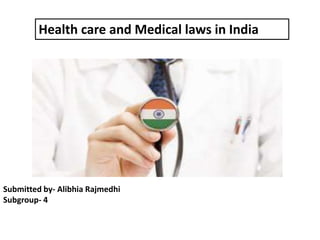
Health care and Medical laws in India
Medical law
Introduction:-
Medical law is the branch of law which concerns
the prerogatives and responsibilities of medical
professionals and the rights of the patient. It
should not be confused with medical
jurisprudence, which is a branch of medicine,
rather than a branch of law.
The main branches of medical law are the law of
torts and criminal law in relation to medical
practice and treatment. Ethics and medical
practice is a growing field..[
Abstract Healthcare in India features a universal healthcare care system run by the constituent
states and territories. Law is an obligation on the part of society imposed by the competent
authority, and non compliance may lead to punishment in the form of monetary fine or
imprisonment or both. The earliest known code of laws called the code of Hammurabi governed
the various aspects of health practices including the fees payable to physician for satisfactory
services . The first ever code of medical ethics called the Hippocratic oath was laid down 2500
years ago, in the 5th century BC, by Hippocrates – the Greek physician. The modern version of
Hippocratic Oath ( called the declaration of Geneva ), devised by the WHO after the second
world war and is accepted by international medical fraternity. The process of establishment of
healthcare system during the colonial rule also necessitated creation of legislative framework for
practitioners of medicine. As the number of doctors qualified in Indian medical colleges
increased, creation of laws for them became necessary. The medical council of India, a national
level statutory body for the doctors of modern medicine, was constituted after the enactment of
Indian medical council act, 1933.
Why do we need Medical law in India:-
The first legal recognition and registration for the Indian systems of medicine came when the
Bombay medical practitioner act was passed in 1938. Laws governing the commissioning of
hospital are the laws to ensure that the hospital facilities are created after due process of
registration, the facilities created are safe for the public using them, have at least the minimum
essential infrastructure for the type and volume of workload anticipated, and are subject to
periodic inspections to ensure compliance. There are other laws pertaining to governing to the
qualification / practice and conduct of professionals, sale, storage of drugs and safe medication,
management of patients, environmental safety, employment and management of manpower,
Medico Legal Aspects and laws pertaining to safety of patients, public and staff within the
hospital premises. There are laws governing professional training and research, business
aspects, licenses / certifications required for hospitals etc. A hospital administrator should be
aware about all these laws, regulations, policies, procedures, reports and returns and keep
abreast with the latest amendments to be on the safe side of law and provide quality care to the
patients.
Rights of patient as inbound by Indian medical law:
1. Right to Information:-
Physicians or their qualified assistants are required to provide adequate information about your illness, its
diagnosis (provisional or confirmed, as it may be), proposed investigation and possible complications to
the patient. If the patient is not in a state to understand this, the physician or their assistant is required to
provide the information to the caretaker.
This has to be done in a simple language that the patient or caretaker will understand.
Apart from this, patients have the right to know the identity and professional status of every doctor and
assistant as well as the primary doctor who is treating them.
Information regarding costs of treatment needs to be given in writing.
2. Right to records and reports:-
Patients or their respective caretakers have the right to access the originals or copies of case papers,
indoor patient records and investigation reports. Investigation reports have to be made available to them
within 24 hours of admission or 72 hours of discharge.
The hospital is responsible for providing a discharge summary or a death summary, in the case of a death,
to the caretakers or kin of the patient with original copies of investigations.
3. RIGHT TO EMERGENCY MEDICAL CARE
IN AN EMERGENCY SITUATION, YOU CAN AVAIL MEDICAL CARE IN ANY GOVERNMENT OR PRIVATE
HOSPITAL. UNDER ARTICLE 21 OF THE CONSTITUTION, WHICH ENSURES THAT EVERY PERSON HAS THE
RIGHT TO LIFE AND PERSONAL LIBERTY, YOU HAVE THE RIGHT TO PROMPT EMERGENCY CARE BY
DOCTORS WITHOUT COMPROMISE ON QUALITY OR SAFETY AND WITHOUT HAVING TO PAY FULL OR
AN ADVANCED FEE TO THE HOSPITAL.
4. RIGHT TO INFORMED CONSENT
IF A HOSPITAL DECIDES UPON CARRYING AN INVASIVE INVESTIGATION OR SURGERY OR
CHEMOTHERAPY ON A PATIENT, THEY REQUIRE TO DO SO AFTER COMPLETING AN APPROPRIATE
POLICY PROCEDURE. THE DOCTOR PRIMARILY IN CHARGE OF A PATIENT HAS TO EXPLAIN THE RISKS,
CONSEQUENCES AND PROCEDURE OF THE INVESTIGATION OR SURGERY IN DETAIL AND A SIMPLE
LANGUAGE BEFORE PROVIDING THE PROTOCOL CONSENT FORM TO THE PATIENT OR TO THE
RESPONSIBLE CARETAKER.
5. RIGHT TO CONFIDENTIALITY, HUMAN DIGNITY AND PRIVACY
THE CODE OF ETHICS DICTATES DOCTORS TO HOLD INFORMATION ABOUT THE ILLNESS AND TREATMENT PLAN FOR
THE PATIENT IN STRICT CONFIDENTIALITY FROM EVERYONE EXCEPT THE PATIENT AND THEIR CARETAKERS.
UNLESS IT IS AN EXCEPTIONAL CASE WHERE SHARING THIS INFORMATION IS “IN THE INTEREST OF PROTECTING
OTHER OR DUE TO PUBLIC HEALTH CONSIDERATIONS.”
IN THE CASE OF A FEMALE PATIENT, SHE HAS THE RIGHT TO DEMAND THE PRESENCE OF ANOTHER WOMAN IF THE
MEDICAL PRACTITIONER CHECKING OR TREATING HER IS MALE. HAVING SAID THIS, THE HOSPITAL IS RESPONSIBLE
FOR UPHOLDING THE DIGNITY OF EVERY PATIENT, IRRESPECTIVE OF THEIR GENDER.
6. Right to non-discrimination
The rights of a patient being upheld without discrimination based on their illness,
condition, HIV status or on their gender, age, religion, caste, ethnicity, sexual orientation,
linguistic or geographical or social origins.
Based on the above characteristics, no person can be subjected to discriminatory
treatment, and the staff of the hospital is responsible for ensuring this.
7. Right to safety and quality care according to standards
Here is a brief list of provisions that come under the list of quality care
standards-
– Safety and security.
– Cleanliness, infection control measures and sanitation facilities and safe
drinking water.
– Healthcare that abides by the latest standards, norms and guidelines under the
National Accreditation Board for Hospitals (NABH).
– To be attended to, treated and cared for in a professional manner and with the
principles of medical ethics.
– Right to seek redressal by patient or caretakers.
8. Right to choose alternative treatment options if available
Hospital staff and doctors are responsible for clarifying all treatment options
to the patient/caretakers. After a thorough study of their choices, the
patient/caretakers can choose to opt for a treatment that may or may not be
the doctor’s primary recommendation. This also means that once the
patient/caretakers choose this alternative treatment, they will shoulder the
responsibility of its consequences.
9. Right to a second opinion
Doctors and the hospital must respect your decision if you choose to seek a
second opinion from a doctor/hospital of your choice. They are responsible
for handing over all record documents and other relevant information should
you choose to approach a different doctor. The hospital can neither stop you
nor discourage you from going elsewhere, only give a detailed explanation of
the health condition and repercussions in case of delay in treatment.
In case you choose to come back to the first hospital after getting your second
opinion, the hospital still cannot compromise on the quality of healthcare
services.
10. Right to transparency in rates, and care according to prescribed rates
wherever relevant
the patient has the right to have a written account of the costs they will have
to bear for the treatment they are receiving. As evidence for this, hospitals
are required to have printed brochures and prominent display boards bearing
the names and rates of medical procedures that are available with them.
Detailed schedules of key rates need to be displayed in conspicuous places
and need to be in both, English as well as the local language.
Patients have the right to get medicines, devices and implants at rates
decided by the National Pharmaceutical Pricing Authority (NPPA) and other
relevant authorities. Patients have the right to receive health care services
that cost within the range prescribed by the Central and State governments,
at the time of receiving it.
Conclusion:-
Since India is an overwhelmingly and dynamically populated country,
so to enhance the health care and welfare of the entire population at
large is of utmost importance and priority to any ruling government of
the state. So, to ensure this the federal government along with its state
government go hand in hand to provide the A-class health care
facilities throughout the country. And we as the citizens and future
doctors firmly stand by the necessities and requirements of the
general population of the nation, and the world at large.