Mechanisms of Osmoregulation in Freshwater and Marine Invertebrates: Adaptations and Processes by zoologyverse
Explore osmoregulation in invertebrates, including definitions, classifications, and mechanisms in freshwater and marine environments, highlighting structures like contractile vacuoles and excretory organs.
Content
• INTRODUCTION
• DEFINITIONOF OSMOREGULATION
• TYPES OF INVERTEBRATES ACCORDING TO THE MEDIUM
• CLASSIFICATION OF INVERTEBRATES ON THE BASIS OF OSMOREGULATION
I. OSMOCONFORMERS
II. OSMOREGULATORS
• MECHANISMS OF OSMOREGULATION
• OSMOREGULATION IN FRESH WATER INVERTEBRATES
• OSMOREGULATION IN MARINE WATER INVERTEBRATES
• CONCLUSION
• REFERENCE
3.
INTRODUCTION
WITH THE HELPOF THEIR SEVERAL STRUCTURES ALL THE LIVING
ORGANISMS MAINTAIN A PROPER AMOUNT OF WATER AND
SALTS IN THEIR BODIES. THIS REGULATION OF THE WATER AND
SALTS CONTENTS OF THE BODY IS TERMED AS
OSMOREGULATION. HOWEVER, THE OSMOTIC REGULATION
AND IONIC REGULATION ARE SOMETIMES TREATED AS THE
DIFFERENT MECHANISMS. BUT IN MOST ANIMALS THE
OSMOREGULATORY MECHANISM INCLUDES BOTH OF THEM
BECAUSE THE REGULATION OF ONE(WATER) ALWAYS AFFECTS
THE OTHER(SALTS).
4.
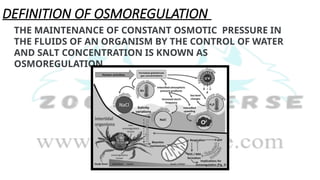
DEFINITION OF OSMOREGULATION
THEMAINTENANCE OF CONSTANT OSMOTIC PRESSURE IN
THE FLUIDS OF AN ORGANISM BY THE CONTROL OF WATER
AND SALT CONCENTRATION IS KNOWN AS
OSMOREGULATION.
5.
Types of INVERTEBRATESACCORDING to the
MEDIUM
• INVERTEBRATES whose body fluids have same concentration as that of their surrounding medium never face
the problem of OSMOREGULATION as long as they live in such a medium are called isotonice or isosmotic
invertebrates. For example, most marine animals are isotonic, as they have their body fluids isotonic with sea
water.
• Invertebrates which live in a MEDIUM of lower salt concentration have face difficulty of hydration and hence
they have evolved special mechanisms to get rid of the excess water that usually enters their body and
dilutes their body fluids are called hypotonic or hhyposmotic INVERTEBRATES . For example, fresh water
protozoans and crustaceans are hypotonic and eliminate the excess water bY contractile vacuoles and
excretory organs respectively.
• INVERTEBRATES which live in a MEDIUM of higher salt concentration have to evolve regulatory mechanisms
by which excess loss of water from the body is prevented are called hypertonic or hyperosmotic
invertebrates. For example, bony fishes of sea.
6.
CLASSIFICATION of theINVERTEBRATES on
the basis of OSMOREGULATION
OSMOCONFORMERS-
Osmoconformers are marine organisms that maintain an internal environment which is osmotic to
their external environment.This means that the osmotic pressure of the organism's cells is equal to
the osmotic pressure of their surrounding environment. By minimizing the osmotic gradient, this
subsequently minimizes thenet influx and efflux of water into and out of cells. Even though
osmoconformers have an internal environment that is isosmotic to their external environment, the
types of ions in the two environments differ greatly in order to allow critical biological function to
order.
7.
OSMOREGULATORS-
AN OSMEGULATORS ISAN ORGANISM THAT CAN REGULATE OR KEEP THE
SOLUTES OR SALTS OF ITS BODY FLUIDS AT A HIGHER OR LOWER
CONCENTRATION THAT THE CONCENTRATION OF THE SOLUTES IN THE
EXTERNAL MEDIUM, ALTHOUGH THIS REGULATION MAY BE LIMITED AT
EXTREMELY HIGH OR EXTREMELY LOW EXTERNAL SOLUTE
CONCENTRATION.
FOR EXAMPLE- MARINE OR FRESH WATER FISHES, PROTISTS LIKE
PARAMECIUM ETC.
8.
MECHANISMS of OSMOREGULATION
•IN FRESH WATER INVERTEBRATES-
• ALL FRESHWATER INVERTEBRATES, AS WELL AS FISHES AND AMPHIBIANS, ARE HYPERTONIC TO THE SURROUNDING
WATER. SINCE THEY ARE NEVER COMPLETELY IMPERMEABLE, THEY HAVE STEADY INFLOW OF WATER AND SOME LOSS OF
SALT. THEY ELIMINATE EXCESS AMOUNT OF WATER AS URINE, AND BY ELABORATING A URINE OF VERY LOW
CONCENTRATION.
• NUMEROUS FRESHWATER INVERTEBRATES CAN ABSORB SALT ACTIVELY AND PROBABLY ALL OF THEM HAVE SOME SALT
ABSORBING MECHANISM.
• FRESHWATER PROTOZOANS LIVING IN HYPOTONIC MEDIUM, ELIMINATE EXCESS WATER BY THEIR CONTRACTILE VACUOLES.
THE PULSATION RATE OF THE VACUOLES INCREASES WHEN MORE WATER PENETRATES INTO THE BODY.
• IN FRESHWATER CRUSTACEANS THE EXCESS WATER IS ELIMINATED BY THEIR EXCRETORY ORGANS, THE ANTENNARY OR
GREEN GLANDS.
• THE SMALL AMOUNT OF SALT LOST WITH THE DILUTE URINE IS RESTORED BY ACTIVE ABSORPTION OF SALTS BY THE GILLS
FROM THE FRESHWATER.
• FRESHWATER MOLLUSCS E.g. UNIO AND ANODONTA ALSO EXCRETE A LARGE AMOUNT OF DILUTE URINE AND ABSORB
SALTUS TO MAKE UP THE LOSS.
• THE FRESHWATER CRAYFISH, ASTACUS, SECRETES URINE EQUAL TO ABOUT 4% OF ITS BODY WEIGHT IN 24Hr, THE OSMOTIC
CONCENTRATION OF WHICH IS ABOUT ONE FIFTH THAT OF ITS BLOOD.
• AS THEY HAVE A LOW SALT CONCENTRATION, THEY HAVE NOT BEEN ABLE TO ADPOT TO A MARINE LIFE, FOR IN SALT
WATER THEY WOULD BECOME DEHYDRATED AND SALT WOULD ENTER THE BODY.
9.
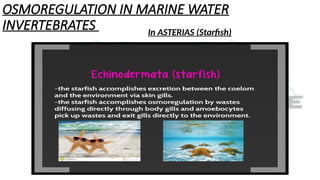
In marine waterINVERTEBRATES-
• MOST INVERTEBRATES LIVING IN THE SEA HAVE AN OSMOTIC CONCENTRATION IN THEIR BODY FLUIDS WHICH EQUAL THAT
OF THE SURROUNDING SEA WATER BUT THEY CAN REGULATE THEIR IONIC COMPOSITION.
• WHEN A MARINE INVERTEBRATES IS PLACED IN DILUTE SEA WATER, THE WATER ENTERS THE ANIMALS DUE TO THE HIGHER
OSMOTIC CONCENTRATION OF THE ANIMAL. BUT AFTER SOMETIME A STATE OF OSMOTIC EQUILIBRIUM IS ATTAINED WITH
THE NEW ENVIRONMENT.
• IF THE MEDIUM BECOMES TOO DILUTE THEY WOULD DIE.
• THE ABILITY OF A MARINE ANIMALS TO PENETRATE INTO A BRACKISH WATER OR ESTUARINE ENVIRONMENT DEPENDS ON
THREE DIFFERENT ABILITIES, OR A COMBINATION OF THEM. THESE ARE-
(I) THE ANIMAL MAY TEMPORARILY EXCLUDE DILUTE SEA WATER, FOR EXAMPLE A CALM OR OYSTER MAY CLOSE ITS
SHELLS WHEN THE CHANGING TIDES BRING HIGHLY DILUTED SEA WATER.
(II) THE ANIMAL MAY TOLERATE THE DECREASE OCCURRING IN THE CONCENTRATION OF ITS BODY FLUIDS AS THE SALINITY
OF THE WATER DECREASES TEMPORARILY.
(III) THE ANIMAL MAY ACTIVELY TAKE UP SALT FROM THE WATER AND MAINTAIN A HIGHER OSMOTIC CONCENTRATION
THAN THE SURROUNDING WATER. THIS FORM OF OSMOTIC REGULATION WILL ENABLE THE EFFICIENT ANIMAL TO LIVE
IN DILUTE WATER, AND MAY EVEN PERMIT HIM TO PENETRATE INTO FRESHWATER.
10.
OSMOREGULATION IN FRESHWATERINVERTEBRATES
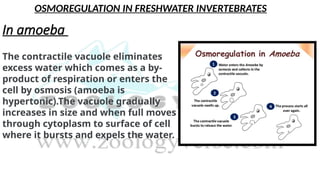
In amoeba
The contractile vacuole eliminates
excess water which comes as a by-
product of respiration or enters the
cell by osmosis (amoeba is
hypertonic).The vacuole gradually
increases in size and when full moves
through cytoplasm to surface of cell
where it bursts and expels the water.
11.
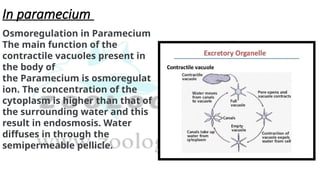
In paramecium
Osmoregulation inParamecium
The main function of the
contractile vacuoles present in
the body of
the Paramecium is osmoregulat
ion. The concentration of the
cytoplasm is higher than that of
the surrounding water and this
result in endosmosis. Water
diffuses in through the
semipermeable pellicle.
12.
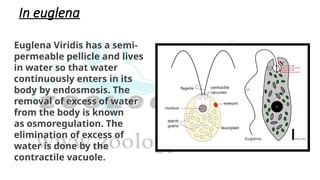
In euglena
Euglena Viridishas a semi-
permeable pellicle and lives
in water so that water
continuously enters in its
body by endosmosis. The
removal of excess of water
from the body is known
as osmoregulation. The
elimination of excess of
water is done by the
contractile vacuole.
13.
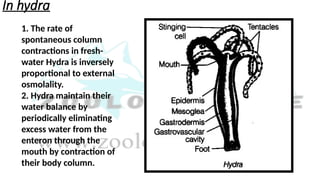
In hydra
1. Therate of
spontaneous column
contractions in fresh-
water Hydra is inversely
proportional to external
osmolality.
2. Hydra maintain their
water balance by
periodically eliminating
excess water from the
enteron through the
mouth by contraction of
their body column.
14.
In ascaris
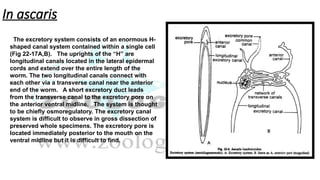
The excretorysystem consists of an enormous H-
shaped canal system contained within a single cell
(Fig 22-17A,B). The uprights of the “H” are
longitudinal canals located in the lateral epidermal
cords and extend over the entire length of the
worm. The two longitudinal canals connect with
each other via a transverse canal near the anterior
end of the worm. A short excretory duct leads
from the transverse canal to the excretory pore on
the anterior ventral midline. The system is thought
to be chiefly osmoregulatory. The excretory canal
system is difficult to observe in gross dissection of
preserved whole specimens. The excretory pore is
located immediately posterior to the mouth on the
ventral midline but it is difficult to find.
15.
IN PLANARIA
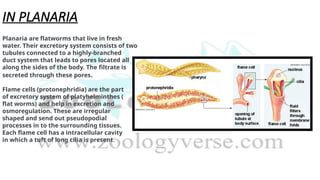
Planaria areflatworms that live in fresh
water. Their excretory system consists of two
tubules connected to a highly-branched
duct system that leads to pores located all
along the sides of the body. The filtrate is
secreted through these pores.
Flame cells (protonephridia) are the part
of excretory system of platyhelminthes (
flat worms) and help in excretion and
osmoregulation. These are irregular
shaped and send out pseudopodial
processes in to the surrounding tissues.
Each flame cell has a intracellular cavity
in which a tuft of long cilia is present.
16.
In pheretina
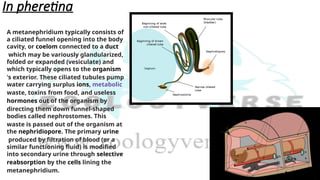
A metanephridiumtypically consists of
a ciliated funnel opening into the body
cavity, or coelom connected to a duct
which may be variously glandularized,
folded or expanded (vesiculate) and
which typically opens to the organism
's exterior. These ciliated tubules pump
water carrying surplus ions, metabolic
waste, toxins from food, and useless
hormones out of the organism by
directing them down funnel-shaped
bodies called nephrostomes. This
waste is passed out of the organism at
the nephridiopore. The primary urine
produced by filtration of blood (or a
similar functioning fluid) is modified
into secondary urine through selective
reabsorption by the cells lining the
metanephridium.
17.
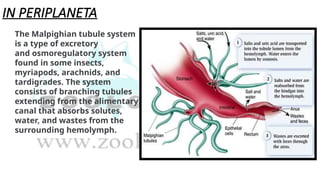
IN PERIPLANETA
The Malpighiantubule system
is a type of excretory
and osmoregulatory system
found in some insects,
myriapods, arachnids, and
tardigrades. The system
consists of branching tubules
extending from the alimentary
canal that absorbs solutes,
water, and wastes from the
surrounding hemolymph.
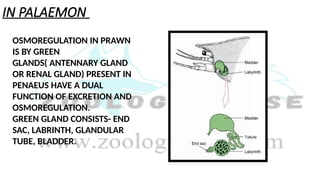
IN PALAEMON
OSMOREGULATION INPRAWN
IS BY GREEN
GLANDS( ANTENNARY GLAND
OR RENAL GLAND) PRESENT IN
PENAEUS HAVE A DUAL
FUNCTION OF EXCRETION AND
OSMOREGULATION.
GREEN GLAND CONSISTS- END
SAC, LABRINTH, GLANDULAR
TUBE, BLADDER.
20.
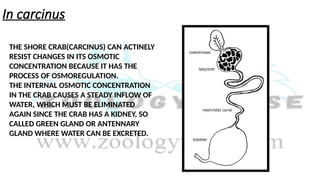
In carcinus
THE SHORECRAB(CARCINUS) CAN ACTINELY
RESIST CHANGES IN ITS OSMOTIC
CONCENTRATION BECAUSE IT HAS THE
PROCESS OF OSMOREGULATION.
THE INTERNAL OSMOTIC CONCENTRATION
IN THE CRAB CAUSES A STEADY INFLOW OF
WATER, WHICH MUST BE ELIMINATED
AGAIN SINCE THE CRAB HAS A KIDNEY, SO
CALLED GREEN GLAND OR ANTENNARY
GLAND WHERE WATER CAN BE EXCRETED.
21.
Conclusion
Osmoregulation means thephysiological processes that an
organism uses to maintain water balance; that is, to compensate
for water loss, avoid excess water gain, and maintain the proper
osmotic concentration (osmolarity) of the body fluids. Their are
two types of organisms which are euryhaline which can tolerate
the salinity and other one is stenohaline which cannot tolerate
salinity. Every invertebrates having their own osmoregulatory
part like contractile vacuole of protozoans, green gland of
arthropods metanephridium in annelids etc. So this process is
very useful for the survival of any organism.
Visit website formore
www.zoologyverse.com
IF YOU ARE IN ZOOLOGY FIELD AND GOT TIRED OF SEARCHING FOR PROPER
NOTES THEN THE SEARCH IS OVER. GO VISIT
https://www.zoologyverse.com/
This website contain all study material of zoology for free it includes the
content like :-
• Study of specimens including their classification, habits and habitat, general
characteristics, special features and their identification feature :-
study of specimens
• Study of dissection of animal :- DISSECTIONS
• Study of different bones :- BONES
• Study of histological slides :- SLIDES