+
Empowered Career Services Coaching
with Immigrant and International Clients
Annual
Conference
April 25, 2014
+
Yuki Tokuji, MA
University of Minnesota-Twin Cities,
International Student & Scholar Services
Jessica Ayub, MA
Adjunct Instructor with International
Students at Concordia University-Saint Paul
Roundtable
and Resource Handout
Co-Presenters:
Annual Conference
April 25, 2014
Minnesota Career Development Association
Empowered Career Services Coaching with
Immigrant and International Clients
+ Career Development
Employment Seeking
Career Services
Office Settings
Section
Divisions
Empowered Career Services Coaching
with Immigrant and International Clients
+
Career Development
Empowered Career Services Coaching
with Immigrant and International Clients
+
Coaching Technique:
Increasing Career Decision
Self-Efficacy and Vocational
Identity in Career Development
Concerning a “common theme expressed by
students; that they have not viewed career as
their own but rather the product of external
factors (e.g., test scores, parental choices,
societal needs).”
+
One Week Group Class or
“Academy”
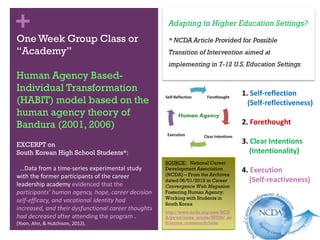
Human Agency Based-
Individual Transformation
(HABIT) model based on the
human agency theory of
Bandura (2001, 2006)
EXCERPT on
South Korean High School Students*:
…Data from a time-series experimental study
with the former participants of the career
leadership academy evidenced that the
participants’ human agency, hope, career decision
self-efficacy, and vocational identity had
increased, and their dysfunctional career thoughts
had decreased after attending the program .
(Yoon, Ahn, & Hutchison, 2012).
1. Self-reflection
(Self-reflectiveness)
2. Forethought
3. Clear Intentions
(Intentionality)
4. Execution
(Self-reactiveness)
SOURCE: National Career
Development Association
(NCDA) – From the Archives
dated 06/01/2012 in Career
Convergence Web Magazine:
Fostering Human Agency:
Working with Students in
South Korea
http://www.ncda.org/aws/NCD
A/pt/sd/news_article/59739/_se
lf/layout_ccmsearch/false
Adapting to Higher Education Settings?
* NCDA Article Provided for Possible
Transition of Intervention aimed at
implementing in 7-12 U.S. Education Settings
+
Coaching Technique:
Circumscription, Compromise,
and Self-Creation
(Linda Gottfredson)
Gottfredson’s
Theory
+
Circumscription, Compromise, and
Self-Creation
(Linda Gottfredson)
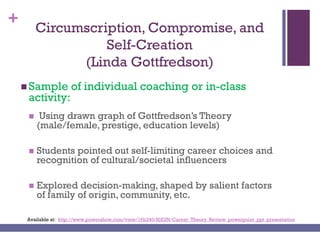
 Sample of individual coaching or in-class
activity:
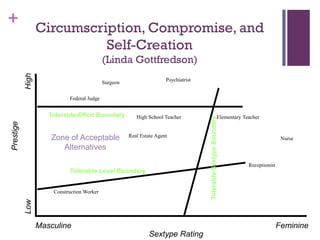
 Using drawn graph of Gottfredson’s Theory
(male/female, prestige, education levels)
 Students pointed out self-limiting career choices and
recognition of cultural/societal influencers
 Explored decision-making, shaped by salient factors
of family of origin, community, etc.
Available at: http://www.powershow.com/view/16b240-NjE2N/Career_Theory_Review_powerpoint_ppt_presentation
+
Explore with Clients: Do you think
society or culture had anything to do
with your decision?
Note that
Gottfredson’s Theory
is Not Specifically
Targeted to People
with International
Perspectives
Jessica has used with
students of color at
Concordia University
with success
+
Circumscription, Compromise, and
Self-Creation
(Linda Gottfredson)
Sextype Rating
Feminine
HighLow
Masculine
Prestige
Construction Worker
Psychiatrist
Receptionist
Nurse
Real Estate Agent
Surgeon
Elementary Teacher
Federal Judge
High School Teacher
Tolerable-Level Boundary
Tolerable-Effort Boundary
Tolerable-SextypeBoundary
Zone of Acceptable
Alternatives
+
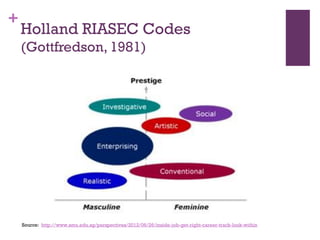
Holland RIASEC Codes
(Gottfredson, 1981)
Source: http://www.smu.edu.sg/perspectives/2012/06/26/inside-job-get-right-career-track-look-within
+
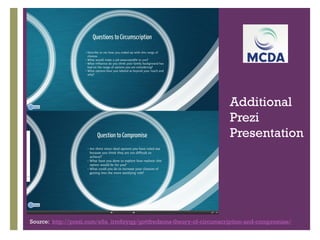
Additional
Prezi
Presentation
Source: http://prezi.com/e5a_irm6zyqg/gottfredsons-theory-of-circumscription-and-compromise/
+
Circumscription, Compromise, and
Self-Creation
(Linda Gottfredson)
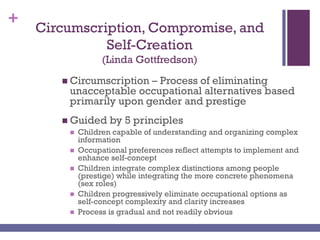
 Circumscription – Process of eliminating
unacceptable occupational alternatives based
primarily upon gender and prestige
 Guided by 5 principles
 Children capable of understanding and organizing complex
information
 Occupational preferences reflect attempts to implement and
enhance self-concept
 Children integrate complex distinctions among people
(prestige) while integrating the more concrete phenomena
(sex roles)
 Children progressively eliminate occupational options as
self-concept complexity and clarity increases
 Process is gradual and not readily obvious
+
Circumscription, Compromise, and
Self-Creation
(Linda Gottfredson)
Source: http://www.smu.edu.sg/perspectives/2012/06/26/inside-job-get-right-career-track-look-within
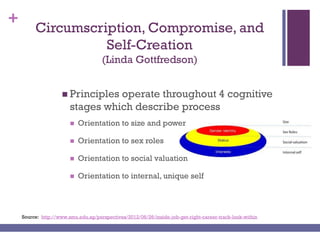
 Principles operate throughout 4 cognitive
stages which describe process
 Orientation to size and power
 Orientation to sex roles
 Orientation to social valuation
 Orientation to internal, unique self
+
Circumscription, Compromise, and
Self-Creation
(Linda Gottfredson)
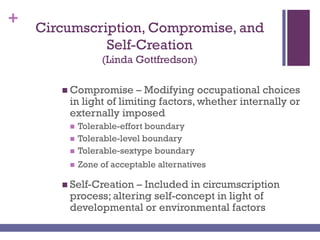
 Compromise – Modifying occupational choices
in light of limiting factors, whether internally or
externally imposed
 Tolerable-effort boundary
 Tolerable-level boundary
 Tolerable-sextype boundary
 Zone of acceptable alternatives
 Self-Creation – Included in circumscription
process; altering self-concept in light of
developmental or environmental factors
+
Employment Seeking
Empowered Career Services Coaching
with International Clients
+
Work Authorization for International
Applicants
Applicants should be knowledgeable about their work
authorization so they can explain it in interviews.
 F-1 students
 Curricular Practical Training (CPT)
 Optional Practical Training (OPT)
*17-month extension of post-completion OPT is available for STEM degree
holders
 J-1 students
 Academic Training (AT)
 H-1B visa
 Other types of employment-based visas
To Learn More: http://studyinthestates.dhs.gov/students/resources/working
+Identify Potential Employers…
 International companies
 They often desire individuals with languages skills, respect for
diversity, and a knowledge of overseas economies.
 Companies that have previously sponsored H-1B visas
 They are familiar with and have successfully completed the
hiring process before.
 http://www.myvisajobs.com/Minnesota-2014WS.htm
 Medium and small companies
 Although they are not large companies,
they may have openings for international
students and should not be discounted.
 Join professional organizations
Recommended Resources – See “International Students” Section:
http://www.udel.edu/CSC/students/handouts.html
+
Possible Cultural Barriers in
Job Search
 Individual responsibility in job search
 Preparation: research organization, networking, join professional
organizations, gain experience
 Self promotion
 Show confidence, assertiveness, talk about
individual accomplishments and skills
 Direct vs indirect communication
 Eye contact, shake hands, direct responses to questions
 How to show “respect”
+
Tips in Coaching International
Clients
 Reality check: Help clients understand the expectations
in the U.S. job search process
 What do they need to do to be a strong candidate?
 What advantages do they have?
 Provide concrete examples, and Practice
 Including first impression, elevator speech, and sample answers
 Different ways to gain experience
 Paid positions are not the only option for them to gain experience
+
Source: http://blogs.hbr.org/2014/04/how-to-adapt-to-american-style-self-promotion/
Self-Promotion Quiz
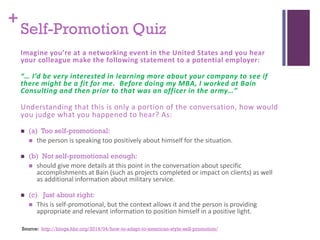
Imagine you’re at a networking event in the United States and you hear
your colleague make the following statement to a potential employer:
“… I’d be very interested in learning more about your company to see if
there might be a fit for me. Before doing my MBA, I worked at Bain
Consulting and then prior to that was an officer in the army…”
Understanding that this is only a portion of the conversation, how would
you judge what you happened to hear? As:
 (a) Too self-promotional:
 the person is speaking too positively about himself for the situation.
 (b) Not self-promotional enough:
 should give more details at this point in the conversation about specific
accomplishments at Bain (such as projects completed or impact on clients) as well
as additional information about military service.
 (c) Just about right:
 This is self-promotional, but the context allows it and the person is providing
appropriate and relevant information to position himself in a positive light.
+
Possible Strengths as an
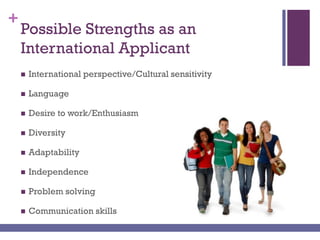
International Applicant
 International perspective/Cultural sensitivity
 Language
 Desire to work/Enthusiasm
 Diversity
 Adaptability
 Independence
 Problem solving
 Communication skills
+
Career Services
Office Settings
Empowered Career Services Coaching
with Immigrant and International Clients
+
Engagement with International Clients
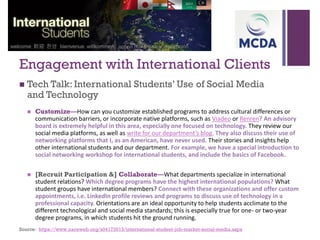
 Tech Talk: International Students’ Use of Social Media
and Technology
 Customize—How can you customize established programs to address cultural differences or
communication barriers, or incorporate native platforms, such as Viadeo or Renren? An advisory
board is extremely helpful in this area, especially one focused on technology. They review our
social media platforms, as well as write for our department’s blog. They also discuss their use of
networking platforms that I, as an American, have never used. Their stories and insights help
other international students and our department. For example, we have a special introduction to
social networking workshop for international students, and include the basics of Facebook.
 [Recruit Participation &] Collaborate—What departments specialize in international
student relations? Which degree programs have the highest international populations? What
student groups have international members? Connect with these organizations and offer custom
appointments, i.e. LinkedIn profile reviews and programs to discuss use of technology in a
professional capacity. Orientations are an ideal opportunity to help students acclimate to the
different technological and social media standards; this is especially true for one- or two-year
degree programs, in which students hit the ground running.
Source: https://www.naceweb.org/s04172013/international-student-job-market-social-media.aspx
+
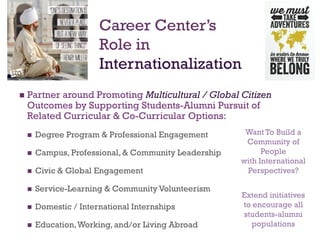
 Partner around Promoting Multicultural / Global Citizen
Outcomes by Supporting Students-Alumni Pursuit of
Related Curricular & Co-Curricular Options:
 Degree Program & Professional Engagement
 Campus, Professional, & Community Leadership
 Civic & Global Engagement
 Service-Learning & Community Volunteerism
 Domestic / International Internships
 Education,Working, and/or Living Abroad
Career Center’s
Role in
Internationalization
Want To Build a
Community of
People
with International
Perspectives?
Extend initiatives
to encourage all
students-alumni
populations
+
Resources:
National Career Development Association (NCDA) – From the Archives dated 06/01/2012 in Career
Convergence Web Magazine: Fostering Human Agency: Working with Students in South Korea:
http://www.ncda.org/aws/NCDA/pt/sd/news_article/59739/_self/layout_ccmsearch/false
Gottfredson’s Theory:
http://www.powershow.com/view/16b240-NjE2N/Career_Theory_Review_powerpoint_ppt_presentation
Images: http://www.smu.edu.sg/perspectives/2012/06/26/inside-job-get-right-career-track-look-within
Gottfredson’s: http://prezi.com/e5a_irm6zyqg/gottfredsons-theory-of-circumscription-and-compromise/
Work Authorization: http://studyinthestates.dhs.gov/students/resources/working
MN H1B Visa Sponsoring Companies: http://www.myvisajobs.com/Minnesota-2014WS.htm
See “International Students” Section: http://www.udel.edu/CSC/students/handouts.html
Blog on Self-Promotion: http://blogs.hbr.org/2014/04/how-to-adapt-to-american-style-self-promotion
Career Offices: https://www.naceweb.org/s04172013/international-student-job-market-social-media.aspx
/
+
Thank you Minnesota Career
Development Association
{ Particular thanks extended to }
Sue Holm, Chair of the Program Committee
Sally Power, Program Committee member