Maturity Indices and Harvesting Techniques for Fruits, Vegetables, and Flowers
Explore maturity indices, commercial maturity, and harvesting methods to optimize quality, shelf life, and market value of horticultural crops for local and distant markets.
Maturity Indices and Harvesting Techniques for Fruits, Vegetables, and Flowers
1.
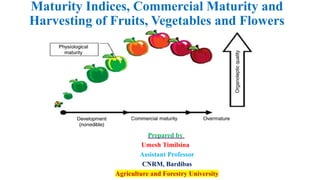
Maturity Indices, CommercialMaturity and
Harvesting of Fruits, Vegetables and Flowers
Prepared by
Umesh Timilsina
Assistant Professor
CNRM, Bardibas
Agriculture and Forestry University
2.
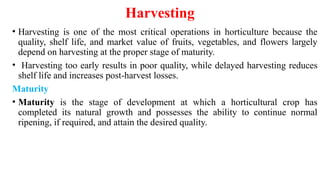
Harvesting
• Harvesting isone of the most critical operations in horticulture because the
quality, shelf life, and market value of fruits, vegetables, and flowers largely
depend on harvesting at the proper stage of maturity.
• Harvesting too early results in poor quality, while delayed harvesting reduces
shelf life and increases post-harvest losses.
Maturity
• Maturity is the stage of development at which a horticultural crop has
completed its natural growth and possesses the ability to continue normal
ripening, if required, and attain the desired quality.
3.
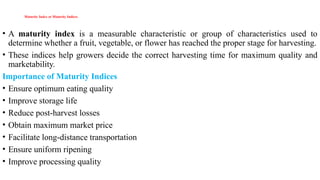
Maturity Index orMaturity Indices
• A maturity index is a measurable characteristic or group of characteristics used to
determine whether a fruit, vegetable, or flower has reached the proper stage for harvesting.
• These indices help growers decide the correct harvesting time for maximum quality and
marketability.
Importance of Maturity Indices
• Ensure optimum eating quality
• Improve storage life
• Reduce post-harvest losses
• Obtain maximum market price
• Facilitate long-distance transportation
• Ensure uniform ripening
• Improve processing quality
4.
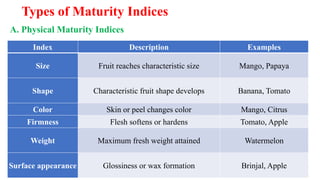
Types of MaturityIndices
A. Physical Maturity Indices
Index Description Examples
Size Fruit reaches characteristic size Mango, Papaya
Shape Characteristic fruit shape develops Banana, Tomato
Color Skin or peel changes color Mango, Citrus
Firmness Flesh softens or hardens Tomato, Apple
Weight Maximum fresh weight attained Watermelon
Surface appearance Glossiness or wax formation Brinjal, Apple
5.
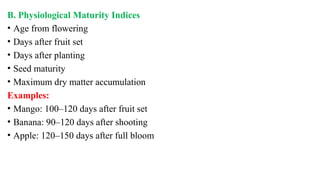
B. Physiological MaturityIndices
• Age from flowering
• Days after fruit set
• Days after planting
• Seed maturity
• Maximum dry matter accumulation
Examples:
• Mango: 100–120 days after fruit set
• Banana: 90–120 days after shooting
• Apple: 120–150 days after full bloom
6.
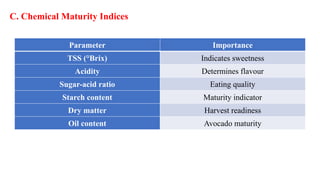
C. Chemical MaturityIndices
Parameter Importance
TSS (°Brix) Indicates sweetness
Acidity Determines flavour
Sugar-acid ratio Eating quality
Starch content Maturity indicator
Dry matter Harvest readiness
Oil content Avocado maturity
7.
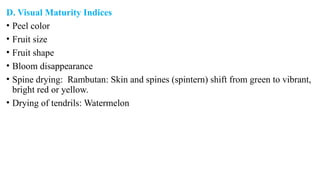
D. Visual MaturityIndices
• Peel color
• Fruit size
• Fruit shape
• Bloom disappearance
• Spine drying: Rambutan: Skin and spines (spintern) shift from green to vibrant,
bright red or yellow.
• Drying of tendrils: Watermelon
8.
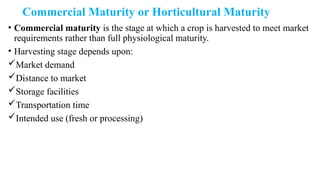
Commercial Maturity orHorticultural Maturity
• Commercial maturity is the stage at which a crop is harvested to meet market
requirements rather than full physiological maturity.
• Harvesting stage depends upon:
Market demand
Distance to market
Storage facilities
Transportation time
Intended use (fresh or processing)
9.
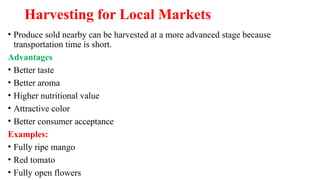
Harvesting for LocalMarkets
• Produce sold nearby can be harvested at a more advanced stage because
transportation time is short.
Advantages
• Better taste
• Better aroma
• Higher nutritional value
• Attractive color
• Better consumer acceptance
Examples:
• Fully ripe mango
• Red tomato
• Fully open flowers
10.
Harvesting for DistantMarkets
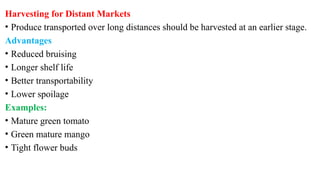
• Produce transported over long distances should be harvested at an earlier stage.
Advantages
• Reduced bruising
• Longer shelf life
• Better transportability
• Lower spoilage
Examples:
• Mature green tomato
• Green mature mango
• Tight flower buds
11.
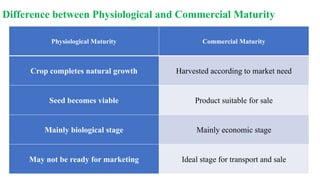
Difference between Physiologicaland Commercial Maturity
Physiological Maturity Commercial Maturity
Crop completes natural growth Harvested according to market need
Seed becomes viable Product suitable for sale
Mainly biological stage Mainly economic stage
May not be ready for marketing Ideal stage for transport and sale
12.
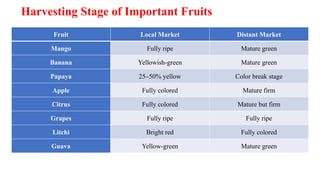
Harvesting Stage ofImportant Fruits
Fruit Local Market Distant Market
Mango Fully ripe Mature green
Banana Yellowish-green Mature green
Papaya 25–50% yellow Color break stage
Apple Fully colored Mature firm
Citrus Fully colored Mature but firm
Grapes Fully ripe Fully ripe
Litchi Bright red Fully colored
Guava Yellow-green Mature green
13.
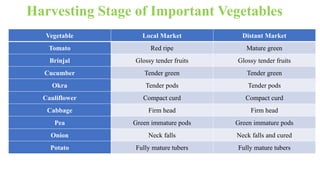
Harvesting Stage ofImportant Vegetables
Vegetable Local Market Distant Market
Tomato Red ripe Mature green
Brinjal Glossy tender fruits Glossy tender fruits
Cucumber Tender green Tender green
Okra Tender pods Tender pods
Cauliflower Compact curd Compact curd
Cabbage Firm head Firm head
Pea Green immature pods Green immature pods
Onion Neck falls Neck falls and cured
Potato Fully mature tubers Fully mature tubers
14.
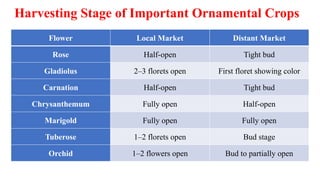
Harvesting Stage ofImportant Ornamental Crops
Flower Local Market Distant Market
Rose Half-open Tight bud
Gladiolus 2–3 florets open First floret showing color
Carnation Half-open Tight bud
Chrysanthemum Fully open Half-open
Marigold Fully open Fully open
Tuberose 1–2 florets open Bud stage
Orchid 1–2 flowers open Bud to partially open
15.
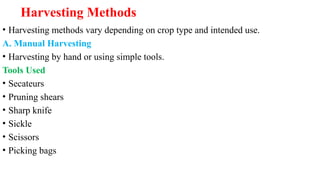
Harvesting Methods
• Harvestingmethods vary depending on crop type and intended use.
A. Manual Harvesting
• Harvesting by hand or using simple tools.
Tools Used
• Secateurs
• Pruning shears
• Sharp knife
• Sickle
• Scissors
• Picking bags
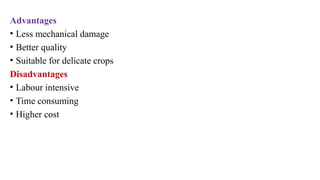
16.
Advantages
• Less mechanicaldamage
• Better quality
• Suitable for delicate crops
Disadvantages
• Labour intensive
• Time consuming
• Higher cost
17.
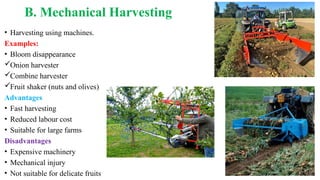
B. Mechanical Harvesting
•Harvesting using machines.
Examples:
• Bloom disappearance
Onion harvester
Combine harvester
Fruit shaker (nuts and olives)
Advantages
• Fast harvesting
• Reduced labour cost
• Suitable for large farms
Disadvantages
• Expensive machinery
• Mechanical injury
• Not suitable for delicate fruits
18.
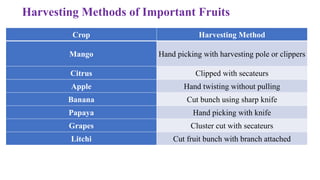
Harvesting Methods ofImportant Fruits
Crop Harvesting Method
Mango Hand picking with harvesting pole or clippers
Citrus Clipped with secateurs
Apple Hand twisting without pulling
Banana Cut bunch using sharp knife
Papaya Hand picking with knife
Grapes Cluster cut with secateurs
Litchi Cut fruit bunch with branch attached
19.
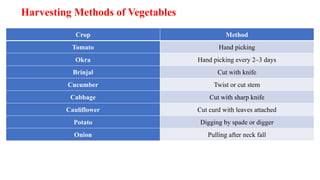
Harvesting Methods ofVegetables
Crop Method
Tomato Hand picking
Okra Hand picking every 2–3 days
Brinjal Cut with knife
Cucumber Twist or cut stem
Cabbage Cut with sharp knife
Cauliflower Cut curd with leaves attached
Potato Digging by spade or digger
Onion Pulling after neck fall
20.
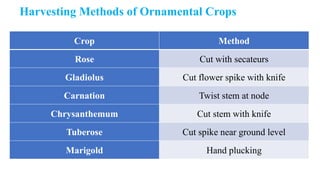
Harvesting Methods ofOrnamental Crops
Crop Method
Rose Cut with secateurs
Gladiolus Cut flower spike with knife
Carnation Twist stem at node
Chrysanthemum Cut stem with knife
Tuberose Cut spike near ground level
Marigold Hand plucking
21.
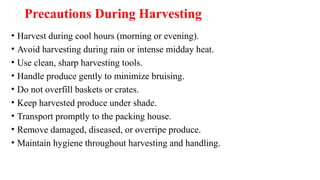
Precautions During Harvesting
•Harvest during cool hours (morning or evening).
• Avoid harvesting during rain or intense midday heat.
• Use clean, sharp harvesting tools.
• Handle produce gently to minimize bruising.
• Do not overfill baskets or crates.
• Keep harvested produce under shade.
• Transport promptly to the packing house.
• Remove damaged, diseased, or overripe produce.
• Maintain hygiene throughout harvesting and handling.
22.
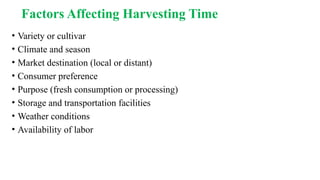
Factors Affecting HarvestingTime
• Variety or cultivar
• Climate and season
• Market destination (local or distant)
• Consumer preference
• Purpose (fresh consumption or processing)
• Storage and transportation facilities
• Weather conditions
• Availability of labor
23.
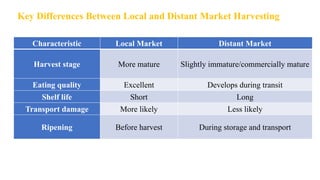
Key Differences BetweenLocal and Distant Market Harvesting
Characteristic Local Market Distant Market
Harvest stage More mature Slightly immature/commercially mature
Eating quality Excellent Develops during transit
Shelf life Short Long
Transport damage More likely Less likely
Ripening Before harvest During storage and transport
24.
Key Points
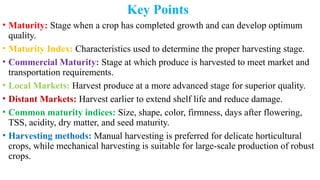
• Maturity:Stage when a crop has completed growth and can develop optimum
quality.
• Maturity Index: Characteristics used to determine the proper harvesting stage.
• Commercial Maturity: Stage at which produce is harvested to meet market and
transportation requirements.
• Local Markets: Harvest produce at a more advanced stage for superior quality.
• Distant Markets: Harvest earlier to extend shelf life and reduce damage.
• Common maturity indices: Size, shape, color, firmness, days after flowering,
TSS, acidity, dry matter, and seed maturity.
• Harvesting methods: Manual harvesting is preferred for delicate horticultural
crops, while mechanical harvesting is suitable for large-scale production of robust
crops.
 Most read
 Most read
 Most read