Mathematics in Everyday Life: Practical Uses for Decision-Making and Problem Solving
Explore how mathematics aids daily decisions, budgeting, cooking, travel, technology, and health through practical applications of percentages, ratios, measurements, and financial calculations.
Mathematics in Everyday Life: Practical Uses for Decision-Making and Problem Solving
1.
MATHEMATICS IN EVERYDAYLIFE
How Mathematics Helps Us Make Decisions, Solve Problems, and Understand the World
2.
Learning Objectives
By theend of the lesson, students should be able to:
• Identify common uses of mathematics in daily life
• Apply basic mathematical skills to real-world situations
• Explain how mathematics supports financial decisions
• Use percentages, ratios, and measurements in practical problems
• Recognize mathematics in technology, science, work, and everyday activities
3.
Why Do WeNeed Mathematics?
Mathematics is more than numbers and formulas. It is a tool for thinking, measuring, comparing,
predicting, and making decisions.
We use mathematics when we:
• Manage money
• Tell time and plan schedules
• Measure ingredients
• Compare prices
• Travel and estimate distances
• Interpret information and data
4.
Mathematics and Money
Mathematicshelps us manage personal finances.
Common applications:
• Budgeting
• Saving
• Computing change
• Comparing prices
• Calculating interest
• Understanding discounts and taxes
Income − Expenses = Money available for saving or other needs
5.
Budgeting
A budget isa plan for how money will be earned, spent, and saved.
Example monthly budget:
Income = ₱15,000
Food = ₱4,000
Transportation = ₱2,000
School needs = ₱3,000
Savings = ₱2,000
Other expenses = ₱4,000
Mathematics helps us check whether expenses stay within our available income.
6.
Percentages and Discounts
Percentagesare useful when shopping and comparing prices.
Example:
A ₱1,000 item has a 20% discount.
Discount = ₱1,000 × 0.20 = ₱200
Sale price = ₱1,000 − ₱200 = ₱800
Understanding percentages helps consumers make informed choices.
7.
Simple Interest
Simple interestis calculated using:
I = Prt
where P = principal, r = interest rate, and t = time.
Example:
₱5,000 at 4% per year for 2 years:
I = 5,000(0.04)(2) = ₱400
Total amount = ₱5,400
8.
Mathematics in Cooking
Cookinginvolves measurement, ratios, fractions, and conversions.
Examples:
• Measuring cups and spoons
• Adjusting recipes
• Converting units
• Dividing ingredients
• Maintaining ingredient ratios
If a recipe serves 4 but you need 8 servings, double each ingredient.
9.
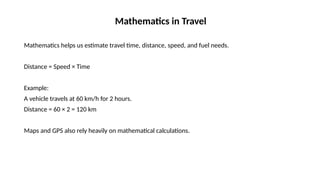
Mathematics in Travel
Mathematicshelps us estimate travel time, distance, speed, and fuel needs.
Distance = Speed × Time
Example:
A vehicle travels at 60 km/h for 2 hours.
Distance = 60 × 2 = 120 km
Maps and GPS also rely heavily on mathematical calculations.
10.
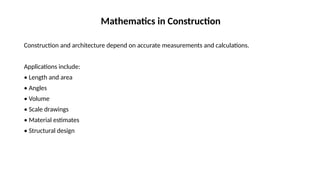
Mathematics in Construction
Constructionand architecture depend on accurate measurements and calculations.
Applications include:
• Length and area
• Angles
• Volume
• Scale drawings
• Material estimates
• Structural design
11.
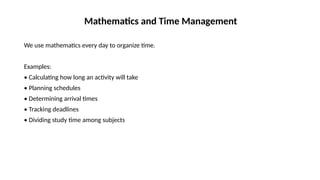
Mathematics and TimeManagement
We use mathematics every day to organize time.
Examples:
• Calculating how long an activity will take
• Planning schedules
• Determining arrival times
• Tracking deadlines
• Dividing study time among subjects
12.
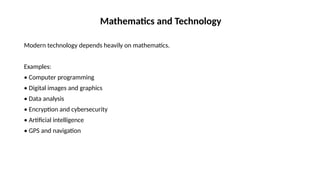
Mathematics and Technology
Moderntechnology depends heavily on mathematics.
Examples:
• Computer programming
• Digital images and graphics
• Data analysis
• Encryption and cybersecurity
• Artificial intelligence
• GPS and navigation
13.
Mathematics in Healthand Fitness
Mathematics is used to understand measurements and information related to health.
Examples:
• Monitoring time and distance during exercise
• Reading graphs and statistics
• Calculating proportions and averages
• Tracking changes over time
14.
Mathematics in Decision-Making
Mathematicalthinking helps us make better decisions.
A simple process:
1. Identify the information.
2. Organize the numbers or data.
3. Compare possible choices.
4. Calculate costs, benefits, or risks.
5. Choose based on evidence.
15.
Quick Practice
1. Anitem costs ₱800 and is discounted by 25%. What is the sale price?
2. A car travels at 50 km/h for 3 hours. How far does it travel?
3. You earn ₱12,000 and spend ₱9,500. How much remains?
4. A recipe uses 2 cups of flour for 4 servings. How much is needed for 8 servings?
5. Why is mathematics important in everyday decision-making?
16.
Answer Key
1. ₱600
2.150 km
3. ₱2,500
4. 4 cups
5. It helps us measure, compare, calculate, analyze information, and make informed decisions.
17.
Key Takeaways
✓ Mathematicsis part of everyday life.
✓ We use math when managing money, time, measurements, and information.
✓ Percentages and ratios help us compare quantities.
✓ Mathematics supports planning and problem-solving.
✓ Technology, science, construction, business, and transportation all depend on mathematics.
✓ Mathematical thinking helps us make informed and practical decisions.