1
MATATAG Kto10
Weekly Lesson
School:Grade Level: 4
Teacher: Learning Area: MATH
Date: JANUARY 5-9, 2026 (Week
8)
Quarter: 3rd / Week 8
MATHEMATICS/QUARTER 3/ GRADE 4
I. CURRICULUM CONTENT, STANDARDS, AND LESSON COMPETENCIES
A. Content
Standards
The learners should have knowledge and understanding of symmetric figures with respect to a line, and resulting images
after applying reflection with respect to a line.
B. Performance
Standards
By the end of the quarter, the learners are able to:
● identify symmetry with respect to a line, and create figures that have line symmetry. (MG)
● perform reflection with respect to a line, including glide reflection, to obtain images of shapes. (MG)
C. Learning
Competencies
and Objectives
1. Identify symmetry with respect to a line.
2. Complete a figure that is symmetric with respect to a line.
3. Draw the image of an object after applying reflection with respect to a line, including glide reflection.
D. Content Symmetry
E. Integration Symmetry in Nature and Culture
II. LEARNING RESOURCES
2.
2
Alexandra, E. (2016).Teach symmetry with backyard nature collage. Kid Minds. https://kidminds.org/teach-symmetry-with-nature-collage/
CueMath. (n.d.). Symmetry. CueMath. https://www.cuemath.com/geometry/symmetry/
Kazlacheva, Z. (2013). Bilateral symmetry in nature. Research Gate. https://www.researchgate.net/figure/Bilateral-symmetry-in-nature-
4_fig1_237838275
Lisa. (2015). Bilateral symmetry in nature. The Smart Happy Project. https://thesmarthappyproject.com/bilateral-symmetry-in-nature/ Mark
Ryan. (2016). How Glides Reflections Work. The Dummies. https://www.dummies.com/article/academics-the-
arts/math/geometry/glide-reflections-work-230054/
MiCath TV. (2021). Symmetry Song | Educational Tagalog Videos | MiCath TV. Youtube.
https://www.youtube.com/watch?app=desktop&v=YMFusUVk_n8
Nicky. (2013). Symmetry in nature. WordPress. https://blogs.baruch.cuny.edu/symmetries/2013/05/24/symmetry-in-nature-2/
University of Oxford. (2022). Nature prefers symmetry and simplicity. University of Oxford. https://www.ox.ac.uk/news/2022-03-31-nature-
prefers-symmetry-and-simplicity
III. TEACHING AND LEARNING PROCEDURE NOTES TO TEACHERS
3.
3
A. Activating Prior
Knowledge
DAY1
1. Short Review
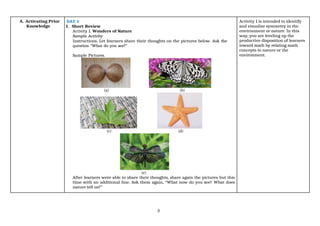
Activity 1. Wonders of Nature
Sample Activity
Instructions. Let learners share their thoughts on the pictures below. Ask the
question “What do you see?”
Sample Pictures.
(a) (b)
(c) (d)
(e)
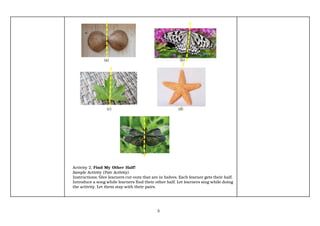
After learners were able to share their thoughts, share again the pictures but this
time with an additional line. Ask them again, “What now do you see? What does
nature tell us?”
Activity 1 is intended to identify
and visualize symmetry in the
environment or nature. In this
way, you are leveling up the
productive disposition of learners
toward math by relating math
concepts to nature or the
environment.
5
(a) (b)
(c) (d)
(e)
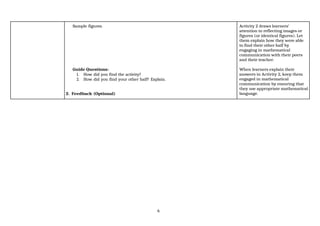
Activity2. Find My Other Half!
Sample Activity (Pair Activity)
Instructions. Give learners cut-outs that are in halves. Each learner gets their half.
Introduce a song while learners find their other half. Let learners sing while doing
the activity. Let them stay with their pairs.
6.
6
Sample figures.
Guide Questions:
1.How did you find the activity?
2. How did you find your other half? Explain.
2. Feedback (Optional)
Activity 2 draws learners’
attention to reflecting images or
figures (or identical figures). Let
them explain how they were able
to find their other half by
engaging in mathematical
communication with their peers
and their teacher.
When learners explain their
answers in Activity 2, keep them
engaged in mathematical
communication by ensuring that
they use appropriate mathematical
language.
7.
7
B. Establishing
Lesson Purpose
1.Lesson Purpose
DAY 1
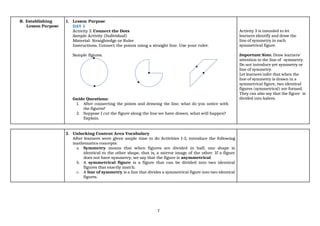
Activity 3. Connect the Dots
Sample Activity (Individual)
Material: Straightedge or Ruler
Instructions. Connect the points using a straight line. Use your ruler.
Sample figures.
Guide Questions:
1. After connecting the points and drawing the line, what do you notice with
the figures?
2. Suppose I cut the figure along the line we have drawn, what will happen?
Explain.
Activity 3 is intended to let
learners identify and draw the
line of symmetry in each
symmetrical figure.
Important Note. Draw learners’
attention to the line of symmetry.
Do not introduce yet symmetry or
line of symmetry.
Let learners infer that when the
line of symmetry is drawn in a
symmetrical figure, two identical
figures (symmetrical) are formed.
They can also say that the figure is
divided into halves.
2. Unlocking Content Area Vocabulary
After learners were given ample time to do Activities 1-3, introduce the following
mathematics concepts:
a. Symmetry means that when figures are divided in half, one shape is
identical to the other shape, that is, a mirror image of the other. If a figure
does not have symmetry, we say that the figure is asymmetrical.
b. A symmetrical figure is a figure that can be divided into two identical
figures that exactly match.
c. A line of symmetry is a line that divides a symmetrical figure into two identical
figures.
8.
8
C. Developing and
Deepening
Understanding
DAY2-3
SUB-TOPIC: Symmetry
1. Explicitation
After doing Activities 1 to 3, let learners further build on the concepts of
symmetry, symmetrical figures, and lines of symmetry.
Some symmetrical figures do not only have 1 line of symmetry. They can have
more than one line of symmetry.
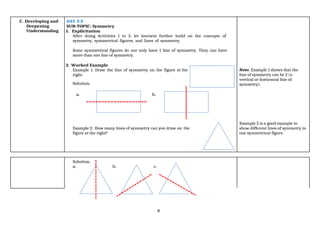
2. Worked Example
Example 1. Draw the line of symmetry on the figure at the
right.
Solution.
Note. Example 1 shows that the
line of symmetry can be 2 (a
vertical or horizontal line of
symmetry).
a. b.
Example 2. How many lines of symmetry can you draw on the
figure at the right?
Example 2 is a good example to
show different lines of symmetry in
one symmetrical figure.
Solution.
a. b. c.
9.
9
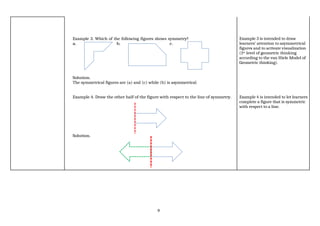
Example 3. Whichof the following figures shows symmetry?
a. b. c.
Example 3 is intended to draw
learners’ attention to asymmetrical
figures and to activate visualization
(1st level of geometric thinking
according to the van Hiele Model of
Geometric thinking).
Solution.
The symmetrical figures are (a) and (c) while (b) is asymmetrical.
Example 4. Draw the other half of the figure with respect to the line of symmetry. Example 4 is intended to let learners
complete a figure that is symmetric
with respect to a line.
Solution.
10.
10
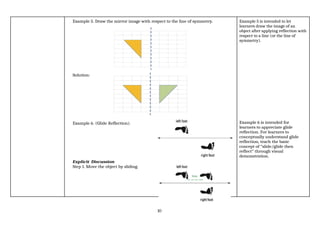
Example 5. Drawthe mirror image with respect to the line of symmetry.
Solution:
Example 6. (Glide Reflection).
Explicit Discussion
Step 1. Move the object by sliding.
Example 5 is intended to let
learners draw the image of an
object after applying reflection with
respect to a line (or the line of
symmetry).
Example 6 is intended for
learners to appreciate glide
reflection. For learners to
conceptually understand glide
reflection, teach the basic
concept of “slide/glide then
reflect” through visual
demonstration.
11.
11
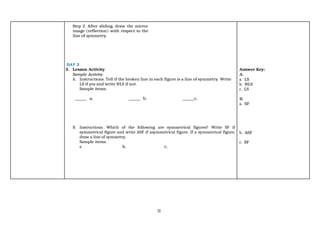
Step 2. Aftersliding, draw the mirror
image (reflection) with respect to the
line of symmetry.
DAY 3
3. Lesson Activity
Sample Activity
A. Instructions. Tell if the broken line in each figure is a line of symmetry. Write
LS if yes and write NLS if not.
Sample items.
a. b. c.
B. Instructions. Which of the following are symmetrical figures? Write SF if
symmetrical figure and write ASF if asymmetrical figure. If a symmetrical figure,
draw a line of symmetry.
Sample items.
a. b. c.
Answer Key:
A.
a. LS
b. NLS
c. LS
B.
a. SF
b. ASF
c. SF
12.
12
D. Making
Generalizations
DAY 2
1.Learners’ Takeaways
Let learners appreciate the lesson by watching this short video. Video:
Symmetry Song
URL: https://www.youtube.com/watch?app=desktop&v=YMFusUVk_n8
Remind learners to bring all
materials related to the performance
task and let them finish this during
Day 3.
Guide Question:
• What three important math ideas you have learned today?
DAY 3
2. Reflection on Learning
(Homework)
Let learners watch this video as homework.
Video: Intro to Symmetry
URL: https://www.youtube.com/watch?v=YFzktJNmnPU
Performance Task. Let them reflect on the concept of symmetry and make a photo
essay on symmetry and the culture of their city. How is symmetry used in the culture
of Filipinos?
Note. This performance task is a
good way to increase the level of
productive disposition (or
mathematical disposition) of
learners to see mathematics as a
worthwhile subject and has
relation not only to nature but also
to the culture of the Filipino people
(and other cultures---this can be
done in a GCED integration).
A photo essay is a storytelling
that uses a series or sequence of
pictures to tell a narrative or
determine a theme. You can use
the following as criteria in
checking the photo essay of the
learners:
1. visual storytelling
2. quality of photographs
3. relevance to the theme
4. clear and concise captions
IV. EVALUATING LEARNING: FORMATIVE ASSESSMENT AND TEACHER’S REFLECTION NOTES TO TEACHERS
13.
13
A. Evaluating
Learning
DAY 4
1.Formative Assessment
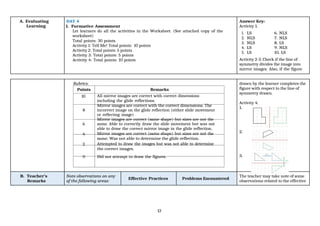
Let learners do all the activities in the Worksheet. (See attached copy of the
worksheet)
Total points: 30 points
Activity 1: Tell Me! Total points: 10 points
Activity 2: Total points: 5 points
Activity 3: Total points: 5 points
Activity 4: Total points: 10 points
Answer Key:
Activity 1.
1. LS 6. NLS
2. NLS 7. NLS
3. NLS 8. LS
4. LS 9. NLS
5. LS 10. LS
Activity 2-3. Check if the line of
symmetry divides the image into
mirror images. Also, if the figure
Rubrics: drawn by the learner completes the
figure with respect to the line of
symmetry drawn.
Activity 4.
1.
2.
3.
Points Remarks
10 All mirror images are correct with correct dimensions
including the glide reflections.
Mirror images are correct with the correct dimensions. The
8 incorrect image on the glide reflection (either slide movement
or reflecting image)
Mirror images are correct (same shape) but sizes are not the
6 same. Able to correctly draw the slide movement but was not
able to draw the correct mirror image in the glide reflection.
4 Mirror images are correct (same shape) but sizes are not the
same. Was not able to determine the glide reflection.
2 Attempted to draw the images but was not able to determine
the correct images.
0 Did not attempt to draw the figures.
B. Teacher’s
Remarks
Note observations on any
of the following areas:
Effective Practices Problems Encountered
The teacher may take note of some
observations related to the effective
14.
14
practices and problems
encounteredafter utilizing the
different strategies, materials used,
learner engagement, and other
related stuff.
Teachers may also suggest ways to
improve the different activities
explored/lesson exemplar.
strategies explored
materials used
learner engagement/
interaction
others
C. Teacher’s
Reflection
Reflection guide or prompt can be on:
• principles behind the teaching
What principles and beliefs informed my lesson? Why
did I teach the lesson the way I did?
• students
What roles did my students play in my lesson?
What did my students learn? How did they learn?
• ways forward
What could I have done differently? What
can I explore in the next lesson?
Teacher’s reflection in every lesson
conducted/facilitated is essential
and necessary to improve practice.
You may also consider this as an
input for the LAC/Collab sessions.

 Most read
 Most read
 Most read