Mastering the 5 Strategic Areas That Shape Our Lives
Explore how managing speech, thoughts, emotions, behavior, and finances leads to personal success and lasting fulfillment through practical strategies and self-discipline.
MEET THE FACILITATOR
RASHEED,Oluwasegun Kazeem (Ph.D)
(+234)-8051700164, (+234)-7066867887
kazeemrasheed1440@gmail.com
Lead Principal Facilitator at HEED – A - DINK CONSUL
3.
Introduction
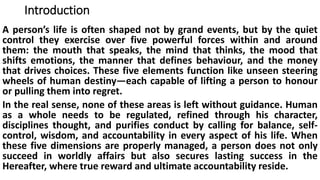
A person’s lifeis often shaped not by grand events, but by the quiet
control they exercise over five powerful forces within and around
them: the mouth that speaks, the mind that thinks, the mood that
shifts emotions, the manner that defines behaviour, and the money
that drives choices. These five elements function like unseen steering
wheels of human destiny—each capable of lifting a person to honour
or pulling them into regret.
In the real sense, none of these areas is left without guidance. Human
as a whole needs to be regulated, refined through his character,
disciplines thought, and purifies conduct by calling for balance, self-
control, wisdom, and accountability in every aspect of his life. When
these five dimensions are properly managed, a person does not only
succeed in worldly affairs but also secures lasting success in the
Hereafter, where true reward and ultimate accountability reside.
4.
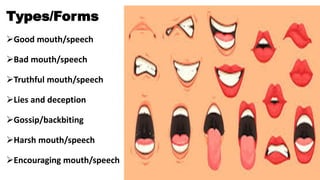
1. MOUTH
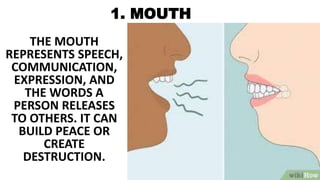
THE MOUTH
REPRESENTSSPEECH,
COMMUNICATION,
EXPRESSION, AND
THE WORDS A
PERSON RELEASES
TO OTHERS. IT CAN
BUILD PEACE OR
CREATE
DESTRUCTION.
IMPACTS OF AGOOD MOUTH
1. Kind and truthful words strengthen friendships and family bonds.
2. People naturally trust someone who speaks honestly and respectfully.
3. Wise speech reduces misunderstandings and unnecessary arguments.
4. Calm and gentle words help maintain harmony among people.
5. A disciplined tongue elevates a person’s honour and reputation.
6. Words of motivation inspire people to do better.
7. Controlled speech helps avoid major moral wrongs.
8. Good communicators are often seen as wise leaders.
9. Speaking calmly reduces anger and emotional regret.
10. Good communication opens doors in education, business, and career.
11. A controlled mouth prevents saying things one later wishes to take back.
12. A good mouth is used for teaching, advising, and sharing beneficial knowledge.
7.
Effects of abad mouth (bad speech/use of tongue)
1. Harsh or false words destroy trust between friends, families, and communities.
2. A bad tongue turns allies into opponents and causes unnecessary conflict.
3. Many people regret words spoken in anger more than actions taken.
4. Backbiting, lying, and insults harm spiritual purity.
5. False speech can ruin a person’s honour and social image.
6. Bad speech spreads rumours that create confusion and division.
7. Weakens Faith
8. Uncontrolled speech is accountable before God.
8.
Effects of abad mouth (bad speech/use of tongue)
9. Causes Anger and Violence
10. Words often trigger fights, revenge, and even physical harm.
11. A person who speaks badly often lives with guilt and inner disturbance.
12. People stop trusting or respecting someone known for bad speech.
13. Careless speech can lead to job loss, missed opportunities, or failure in business.
14. False statements can wrongly accuse innocent people.
15. Insults and criticism can lead to sadness, anxiety, and depression in others.
16. People avoid someone known for offensive or toxic speech.
9.
STRATEGIC WAYS TOMANAGE THE MOUTH
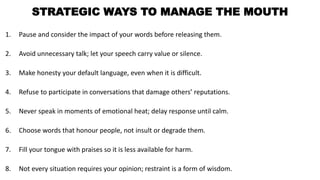
1. Pause and consider the impact of your words before releasing them.
2. Avoid unnecessary talk; let your speech carry value or silence.
3. Make honesty your default language, even when it is difficult.
4. Refuse to participate in conversations that damage others’ reputations.
5. Never speak in moments of emotional heat; delay response until calm.
6. Choose words that honour people, not insult or degrade them.
7. Fill your tongue with praises so it is less available for harm.
8. Not every situation requires your opinion; restraint is a form of wisdom.
10.
STRATEGIC WAYS TOMANAGE THE MOUTH
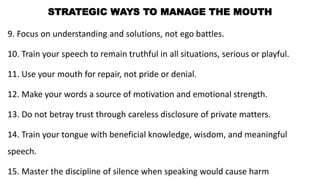
9. Focus on understanding and solutions, not ego battles.
10. Train your speech to remain truthful in all situations, serious or playful.
11. Use your mouth for repair, not pride or denial.
12. Make your words a source of motivation and emotional strength.
13. Do not betray trust through careless disclosure of private matters.
14. Train your tongue with beneficial knowledge, wisdom, and meaningful
speech.
15. Master the discipline of silence when speaking would cause harm
11.
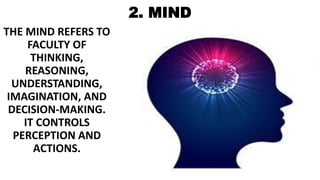
2. MIND
THE MINDREFERS TO
FACULTY OF
THINKING,
REASONING,
UNDERSTANDING,
IMAGINATION, AND
DECISION-MAKING.
IT CONTROLS
PERCEPTION AND
ACTIONS.
12.
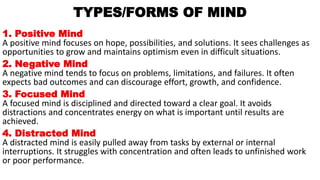
TYPES/FORMS OF MIND
1.Positive Mind
A positive mind focuses on hope, possibilities, and solutions. It sees challenges as
opportunities to grow and maintains optimism even in difficult situations.
2. Negative Mind
A negative mind tends to focus on problems, limitations, and failures. It often
expects bad outcomes and can discourage effort, growth, and confidence.
3. Focused Mind
A focused mind is disciplined and directed toward a clear goal. It avoids
distractions and concentrates energy on what is important until results are
achieved.
4. Distracted Mind
A distracted mind is easily pulled away from tasks by external or internal
interruptions. It struggles with concentration and often leads to unfinished work
or poor performance.
13.
TYPES/FORMS OF MIND
5.Wise Mind
A wise mind combines knowledge, experience, and good judgment. It
thinks carefully before acting and considers consequences, leading to
balanced and sound decisions.
6. Corrupted Mind
A corrupted mind is influenced by immoral values, wrong intentions, or
harmful desires. It may justify bad behavior and lose sensitivity to truth and
ethics.
7. Reflective Mind
A reflective mind thinks deeply about experiences, actions, and outcomes.
It learns from the past, improves decision-making, and promotes personal
growth.
14.
IMPACTS OF THEMIND ON OUR LIVES
1. The mind determines the choices a person makes, whether good or
bad, simple or complex.
2. It influences how a person acts, reacts, and responds to situations.
3. The mind shapes emotions such as happiness, anger, fear, and
calmness.
4. A healthy mind improves understanding, memory, and academic
performance.
5. The mind generates ideas, imagination, and problem-solving
abilities.
6. It helps a person distinguish between right and wrong actions.
The mind drives ambition, determination, and willingness to
achieve goals.
15.
IMPACTS OF THEMIND ON OUR LIVES
7. A stable mind handles pressure well, while a weak mind becomes
overwhelmed easily.
8. The mind influences communication, empathy, and how people relate
with others.
9. It affects reflection, faith, and awareness of higher purpose and values
10. A focused mind increases efficiency and achievement in personal and
professional life.
11. The mindset a person carries shapes long-term goals, destiny, and
overall life outcomes.
16.
EFFECTS OF AGOOD MIND
1. Promotes positive thinking and optimism
2. Improves sound decision-making
3. Enhances concentration and focus
4. Encourages self-discipline and responsibility
5. Builds strong moral and ethical behaviour
6. Strengthens emotional stability and control
7. Improves academic and work performance
8. Promotes healthy relationships with others
9. Enhances creativity and problem-solving skills
10. Encourages patience and perseverance
11. Supports personal growth and self-improvement
12. Leads to peace of mind and happiness
17.
EFFECTS OF ABAD MIND
1. Promotes negative thinking and pessimism
2. Leads to poor and impulsive decisions
3. Causes lack of concentration and distraction
4. Encourages indiscipline and irresponsibility
5. Promotes immoral and unethical behaviour
6. Leads to emotional instability and anger
7. Reduces academic and job performance
8. Causes conflict and broken relationships
9. Weakens creativity and problem-solving ability
10. Encourages impatience and frustration
11. Prevents personal development and growth
12. Leads to stress, anxiety, and unhappiness
18.
STRATEGIC WAYS TOMANAGE THE MIND EFFECTIVELY
1. Train your mind to focus on possibilities, solutions, and hopeful outcomes.
2. A defined direction helps the mind stay focused and reduces confusion.
3. Control impulses and stick to planned actions even when motivation is low.
4. Stay away from toxic environments, harmful media, and negative people.
5. Think about your actions, mistakes, and lessons to improve future decisions.
6. Stay present and aware of your thoughts instead of overthinking or worrying.
7. Organize tasks to reduce stress and prevent mental overload.
8. well-informed mind is more stable, wise, and confident.
9. Good sleep, exercise, and nutrition support mental balance and clarity.
10. Pause before responding to anger or pressure to avoid regretful actions.
11. Supportive relationships help shape constructive thinking patterns.
12. Spiritual or meditative practices calm the mind and improve inner peace.
19.
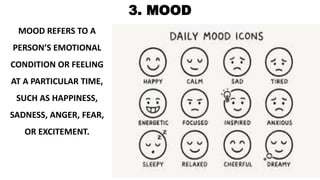
3. MOOD
MOOD REFERSTO A
PERSON’S EMOTIONAL
CONDITION OR FEELING
AT A PARTICULAR TIME,
SUCH AS HAPPINESS,
SADNESS, ANGER, FEAR,
OR EXCITEMENT.
20.
TYPES/FORMS OF MOOD
1.Happy Mood
A happy mood is a state of joy and satisfaction. It makes a person feel
cheerful, energetic, and positive about life and situations.
2. Sad Mood
A sad mood is characterized by feelings of sorrow, disappointment, or loss. It
can reduce energy and interest in normal activities.
3. Angry Mood
An angry mood involves strong feelings of irritation or frustration. It may lead
to harsh reactions if not properly controlled.
4. Calm Mood
A calm mood is peaceful and relaxed. A person feels emotionally stable,
thinks clearly, and handles situations without stress.
21.
TYPES/FORMS OF MOOD
5.Anxious Mood
An anxious mood is marked by worry, fear, or uneasiness about future events. It
can affect concentration and confidence.
6. Motivated Mood
A motivated mood is full of energy, determination, and willingness to achieve
goals. It drives action and productivity.
7. Depressed Mood
A depressed mood is a persistent feeling of deep sadness, hopelessness, and
low interest in life activities. It can affect daily functioning and wellbeing.
22.
IMPACTS OF MOODON OUR LIVES
1. Influences decision-making ability
2. Affects concentration and focus
3. Shapes behaviour and actions
4. Determines productivity level
5. Influences communication style
6. Affects learning and memory retention
7. Impacts relationships with others
8. Influences creativity and thinking ability
23.
IMPACTS OF MOODON OUR LIVES
9. Affects emotional stability
10. Determines motivation level
11. Influences problem-solving skills
12. Affects physical energy and activity level
13. Shapes attitude toward challenges
14. Influences academic performance
15. Affects overall life satisfaction
16. Influences self-control and discipline
24.
EFFECTS OF MOODON OUR LIVES
1. Can improve or reduce productivity
2. Influences positive or negative thinking
3. Affects mental health and wellbeing
4. Determines level of stress or relaxation
5. Influences social interaction quality
6. Affects self-confidence
7. Impacts work efficiency
8. Can cause emotional reactions (anger, joy,
sadness)
25.
EFFECTS OF MOODON OUR LIVES
9. Affects sleep quality
10. Influences motivation and drive
11. Can lead to impulsive or controlled actions
12. Affects learning ability
13. Impacts decision outcomes
14. Influences communication clarity
15. Affects physical health and energy
16. Determines overall quality of life
26.
STRATEGIES TO MANAGEMOOD
1. Practice positive thinking
2. Engage in regular exercise
3. Get enough sleep daily
4. Eat balanced and healthy meals
5. Practice deep breathing exercises
6. Avoid negative people and environments
7. Listen to calming or uplifting music
8. Talk to trusted friends or mentors
27.
STRATEGIES TO MANAGEMOOD
9. Practice mindfulness and meditation
10. Set realistic goals and expectations
11. Take breaks when stressed
12. Engage in hobbies and enjoyable activities
13. Pray or engage in spiritual reflection
14. Write down thoughts in a journal
15. Seek professional help when necessary
16. Practice gratitude daily
TYPES/FORMS
1. Good Manners
Goodmanners are polite and respectful behaviours that show consideration
for others in speech and actions. They help maintain harmony in society.
2. Bad Manners
Bad manners are rude, disrespectful, or unacceptable behaviours that offend
or hurt others and disrupt social relationships.
3. Humility
Humility is the quality of being modest and not proud. A humble person
recognizes their limitations and respects others regardless of status.
4. Respect
Respect is the act of valuing others’ feelings, rights, opinions, and dignity. It
involves treating people with honour and consideration.
30.
TYPES/FORMS
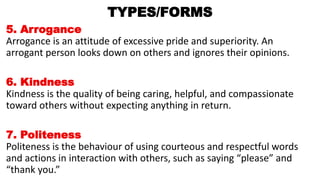
5. Arrogance
Arrogance isan attitude of excessive pride and superiority. An
arrogant person looks down on others and ignores their opinions.
6. Kindness
Kindness is the quality of being caring, helpful, and compassionate
toward others without expecting anything in return.
7. Politeness
Politeness is the behaviour of using courteous and respectful words
and actions in interaction with others, such as saying “please” and
“thank you.”
31.
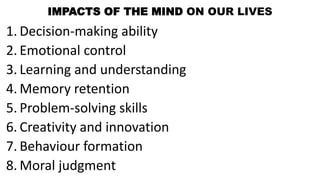
IMPACTS OF THEMIND ON OUR LIVES
1. Decision-making ability
2. Emotional control
3. Learning and understanding
4. Memory retention
5. Problem-solving skills
6. Creativity and innovation
7. Behaviour formation
8. Moral judgment
32.
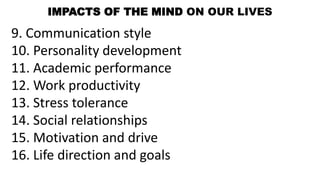
IMPACTS OF THEMIND ON OUR LIVES
9. Communication style
10. Personality development
11. Academic performance
12. Work productivity
13. Stress tolerance
14. Social relationships
15. Motivation and drive
16. Life direction and goals
33.
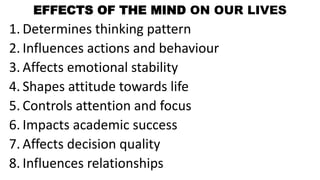
EFFECTS OF THEMIND ON OUR LIVES
1. Determines thinking pattern
2. Influences actions and behaviour
3. Affects emotional stability
4. Shapes attitude towards life
5. Controls attention and focus
6. Impacts academic success
7. Affects decision quality
8. Influences relationships
34.
EFFECTS OF THEMIND ON OUR LIVES
1. Affects mental health
2. Determines level of confidence
3. Influences self-esteem
4. Shapes habits and lifestyle
5. Affects stress level
6. Impacts productivity
7. Influences spiritual outlook
8. Determines overall life satisfaction
35.
STRATEGIES TO TRAINTHE MIND
1. Practice positive thinking
2. Set clear goals
3. Avoid negative environments
4. Practice mindfulness
5. Engage in daily reflection
6. Read good and educational materials
7. Maintain good sleep habits
8. Exercise regularly
36.
STRATEGIES TO TRAINTHE MIND
9. Eat balanced diet
10. Control emotional reactions
11. Practice deep breathing techniques
12. Pray or meditate regularly
13. Manage time effectively
14. Surround yourself with positive people
15. Reduce social media distractions
16. Seek guidance or counselling when needed
37.
5. MONEY
MONEY ISA
MEDIUM OF
EXCHANGE AND
A RESOURCE
USED TO MEET
NEEDS, SUPPORT
FAMILY, AND
FULFILL
RESPONSIBILITIES
.
38.
IMPACTS OF MONEYON OUR LIVES
1. Determines standard of living
2. Influences access to education
3. Affects quality of healthcare
4. Shapes social status in society
5. Provides security and stability
6. Enables business opportunities
7. Influences lifestyle choices
8. Supports family welfare
39.
IMPACTS OF MONEYON OUR LIVES
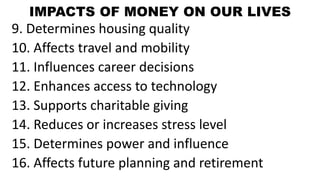
9. Determines housing quality
10. Affects travel and mobility
11. Influences career decisions
12. Enhances access to technology
13. Supports charitable giving
14. Reduces or increases stress level
15. Determines power and influence
16. Affects future planning and retirement
40.
EFFECTS OF MONEY(PROPER AND IMPROPER USE)
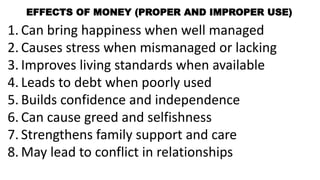
1. Can bring happiness when well managed
2. Causes stress when mismanaged or lacking
3. Improves living standards when available
4. Leads to debt when poorly used
5. Builds confidence and independence
6. Can cause greed and selfishness
7. Strengthens family support and care
8. May lead to conflict in relationships
41.
EFFECTS OF MONEY(PROPER AND IMPROPER USE)
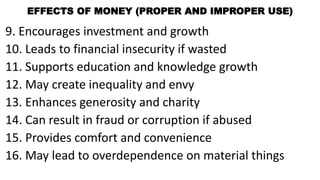
9. Encourages investment and growth
10. Leads to financial insecurity if wasted
11. Supports education and knowledge growth
12. May create inequality and envy
13. Enhances generosity and charity
14. Can result in fraud or corruption if abused
15. Provides comfort and convenience
16. May lead to overdependence on material things
42.
STRATEGIES FOR MANAGINGMONEY
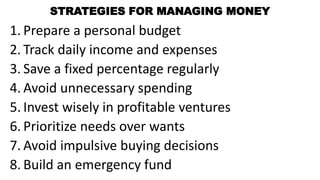
1. Prepare a personal budget
2. Track daily income and expenses
3. Save a fixed percentage regularly
4. Avoid unnecessary spending
5. Invest wisely in profitable ventures
6. Prioritize needs over wants
7. Avoid impulsive buying decisions
8. Build an emergency fund
43.
STRATEGIES FOR MANAGINGMONEY
9. Set financial goals (short and long term)
10. Avoid excessive debt and loans
11. Learn basic financial literacy
12. Separate savings from spending money
13. Compare prices before purchasing
14. Practice discipline in spending habits
15. Seek professional financial advice when needed
16. Give charity while maintaining balance

 Most read
 Most read