1
ASPEE AGRIBUSINESS MANAGEMENT INSTITUTE
NAVSARI AGRICULTURAL UNIVERSITY
NAVSARI-396450
Marketing of horticulture produce : status,prospect and challenges
Presented by
Bodar Jagdish B.
Reg. No. :- 2070523002
2nd Sem MBA(ABM)
AABMI, NAU, Navsari
Major Advisor
Dr. Mehul G. Thakkar
Asso. Professor in HRM
Flow of presentation
Introduction
Present status of horticulture in india
Domestic market scenario
Drivers of market growth
Horticulture Produce Marketing: Regulated markets
Alternative Approaches to Horticulture produce market
Export potential of horticulture produce
Prospects of horticulture produce marketing
Challenges of marketing horticulture produce
Strategies for Effective marketing of Horticultural
produce
Conclusion
References
Introduction
 What is Horticulture ?
 Horticulture is the science and art of growing (plants) – fruits, vegetables, flowers and other plants.
 Horticulture is the prime engine that provides relatively higher income, employment opportunity in
rural areas besides providing nutritional security.
 The Aim of Horticulture is to improving plant growth, yields quality, nutritional values, and resistance
to Insects, Diseases and Environmental stresses.
 Horticulture even refers to the growing of plants in a field or garden.
Source : https://agritech.tnau.ac.in/horticulture/pdf/policy%20notes/horti-12.pdf
Source: tnau
Present Status of Horticulture in India
Horticulture as a sector has performed remarkably in recent years.
In 2022-23, India’s horticulture production stood at 351.92 Million Tonnes.
Share of horticulture in agricultural production was more than 33%
India’s horticulture production risen by 33 per cent in the last five years an impressive
rise, preceding five years (23%)
India is currently producing 351.92 million tonnes of horticulture produce from an area
of. 28.28 million hectares (mh)
It also contributes about 30 % of India’s Agricultural GDP from 13.08% of cropped
area.
India among the foremost countries in horticulture production, just behind China.
source: https://agriexchange.apeda.gov.in/news/NewsSearch.aspx?newsid=53779#:~:text=Horticulture%20Production.&text=As%20per%20the%202nd%20advance,and%20fruits%20in%20the%20world.
Domestic Market Scenario
 Production may be insufficient if domestic markets all over the country targeted efficiently
& effectively.
 Mango, Grapes, Apples, Pineapples, Pomegranates, Litchis can be sold out in the country it
self because of the production in limited orchards & demand in whole country.
 Markets in the rural & semi urban(around 60-65%) should also be tapped along with Metros
or big cities(around 12-15%)
Drivers of market growth
Rise in incomes, urbanization and consciousness about ‘healthy foods’ increasing.
Diversification in consumption patterns towards HVA(High Value Agricultural) products .
Globalization may further create opportunities for the export of HVCs (high-value commodities).
National nutrition policy has laid emphasis on protective food items like fruits, vegetables, milk, meat,
egg and fish.
Horticulture export over the last decade the growth has been to the extent of 150%.
Horticulture Produce Marketing: (Regulated Markets)
 Majority of the F&V marketed through the “open market transactions system” under APMC
regulations.
 Selling and buying of agricultural produce should take place only in the (market yard)
notified by Market Committee.
 Only State Governments were permitted to set up markets .
 Purpose to protect farmers from the exploitation of intermediaries and traders and also to
ensure better prices and timely payment for his produce.
 APMC’s does not carry out auction‐function instead, gives licenses to brokers/ commission
agents known as “Arthiya” for carrying out auction of produce brought to the market.
 “Arthiyas” responsible to pay the price of the produce to the seller and has to recover
purchase price from the buyers.
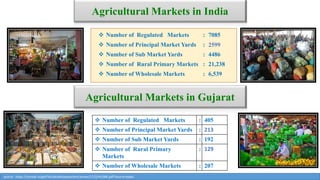
Agricultural Markets in India
 Number of Regulated Markets : 7085
 Number of Principal Market Yards : 2599
 Number of Sub Market Yards : 4486
 Number of Rural Primary Markets : 21,238
 Number of Wholesale Markets : 6,539
 Number of Regulated Markets : 405
 Number of Principal Market Yards : 213
 Number of Sub Market Yards : 192
 Number of Rural Primary
Markets
: 129
 Number of Wholesale Markets : 207
Agricultural Markets in Gujarat
source : https://sansad.in/getFile/loksabhaquestions/annex/1715/AU588.pdf?source=pqals
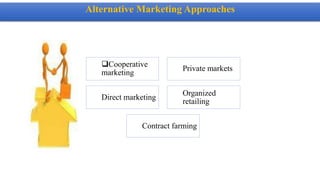
Alternative Marketing Approaches
Cooperative
marketing
Private markets
Direct marketing
Organized
retailing
Contract farming
Cooperative Marketing
Majority fruits and vegetable growers are small farmers.
Formation of co-operatives attempted in many parts of the country to
(a) establish the bargaining position of the farmers with the buyers
(b) spreading the price risk over a large amount of produce in order to reduce the
risk of an individual farmer
(c) discipline the market to reduce the unfair trading practices.
Supplying inputs and other related services needed for production.
At a later stage, they started processing F&V into various other products.
Some Horticultural Cooperatives
 Mahagrapes in Maharashtra .
 HOPCOMS in Karnataka.
 Valsad Jilla Fal Ane Shakbhaji Sahakari Sangh Limited in South Gujarat.
 Co-operatives marketing banana in Jalgaon district,(MH).
 Vegetables co-operatives.
Benefit of corporative marketing for farmers
 Group/Cooperative/producer Company formation can help in lowering transaction costs in marketing
and purchase of inputs and increasing bargaining strength.
 Helps in aggregation of market surpluses & value addition and development of forward linkages with
exporters/Suppliers/Processors/future market.
 Facilitates access to technical services and credit.
 Can help in managing & owning marketing /processing facilities.
Private Markets
The Model APMC Act suggests provisions for private markets or yards managed by persons other than
APMCs.
 Most of the states have the provision for private market yards but Rules/bye-laws have not been
formulated by all.
 Madhya Pradesh has provision for direct purchase and not for private market.
Andhra Pradesh has formulated Rules, which stipulate a license fee and minimum cost of Rs 10 crores
for setting up of private markets.
Some States have also prescribed a minimum distance of these markets from the APMC market.
Only the States of Maharashtra, Karnataka, Gujarat and Tamil Nadu have issued license to Private
Markets. However, only one Private Market has come up in Maharashtra.
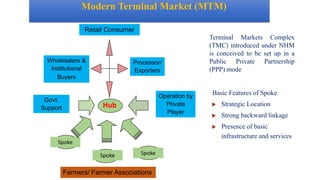
Spoke
Spoke
Spoke
Modern Terminal Market (MTM)
Hub
Farmers/ Farmer Associations
Retail Consumer
Wholesalers &
Institutional
Buyers
Processor/
Exporters
Govt.
Support
Operation by
Private
Player
Basic Features of Spoke
Strategic Location
Strong backward linkage
Presence of basic
infrastructure and services
Terminal Markets Complex
(TMC) introduced under NHM
is conceived to be set up in a
Public Private Partnership
(PPP) mode
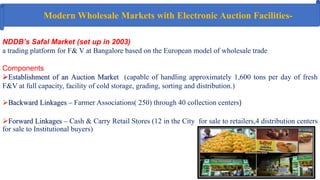
NDDB’s Safal Market (set up in 2003)
a trading platform for F& V at Bangalore based on the European model of wholesale trade
Components
Establishment of an Auction Market (capable of handling approximately 1,600 tons per day of fresh
F&V at full capacity, facility of cold storage, grading, sorting and distribution.)
Backward Linkages – Farmer Associations( 250) through 40 collection centers)
Forward Linkages – Cash & Carry Retail Stores (12 in the City for sale to retailers,4 distribution centers
for sale to Institutional buyers)
Modern Wholesale Markets with Electronic Auction Facilities‐
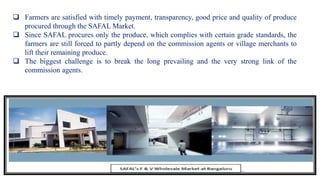
 Farmers are satisfied with timely payment, transparency, good price and quality of produce
procured through the SAFAL Market.
 Since SAFAL procures only the produce, which complies with certain grade standards, the
farmers are still forced to partly depend on the commission agents or village merchants to
lift their remaining produce.
 The biggest challenge is to break the long prevailing and the very strong link of the
commission agents.
16
Direct marketing by farmers is being encouraged as an innovative channel.
 Apni Mandi in Punjab.
 Hadaspar Mandi in Pune.
 Rythu Bazars in A.P.
 Uzhavar Sandies in Tamilnadu.
 Krushak Baazars in Odisha.
These channels are mostly adopted in sales transactions of fruits, vegetables and flowers, which are
highly perishable.
In this channel, the produce moves quickly from farmers to consumer due to lack of middlemen.
If farmers directly sell their produce to the consumers, it will not only save losses but may also increase
farmers’ share in the price paid by the consumer.
Direct Marketing
CONTRACT FARMING
 Contract farming can be defined as a system for the production and supply
of Agricultural/ Horticulture produce by primary producers under advance
contracts.
18
It basically involves four things –
1.) Pre-agreed price
2.)Pre-agreed quality
3.) Pre-agreed quantity
4.) Pre-agreed time.
 Some of the private players such as PepsiCo, Reliance Life Sciences,
ITC (agri-business division) and McDonalds have modified their sourcing
channels to include contract farming.
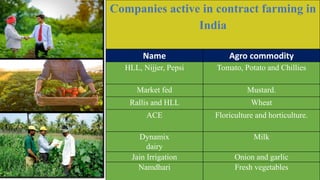
Companies active in contract farming in
India
Name Agro commodity
HLL, Nijjer, Pepsi Tomato, Potato and Chillies
Market fed Mustard.
Rallis and HLL Wheat
ACE Floriculture and horticulture.
Dynamix
dairy
Milk
Jain Irrigation Onion and garlic
Namdhari Fresh vegetables
Contract farming - Why it is critical?
This firm –farm linkage offers several advantages.
Sharing risks with farmers(Production and market risk).
Lower transaction costs.
Boosts returns through increased productivity, value addition.
Provides technology and know-how to grow new varieties (especially high value).
Provides infrastructural facilities(cold chain, storage).
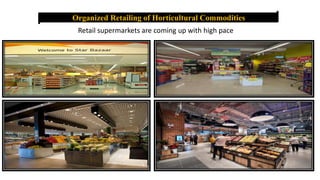
Organized Retailing of Horticultural Commodities
Retail supermarkets are coming up with high pace
Organized Retailing of Horticultural Commodities
 Organized Retail chains provide a new market linkage for the primary producers of F&V.
 It is called contact farming model ( lack of formal commitment to buy and sell ) unlike contract
farming.
 Retail chains bring quality culture and more commercial nature of production and marketing at
the farmer level.
 Logistics and infrastructure investments by these organized players as mandated by the
Government would help in improving the overall system and go way ahead in ensuring the
quality, reinventing the supply chain .
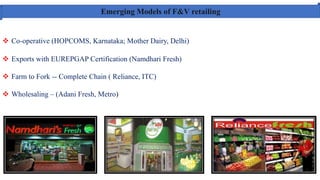
Emerging Models of F&V retailing
 Co-operative (HOPCOMS, Karnataka; Mother Dairy, Delhi)
 Exports with EUREPGAP Certification (Namdhari Fresh)
 Farm to Fork -- Complete Chain ( Reliance, ITC)
 Wholesaling – (Adani Fresh, Metro)
Export potential of horticulture produce
India is a large, low cost agricultural producer, its share in global agriculture exports is very small.
India produces nearly 11 per cent of all the world’s vegetables and 15 percent of all fruits, yet its
share in global exports of vegetables is only 1.7 per cent and in fruits a meagre 0.5 per cent.
Vast opportunity for Indian horticulture sector in WTO regime.
Issues like quality production, cost of transportation, higher domestic price of most of the
horticulture produce and a vast consumer base within the country may also be responsible for
lower levels of exports.
Export potential of horticulture produce
 Export of major horticulture produce from India have recorded a rising trend in the last decade.
 Success in table grapes, mangoes and floriculture ,pomegranate, banana and gherkins.
 Production of critical quantity of export‐quality horticulture produce has facilitated their exports.
 The success has been possible due to concerted effort by farmers’ organizations, public and private
sector initiatives.
Export Opportunities
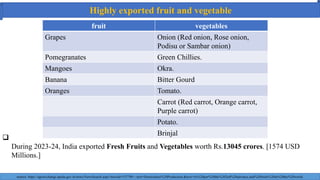
Highly exported fruit and vegetable

During 2023-24, India exported Fresh Fruits and Vegetables worth Rs.13045 crores. [1574 USD
Millions.]
fruit vegetables
Grapes Onion (Red onion, Rose onion,
Podisu or Sambar onion)
Pomegranates Green Chillies.
Mangoes Okra.
Banana Bitter Gourd
Oranges Tomato.
Carrot (Red carrot, Orange carrot,
Purple carrot)
Potato.
Brinjal
source: https://agriexchange.apeda.gov.in/news/NewsSearch.aspx?newsid=53779#:~:text=Horticulture%20Production.&text=As%20per%20the%202nd%20advance,and%20fruits%20in%20the%20world.
Source : apeda
https://agriexchange.apeda.gov.in/newsletter/newsletters/Newsletter_11_October_2021.html
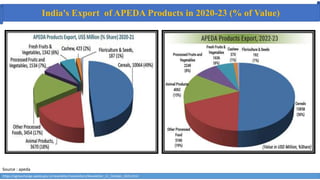
India's Export of APEDA Products in 2020-23 (% of Value)
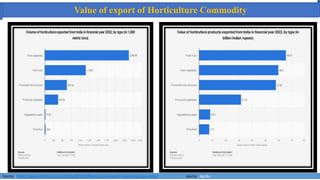
Value of export of Horticulture Commodity
Source : https://www.statista.com/statistics/621692/horticulture-export-volume-by-type-india/ source : dgci&s
Prospects of horticulture produce marketing
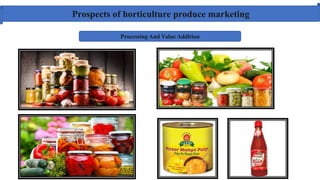
Processing And Value Addition
31
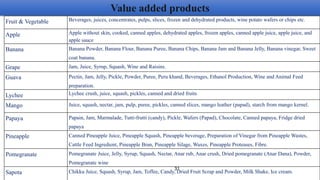
Value added products
Fruit & Vegetable Beverages, juices, concentrates, pulps, slices, frozen and dehydrated products, wine potato wafers or chips etc.
Apple Apple without skin, cooked, canned apples, dehydrated apples, frozen apples, canned apple juice, apple juice, and
apple sauce
Banana Banana Powder, Banana Flour, Banana Puree, Banana Chips, Banana Jam and Banana Jelly, Banana vinegar, Sweet
coat banana.
Grape Jam, Juice, Syrup, Squash, Wine and Raisins.
Guava Pectin, Jam, Jelly, Pickle, Powder, Puree, Peru khand, Beverages, Ethanol Production, Wine and Animal Feed
preparation.
Lychee Lychee crush, juice, squash, pickles, canned and dried fruits
Mango Juice, squash, nectar, jam, pulp, puree, pickles, canned slices, mango leather (papad), starch from mango kernel.
Papaya Papain, Jam, Marmalade, Tutti-frutti (candy), Pickle, Wafers (Papad), Chocolate, Canned papaya, Fridge dried
papaya
Pineapple Canned Pineapple Juice, Pineapple Squash, Pineapple beverage, Preparation of Vinegar from Pineapple Wastes,
Cattle Feed Ingredient, Pineapple Bran, Pineapple Silage, Waxes, Pineapple Proteases, Fibre.
Pomegranate Pomegranate Juice, Jelly, Syrup, Squash, Nectar, Anar rub, Anar crush, Dried pomegranate (Anar Dana), Powder,
Pomegranate wine
Sapota Chikku Juice, Squash, Syrup, Jam, Toffee, Candy, Dried Fruit Scrap and Powder, Milk Shake, Ice cream.
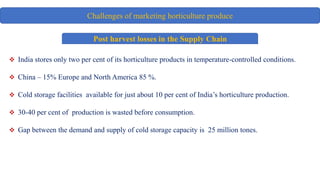
 India stores only two per cent of its horticulture products in temperature-controlled conditions.
 China – 15% Europe and North America 85 %.
 Cold storage facilities available for just about 10 per cent of India’s horticulture production.
 30-40 per cent of production is wasted before consumption.
 Gap between the demand and supply of cold storage capacity is 25 million tones.
Challenges of marketing horticulture produce
Post harvest losses in the Supply Chain
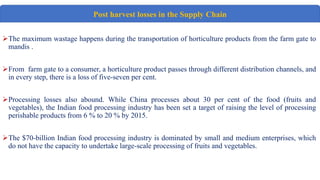
The maximum wastage happens during the transportation of horticulture products from the farm gate to
mandis .
From farm gate to a consumer, a horticulture product passes through different distribution channels, and
in every step, there is a loss of five-seven per cent.
Processing losses also abound. While China processes about 30 per cent of the food (fruits and
vegetables), the Indian food processing industry has been set a target of raising the level of processing
perishable products from 6 % to 20 % by 2015.
The $70-billion Indian food processing industry is dominated by small and medium enterprises, which
do not have the capacity to undertake large-scale processing of fruits and vegetables.
H
Post harvest losses in the Supply Chain
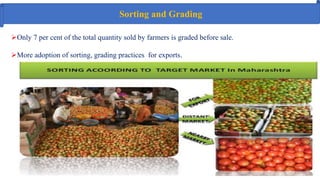
Sorting and Grading
Only 7 per cent of the total quantity sold by farmers is graded before sale.
More adoption of sorting, grading practices for exports.
Packaging
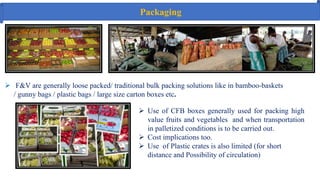
 F&V are generally loose packed/ traditional bulk packing solutions like in bamboo‐baskets
/ gunny bags / plastic bags / large size carton boxes etc.
 Use of CFB boxes generally used for packing high
value fruits and vegetables and when transportation
in palletized conditions is to be carried out.
 Cost implications too.
 Use of Plastic crates is also limited (for short
distance and Possibility of circulation)
Transportation
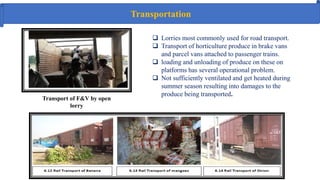
 Lorries most commonly used for road transport.
 Transport of horticulture produce in brake vans
and parcel vans attached to passenger trains.
 loading and unloading of produce on these on
platforms has several operational problem.
 Not sufficiently ventilated and get heated during
summer season resulting into damages to the
produce being transported.
Transport of F&V by open
lorry
Challenges of marketing horticulture produce
Lack of transparency in auction of agriculture produce
Buyers like exporters, processors and retail chain operators may not get desired quality and quantity for
their business.
Poor Backward and Forward linkages
Long marketing chains result in substantial leakage of value and physical loss.
Existing markets do not play a pro-active role in attracting produce.
Difficult to maintain traceability in export‐markets.
Regulated markets expected to plough back their revenue earnings into development of crop specific
infrastructure; however not developed .
Markets are inefficient, evidenced by price gap between producer’s price and consumer rupee.
Strategies for Effective marketing of Horticultural produce
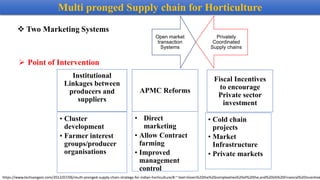
Institutional
Linkages between
producers and
suppliers
• Cluster
development
• Farmer interest
groups/producer
organisations
APMC Reforms
• Direct
marketing
• Allow Contract
farming
• Improved
management
control
Fiscal Incentives
to encourage
Private sector
investment
• Cold chain
projects
• Market
Infrastructure
• Private markets
Open market
transaction
Systems
Privately
Coordinated
Supply chains
 Two Marketing Systems
 Point of Intervention
Multi pronged Supply chain for Horticulture
https://www.techsangam.com/2012/07/06/multi-pronged-supply-chain-strategy-for-indian-horticulture/#:~:text=Given%20the%20complexities%20of%20the,and%20(4)%20Financial%20Incentive
Strategies for Effective marketing of Horticultural produce
Mechanisms for
strengthening
APMC’s
 Strong in terms of infrastructure, management and transparency .
 More efficient and lower cost APMC markets .
 Open auction system should be ensured .
 All APMCs Mandis should introduce electronic auction platform.
 More buyer competition with more licenses .
 Encourage private sector to invest in upgradation of APMC
markets under PPP mode.
Strategies for Effective marketing of Horticultural produce
 Permitting setting up Private Markets in Area of Operation of
APMCs.
 Freedom on Inter-state movement of agriculture produce.
 Improving the agriculture extension services.
 Identification of Focus Crops and Estimating Export Opportunity .
 Quality management for Horticulture Produce.
 Investment in Capital Intensive, hi‐tech infrastructure.
Strategies for Effective marketing of Horticultural produce
 Direct Market Access by Growers’Association.
 Compulsory buying of agriculture produce directly from farmers for
organized retail players.
 Scale up and strengthen food processing sector :
It is important to boost the food processing sector through
establishment of an integrated supply chain management to take food in
various forms from the farm gate to the retail outlet .
43
To emerge as a major producer of horticultural products, India needs some critical inputs, especially
of supply chain management and collaboration among various stake-holders along with efficient
vertical and horizontal integrations.
The government intervention is required to create a policy environment that will ensure a mutually
beneficial relationship between the farmers and organized sector.
Besides strengthening wholesale markets in terms of infrastructure, transparency and management,
Newer institutional arrangements for price discovery and transparency and enhancing efficiency in
food marketing chain should also be carried out expeditiously.
Development of horticultural sector should be accompanied by the growth of agro-processing
industry.
 The strategy should target meeting domestic and export demand of not only fresh products but of the
processed products also.
It is high time we brought out significant strategies in agricultural marketing with innovative and
creative approaches to bring fruits of labor to the farmers.
Conclusion
Agricultural and Processed Food Products Export Development Authority. (2024, March). Export Statistics. Directorate General
of Commercial Intelligence and Statistics (DGCI&S). https://agriexchange.apeda.gov.in/indexp/monthexport.aspx
Chandra, P. (2007). Role of terminal market in fresh fruit export. Indian Council of Agricultural Research.
https://uncsam.org/sites/default/files/202101/Role%20of%20Terminal%20Market%20in%20Fresh%20Fruit%20Export.pdf
Department of Agriculture and Farmers Welfare. (2022). Operational agricultural mandis in the country (Rajya sabha). Ministry
of agriculture and farmers welfare, Government of India.
https://sansad.in/getFile/annex/257/AU1465.pdf?source=pqars#:~:text=(b)%3A%20There%20are%20a,2021.
Food and Agriculture organization. (2011, February 11). Contract Farming Resource Centre. https://www.fao.org/in-
action/contract-farming/background/what-is-contract-farming/en/
References
Press Information Bureau. (2023, October 18). Second advance estimate for the year 2022-23 released for area and production of
horticultural crops [Press release]. Ministry of agriculture and farmers welfare, Government of India.
https://pib.gov.in/PressReleasePage.aspx?PRID=1968772#:~:text=Total%20horticulture%20production%20in%20the%20yea
r%202022%2D23%20is%20estimated,2021%2D22%20(final).&text=Production%20of%20fruits%2C%20vegetables%2C%2
0plantation,honey%20is%20expected%20to%20increase.
Shaikh, N. (2020). Direct marketing of agriculture products: a new initiative for Indian farmers. eKrishiKendra.
https://www.ekrishikendra.com/home/sen/b-24
United States Department of Agriculture Rural Development (2000). Understanding Cooperatives: Agricultural Marketing
Cooperatives (Cooperative Information Report 45, Section 15). https://www.rd.usda.gov/sites/default/files/CIR45-15.pdf