Marketing Authorization and Regulatory Compliance in South-East Asian Pharmaceutical Markets
Overview of marketing authorization processes, regulatory authorities, dossier requirements, and post-approval obligations in Vietnam, Malaysia, and the Philippines pharmaceutical sectors.
Marketing Authorization and Regulatory Compliance in South-East Asian Pharmaceutical Markets
1.
SOUTH-EAST ASIAN MARKETS
MarketingAuthorization and Post-Approval Requirements in Vietnam, Malaysia and
the Philippines
UNIT 5
SAROJINI NAIDU VANITA PHARMACY MAHA VIDYALAYA (CO – ED)
(Sponsored By The Exhibition Society)
(UGC AUTONOMOUS INSTITUTION)
Affiliated To Osmania University
Approved By PCI, NBAAccredited, Accredited A+ Grade By NAAC
Presented by: Ms. Surampally Srilakshmi
M.Pharmacy II sem
Department of Regulatory Affairs
1704-25-867-012
Regulatory Aspects Of Drugs & Cosmetics
2.
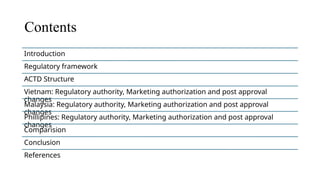
Contents
Introduction
Regulatory framework
ACTD Structure
Vietnam:Regulatory authority, Marketing authorization and post approval
changes
Malaysia: Regulatory authority, Marketing authorization and post approval
changes
Phillipines: Regulatory authority, Marketing authorization and post approval
changes
Comparision
Conclusion
References
3.
Introduction
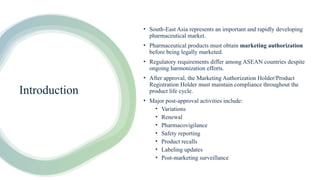
• South-East Asiarepresents an important and rapidly developing
pharmaceutical market.
• Pharmaceutical products must obtain marketing authorization
before being legally marketed.
• Regulatory requirements differ among ASEAN countries despite
ongoing harmonization efforts.
• After approval, the Marketing Authorization Holder/Product
Registration Holder must maintain compliance throughout the
product life cycle.
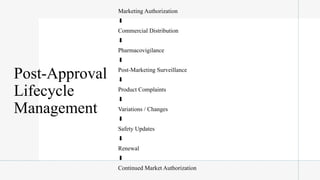
• Major post-approval activities include:
• Variations
• Renewal
• Pharmacovigilance
• Safety reporting
• Product recalls
• Labeling updates
• Post-marketing surveillance
4.
ASEAN
Pharmaceutical
Regulatory
Framework
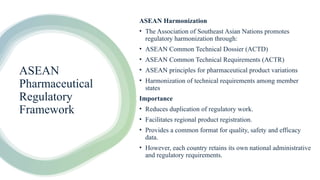
ASEAN Harmonization
• TheAssociation of Southeast Asian Nations promotes
regulatory harmonization through:
• ASEAN Common Technical Dossier (ACTD)
• ASEAN Common Technical Requirements (ACTR)
• ASEAN principles for pharmaceutical product variations
• Harmonization of technical requirements among member
states
Importance
• Reduces duplication of regulatory work.
• Facilitates regional product registration.
• Provides a common format for quality, safety and efficacy
data.
• However, each country retains its own national administrative
and regulatory requirements.
5.
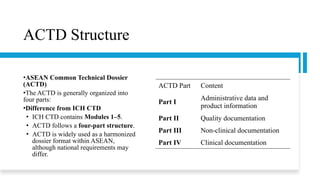
ACTD Structure
•ASEAN CommonTechnical Dossier
(ACTD)
•The ACTD is generally organized into
four parts:
•Difference from ICH CTD
• ICH CTD contains Modules 1–5.
• ACTD follows a four-part structure.
• ACTD is widely used as a harmonized
dossier format within ASEAN,
although national requirements may
differ.
ACTD Part Content
Part I
Administrative data and
product information
Part II Quality documentation
Part III Non-clinical documentation
Part IV Clinical documentation
6.
Vietnam:
Regulatory
Authority
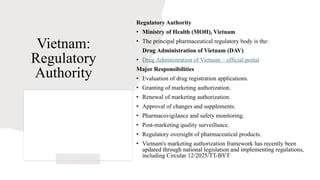
Regulatory Authority
• Ministryof Health (MOH), Vietnam
• The principal pharmaceutical regulatory body is the:
Drug Administration of Vietnam (DAV)
• Drug Administration of Vietnam – official portal
Major Responsibilities
• Evaluation of drug registration applications.
• Granting of marketing authorization.
• Renewal of marketing authorization.
• Approval of changes and supplements.
• Pharmacovigilance and safety monitoring.
• Post-marketing quality surveillance.
• Regulatory oversight of pharmaceutical products.
• Vietnam's marketing authorization framework has recently been
updated through national legislation and implementing regulations,
including Circular 12/2025/TT-BYT
7.
Vietnam:
Marketing
Authorization
Process
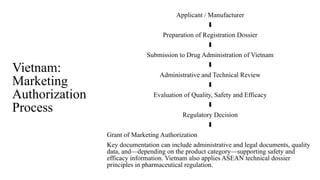
Applicant / Manufacturer
⬇
Preparationof Registration Dossier
⬇
Submission to Drug Administration of Vietnam
⬇
Administrative and Technical Review
⬇
Evaluation of Quality, Safety and Efficacy
⬇
Regulatory Decision
⬇
Grant of Marketing Authorization
Key documentation can include administrative and legal documents, quality
data, and—depending on the product category—supporting safety and
efficacy information. Vietnam also applies ASEAN technical dossier
principles in pharmaceutical regulation.
8.
Vietnam:
Major
Marketing
Authorization
Requirements
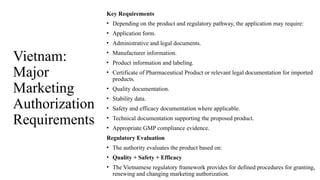
Key Requirements
• Dependingon the product and regulatory pathway, the application may require:
• Application form.
• Administrative and legal documents.
• Manufacturer information.
• Product information and labeling.
• Certificate of Pharmaceutical Product or relevant legal documentation for imported
products.
• Quality documentation.
• Stability data.
• Safety and efficacy documentation where applicable.
• Technical documentation supporting the proposed product.
• Appropriate GMP compliance evidence.
Regulatory Evaluation
• The authority evaluates the product based on:
• Quality + Safety + Efficacy
• The Vietnamese regulatory framework provides for defined procedures for granting,
renewing and changing marketing authorization.
9.
Vietnam:
Validity and
Renewal
Validity ofMarketing Authorization
• Generally:
• 5 years for a marketing authorization, subject to applicable exceptions.
• 3 years for products requiring continued monitoring of safety and efficacy,
including certain new products.
Renewal documentation may include:
• Renewal application.
• Valid pharmaceutical product documentation for imported products, where
applicable.
• Safety and efficacy report from the marketing period.
• Vietnam's current framework also specifies that an application for renewal
must be submitted before expiry under the applicable procedure.
10.
Vietnam: Post-
Approval
Requirements
• Changesafter approval may require submission to the regulatory
authority.
Examples include:
• Change in manufacturer.
• Manufacturing-site changes.
• Changes in manufacturing process.
• Changes in specifications.
• Changes in packaging.
• Labeling changes.
• Changes in administrative information.
• Changes that may affect quality, safety or efficacy.
• The dossier for a change generally includes:
• Application for change/supplementation.
• Technical documentation supporting the proposed change.
• Vietnam also provides shorter regulatory handling for certain
changes that do not affect product quality, safety or efficacy.
11.
Malaysia: Regulatory Authority
•National Pharmaceutical Regulatory Agency (NPRA)
• The NPRA operates under Malaysia's Ministry of Health and supports regulatory control of pharmaceutical
products.
• National Pharmaceutical Regulatory Agency (NPRA)
Key Functions
• Product registration.
• Evaluation of pharmaceutical products.
• Regulatory review of variations.
• Pharmacovigilance.
• Post-marketing surveillance.
• Product quality monitoring.
• Product recalls and regulatory enforcement.
12.
Malaysia: Marketing Authorization
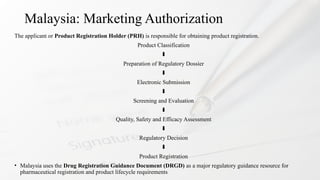
Theapplicant or Product Registration Holder (PRH) is responsible for obtaining product registration.
Product Classification
⬇
Preparation of Regulatory Dossier
⬇
Electronic Submission
⬇
Screening and Evaluation
⬇
Quality, Safety and Efficacy Assessment
⬇
Regulatory Decision
⬇
Product Registration
• Malaysia uses the Drug Registration Guidance Document (DRGD) as a major regulatory guidance resource for
pharmaceutical registration and product lifecycle requirements.
13.
Malaysia:
Dossier
Requirements
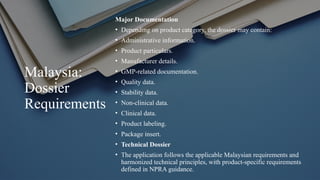
Major Documentation
• Dependingon product category, the dossier may contain:
• Administrative information.
• Product particulars.
• Manufacturer details.
• GMP-related documentation.
• Quality data.
• Stability data.
• Non-clinical data.
• Clinical data.
• Product labeling.
• Package insert.
• Technical Dossier
• The application follows the applicable Malaysian requirements and
harmonized technical principles, with product-specific requirements
defined in NPRA guidance.
14.
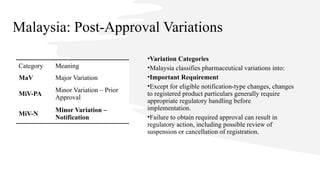
Malaysia: Post-Approval Variations
•VariationCategories
•Malaysia classifies pharmaceutical variations into:
•Important Requirement
•Except for eligible notification-type changes, changes
to registered product particulars generally require
appropriate regulatory handling before
implementation.
•Failure to obtain required approval can result in
regulatory action, including possible review of
suspension or cancellation of registration.
Category Meaning
MaV Major Variation
MiV-PA
Minor Variation – Prior
Approval
MiV-N
Minor Variation –
Notification
15.
Malaysia:
Pharmacovigilance
and Post-Marketing
Surveillance
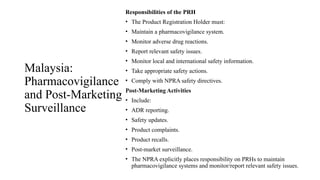
Responsibilities ofthe PRH
• The Product Registration Holder must:
• Maintain a pharmacovigilance system.
• Monitor adverse drug reactions.
• Report relevant safety issues.
• Monitor local and international safety information.
• Take appropriate safety actions.
• Comply with NPRA safety directives.
Post-Marketing Activities
• Include:
• ADR reporting.
• Safety updates.
• Product complaints.
• Product recalls.
• Post-market surveillance.
• The NPRA explicitly places responsibility on PRHs to maintain
pharmacovigilance systems and monitor/report relevant safety issues.
16.
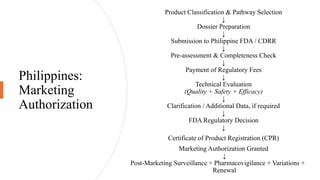
Philippines:
Regulatory Authority
• Foodand Drug Administration (FDA),
Philippines
• The Philippine FDA regulates pharmaceutical
products before and after marketing
authorization.
• Philippine Food and Drug Administration
Key Functions
• Product registration.
• Evaluation of quality, safety and efficacy.
• Issuance of Certificates of Product
Registration.
• Approval of post-approval changes.
• Pharmacovigilance.
• Post-market surveillance.
• Product recalls and regulatory enforcement.
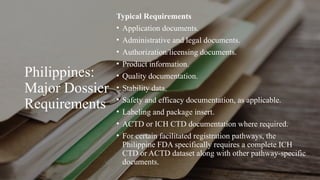
Philippines:
Major Dossier
Requirements
Typical Requirements
•Application documents.
• Administrative and legal documents.
• Authorization/licensing documents.
• Product information.
• Quality documentation.
• Stability data.
• Safety and efficacy documentation, as applicable.
• Labeling and package insert.
• ACTD or ICH CTD documentation where required.
• For certain facilitated registration pathways, the
Philippine FDA specifically requires a complete ICH
CTD or ACTD dataset along with other pathway-specific
documents.
19.
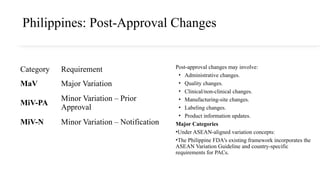
Philippines: Post-Approval Changes
Post-approvalchanges may involve:
• Administrative changes.
• Quality changes.
• Clinical/non-clinical changes.
• Manufacturing-site changes.
• Labeling changes.
• Product information updates.
Major Categories
•Under ASEAN-aligned variation concepts:
•The Philippine FDA's existing framework incorporates the
ASEAN Variation Guideline and country-specific
requirements for PACs.
Category Requirement
MaV Major Variation
MiV-PA
Minor Variation – Prior
Approval
MiV-N Minor Variation – Notification
Conclusion
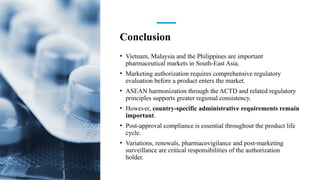
• Vietnam, Malaysiaand the Philippines are important
pharmaceutical markets in South-East Asia.
• Marketing authorization requires comprehensive regulatory
evaluation before a product enters the market.
• ASEAN harmonization through the ACTD and related regulatory
principles supports greater regional consistency.
• However, country-specific administrative requirements remain
important.
• Post-approval compliance is essential throughout the product life
cycle.
• Variations, renewals, pharmacovigilance and post-marketing
surveillance are critical responsibilities of the authorization
holder.
23.
References
Vietnam
• Ministry ofHealth / Drug Administration of Vietnam
• DAV regulatory and administrative services portal
• Vietnam Ministry of Health legal framework on
marketing authorization, renewal and changes.
Malaysia
• NPRA – Drug Registration Guidance Document and r
elated guidance
• NPRA Post-Marketing Activities
• NPRA Pharmacovigilance Guidelines
Philippines
• Philippine FDA – Facilitated Registration Pathways
• Philippine FDA – WHO Collaborative Procedure
• Philippine FDA post-approval change framework