CRICOS No.00213J
Digital Media Research Centre
<Subheading here>
Mapping News Media Polarisation
during Australia’s Indigenous Voice
to Parliament Referendum
Katharina Esau, Axel Bruns, Michelle Riedlinger, Laura Vodden, Thet Zin Myint & Samantha Vilkins
Digital Media Research Centre
Queensland University of Technology
Brisbane, Australia
Contact: katharina.esau@qut.edu.au, @kathaesa, @kathaesa.bsky.social
CRICOS No.00213J
Digital Media Research Centre
<Subheading here>
CRICOS No.00213J
Digital Media Research Centre
<Subheading here>
Image: Midjourney
“destructive ”
Image: Midjourney “shifts in the
media and communication
landscape during COVID”
Polycrisis & Media
CRICOS No.00213J
Digital Media Research Centre
<Subheading here>
News Media Polarisation
• Polarisation is ill-defined, inconsistent and unsystematic usage in the literature; esp. within
media and communication research (e.g., Esau et al., 2024; Kreiss & McGregor, 2024)
• Traditional definitions of news polarisation centre on audience-focused studies and on left-
right ideological divide (Park et al., 2024; Ross Arguedas et al., 2022)
• Existing definitions of types/forms of polarisation: e.g., ideological, issue-, affective,
perceived (Bruns et al., 2024; Vilkins et al., forthcoming); Previous studies on media bias, news
slant, partisan media, media-party parallelism (Hassell et al., 2021; van Kempen, 2007)
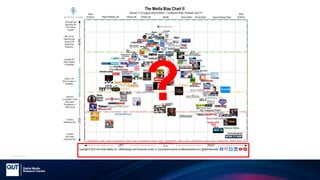
➢How can we conceptualise and measure News Media Polarisation?
➢When is polarisation a problem (see “destructive polarisation” Esau et al., 2024)?
CRICOS No.00213J
Digital Media Research Centre
<Subheading here>
?
CRICOS No.00213J
Digital Media Research Centre
<Subheading here>
Research question:
How polarised was Australia’s media landscape in the lead-up to the Voice
referendum, and what constitutes the poles of this polarisation?
CRICOS No.00213J
Digital Media Research Centre
<Subheading here>
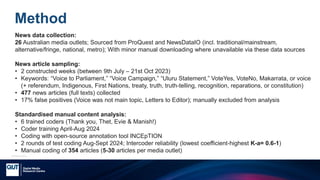
Method
News data collection:
26 Australian media outlets; Sourced from ProQuest and NewsDataIO (incl. traditional/mainstream,
alternative/fringe, national, metro); With minor manual downloading where unavailable via these data sources
News article sampling:
• 2 constructed weeks (between 9th July – 21st Oct 2023)
• Keywords: “Voice to Parliament,” “Voice Campaign,” “Uluru Statement,” VoteYes, VoteNo, Makarrata, or voice
(+ referendum, Indigenous, First Nations, treaty, truth, truth-telling, recognition, reparations, or constitution)
• 477 news articles (full texts) collected
• 17% false positives (Voice was not main topic, Letters to Editor); manually excluded from analysis
Standardised manual content analysis:
• 6 trained coders (Thank you, Thet, Evie & Manish!)
• Coder training April-Aug 2024
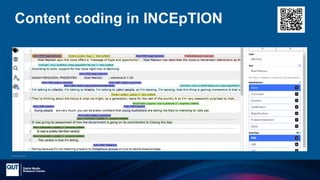
• Coding with open-source annotation tool INCEpTION
• 2 rounds of test coding Aug-Sept 2024; Intercoder reliability (lowest coefficient-highest K-a= 0.6-1)
• Manual coding of 354 articles (5-30 articles per media outlet)
CRICOS No.00213J
Digital Media Research Centre
<Subheading here>
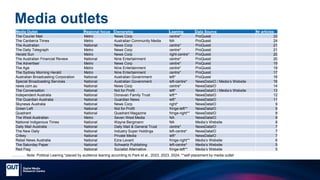
Media outlets
Media Outlet Regional focus Ownership Leaning Data Source Nr articles
The Courier Mail Metro News Corp centre* ProQuest 33
The Canberra Times Metro Australian Community Media NA ProQuest 24
The Australian National News Corp centre* ProQuest 21
The Daily Telegraph Metro News Corp centre* ProQuest 21
Herald Sun Metro News Corp right-centre* ProQuest 20
The Australian Financial Review National Nine Entertainment centre* ProQuest 20
The Advertiser Metro News Corp centre* ProQuest 19
The Age Metro Nine Entertainment centre* ProQuest 19
The Sydney Morning Herald Metro Nine Entertainment centre* ProQuest 17
Australian Broadcasting Corporation National Australian Government left* ProQuest 16
Special Broadcasting Services National Australian Government left-centre* NewsDataIO / Media’s Website 16
news.com.au National News Corp centre* NewsDataIO 14
The Conversation National Not for Profit left* NewsDataIO / Media’s Website 13
Independent Australia National Donavan Family Trust left** NewsDataIO 12
The Guardian Australia National Guardian News left* NewsDataIO 11
Skynews Australia National News Corp right* NewsDataIO 9
Green Left National Not for Profit fringe-left** NewsDataIO 9
Quadrant National Quadrant Magazine fringe-right** NewsDataIO 8
The West Australian Metro Seven West Media NA NewsDataIO 8
National Indigenous Times National Wayne Bergmann NA Media’s Website 8
Daily Mail Australia National Daily Mail & General Trust centre* NewsDataIO 7
The New Daily National Industry Super Holdings left-centre* NewsDataIO 7
Crikey National Private Media left* NewsDataIO 7
Rebel News Australia National Ezra Levant fringe-right** Media’s Website 6
The Saturday Paper National Schwartz Publishing left-centre* Media’s Website 5
Red Flag National Socialist Alternative fringe-left** Media’s Website 5
Note: Political Leaning *placed by audience leaning according to Park et al., 2023, 2023, 2024; **self-placement by media outlet
CRICOS No.00213J
Digital Media Research Centre
<Subheading here>
Content coding in INCEpTION
CRICOS No.00213J
Digital Media Research Centre
<Subheading here>
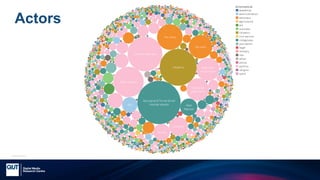
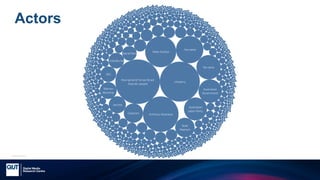
Actors
CRICOS No.00213J
Digital Media Research Centre
<Subheading here>
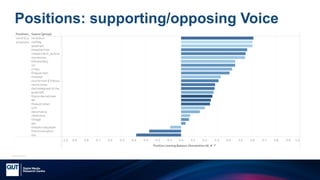
Positions: supporting/opposing Voice
CRICOS No.00213J
Digital Media Research Centre
<Subheading here>
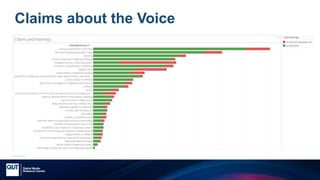
Claims about the Voice
CRICOS No.00213J
Digital Media Research Centre
<Subheading here>
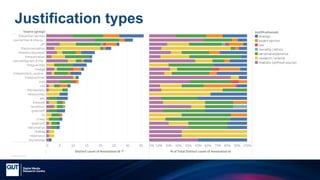
Justification types
CRICOS No.00213J
Digital Media Research Centre
<Subheading here>
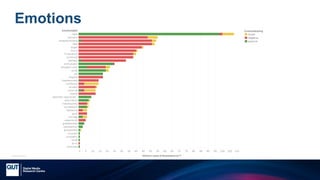
Emotions
CRICOS No.00213J
Digital Media Research Centre
<Subheading here>
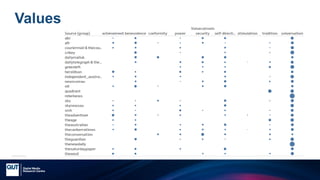
Values
CRICOS No.00213J
Digital Media Research Centre
<Subheading here>
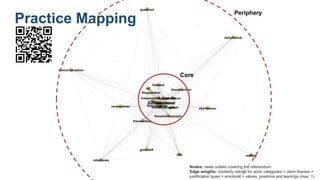
Practice Mapping
Core
Periphery
Nodes: news outlets covering the referendum
Edge weights: similarity ratings for actor categories × claim themes ×
justification types × emotions × values, positions and leanings (max. 1)
CRICOS No.00213J
Digital Media Research Centre
<Subheading here>
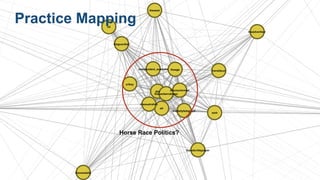
Practice Mapping
Horse Race Politics?
CRICOS No.00213J
Digital Media Research Centre
<Subheading here>
Summary & Discussion
• Polarised, but not bi-polar: Australian media landscape was polarised, but not (only) along a
left-vs-right axis. The strongest divergence lies between the core of traditional mainstream
journalism (e.g., ABC, The Australian) and the periphery of fringe and alternative outlets (e.g.,
Quadrant, Rebel News, Red Flag, Green Left)
• Horse race politics and othering: The emphasis on horse race politics and othering narratives
was prevalent across the core and periphery, albeit expressed in different ways
• Notable outliers: SBS, The Conversation, Daily Mail, Sky News, and news.com.au occupy their
own distinct spaces, some as peripheral actors (e.g., Hermida & Young, 2019). While self-identified
closer to traditional journalism, they differ in style, tone and framing from the mainstream core
• Fringe amplification: Fringe and alternative outlets played a significant role in amplifying
polarising narratives; we show that they chose distinct selective framing targeting audiences
• Digital platforms further amplified this divergence, shaping alternative digital publics
CRICOS No.00213J
This research was supported by the ARC Laureate Fellowship project Determining the Dynamics of
Partisanship and Polarisation in Online Public Debate.
Acknowledgments
CRICOS No.00213J
Digital Media Research Centre
<Subheading here>
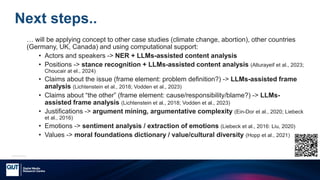
Next steps..
… will be applying concept to other case studies (climate change, abortion), other countries
(Germany, UK, Canada) and using computational support:
• Actors and speakers -> NER + LLMs-assisted content analysis
• Positions -> stance recognition + LLMs-assisted content analysis (Alturayeif et al., 2023;
Choucair at el., 2024)
• Claims about the issue (frame element: problem definition?) -> LLMs-assisted frame
analysis (Lichtenstein et al., 2018; Vodden et al., 2023)
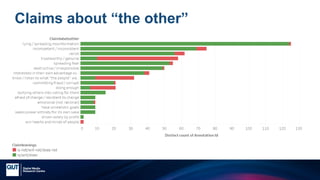
• Claims about “the other” (frame element: cause/responsibility/blame?) -> LLMs-
assisted frame analysis (Lichtenstein et al., 2018; Vodden et al., 2023)
• Justifications -> argument mining, argumentative complexity (Ein-Dor et al., 2020; Liebeck
et al., 2016)
• Emotions -> sentiment analysis / extraction of emotions (Liebeck et al., 2016: Liu, 2020)
• Values -> moral foundations dictionary / value/cultural diversity (Hopp et al., 2021)
CRICOS No.00213J
Digital Media Research Centre
<Subheading here>
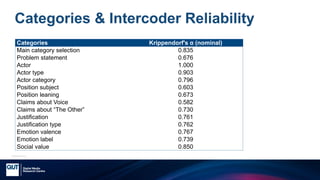
Categories & Intercoder Reliability
Categories Krippendorf's α (nominal)
Main category selection 0.835
Problem statement 0.676
Actor 1.000
Actor type 0.903
Actor category 0.796
Position subject 0.603
Position leaning 0.673
Claims about Voice 0.582
Claims about “The Other” 0.730
Justification 0.761
Justification type 0.762
Emotion valence 0.767
Emotion label 0.739
Social value 0.850
CRICOS No.00213J
Digital Media Research Centre
<Subheading here>
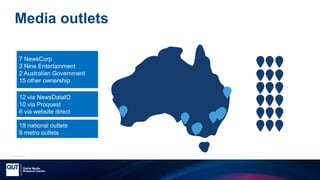
Media outlets
7 NewsCorp
3 Nine Entertainment
2 Australian Government
15 other ownership
12 via NewsDataIO
10 via Proquest
6 via website direct
18 national outlets
8 metro outlets
CRICOS No.00213J
Digital Media Research Centre
<Subheading here>
Actors
CRICOS No.00213J
Digital Media Research Centre
<Subheading here>
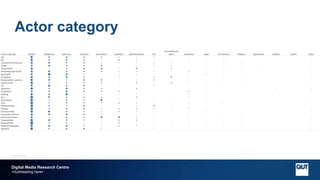
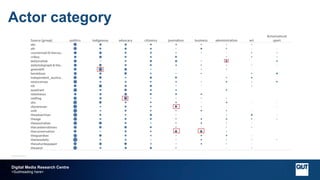
Actor category
CRICOS No.00213J
Digital Media Research Centre
<Subheading here>
Claims about “the other”
CRICOS No.00213J
Digital Media Research Centre
<Subheading here>
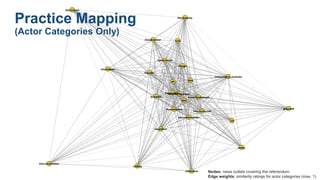
Practice Mapping
(Actor Categories Only)
Nodes: news outlets covering the referendum
Edge weights: similarity ratings for actor categories (max. 1)
CRICOS No.00213J
Digital Media Research Centre
<Subheading here>
Actor category
CRICOS No.00213J
Digital Media Research Centre
<Subheading here>
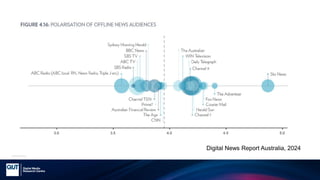
Digital News Report Australia, 2024
CRICOS No.00213J
Digital Media Research Centre
<Subheading here>
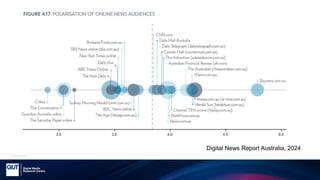
Digital News Report Australia, 2024