Cognitive Changes after
 Breast Cancer and its
      Treatment
                 Fremonta Meyer, MD
 Department of Psychosocial Oncology and Palliative Care
             Dana-Farber Cancer Institute
                     June 6, 2012
Outline
   Impact

   Why focus on breast cancer?

   Research findings

   Interventions
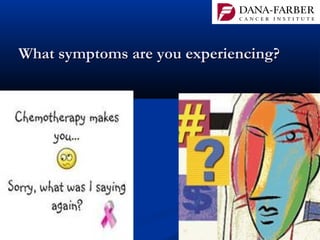
What symptoms are you experiencing?
So…
   Is it real?

   What causes it?

   What can be done about it?
Patient Experiences
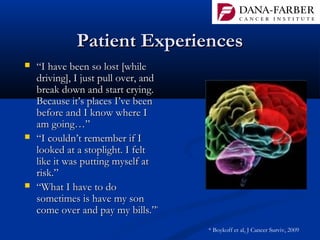
   “I have been so lost [while
    driving], I just pull over, and
    break down and start crying.
    Because it’s places I’ve been
    before and I know where I
    am going…”
   “I couldn’t remember if I
    looked at a stoplight. I felt
    like it was putting myself at
    risk.”
   “What I have to do
    sometimes is have my son
    come over and pay my bills.”*
                                      * Boykoff et al, J Cancer Surviv, 2009
Impact on Quality of Life
   Distress due to lack of acknowledgment by medical
    community

   Mixed reactions from family and friends

   Decline in job performance

   Avoidance of social occasions

   Depression and anxiety

            * Boykoff et al, J Cancer Surviv, 2009
Chemobrain can affect many areas of
       cognitive function
   Memory
   Attention/concentration
   Information processing speed
   Executive function
     Initiation
     Planning
     Organization
     Multi-tasking
     Response inhibition
Research shows that the majority of patients on
    chemotherapy experience cognitive side effects
   67% of patients reported experiencing memory and
    concentration problems during chemotherapy
   These problems were still present 6 months after completing
    chemotherapy
      Memory                                           Concentration


                            *Kohli et al, J Oncol
                            Practice, 2007
For most people, chemobrain
      gradually disappears over time
   17-34% of people continue to have problems
    after the end of chemotherapy

   Some neuroimaging studies show
    improvement/resolution of regional brain
    volume differences as of 3 years post-
    chemotherapy
                    *Inagaki et al, Cancer, 2007
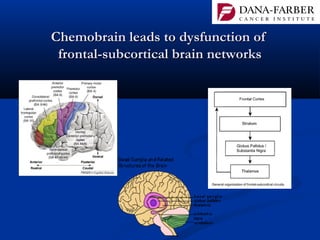
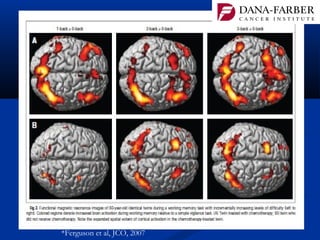
Chemobrain leads to dysfunction of
 frontal-subcortical brain networks
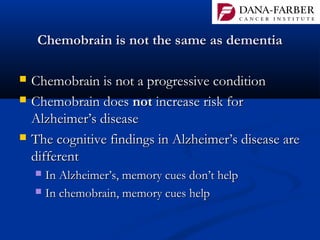
Chemobrain is not the same as dementia

   Chemobrain is not a progressive condition
   Chemobrain does not increase risk for
    Alzheimer’s disease
   The cognitive findings in Alzheimer’s disease are
    different
     In Alzheimer’s, memory cues don’t help
     In chemobrain, memory cues help
*Ferguson et al, JCO, 2007
Why do we study breast cancer?
   Common cancer with largest population of
    survivors (23%; 2.6 million)

   Limited direct effects of cancer on brain other
    than chemotherapy

   Population allows chemotherapy vs non-
    chemotherapy study designs
Why don’t more oncologists study this?


   Oncology research tends to focus on clearly
    defined outcomes or “endpoints”
     Overall survival (OS)
     Progression-free survival (PS)


   What’s the “endpoint” for chemobrain?
Endpoints for chemobrain are controversial.

    Functional neuroimaging findings (fMRI)

    Neuropsychological tests
         May not reflect “real life”

    Self-reported cognitive problems
       May have other causes
       But, interestingly, seems to be most similar to fMRI
        results
Empathy for your oncologist
          and other physicians…
   It’s important to understand where your
    oncologist is coming from…

     The research on this topic is very confusing
     There aren’t yet any FDA approved treatments for
      chemobrain
     This makes it hard for them to know what to
      recommend!
Problems with the Older Research
   Cross-sectional studies
        Looking only at people who already completed cancer treatment

   Prospective studies without matched control groups
        Looking only at people who had cancer and received chemotherapy

   Not enough patients

   Multiple chemotherapy regimens

   Not controlling for hormonal therapies

   Not controlling for patients getting better at neuropsychological tests because they
    have practiced them (rather than their chemobrain actually improving)

   Excluding people with depression, anxiety, sleep problems
Summary of the better-quality research
          using neuropsychological testing
   8 prospective longitudinal studies with matched control
    +/- healthy control group*
       Acute declines in motor skills, processing speed,
        verbal/visual memory which improved over time
       Chemotherapy may have specific negative effect on verbal
        fluency
       Patients exposed to chemotherapy plus tamoxifen did
        worse at later timepoints than pts exposed to chemotherapy
        alone

       But: 3 studies did not show any cognitive impairment with
        standard-dose chemotherapy
        *Quesnel 2009, Schagen 2009, Tager 2010, Bender 2006, Collins 2009, Jenkins 2006,
        Mehlsen 2009, Ahles 2010
How would you design a
study, from your perspective
    as a cancer survivor?
Added Observations
   Some people with breast cancer (11-33%) have
    cognitive problems prior to receiving any
    chemotherapy at all*

     Anxiety
     Anesthesia from surgeries

     Something that the tumor directly causes –
      “paraneoplastic”

        *Ahles et al, Breast Cancer Res Treat, 2008
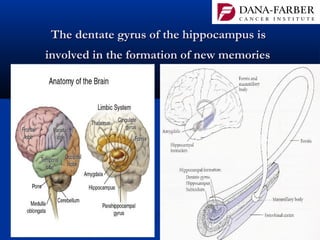
The dentate gyrus of the hippocampus is
involved in the formation of new memories
A Close-Up of the Dentate Gyrus
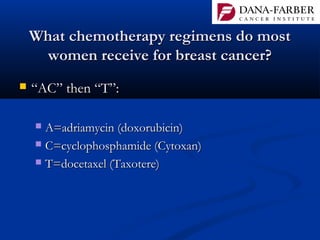
What chemotherapy regimens do most
      women receive for breast cancer?
   “AC” then “T”:

     A=adriamycin (doxorubicin)
     C=cyclophosphamide (Cytoxan)

     T=docetaxel (Taxotere)
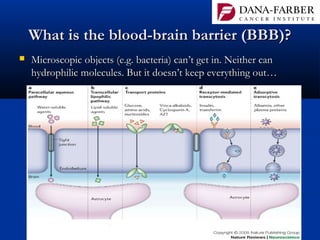
What is the blood-brain barrier (BBB)?
   Microscopic objects (e.g. bacteria) can’t get in. Neither can
    hydrophilic molecules. But it doesn’t keep everything out…
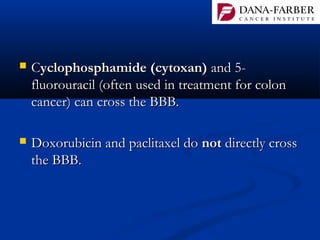
   Cyclophosphamide (cytoxan) and 5-
    fluorouracil (often used in treatment for colon
    cancer) can cross the BBB.

   Doxorubicin and paclitaxel do not directly cross
    the BBB.
In mice, chemotherapy agents appear to result in reduced
   cell growth in the dentate gyrus of the hippocampus


                                              *Janelsins et al, Cancer
                                              Investigation, 2010
Take-Home Points
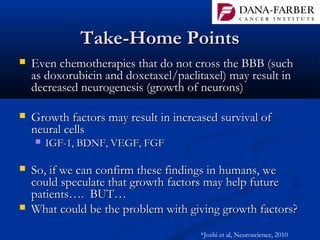
   Even chemotherapies that do not cross the BBB (such
    as doxorubicin and doxetaxel/paclitaxel) may result in
    decreased neurogenesis (growth of neurons)

   Growth factors may result in increased survival of
    neural cells
       IGF-1, BDNF, VEGF, FGF

   So, if we can confirm these findings in humans, we
    could speculate that growth factors may help future
    patients…. BUT…
   What could be the problem with giving growth factors?
                                       *Joshi et al, Neuroscience, 2010
“Seed”


                       “Soil”


         “Pesticide”
Cancer and Chemotherapy…
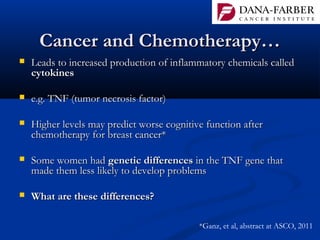
   Leads to increased production of inflammatory chemicals called
    cytokines

   e.g. TNF (tumor necrosis factor)

   Higher levels may predict worse cognitive function after
    chemotherapy for breast cancer*

   Some women had genetic differences in the TNF gene that
    made them less likely to develop problems

   What are these differences?

                                            *Ganz, et al, abstract at ASCO, 2011
Single Nucleotide Polymorphisms (SNPs)
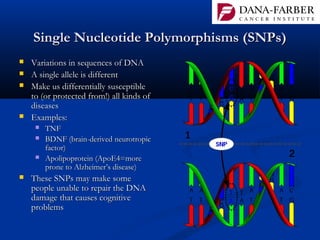
   Variations in sequences of DNA
   A single allele is different
   Make us differentially susceptible
    to (or protected from!) all kinds of
    diseases
   Examples:
        TNF
        BDNF (brain-derived neurotropic
         factor)
        Apolipoprotein (ApoE4=more
         prone to Alzheimer’s disease)
   These SNPs may make some
    people unable to repair the DNA
    damage that causes cognitive
    problems
Hormonal therapy for breast cancer may
           also have a negative effect on cognition
   High levels of estrogen increase verbal memory, verbal fluency
    and fine motor skills
   Surgically induced or abrupt menopause
       Acute decline in verbal memory
   It’s unclear that hormone replacement therapy truly protects
    against dementia

   Tamoxifen and aromatase inhibitors (eg Aromasin, Arimidex,
    Femara) may have an anti-estrogen role in some brain areas
    related to cognitive function
       Effects are not widespread or severe
       Primarily seen in verbal memory and processing speed
Chemobrain is associated with several
         common, treatable problems
   Sleep disturbance

   Fatigue

   Depression

   Anxiety
What can be done?
Medications-1
   Stimulants
       methylphenidate (Ritalin, Concerta, Focalin),
        dextroamphetamine (Adderall)
       Despite negative study*, they are sometimes effective in
        clinical practice

   Modafinil (Provigil)*
       Improved attention and memory in a group of breast cancer
        survivors with fatigue


        *Mar Fan et al, Support Care Cancer, 2008
        *Kohli et al, Cancer, 2009
Medications-2
   Antidepressants
        Celexa (citalopram), Zoloft (sertraline), Lexapro (escitalopram), Prozac
         (fluoxetine), Paxil (paroxetine)
        Effexor (venlafaxine), Cymbalta (duloxetine)
        Wellbutrin (bupropion)
        Remeron (mirtazapine)

   Anxiolytics
        lorazepam (Ativan), clonazepam (Klonopin), alprazolam (Xanax), diazepam
         (Valium)
        Use with caution

   Sleep medications
        zolpidem (Ambien), eszopiclone (Lunesta), trazodone (desyrel)
        Use with caution
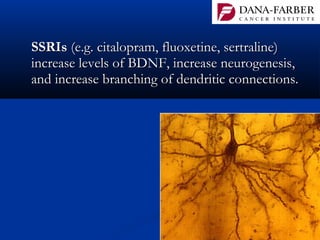
SSRIs (e.g. citalopram, fluoxetine, sertraline)
increase levels of BDNF, increase neurogenesis,
and increase branching of dendritic connections.
Other Activities
   Regular aerobic exercise

        May improve neural proliferation
         in the dentate gyrus!

        In a review of many studies, this
         was the only factor associated
         with lowering your risk of
         dementia

   Social connections

   Good nutrition
        e.g. fish w/omega 3’s,
         antioxidants, flavanols
First Step: Get Help!
   If you’re more than 6 months out from chemotherapy and you are having difficulty
    functioning in your daily life (with work, school, relationships) due to chemobrain…

   Ask your oncologist for a referral to a neuropsychologist.

   A neurologist can be helpful if you have a family history of dementia, or if you have
    other neurological symptoms such as persistent neuropathy, headaches,
    weakness/numbness in a body part, etc.

   If you have any sleep problems, fatigue, depression, or anxiety:

        Consider seeing a psychiatrist
        Also consider seeing a sleep medicine physician (who can decide if a sleep study is needed).

   Finally, make sure your PCP is in the loop.
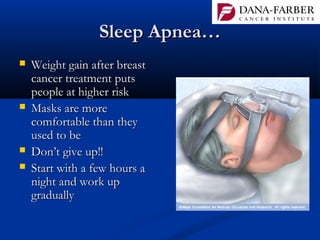
Sleep Apnea…
   Weight gain after breast
    cancer treatment puts
    people at higher risk
   Masks are more
    comfortable than they
    used to be
   Don’t give up!!
   Start with a few hours a
    night and work up
    gradually
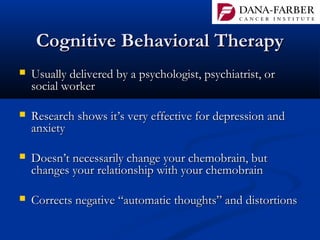
Cognitive Behavioral Therapy
   Usually delivered by a psychologist, psychiatrist, or
    social worker

   Research shows it’s very effective for depression and
    anxiety

   Doesn’t necessarily change your chemobrain, but
    changes your relationship with your chemobrain

   Corrects negative “automatic thoughts” and distortions
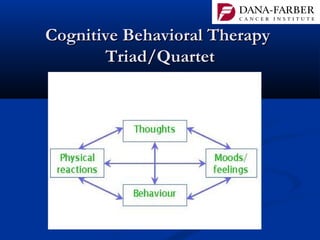
Cognitive Behavioral Therapy
       Triad/Quartet
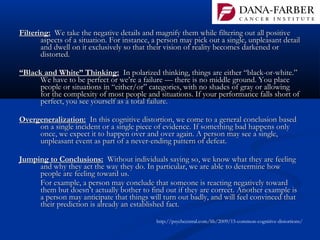
Filtering: We take the negative details and magnify them while filtering out all positive
       aspects of a situation. For instance, a person may pick out a single, unpleasant detail
       and dwell on it exclusively so that their vision of reality becomes darkened or
       distorted.

“Black and White” Thinking: In polarized thinking, things are either “black-or-white.”
      We have to be perfect or we’re a failure — there is no middle ground. You place
      people or situations in “either/or” categories, with no shades of gray or allowing
      for the complexity of most people and situations. If your performance falls short of
      perfect, you see yourself as a total failure.

Overgeneralization: In this cognitive distortion, we come to a general conclusion based
     on a single incident or a single piece of evidence. If something bad happens only
     once, we expect it to happen over and over again. A person may see a single,
     unpleasant event as part of a never-ending pattern of defeat.

Jumping to Conclusions: Without individuals saying so, we know what they are feeling
     and why they act the way they do. In particular, we are able to determine how
     people are feeling toward us.
     For example, a person may conclude that someone is reacting negatively toward
     them but doesn’t actually bother to find out if they are correct. Another example is
     a person may anticipate that things will turn out badly, and will feel convinced that
     their prediction is already an established fact.

                                             http://psychcentral.com/lib/2009/15-common-cognitive-distortions/
Catastrophizing: We expect disaster to strike, no matter what. This is also referred to as
   “magnifying or minimizing.” We hear about a problem and use what if questions (e.g.,
   “What if tragedy strikes?” “What if it happens to me?”).
  For example, a person might exaggerate the importance of insignificant events (such as
   their mistake, or someone else’s achievement). Or they may inappropriately shrink the
   magnitude of significant events until they appear tiny (for example, a person’s own
   desirable qualities or someone else’s imperfections)
Personalization: Personalization is a distortion where a person believes that everything
   others do or say is some kind of direct, personal reaction to the person. We also compare
   ourselves to others trying to determine who is smarter, better looking, etc.
  A person engaging in personalization may also see themselves as the cause of some
   unhealthy external event that they were not responsible for. For example, “We were late
   to the dinner party and caused the hostess to overcook the meal. If I had only pushed my
   husband to leave on time, this wouldn’t have happened.”
Control Fallacies: If we feel externally controlled, we see ourselves as helpless a victim of fate.
   For example, “I can’t help it if the quality of the work is poor, my boss demanded I work
   overtime on it.” The fallacy of internal control has us assuming responsibility for the pain
   and happiness of everyone around us. For example, “Why aren’t you happy? Is it because
   of something I did?”
Fallacy of Fairness: We feel resentful because we think we know what is fair, but other
    people won’t agree with us. As our parents tell us, “Life is always fair,” and people who go
    through life applying a measuring ruler against every situation judging its “fairness” will
    often feel badly and negative because of it.
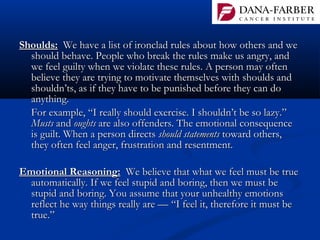
Shoulds: We have a list of ironclad rules about how others and we
  should behave. People who break the rules make us angry, and
  we feel guilty when we violate these rules. A person may often
  believe they are trying to motivate themselves with shoulds and
  shouldn’ts, as if they have to be punished before they can do
  anything.
  For example, “I really should exercise. I shouldn’t be so lazy.”
  Musts and oughts are also offenders. The emotional consequence
  is guilt. When a person directs should statements toward others,
  they often feel anger, frustration and resentment.

Emotional Reasoning: We believe that what we feel must be true
 automatically. If we feel stupid and boring, then we must be
 stupid and boring. You assume that your unhealthy emotions
 reflect he way things really are — “I feel it, therefore it must be
 true.”
Naming Emotions
   Anxiety= signal of an emotion that lies underneath
   Primary emotions (like primary colors!)
       Sadness
       Fear
       Anger
       Guilt
       Shame
       Envy
       Jealousy
   Naming the emotion can reduce the anxiety
Behavioral Approaches

   Behavioral activation

   Systematic desensitization
       Gradually exposing yourself to feared situations over
        time
Cognitive rehabilitation helps many patients
   It’s done by a speech-language pathologist
        This is often covered by insurance – specifically, your physical/occupational
         therapy benefit

   Exercises to retrain your brain

   Tracking and understanding what causes cognitive worsening
        e.g. fatigue

   Coping strategies
        PDAs; 1 notebook w/3 sections; Note taking

   Stress relief strategies
        Diaphragmatic breathing; muscle relaxation; guided imagery
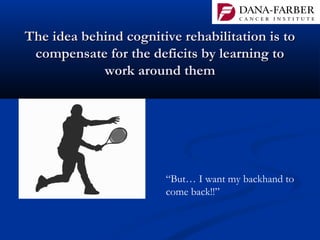
The idea behind cognitive rehabilitation is to
 compensate for the deficits by learning to
            work around them


                       “But… I want my backhand to
                       come back!!”
Newest developments are trying
     to take advantage of brain plasticity
              to restore function
   POSIT brain science program
    (http://www.positscience.com)
     40-hour training program
     Effective for age-related cognitive decline and mild
      cognitive impairment
     It’s being studied in chemobrain by Janelle Vardy at
      the University of Sydney
           Study results not yet available
EEG Biofeedback
Preliminary Study of EEG
                Biofeedback
   Preliminary data from Alvarez et al (we are submitting
    to journals presently): 23 breast cancer survivors
    showed marked improvements in self-reported
    cognitive function, sleep, and fatigue after 20 sessions
    of neurofeedback over 10 weeks

   More study with neuropsychological tests is needed.
In order to have chemobrain, you have to be alive