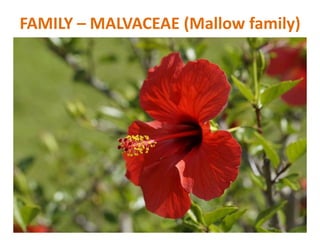
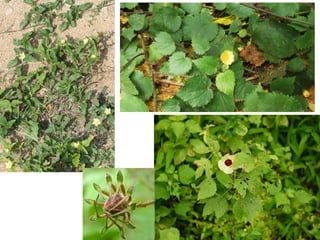
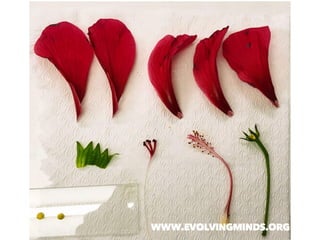
FAMILY – MALVACEAE (Mallow family)
Systematic Position:
Class : Dicotyledons
Subclass : Polypetalae
Series : Thalamiflorae
Order : Malvales
Family : Malavaceae
Characteristics of each taxon:
Dicotyledons – seed with two cotyledons, leaf with reticulate venation
& flowers tetramerous/ pentamerous
Polypetalae- Petals are free & so stamens are free
Thalamiflorae – thalamus prominent, flower hypogynous & ovary
superior
Malvales –
•leaves with palmate venation (often three principal veins arising from
the base of the leaf blade)
• mucilage canals within the tissues
• stellate (star-shaped) hairs on the vegetative parts of the plant
• stipules (leaf-like structures at the base of the leaf stalk).
Families under order Malvales:
•Malvaceae
• Sterculiaceae
• Tiliaceae
•Representatives: 246 genera & 4225 species
• Distribution: Cosmoplitan,
confined to tropics
•Habitat: Mesophytic
• Habit : Herbs, Shrubs & trees
• Herbs – Sida, Abutilon, Urena
• Shrubs – Gossypium, Hibiscus
• Trees – Thepesia, Kydia
•Exceptions: - prostrate herbs with trailing branches –
Malvastrum coromandelianum
Sida cordata
- Armed rambling shrub – Hibiscus hispidissimus
*Vegetative parts covered by stellate hairs
•Presence of mucilage sacs in the plant, parts slimy when cut
•Root system – Taproot, branched
•Leaves: Simple/ palmately lobed, alternate, stipulate, petiolate with
entire/variously lobed margins. Stipules free lateral (hibiscus) ,
caducous in nature
• Inflorescence: Solitary axillary (Hibiscus), Solitary terminal
( Gossypium), axillary/ terminal panicles in Kydia
• Flowers: Brightly coloured, bracteate, bracteolate, bisexual,
actinomrphic, hypogynous, cyclic, pentamerous, dichlamydeous &
complete.
• Bracteoles in a whorl & known as Epicalyx ( Involucel).
• Exceptions: - Unisexual flowers – Napea
• polygamodioecious - Kydia
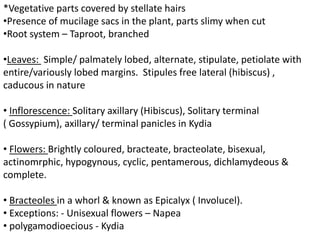
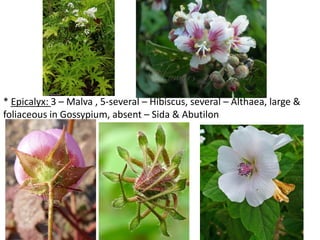
* Epicalyx: 3 – Malva , 5-several – Hibiscus, several – Althaea, large &
foliaceous in Gossypium, absent – Sida & Abutilon
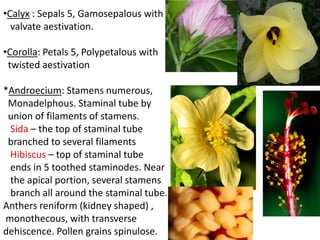
•Calyx : Sepals 5, Gamosepalous with
valvate aestivation.
•Corolla: Petals 5, Polypetalous with
twisted aestivation
*Androecium: Stamens numerous,
Monadelphous. Staminal tube by
union of filaments of stamens.
Sida – the top of staminal tube
branched to several filaments
Hibiscus – top of staminal tube
ends in 5 toothed staminodes. Near
the apical portion, several stamens
branch all around the staminal tube.
Anthers reniform (kidney shaped) ,
monothecous, with transverse
dehiscence. Pollen grains spinulose.
Gynoecium: Carpels 3 – many, Superior syncarpous , Style branches as
many as / double the number of carpels, Ovules 1 or more on axile
placentation, Stigma capitate.
Pentacarpellary pentalocular (Hibiscus)
Multicarpellary, multilocular (Abutilon)
5-10 carpel (Sida)
Kydia -3 carpels
Urena & Pavonia – style double the number of carpels
Fruit: Dry capsular fruits
Abelmoschus & Gossypium –
Loculicidal capsule
Abutilon – schizocarp
*Seeds: mucilaginous, Reniform/ ovoid; glabrous hairy/ wooly
Embryo straight/ curved; Endosperm oily
Gossypium – epidermal outgrowths of seed, sida & Urena – hooks on
Economic importance:
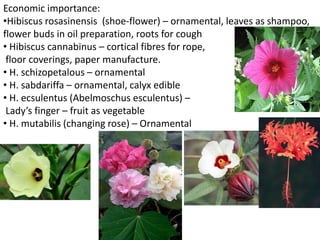
•Hibiscus rosasinensis (shoe-flower) – ornamental, leaves as shampoo,
flower buds in oil preparation, roots for cough
• Hibiscus cannabinus – cortical fibres for rope,
floor coverings, paper manufacture.
• H. schizopetalous – ornamental
• H. sabdariffa – ornamental, calyx edible
• H. ecsulentus (Abelmoschus esculentus) –
Lady’s finger – fruit as vegetable
• H. mutabilis (changing rose) – Ornamental
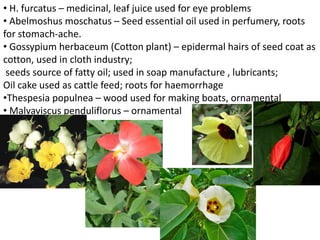
• H. furcatus – medicinal, leaf juice used for eye problems
• Abelmoshus moschatus – Seed essential oil used in perfumery, roots
for stomach-ache.
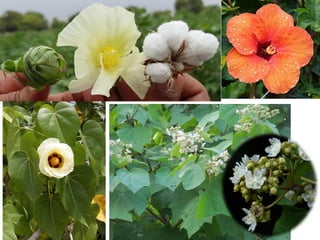
• Gossypium herbaceum (Cotton plant) – epidermal hairs of seed coat as
cotton, used in cloth industry;
seeds source of fatty oil; used in soap manufacture , lubricants;
Oil cake used as cattle feed; roots for haemorrhage
•Thespesia populnea – wood used for making boats, ornamental
• Malvaviscus penduliflorus – ornamental
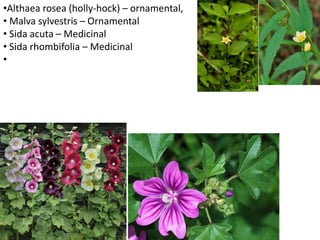
•Althaea rosea (holly-hock) – ornamental,
• Malva sylvestris – Ornamental
• Sida acuta – Medicinal
• Sida rhombifolia – Medicinal
•
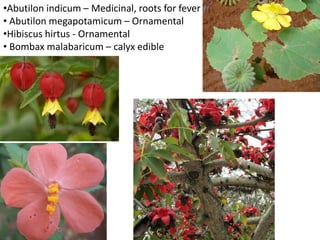
•Abutilon indicum – Medicinal, roots for fever
• Abutilon megapotamicum – Ornamental
•Hibiscus hirtus - Ornamental
• Bombax malabaricum – calyx edible
Diagnostic features of the family:
•Plants herbs, shrubs or trees
• leaf simple, alternate, stipulate, petiolate with enitre or serrate
margins
• inflorescence solitary cyme
• Flower bisexual, actinomorphic, hypogynous, dichlamydeous,
pentamerous, cyclic, bracteolate and complete
• bracteole as epicalyx
• calyx 5, gamosepalous with valvate aestivation.
• corolla 5, polypetalous with twisted aestivation
• Androecium with infinite no. of stamens, monadelphous,
monothecous with reniform anthers
• presence of 5 stamoniodes
• Gynoecium superior, 3- multicarpellary, syncarpous, 3-many loculed
with 1 or more ovules on axile placentation.
• fruit dry capsule- loculicidal capsule
• seeds many, mucilaginous , wooly or glabrous with oily endosperm.
Malvaceae.pdf for study the family of malvaceae group