Making Indoor Air Qualitative- Best Option and Panacea to Make
Humanity Happy, Healthy and More Productive
 Jit Kumar Gupta
 jit.kumar1944@gmail.com
1. Introduction
1.1 Buildings and human living remain universally connected and integrated.
Buildings are more than physical structures. They are essentially living entities.
Buildings are universally valued, for its critical role, relevance and importance, in
providing identity, safety, security and physical space for living and working of
human beings. Considering the fact that more than 80% life span of human
beings, is spent within four walls of buildings , quality of spaces and quality of
air available within these spaces, remains critical and valuable for determining
quality of human living. Buildings are also known to define/ shape human
behavior, emotions, and culture, while reflecting societal values and aspirations.
1.2 It also needs to be understood and appreciated that buildings have both
positivity and negativity. Quality of space, natural light, and green materials used
for making buildings remain major determinant of comfort and inspiration.
Natural light and open spaces often lead to human health, happiness and human
well-being. Accordingly, buildings are known to impact and define, how people
feel, how they interact, and live, creating a dynamic relationship between human
living and built environment created by them. As shared spaces, buildings are
known to foster connectivity with social cohesion. If human beings are credited
with designing buildings to meet human needs and express identity, then buildings
are known to reshape and redefine human experience, quality of life, health,
emotions, and cultural identity.
1.3 In essence, the relationship between buildings and human beings remains
symbiotic, never static and never finite. Buildings are known for creating cultural
identity, ensuring psychological well-being, promoting social cohesion and
creating sustainability. When not planned , designed and constructed rationally,
buildings can adversely impact human health , human psyche, quality of life and
productivity.
1.4 Looking at the critical role and relevance of buildings in human living,
buildings have to be planned , designed, constructed and maintained in such a
manner, that it provides best of environment to the users, so that they can lead a
happy and healthy life. Unfortunately, currently buildings are being planned and
designed in a manner, which make them look beautiful and aesthetically pleasing
from outside, without caring what happens within and in the interior spaces ,
created within the building. It needs to be understood and appreciated that people
live within spaces created inside and not outside buildings. While outer
faces/facades of buildings belong to community and neighborhood, the interior
spaces remain relevant for the users, occupier and the owners. For making people
happy, healthy and more productive, it is important and crucial that users are
provided access to best of the indoor air quality, free from pollutants, chemicals
and toxicants, as a matter of right. Achieving this agenda casts an obligation on
the part of Architects, engineers and Physical Planners that neighbourhood and
buildings planned by them create appropriate opportunities to provide best of
the indoor air quality.
1.5 The context of clean air for human beings also assumes importance for the
reason, that human living has high degree of indoor focus, with 80% of life span
spent indoor, within four walls of the building, which makes IAQ critical
determinant of quality of human living. In addition, indoor spaces have large
exposures to pollution, generated by cooking fed by oil and use of solid fuels,
cleaning houses with chemicals, molds generated by dampness and aggravated by
poor ventilation , besides people smoking within houses. Considering the critical
role and importance, monitoring IAQ and taking preventive measures can
significantly reduce exposure to harmful pollutants and improve overall health of
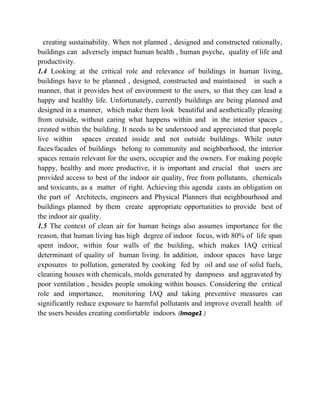
the users besides creating comfortable indoors. (Image1 )
Image 1; Indoor Air Quality;
Source; Microsoft Bing ; vistaza.com
2. Definition;
2.1 Looking at the context, role, relevance and critical implications, indoor air
quality has been defined, differently and distinctly, by various authors, researchers
and scholars in following terms ;
 Indoor air quality (IAQ) is the air quality within buildings and structures.
 Indoor air quality refers to the condition of the air inside buildings and its
impact on the health and comfort of occupants.
 Indoor air quality (IAQ) describes the quality of air within and around
buildings, particularly as it affects the health, comfort, and well-being of
people inside.
 Indoor air quality (IAQ) refers to the types and concentrations of airborne
contaminants found in buildings.(ASHRAE)
 IAQ is the measure of air cleanliness inside enclosed spaces, focusing on
pollutants, ventilation, and thermal comfort. (ASHRAE)
2.2 Looking at the above definitions, it can be observed that the entire context of
indoor Air Quality revolves around determining the quality of air contained within
the interior spaces of buildings/structures in terms of ; cleanliness of air; extent
and nature of pollutants present; quality of ventilation available, thermal comfort
provided, extent and nature of contaminants; impact on human health, level of
occupant’s comfort etc. All these factors cumulatively are known to be the
determinant of quality of air, in terms of its positivity and negativities for human
living. In addition, IAQ is also known to helps in defining norms /standards for
air inside buildings, to make these spaces more qualitative and fit for human
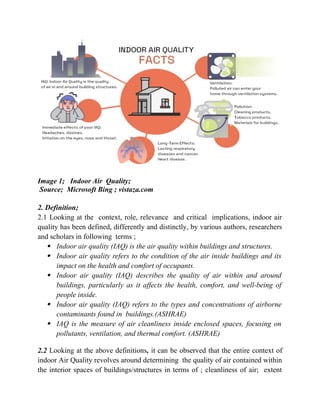
habitation.(Image 2)
Image 2; Indoor Air Quality;
Source; Microsoft Bing ; kenneshepherered.com
3. Role , Relevance & Importance of Good IAQ
3.1 It needs to be understood and appreciated that human living is closely
connected with quality of indoor spaces and building quality of air inhaled.
Polluted air can cause enormous damage to the human health and human psyche. It
is known to be the root cause of sick building syndrome, making human beings
sick, adversely
impacting their capacity and capability to understand, learn and perform. Long-
term exposure to poor indoor air quality, is also known to be the cause of heart
disease, cancer, and cognitive deficits, while short-term exposure can lead to
irritation, allergies, and infection and emerging of symptoms like, burning of the
eyes, scratchy throat, blocked nose, and headaches. WHO estimates that 3.8
million people die annually from illnesses linked to indoor air pollution, especially
from dirty cookstoves and fuels.
3.2 Besides overcoming numerous challenges, improving IAQ also helps in
providing numerous economic benefits in terms of; having higher worker
productivity ;improved learning ;lower absentee rates; reduced healthcare costs;
reducing employee costs; increased return on investment Accordingly, it will be
important that adequate care is taken during planning, construction and operation
of buildings, that role and relevance of IAQ is not diluted, muted and
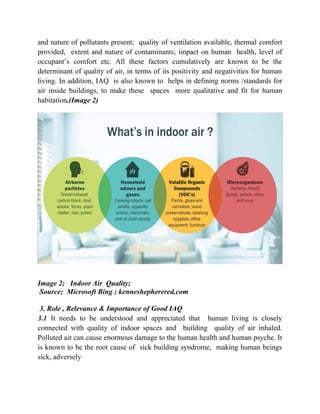
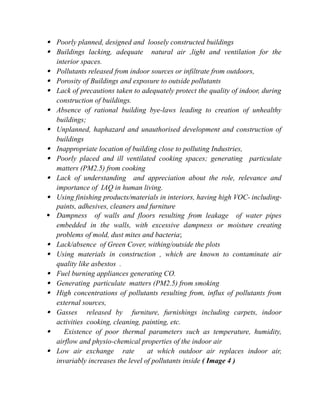
marginalized. (Image 3 )
3.3 Role and relevance of good IAQ can be summarized in terms of ;
 Making people happy healthy and more productive
 Overcoming and minimsing the challenge posed by sick building
syndrome
 Empowering people and communities, to remain happy and healthy
besides improving economy and promoting prosperity.
 Helping in reducing the incidences of human sickness, leading to
lowering the need and demand for healthcare institutions, catering
essentially to caring of sick patients.
 Helping in improving concentration and quality of sleep besides
ensuring workplace efficiency and higher productivity.
 Helping in promoting respiratory health, minimising risks of asthma,
COPD, and other air-based infections.
 Helping in making people safe by preventing exposure to toxic gases
like carbon monoxide and carcinogens
 Safeguarding vulnerable groups like Children, elderly, and people,
having pre-existing conditions of poor health
 Making education more qualitative by improving the quality of
spaces used for teaching-learning
 Increasing the operation
 al efficiency of institutions engaged in providing healthcare by creating
healthy indoor environment
 Making human living more qualitative, by providing best of the indoor
environment.
 Removing barriers, adversely impacting people’s health, comfort,
well-being, learning outcomes and work performance.
• Bringing substantial health and economic benefits for communities,
individual as well as owners and occupants.
 Creating win-win situation for all the stake holders
Image 3; Role, Relevance and Importance of Indoor Air Quality
Source; Microsoft Bing ; smartairfilters.com
4. Causes of poor indoor air Quality
4.1 Air remains a mixture of number of gasses. Because of its universal presence,
complexity and mobility, air remains susceptible to number of elements which
remain present in the urban/rural settlements. Poor indoor air quality (IAQ) can be
attributed due to numerous causes and actions which can be attributed to human
activities and operations related to built-environment. Inadequate ventilation,
indoor pollutant, using tobacco, smoke, mold, building materials, and outdoor
pollutants entering indoors have been recognized as the major causes of poor
indoor air quality. These air pollutants have been considered prime causes of
respiratory issues, allergies, and long-term health risks impacting human health
and quality of life.
4.2 Major Causes of Poor IAQ, can be enumerated in terms of ;
 Inadequate/poor ventilation; Poor natural lighting coupled with poor
airflow invariably traps pollutants indoors, especially in tightly sealed
modern buildings.
 Biological contaminants; Dampness/water intrusion help in microbial
contamination Mold, mildew, dust mites, pet dander, and pollen which are
known to thrive in humid or poorly maintained spaces.
 Combustion sources; Tobacco smoke, cooking fumes, candles, and
fireplaces release harmful particulates and gases.
 Using Chemical based Household products; Cleaning agents, pesticides,
paints, and air fresheners emit volatile organic compounds (VOCs), using
pesticides, chemical based paints, household cleaning agents, carpeting
floors
 Using Toxic Building materials; Using toxic building material and high
VOC compounds like Asbestos, formaldehyde from pressed wood, and
lead-based paints are major contributors.
 Addition of polluting Gases and chemicals; Radon, carbon monoxide, and
nitrogen dioxide can accumulate indoors without detection.
 Outdoor pollutants Vehicle exhaust, industrial emissions, and dust can
infiltrate through windows and ventilation systems.
 Poorly insulated and porous building envelop & Poor site
planning/management & Poor pollution controls during construction
 Damaging/destruction of existing vegetation/trees
4.3 In addition, Air pollutants can enter a building in many ways. Open doors or
windows and poorly maintained air conditioners/ventilation systems can harbour
mold, bacteria, and other contaminants, which are then circulated throughout
indoor spaces, contributing to emergence of respiratory problems and allergies.
Various factors contributing to lowering the quality and adding pollutants to the
Indoor air can be enumerated as under;
 Poorly planned, designed and loosely constructed buildings
 Buildings lacking, adequate natural air ,light and ventilation for the
interior spaces.
 Pollutants released from indoor sources or infiltrate from outdoors,
 Porosity of Buildings and exposure to outside pollutants
 Lack of precautions taken to adequately protect the quality of indoor, during
construction of buildings.
 Absence of rational building bye-laws leading to creation of unhealthy
buildings;
 Unplanned, haphazard and unauthorised development and construction of
buildings
 Inappropriate location of building close to polluting Industries,
 Poorly placed and ill ventilated cooking spaces; generating particulate
matters (PM2.5) from cooking
 Lack of understanding and appreciation about the role, relevance and
importance of IAQ in human living.
 Using finishing products/materials in interiors, having high VOC- including-
paints, adhesives, cleaners and furniture
 Dampness of walls and floors resulting from leakage of water pipes
embedded in the walls, with excessive dampness or moisture creating
problems of mold, dust mites and bacteria;
 Lack/absence of Green Cover, withing/outside the plots
 Using materials in construction , which are known to contaminate air
quality like asbestos .
 Fuel burning appliances generating CO.
 Generating particulate matters (PM2.5) from smoking
 High concentrations of pollutants resulting from, influx of pollutants from
external sources,
 Gasses released by furniture, furnishings including carpets, indoor
activities cooking, cleaning, painting, etc.
 Existence of poor thermal parameters such as temperature, humidity,
airflow and physio-chemical properties of the indoor air
 Low air exchange rate at which outdoor air replaces indoor air,
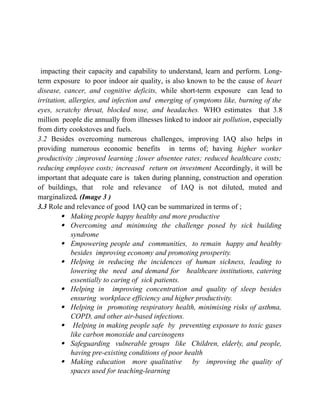
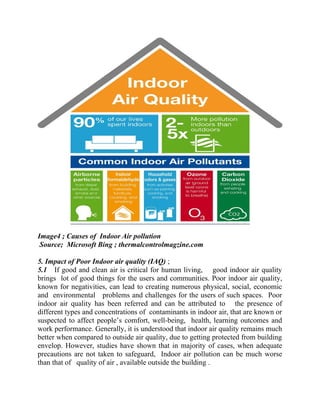
invariably increases the level of pollutants inside ( Image 4 )
Image4 ; Causes of Indoor Air pollution
Source; Microsoft Bing ; thermalcontrolmagzine.com
5. Impact of Poor Indoor air quality (IAQ) ;
5.1 If good and clean air is critical for human living, good indoor air quality
brings lot of good things for the users and communities. Poor indoor air quality,
known for negativities, can lead to creating numerous physical, social, economic
and environmental problems and challenges for the users of such spaces. Poor
indoor air quality has been referred and can be attributed to the presence of
different types and concentrations of contaminants in indoor air, that are known or
suspected to affect people’s comfort, well-being, health, learning outcomes and
work performance. Generally, it is understood that indoor air quality remains much
better when compared to outside air quality, due to getting protected from building
envelop. However, studies have shown that in majority of cases, when adequate
precautions are not taken to safeguard, Indoor air pollution can be much worse
than that of quality of air , available outside the building .
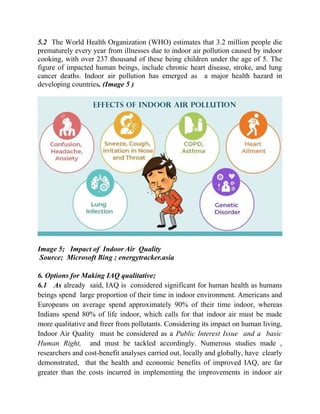
5.2 The World Health Organization (WHO) estimates that 3.2 million people die
prematurely every year from illnesses due to indoor air pollution caused by indoor
cooking, with over 237 thousand of these being children under the age of 5. The
figure of impacted human beings, include chronic heart disease, stroke, and lung
cancer deaths. Indoor air pollution has emerged as a major health hazard in
developing countries. (Image 5 )
Image 5; Impact of Indoor Air Quality
Source; Microsoft Bing ; energytracker.asia
6. Options for Making IAQ qualitative;
6.1 As already said, IAQ is considered significant for human health as humans
beings spend large proportion of their time in indoor environment. Americans and
Europeans on average spend approximately 90% of their time indoor, whereas
Indians spend 80% of life indoor, which calls for that indoor air must be made
more qualitative and freer from pollutants. Considering its impact on human living,
Indoor Air Quality must be considered as a Public Interest Issue and a basic
Human Right, and must be tackled accordingly. Numerous studies made ,
researchers and cost-benefit analyses carried out, locally and globally, have clearly
demonstrated, that the health and economic benefits of improved IAQ, are far
greater than the costs incurred in implementing the improvements in indoor air
quality. Accordingly, valuing quality of air must be embedded as integral part of
building planning, designing, construction, operation and maintenanace of
buildings.
6.2 For planning IAQ sensitive and responsive buildings, Architects and design
engineers must integrate IAQ into the building design and construction process,
along with other design criteria of cost, quality and aesthetics. Architects should
value IAQ in building design, as an essential ingredient, which remain
vital/important for building occupants, owners, and designers, for the simple
reason that IAQ significantly impact health and economy of the occupants . It
therefore, becomes essential to consider quality of indoor air, in all phases of
building planning, design, construction and operation in order to provide best of
indoor environment to the users and inhabitants of buildings.
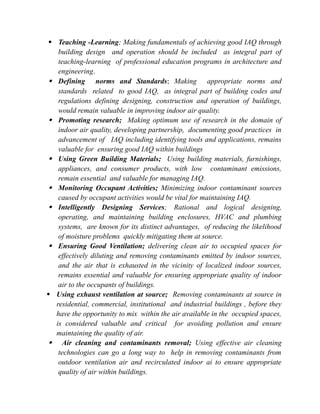
6.3 Considering complexity of indoor air quality, following options , when used,
can help in improving and adding value to the quality of indoor air ;(annexure 6)
 Sensitive Designing; Considering and evaluating the intricate and
complex relationship between IAQ and external environment besides
evaluating the impact of climate change, it becomes essential that buildings
must be designed and operated so that they remain comfortable and healthy
for the occupants.
 Controlling Sources of Pollution; Controlling source have been valued as
the primary methods for improving indoor air quality. Accordingly, best
option for improving IAQ would be to control the source of pollution,
indoors and outdoors and leverage the option of filtration/ using
ventilation, to dilute contaminants
 Leveraging Filtration; Where outdoor pollution can deteriorate, indoor air
quality, system of ventilation, may have to be adequately and
appropriately supported by filtration. Removing outdoor contaminants
using the mechanism of filtration and air cleaning, before they enter a
building; have been valued for its operational efficiency in making indoor
air more qualitative.
 Embedding technology; Use of appropriate technology remains valuable,
for monitoring human exposure to pollutants, analysis of building surfaces,
and computer modelling of air flow inside buildings , in evolving options
for improving IAQ.
 Teaching -Learning; Making fundamentals of achieving good IAQ through
building design and operation should be included as integral part of
teaching-learning of professional education programs in architecture and
engineering.
 Defining norms and Standards; Making appropriate norms and
standards related to good IAQ, as integral part of building codes and
regulations defining designing, construction and operation of buildings,
would remain valuable in improving indoor air quality.
 Promoting research; Making optimum use of research in the domain of
indoor air quality, developing partnership, documenting good practices in
advancement of IAQ including identifying tools and applications, remains
valuable for ensuring good IAQ within buildings
 Using Green Building Materials; Using building materials, furnishings,
appliances, and consumer products, with low contaminant emissions,
remain essential and valuable for managing IAQ.
 Monitoring Occupant Activities; Minimizing indoor contaminant sources
caused by occupant activities would be vital for maintaining IAQ.
 Intelligently Designing Services; Rational and logical designing,
operating, and maintaining building enclosures, HVAC and plumbing
systems, are known for its distinct advantages, of reducing the likelihood
of moisture problems quickly mitigating them at source.
 Ensuring Good Ventilation; delivering clean air to occupied spaces for
effectively diluting and removing contaminants emitted by indoor sources,
and the air that is exhausted in the vicinity of localized indoor sources,
remains essential and valuable for ensuring appropriate quality of indoor
air to the occupants of buildings.
 Using exhaust ventilation at source; Removing contaminants at source in
residential, commercial, institutional and industrial buildings , before they
have the opportunity to mix within the air available in the occupied spaces,
is considered valuable and critical for avoiding pollution and ensure
maintaining the quality of air.
 Air cleaning and contaminants removal; Using effective air cleaning
technologies can go a long way to help in removing contaminants from
outdoor ventilation air and recirculated indoor ai to ensure appropriate
quality of air within buildings.
 Adopting Integrated and Holistic Design Approach; Adopting integrated
approach to building design, that considers both IAQ and energy, in
addition to other key aspects of building performance, is known for its
distinct advantages, for designing high performing buildings which are not
only energy efficient but also ensure appropriate good IAQ in the building
 Keeping Buildings Dry; Presence of moistures in the building are known to
be prime cause of adversely impacting quality of indoor air. Accordingly,
minimizing indoor sources of water vapours/moistures and control of
moistures, using humidifiers/ dehumidifiers while designing and
constructing building enclosures and installing HVAC systems , can help
in overcoming the challenge/problems of moistures in buildings.
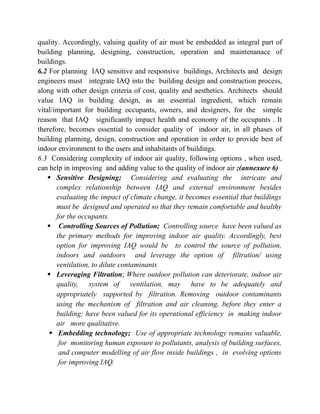
Image 6; Indoor Air Quality Management;
Source; Microsoft Big ; fity.club
7. Conclusion;
7.1 In conclusion, it can be safely said that Indoor air quality remains a silent but
most powerful and valuable determinant of human health, happiness, and
livability, often more impactful than outdoor pollution ,because of the sheer
amount of time spent indoors. Let us value, honor & celebrate interior spaces to
make them great spaces for human habitation Challenges of Indoor air quality can
be appropriately addressed; and defined goals of making IAQ qualitative; can
be achieved during the planning, designing and construction of new buildings by
adopting measures proposed by the, ‘Institute of Air Quality Management’.
7.2. Considering its impact on human living, Indoor Air Quality must be
considered as a Public Interest Issue and a basic Human Right, and must be
tackled accordingly. The hierarchy of measures proposed to overcome challenges
of IAQ, emphasize that ;
 Identify, quantify and remove sources of indoor air pollution,
 Use options for reducing emissions from other remaining sources,
 Adopt strategies for disrupting pathways between sources and the people
exposed, -
 Ensure protecting people from exposure to pollutants, and
 Ensure shifting people from areas, with poor air quality
Author:
 * Ar. Jit Kumar Gupta
 Former Advisor, Town Planning, Puda
 Email: jit.kumar1944@ gmail.com