Background and Aims
•Nonalcoholic steatohepatitis (NASH), also known (MASH): Progressive liver disease characterized
by the presence of 5% or greater hepatic steatosis with hepatocellular damage and inflammation.
• Once NASH progresses to fibrosis stages F2 and F3, the risk of adverse clinical outcomes markedly
increases.
• Estimated global prevalence of NASH is approximately 4 to 6%
• Pathophysiology: Multifactorial with multiple systemic alterations involved
4.
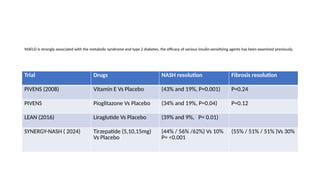
MAFLD is stronglyassociated with the metabolic syndrome and type 2 diabetes, the efficacy of various insulin-sensitizing agents has been examined previously.
Trial Drugs NASH resolution Fibrosis resolution
PIVENS (2008) Vitamin E Vs Placebo (43% and 19%, P=0.001) P=0.24
PIVENS Pioglitazone Vs Placebo (34% and 19%, P=0.04) P=0.12
LEAN (2016) Liraglutide Vs Placebo (39% and 9%, P= 0.01)
SYNERGY-NASH ( 2024) Tirzepatide (5,10,15mg)
Vs Placebo
(44% / 56% /62%) Vs 10%
P= <0.001
(55% / 51% / 51% )Vs 30%
5.
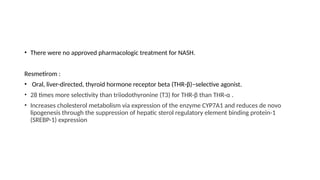
• There wereno approved pharmacologic treatment for NASH.
Resmetirom :
• Oral, liver-directed, thyroid hormone receptor beta (THR-β)–selective agonist.
• 28 times more selectivity than triiodothyronine (T3) for THR-β than THR-α .
• Increases cholesterol metabolism via expression of the enzyme CYP7A1 and reduces de novo
lipogenesis through the suppression of hepatic sterol regulatory element binding protein-1
(SREBP-1) expression
6.
Trial Design andIntervention:
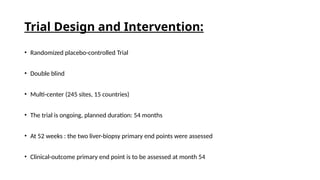
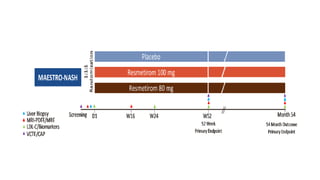
• Randomized placebo-controlled Trial
• Double blind
• Multi-center (245 sites, 15 countries)
• The trial is ongoing, planned duration: 54 months
• At 52 weeks : the two liver-biopsy primary end points were assessed
• Clinical-outcome primary end point is to be assessed at month 54
7.
Eligibility criteria
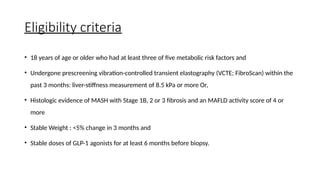
• 18years of age or older who had at least three of five metabolic risk factors and
• Undergone prescreening vibration-controlled transient elastography (VCTE; FibroScan) within the
past 3 months: liver-stiffness measurement of 8.5 kPa or more Or,
• Histologic evidence of MASH with Stage 1B, 2 or 3 fibrosis and an MAFLD activity score of 4 or
more
• Stable Weight : <5% change in 3 months and
• Stable doses of GLP-1 agonists for at least 6 months before biopsy.
8.
Exclusion criteria
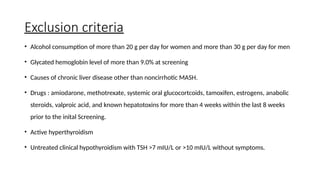
• Alcoholconsumption of more than 20 g per day for women and more than 30 g per day for men
• Glycated hemoglobin level of more than 9.0% at screening
• Causes of chronic liver disease other than noncirrhotic MASH.
• Drugs : amiodarone, methotrexate, systemic oral glucocortcoids, tamoxifen, estrogens, anabolic
steroids, valproic acid, and known hepatotoxins for more than 4 weeks within the last 8 weeks
prior to the inital Screening.
• Active hyperthyroidism
• Untreated clinical hypothyroidism with TSH >7 mIU/L or >10 mIU/L without symptoms.
9.
• Use ofhigh dose vitamin E (>400 IU/day) unless stable for ≥24 weeks prior to an eligible screening liver
biopsy.
• MELD score ≥12, due to liver disease.
• Hepatic decompensation: esophageal varices, ascites, or hepatic encephalopathy
• Serum albumin <3.5 g/dL, except as explained by non-hepatic causes
• INR >1.4
• Total bilirubin >1.5 × upper limit of normal.
• Uncontrolled hypertension : > 170/100
• NYHA Class III or IV heart failure or LVEF<30%.
• Myocardial infarction, unstable angina, percutaneous coronary intervention, coronary artery bypass graft, or
stroke within 12 weeks prior to randomization.
10.
Methods:
• 1:1:1 ratio: to receive resmetirom at a dose of 80 mg :100 mg : placebo
• Administered orally once daily
• Screening biopsy results were used as baseline values for histologic variables
• Second biopsy was performed at week 52
• Biopsy specimens were assessed centrally by two independent expert pathologists to determine
the NAFLD activity score and fibrosis stage.
• The pathologists were unaware of the trial-group assignments, patient characteristics, and each
other’s assessments.
11.
Patient’s outcomes wereclassified and scored as following:
• (1,1): Both pathologist’s scores indicated the patient was a Responder – score of 1
• (1,0): Path A’s scores indicated patient was a responder; Patht B’s scores indicated a Non-Responder- score of
0.5
• (0,1): Path B’s scores indicated patient was a responder; Path A’s scores indicated a Non-Responder- score of
0.5
• (0,0): Both pathologist’s scores indicated the patient was a Non-Responder – score of 0.
• Primary statistical analysis of pathologist response was done using the Cochran-Mantel-Haenszel (CMH) test.
14.
Primary Endpoint
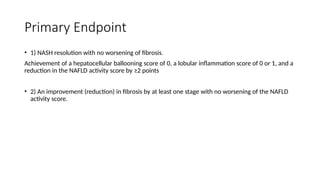
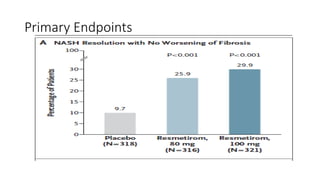
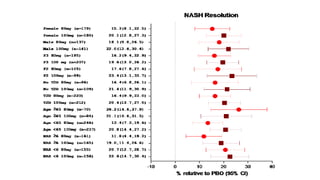
• 1)NASH resolution with no worsening of fibrosis.
Achievement of a hepatocellular ballooning score of 0, a lobular inflammation score of 0 or 1, and a
reduction in the NAFLD activity score by ≥2 points
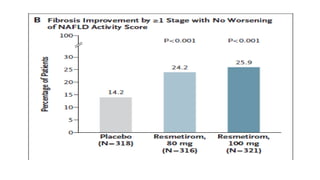
• 2) An improvement (reduction) in fibrosis by at least one stage with no worsening of the NAFLD
activity score.
15.
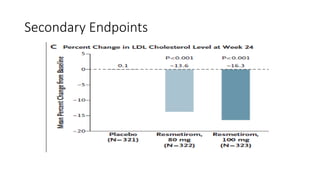
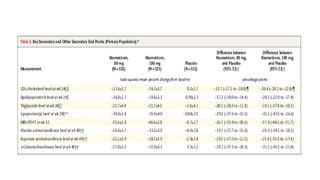
Key Secondary Endpoint
•The percent change from baseline in the low-density lipoprotein (LDL) cholesterol level at week
24.
Discussion
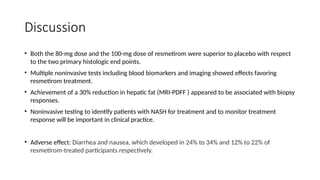
• Both the80-mg dose and the 100-mg dose of resmetirom were superior to placebo with respect
to the two primary histologic end points.
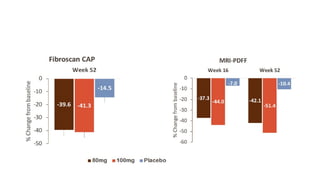
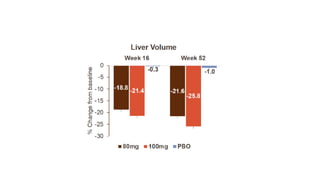
• Multiple noninvasive tests including blood biomarkers and imaging showed effects favoring
resmetirom treatment.
• Achievement of a 30% reduction in hepatic fat (MRI-PDFF ) appeared to be associated with biopsy
responses.
• Noninvasive testing to identify patients with NASH for treatment and to monitor treatment
response will be important in clinical practice.
• Adverse effect: Diarrhea and nausea, which developed in 24% to 34% and 12% to 22% of
resmetirom-treated participants respectively.
27.
Limitation
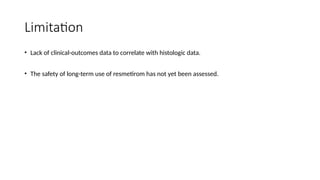
• Lack ofclinical-outcomes data to correlate with histologic data.
• The safety of long-term use of resmetirom has not yet been assessed.
28.
Summary:
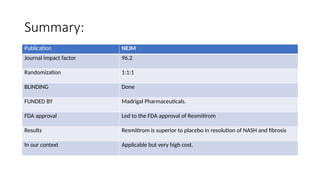
Publication NEJM
Journal impactfactor 96.2
Randomization 1:1:1
BLINDING Done
FUNDED BY Madrigal Pharmaceuticals.
FDA approval Led to the FDA approval of Resmitirom
Results Resmitirom is superior to placebo in resolution of NASH and fibrosis
In our context Applicable but very high cost.
29.
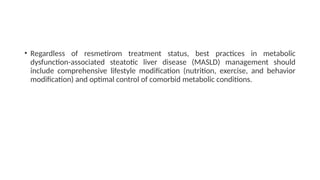
• Regardless ofresmetirom treatment status, best practices in metabolic
dysfunction-associated steatotic liver disease (MASLD) management should
include comprehensive lifestyle modification (nutrition, exercise, and behavior
modification) and optimal control of comorbid metabolic conditions.
#2 especially among patients with type 2 diabetes
In MASH, THR-β function in the liver is impaired, which leads to a reduction in mitochondrial function and β-oxidation of fatty acids in association with an increase in fibrosis.
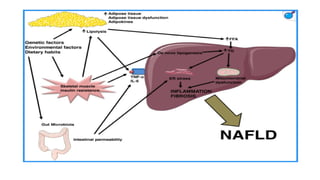
#3 Genetic, dietary and environmental factors lead to the development of insulin resistance, adipocytes proliferation and dysfunction, and alteration of intestinal microbiota. Subsequently, insulin resistance leads to lipolysis, release of adipokines such as TNF-α or IL-6, and stimulates hepatic DNL. As a consequence, the increased flux of hepatic FFAs induces the accumulation of TG, which cause mitochondrial dysfunction and ER stress. Intestinal permeability participates in the activation of hepatic inflammation and ER stress. Altogether these multiple parallel hits lead to the development of NAFLD and its progression to fibrosis and cirrhosis.
#5 In MASH, THR-β function in the liver is impaired, which leads to a reduction in mitochondrial function and β-oxidation of fatty acids in association with an increase in fibrosis.
#7 showed a controlled attenuation parameter (CAP) of 280 dB per meter or more and a
(on a scale of 0 to 8, with higher scores indicating more severe disease), with a score of 1 or more for each component (steatosis [on a scale from 0 to 3], lobular inflammation [on a scale from 0 to 3], and hepatocellular ballooning [on a scale from
#8 estrogens at doses greater than those used for hormone replacement or contracepon, anabolic steroids except testosterone replacement
Subclinical hypothyroidism and paents on stable thyroxine (T4) therapy up to 75 μg per day are eligible
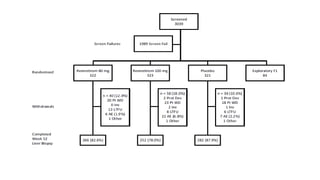
#12 Total 1050 pt. were randomized
800 were analysed.
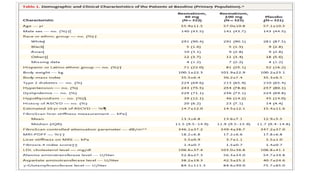
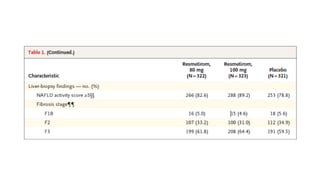
#16 Most patients were White (89.3%), with a high incidence of metabolic risk factors (hypertension, 78.1%; dyslipidemia, 71.3%; and type 2 diabetes, 67.0%).
Mean body-mass index was 35.7±6.8
#19 NASH resolution was defined as achievement of a hepatocellular ballooning score of 0, a lobular inflammation score of 0 or 1, and a reduction in the NAFLD activity score by at least 2 points.
#26 Typical onset was less than 12 weeks after initiation of resmetirom therapy and often less than 4 weeks