THE EMPIRICAL IMPACT EVOLUTION
OF THE NEXT GENERATION FIREWALL
IN CONTRAST WITH THE
TRADITIONAL
MEMBERS
Reporter 1 Reporter 2 Reporter 3 Reporter 4 Reporter 5
INTRODUCTION
In this paper, the performance of firewall is
measured and compared on Windows and Linux
platform individual. To evaluate the performance,
a private network has been setup in which three
machines are connected via a switch; one
Windows machine running windows firewall, one
Linux machine running Linux firewall (IPTable) and
one more machine that acting as a client.
PURPOSE AND DESCRIPTION
As perceived by the researchers, this
research will be beneficial to the
researchers, the community and to
future researchers.
The main objective of this project is to assess the most appropriate content-filtering on the
traditional and next generation firewall with the demonstration and testing of these technologies to
be proposed for home network. The objective specifics the study are to wit:
To assess the most appropriate content-filtering of the traditional and next generation
firewall for home network
To design and demonstrate a content-filtering mechanism for home use.
To assess the security feature of the proposed content-filtering mechanism for home
use.
OBJECTIVES OF THE
PROJECT
The study aimed to demonstrate and propose a content filtering
mechanism based on the analysis of a traditional and next
generation firewall for home network as means of a security
mechanism for home use. This is going to be done by exploring the
security feature with the applied technology through anchoring
virtualization, open-source, and proprietary technology.
SCOPE AND LIMITATION
METHODOLOGY
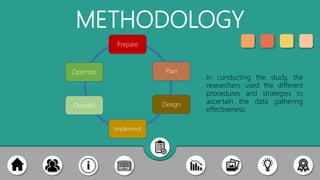
In conducting the study, the
researchers used the different
procedures and strategies to
ascertain the data gathering
effectiveness.
Prepare
Implement
Operate
Optimize
Design
Plan
DATA GATHERING
INTERNET
INTERVIEW, SURVEY AND QUESTIONAIRE
DARA ANALYSIS AND INTERPRETATION
PROJECT SCHEDULE
Act. Dec Jan Feb Mar Apr
1 2 3 4 1 2 3 4 1 2 3 4 1 2 3 4 1 2 3 4
PREPARE
PLAN
DESIGN
IMPLEMENT
OPERATE
OPTIMIZE
RESULT
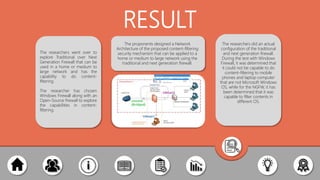
The researchers went over to
explore Traditional over Next
Generation Firewall that can be
used in a home or medium to
large network and has the
capability to do content-
filtering.
The researcher has chosen
Windows Firewall along with an
Open-Source firewall to explore
the capabilities in content-
filtering.
The proponents designed a Network
Architecture of the proposed content-filtering
security mechanism that can be applied to a
home or medium to large network using the
traditional and next generation firewall.
The researchers did an actual
configuration of the traditional
and next generation firewall.
During the test with Windows
Firewall, it was determined that
it could not be capable to do
content-filtering to mobile
phones and laptop computer
that are not Microsoft Windows
OS, while for the NGFW, it has
been determined that it was
capable to filter contents in
different OS.
CONCLUSION
1. The researchers explored on Windows and Open-source firewall,
and according to the findings, content-filtering is doable with
open-source firewall.
2. The Windows firewall has no capability to be deployed along with
other machines while the open-source firewall is flexible and can
handle any machine that is connected to the home or medium to
large network and it has been tested in a virtual machine
environment.
3. Based of the findings, it is very straight forward to filter unwanted
sites using open-source firewall especially to home network for
kids prohibited to access unwanted sites.
RECOMMENDATION
1. To explore more in the features of the open-source firewall along
with other providers or machines.
2. To increase the number of test case in exploring the firewall.
3. To explore in other technologies that can offer the same content-
filtering capability and compare which of them has a better and
faster solution.
THANK YOU!
Reporter 1 Reporter 2 Reporter 3 Reporter 4 Reporter 5