LIMIT
TEST
Impurities
• Definition: A compound is said to be
impure if it is having foreign matter,
i.e. impurities.
• Chemical purity implies freedom from
foreign matter. It means that a pure
chemical refers to that compound
which is having no foreign matter, i.e.
impurities.
Dr. MEENU, Asst. Prof., Dept. of Pharmacy, SGRRITS, Dehradun
:Source of impurities
1. Raw material employed in manufacturing
2. Reagent used in manufacturing process
3. Method or process used in
4. Chemical method used in manufacture
5. Atmospheric contamination during manufacturing
process
6. Defect in manufacturing process
7. Manufacturing hazards
8. Storage conditions
9. Accidental substitution with spurious or useless
materials
Dr. MEENU, Asst. Prof., Dept. of Pharmacy, SGRRITS, Dehradun
Pharmacopoeia
• A description of the article
• Tests for identity
• Physical constants
• Quantitative assay
• Limit test Storage conditions
official = obey the requirement
Dr. MEENU, Asst. Prof., Dept. of Pharmacy, SGRRITS, Dehradun
Pharmacopoeia
• British pharmacopoeia (BP)
• European pharmacopoeia (Eu.Ph)
• United state pharmacopoeia (USP)
Dr. MEENU, Asst. Prof., Dept. of Pharmacy, SGRRITS, Dehradun
Limit test
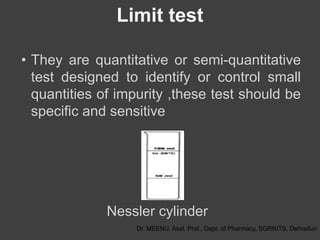
• They are quantitative or semi-quantitative
test designed to identify or control small
quantities of impurity ,these test should be
specific and sensitive
Nessler cylinder
Dr. MEENU, Asst. Prof., Dept. of Pharmacy, SGRRITS, Dehradun
Limit test
Type:
1. Comparison method
2. Quantitative determination
3. Test in which there is no visible
reaction
Dr. MEENU, Asst. Prof., Dept. of Pharmacy, SGRRITS, Dehradun
Limit test
General principle
• If the sample is lighter than the
standard solution then it is within the
pharmacopeial limit (accepted)
• If the sample is darker/heavier than the
standard solution then it is above the
pharmacopeial limit (rejected)
Dr. MEENU, Asst. Prof., Dept. of Pharmacy, SGRRITS, Dehradun
Limit test
NESSLER cylinder
(appendix VII A127 )
clear glasses with normal capacity 50ml, the
overall height is about 15cm, the external height
to the 50ml mark 11.0 to 12.4 cm ,the thickness
of the wall 1.0 to 1.5 mm and the thickness of
the base 1.0 to 3.0mm the external heights to
the 50 mark of cylinders used to test must not
differ by more than 1 mm
Dr. MEENU, Asst. Prof., Dept. of Pharmacy, SGRRITS, Dehradun
Limit test
General precaution
1. The liquid used must be clean and filtered if
necessary
2. The Nessler cylinder must be made of
colorless glass and of the same inner
diameter
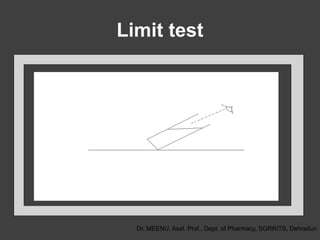
3. Detecting opalescence or color
development must be performed in daylight
4. When comparing turbidity it should be done
against black background
5. When comparing color it should be done
against white background
Dr. MEENU, Asst. Prof., Dept. of Pharmacy, SGRRITS, Dehradun
Limit test
Dr. MEENU, Asst. Prof., Dept. of Pharmacy, SGRRITS, Dehradun
Limit Test for Chloride
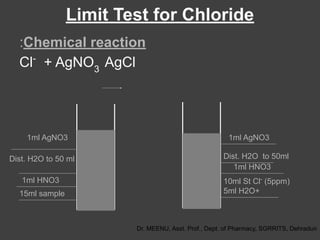
:Chemical reaction
AgCl
Cl-
+ AgNO3
15ml sample
1ml HNO3
Dist. H2O to 50 ml
1ml AgNO3
10ml St Cl-
(5ppm)
5ml H2O+
1ml HNO3
Dist. H2O to 50ml
1ml AgNO3
Dr. MEENU, Asst. Prof., Dept. of Pharmacy, SGRRITS, Dehradun
Principle:
•This test, which is mainly used to control chloride
impurity in inorganic substance, depends upon
the simple reaction between silver nitrate and
soluble chlorides to give insoluble silver chloride
in the presence of dilute nitric acid.
•The insoluble silver chloride makes the solution
opalescent and the extent of opalescence
depending upon the amount of chloride present in
the substance, is compared with a standard
opalescence produced in a standard solution
having a known amount of chloride by adding
silver nitrate and same volume of dilute nitric acid
as used in the test solution.
Dr. MEENU, Asst. Prof., Dept. of Pharmacy, SGRRITS, Dehradun
•If the opalescence produced in the test is less
intense than that of standard opalescence, the
sample passes the limit test for chloride and vice
versa.
Note: Dilute nitric acid in used to prevent the
precipitation of other acid radicals with silver
nitrate solution. It acts by providing common ion
i.e. nitrate.
Dr. MEENU, Asst. Prof., Dept. of Pharmacy, SGRRITS, Dehradun
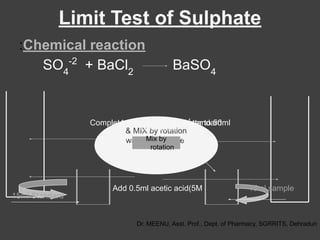
Limit Test of Sulphate
:Chemical reaction
SO4
-2
+ BaCl2
BaSO4
1ml 25%BaCl2
1.5ml ethanolic SO4
standard
& MIX by rotation
wait for 1 minute
15ml Standard
15ml sample
15ml water
Mix by
rotation
Add 0.5ml acetic acid(5M
Complete volume with Dil.water to 50ml
Dr. MEENU, Asst. Prof., Dept. of Pharmacy, SGRRITS, Dehradun
:Principle
•It is based upon the reaction between barium
chloride and soluble sulphate in presence of dil.
Hydrocloric acid.
•The comparison of turbidity is done with the
standard turbidity obtained from a known
amount of sulphate and same volume of dilute
HCl in the both solutions.
•In I.P. barium chloride solution is replaced with
barium chloride reagent to enhance the
reactivity of test.
Dr. MEENU, Asst. Prof., Dept. of Pharmacy, SGRRITS, Dehradun
•The opalescence produced in the test is compared
with that of standard opalescence obtained from a
standard sulphate solution containing known amount
of sulphate produced in the same manner.
•If the test opalescence is less intense than that of
standard opalescence, the sample passes the limit test
for sulphate and vice versa.
Note: The solubilities of barium sulphate
precipitates are very much affected by the
concentration of the acid. The acidity of the
solution is controlled by using acetic acid.
Dr. MEENU, Asst. Prof., Dept. of Pharmacy, SGRRITS, Dehradun
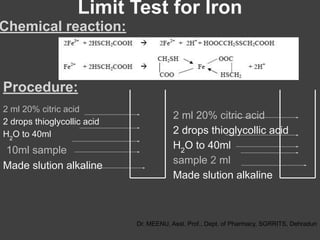
Limit Test for Iron
2 ml 20% citric acid
2 drops thioglycollic acid
H2
O to 40ml
10ml sample
Made slution alkaline
2 ml 20% citric acid
2 drops thioglycollic acid
H2
O to 40ml
sample 2 ml
Made slution alkaline
Chemical reaction:
Procedure:
Dr. MEENU, Asst. Prof., Dept. of Pharmacy, SGRRITS, Dehradun
Principle:
•The limit test for iron is based on the formation of
pale pink to deep reddish purple colour by reaction
of iron with thioglycollic acid in the presence of citric
acid in a solution made alkaline with ammonia
solution.
•The colour is due to the formation of the
co-ordination compound, ferrous thioglycolate
Fe(HSCH2
COO)2
.
•The original state of oxidation of the iron is
immaterial since thioglycollic acid also reduces ferric
iron to the ferrous state.
Dr. MEENU, Asst. Prof., Dept. of Pharmacy, SGRRITS, Dehradun
The colour produced is compared with the standard
colour containing a definite quantity of iron by
viewing transversely through the Nessler cylinders.
NOTE: Citric acid is added in the official process
to prevent the precipitation of iron by ammonia.
Iron gets precipitated in the form of Fe(OH)2
and
Fe(OH)3
depending upon the oxidation state of
the iron in the presence of ammonia.
•Citric acid makes soluble complex with iron and
ammonia will not be able precipitate iron and it
will just provide alkaline medium.
Dr. MEENU, Asst. Prof., Dept. of Pharmacy, SGRRITS, Dehradun
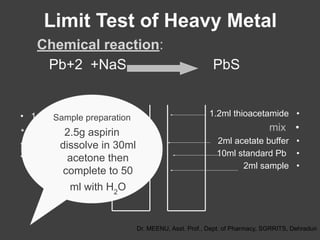
Limit Test of Heavy Metal
• 1.2ml thioacetamide
• mix
• 2ml acetate buffer
• 12ml sample
•
1.2ml thioacetamide
•
mix
•
2ml acetate buffer
•
10ml standard Pb
•
2ml sample
Chemical reaction:
Pb+2 +NaS PbS
Sample preparation
2.5g aspirin
dissolve in 30ml
acetone then
complete to 50
ml with H2
O
Dr. MEENU, Asst. Prof., Dept. of Pharmacy, SGRRITS, Dehradun
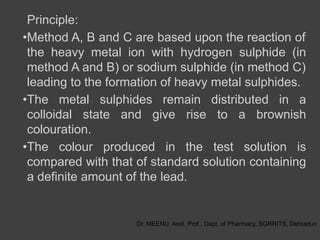
Principle:
•Method A, B and C are based upon the reaction of
the heavy metal ion with hydrogen sulphide (in
method A and B) or sodium sulphide (in method C)
leading to the formation of heavy metal sulphides.
•The metal sulphides remain distributed in a
colloidal state and give rise to a brownish
colouration.
•The colour produced in the test solution is
compared with that of standard solution containing
a definite amount of the lead.
Dr. MEENU, Asst. Prof., Dept. of Pharmacy, SGRRITS, Dehradun
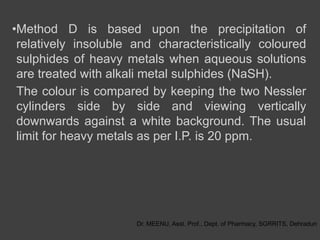
•Method D is based upon the precipitation of
relatively insoluble and characteristically coloured
sulphides of heavy metals when aqueous solutions
are treated with alkali metal sulphides (NaSH).
The colour is compared by keeping the two Nessler
cylinders side by side and viewing vertically
downwards against a white background. The usual
limit for heavy metals as per I.P. is 20 ppm.
Dr. MEENU, Asst. Prof., Dept. of Pharmacy, SGRRITS, Dehradun
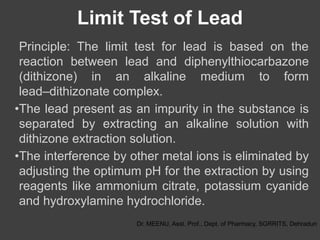
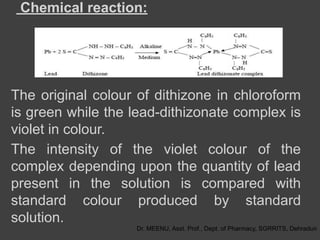
Principle: The limit test for lead is based on the
reaction between lead and diphenylthiocarbazone
(dithizone) in an alkaline medium to form
lead–dithizonate complex.
•The lead present as an impurity in the substance is
separated by extracting an alkaline solution with
dithizone extraction solution.
•The interference by other metal ions is eliminated by
adjusting the optimum pH for the extraction by using
reagents like ammonium citrate, potassium cyanide
and hydroxylamine hydrochloride.
Limit Test of Lead
Dr. MEENU, Asst. Prof., Dept. of Pharmacy, SGRRITS, Dehradun
The original colour of dithizone in chloroform
is green while the lead-dithizonate complex is
violet in colour.
The intensity of the violet colour of the
complex depending upon the quantity of lead
present in the solution is compared with
standard colour produced by standard
solution.
Chemical reaction:
Dr. MEENU, Asst. Prof., Dept. of Pharmacy, SGRRITS, Dehradun
Limit Test of Arsenic
Principle: The limit test for arsenic is based on the
reduction of the arsenic in the arsenious state to the
arsine gas (AsH3
) with zinc and hydrochloric acid. The
arsine gas stains the mercuric chloride paper yellow.
The sample is dissolved in acid whereby the arsenic
present as impurity in the sample gets converted to
arsenic acid.
The arsenic acid is reduced to arsenious acid by
reducing agents like stannous acid, potassium iodine etc.
The nascent hydrogen formed during the reaction further
reduced arsenious acid to the arsine gas. The arsine gas
reacts with mercuric chloride paper to produce a yellow
stain.
Dr. MEENU, Asst. Prof., Dept. of Pharmacy, SGRRITS, Dehradun
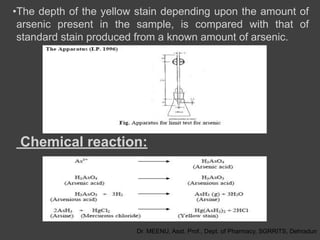
•The depth of the yellow stain depending upon the amount of
arsenic present in the sample, is compared with that of
standard stain produced from a known amount of arsenic.
Chemical reaction:
Dr. MEENU, Asst. Prof., Dept. of Pharmacy, SGRRITS, Dehradun
Non Aqueous Acid-Base
Titration
Main reasons for non aqueous titration :
• Solubility: many organic compound (acid
or base) sparingly soluble in water but
readily soluble in organic solvent
• Too weak acid or base : they didn’t give
sharp end point in aqueous titration but
can titrated accurately in suitable non
aqueous solvent
Dr. MEENU, Asst. Prof., Dept. of Pharmacy, SGRRITS, Dehradun
Non Aqueous Acid-Base Titration
Protic solvent :
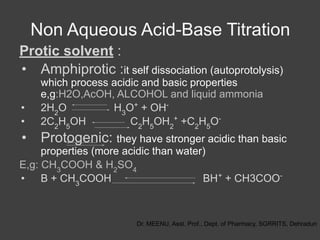
• Amphiprotic :it self dissociation (autoprotolysis)
which process acidic and basic properties
e,g:H2O,AcOH, ALCOHOL and liquid ammonia
• 2H2
O H3
O+
+ OH-
• 2C2
H5
OH C2
H5
OH2
+
+C2
H5
O-
• Protogenic: they have stronger acidic than basic
properties (more acidic than water)
E,g: CH3
COOH & H2
SO4
• B + CH3
COOH BH+
+ CH3COO-
Dr. MEENU, Asst. Prof., Dept. of Pharmacy, SGRRITS, Dehradun
Non Aqueous Acid-Base Titration
Protic solvent :
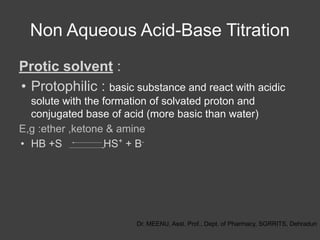
• Protophilic : basic substance and react with acidic
solute with the formation of solvated proton and
conjugated base of acid (more basic than water)
E,g :ether ,ketone & amine
• HB +S HS+
+ B-
Dr. MEENU, Asst. Prof., Dept. of Pharmacy, SGRRITS, Dehradun
Non Aqueous Acid-Base Titration
Advantage of These Titrant
• Excellent potentiometric curve using
ordinary glass or calomel electrode
• The salt formed from this titration are
soluble in the solvent commonly used
Dr. MEENU, Asst. Prof., Dept. of Pharmacy, SGRRITS, Dehradun
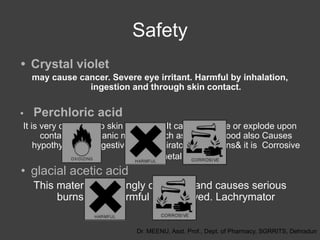
Safety
• Crystal violet
may cause cancer. Severe eye irritant. Harmful by inhalation,
ingestion and through skin contact.
• Perchloric acid
It is very corrosive to skin and eyes, It can also ignite or explode upon
contact with organic material such as cloth or wood also Causes
hypothyroidism digestive and respiratory tract burns& it is Corrosive
to metal
• glacial acetic acid
This material is strongly corrosive and causes serious
burns. Very harmful if swallowed. Lachrymator
Dr. MEENU, Asst. Prof., Dept. of Pharmacy, SGRRITS, Dehradun
References:
1. Indian Pharmacopoeia, 1996, Vol. I & II.
2. United States Pharmacopoeia, USP 29 and National Formulary, NF 24,
Asian ed.,2006 3. A.H. Beckett, & J.B.Stenlake, Practical Pharmaceutical
Chemistry, 5th ed., Part One, CBS Publishers and Distributors, 2004
4. L.M.Atherden, Bentley and Driver’s Textbook of Pharmaceutical Chemistry,
8th ed., Oxford University Press, 2005
5. Holleman-Wiberg, Inorganic Chemistry, Academic Press, 2001
6. J.D.Lee, Concise Inorganic Chemistry, 5th ed., Blackwell Publishing, 2006
7. Remington’s Pharmaceutical Sciences,Indian ed., 21st ed., Vol. I & Vol. – II,
Mack Publishing Co.
8. J.H.Block, E.Roche, T.O.Soine, & C.O.Wilson, Inorganic Medicinal and
Pharmaceutical Chemistry, Lea and Febiger.
9. F.A. Cotton, & G., Wilkinson, Basic Inorganic Chemistry, Wiley
10. L.A. Discher, Modern Inorganic Pharmaceutical Chemistry.
11. Vogel, s qualitative inorganic analysis, revised by G.Svehla, 7th ed.,
Pearson Education Publisher
Dr. MEENU, Asst. Prof., Dept. of Pharmacy, SGRRITS, Dehradun
Thank you