FROM COMPUTER RESERVATION SYSTEMS TO GLOBAL DISTRIBUTION SYSTEMS - Lesson 3 - 
Angelina Njeguš, PhD 
Associate Professor at Singidunum University 
Belgrade - Serbia, 2013
Prof. dr Angelina Njeguš 
Table of Contents 
Introduction to Computer Reservation Systems 
Typical CRS Functions 
Evolution of CRS 
Global Distribution Systems 
GDS Organisations 
Challenges for CRS/GDS 
Big Data
Prof. dr Angelina Njeguš 
What is CRS? 
Computer Reservation System (CRS) is an information system that promotes sales and provides fast and accurate information about availability, price and bookings of tourism products and services 
Originally CRSs were developed to facilitate business transactions and bookings related to air travel 
Later, CRSs were extended for the use of travel agencies, hotels, and other tourism and hospitality businesses to manage their inventory and allow direct access through terminals to check for availability, make reservations and issue tickets 
Today, CRSs are of high importance for travel and tourism industry with the main focus on direct reservations (e.g. directly in the hotel)
Prof. dr Angelina Njeguš 
CRS History 
CRS is the first information system that was used in tourism industry 
Primarily was used as inventory-control system by airlines 
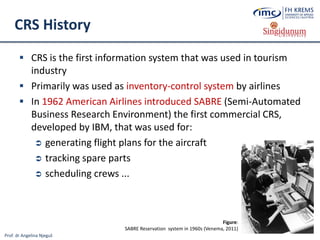
In 1962 American Airlines introduced SABRE (Semi-Automated Business Research Environment) the first commercial CRS, developed by IBM, that was used for: 
generating flight plans for the aircraft 
tracking spare parts 
scheduling crews ... 
Figure: SABRE Reservation system in 1960s (Venema, 2011)
Prof. dr Angelina Njeguš 
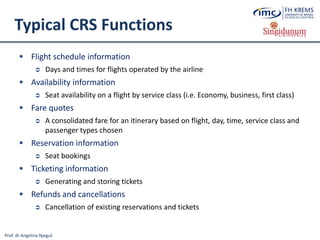
Typical CRS Functions 
Flight schedule information 
Days and times for flights operated by the airline 
Availability information 
Seat availability on a flight by service class (i.e. Economy, business, first class) 
Fare quotes 
A consolidated fare for an itinerary based on flight, day, time, service class and passenger types chosen 
Reservation information 
Seat bookings 
Ticketing information 
Generating and storing tickets 
Refunds and cancellations 
Cancellation of existing reservations and tickets
Prof. dr Angelina Njeguš 
Evolution of CRS 
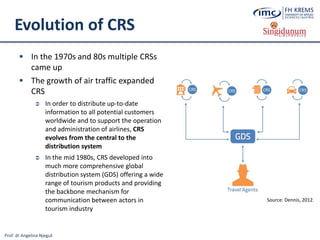
In the 1970s and 80s multiple CRSs came up 
The growth of air traffic expanded CRS 
In order to distribute up-to-date information to all potential customers worldwide and to support the operation and administration of airlines, CRS evolves from the central to the distribution system 
In the mid 1980s, CRS developed into much more comprehensive global distribution system (GDS) offering a wide range of tourism products and providing the backbone mechanism for communication between actors in tourism industry 
Source: Dennis, 2012.
Prof. dr Angelina Njeguš 
Travel Agent before GDSs 
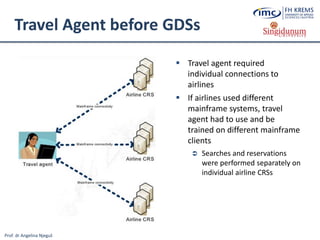
Travel agent required individual connections to airlines 
If airlines used different mainframe systems, travel agent had to use and be trained on different mainframe clients 
Searches and reservations were performed separately on individual airline CRSs
Prof. dr Angelina Njeguš 
Travel Agent after GDSs 
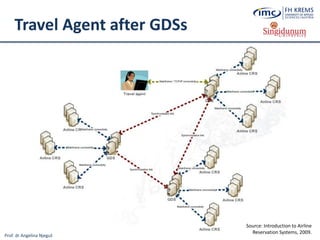
Source: Introduction to Airline Reservation Systems, 2009.
Prof. dr Angelina Njeguš 
From CRS to GDS 
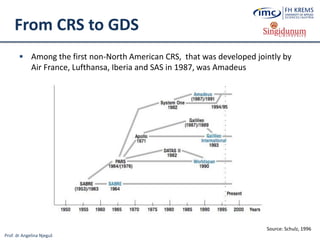
Among the first non-North American CRS, that was developed jointly by Air France, Lufthansa, Iberia and SAS in 1987, was Amadeus 
Source: Schulz, 1996
Prof. dr Angelina Njeguš 
Global Distribution Systems - GDS 
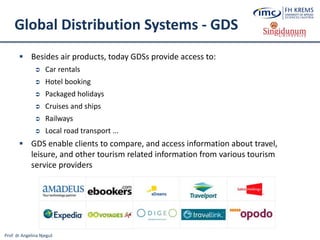
Besides air products, today GDSs provide access to: 
Car rentals 
Hotel booking 
Packaged holidays 
Cruises and ships 
Railways 
Local road transport ... 
GDS enable clients to compare, and access information about travel, leisure, and other tourism related information from various tourism service providers
Prof. dr Angelina Njeguš 
What is GDS? 
GDS is an integrated information system and communication channel that: 
incorporates all travel services 
connects service providers with end users 
providing information from all segments of the journey 
allows booking and selling of the required services 
Today GDS is: 
the most cost effective tool for buyers of business travel to manage the complexity of supply 
more than just a reservation tool - integrates the core business processes of tourism businesses and therefore increase their productivity, speed, and performance
Prof. dr Angelina Njeguš 
Major GDSs in operation today 
Sabre 
Amadeus 
Travelport (the umbrella company for the Galileo, Apollo, and Worldspan) 
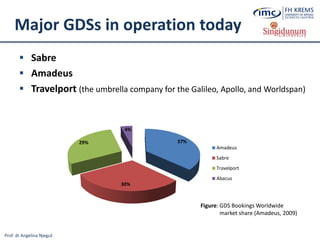
Figure: GDS Bookings Worldwide market share (Amadeus, 2009) 
37% 
30% 
29% 
4% 
Amadeus 
Sabre 
Travelport 
Abacus
Prof. dr Angelina Njeguš 
Sabre 
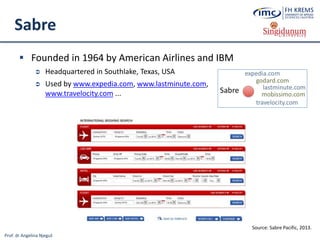
Founded in 1964 by American Airlines and IBM 
Headquartered in Southlake, Texas, USA 
Used by www.expedia.com, www.lastminute.com, www.travelocity.com ... 
Source: Sabre Pacific, 2013.
Prof. dr Angelina Njeguš 
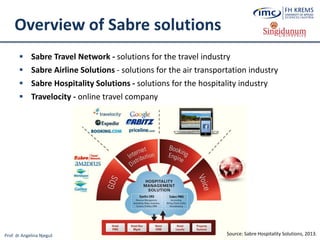
Overview of Sabre solutions 
Sabre Travel Network - solutions for the travel industry 
Sabre Airline Solutions - solutions for the air transportation industry 
Sabre Hospitality Solutions - solutions for the hospitality industry 
Travelocity - online travel company 
Source: Sabre Hospitality Solutions, 2013.
Prof. dr Angelina Njeguš 
Amadeus 
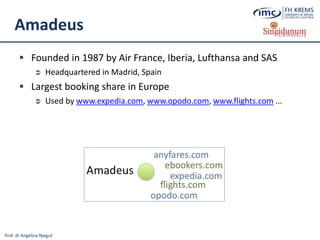
Founded in 1987 by Air France, Iberia, Lufthansa and SAS 
Headquartered in Madrid, Spain 
Largest booking share in Europe 
Used by www.expedia.com, www.opodo.com, www.flights.com ...
Prof. dr Angelina Njeguš 
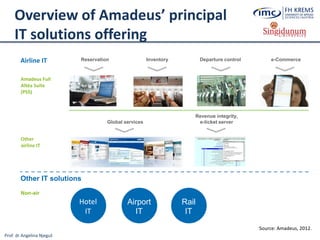
Overview of Amadeus’ principal IT solutions offering 
Amadeus Full Altéa Suite (PSS) 
Airline IT 
Other IT solutions 
Other airline IT 
Reservation 
Inventory 
Departure control 
e-Commerce 
Global services 
Revenue integrity, e-ticket server 
Non-air 
Hotel IT 
Airport IT 
Rail IT 
Source: Amadeus, 2012.
Prof. dr Angelina Njeguš 
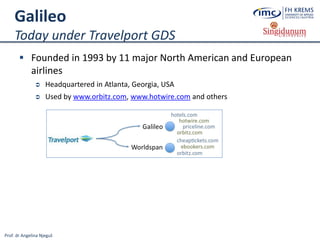
Galileo Today under Travelport GDS 
Founded in 1993 by 11 major North American and European airlines 
Headquartered in Atlanta, Georgia, USA 
Used by www.orbitz.com, www.hotwire.com and others
Prof. dr Angelina Njeguš 
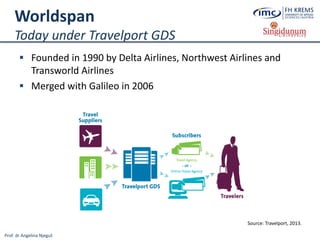
Worldspan Today under Travelport GDS 
Founded in 1990 by Delta Airlines, Northwest Airlines and Transworld Airlines 
Merged with Galileo in 2006 
Source: Travelport, 2013.
Prof. dr Angelina Njeguš 
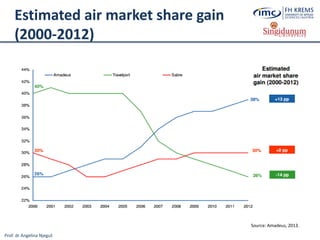
Estimated air market share gain (2000-2012) 
Source: Amadeus, 2013.
Prof. dr Angelina Njeguš 
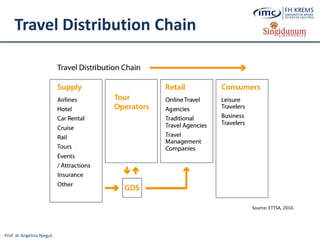
Travel Distribution Chain 
Source: ETTSA, 2010.
Prof. dr Angelina Njeguš 
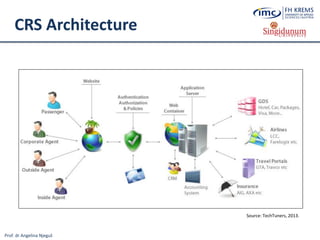
CRS Architecture 
Source: TechTuners, 2013.
Prof. dr Angelina Njeguš 
GDS Organisations 
In order to promote fair competition and to ensure that consumers do not receive inaccurate or misleading information on travel services, it is necessary to have regulations on GDS 
Organisations work together with governments, and other relevant authorities to help define the correct regulatory framework for the travel and transport industry 
There are several organisations, such as: 
IATA - International Air Transport Association 
ICAO - International Civil Aviation Organization 
ETTSA - European Technology and Travel Services Association 
ATPCO - Airline Tariff Publishing Company 
IATAN - International Airlines Travel Agent Network 
SITA - Société Internationale de Télécommunications Aéronautiques 
and many others
Prof. dr Angelina Njeguš 
IATA International Air Transport Association 
Trade association for the world’s airlines 
Representing around 240 airlines or 84% of total air traffic 
Formed on 1945 
Headquartered in Montreal, Quebec, Canada 
Supports many areas of aviation activity and helps formulate industry policy and standards on critical aviation issues, such as: 
Security of passengers and cargo 
Airline safety 
Airline revenues 
Infrastructure issues 
Chargers and economic regulation and taxation 
Fuel 
Airline distribution 
Environment ...
Prof. dr Angelina Njeguš 
ETTSA European Technology and Travel Services Association 
Promote the interests of GDSs and travel distributors and support full transparency, fair competition and consumer choice in the travel distribution chain 
Launched in 2009 
Based in Brussels 
Members are Amadeus, ebookers, Expedia, Odigeo (and its brands eDreams, GoVoyages, Opodo and Travelink), Sabre (including its affiliate lastminute.com), and Travelport. 
ETTSA’s main activities include: 
Engaging in policy-making 
Providing insight and information 
Reporting new developments
Prof. dr Angelina Njeguš 
SITA Société Internationale de Télécommunications Aéronautiques 
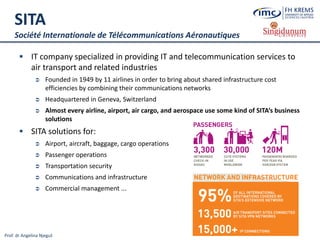
IT company specialized in providing IT and telecommunication services to air transport and related industries 
Founded in 1949 by 11 airlines in order to bring about shared infrastructure cost efficiencies by combining their communications networks 
Headquartered in Geneva, Switzerland 
Almost every airline, airport, air cargo, and aerospace use some kind of SITA’s business solutions 
SITA solutions for: 
Airport, aircraft, baggage, cargo operations 
Passenger operations 
Transportation security 
Communications and infrastructure 
Commercial management ...
Prof. dr Angelina Njeguš 
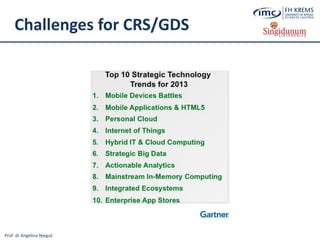
Challenges for CRS/GDS
Prof. dr Angelina Njeguš 
Problems of Big Data 
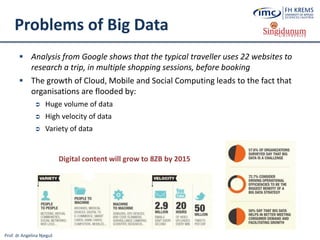
Analysis from Google shows that the typical traveller uses 22 websites to research a trip, in multiple shopping sessions, before booking 
The growth of Cloud, Mobile and Social Computing leads to the fact that organisations are flooded by: 
Huge volume of data 
High velocity of data 
Variety of data 
Digital content will grow to 8ZB by 2015
Prof. dr Angelina Njeguš 
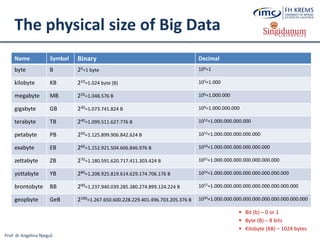
The physical size of Big Data 
Name 
Symbol 
Binary 
Decimal 
byte 
B 
20=1 byte 
100=1 
kilobyte 
KB 
210=1.024 byte (B) 
103=1.000 
megabyte 
MB 
220=1.048.576 B 
106=1.000.000 
gigabyte 
GB 
230=1.073.741.824 B 
109=1.000.000.000 
terabyte 
TB 
240=1.099.511.627.776 B 
1012=1.000.000.000.000 
petabyte 
PB 
250=1.125.899.906.842.624 B 
1015=1.000.000.000.000.000 
exabyte 
EB 
260=1.152.921.504.606.846.976 B 
1018=1.000.000.000.000.000.000 
zettabyte 
ZB 
270=1.180.591.620.717.411.303.424 B 
1021=1.000.000.000.000.000.000.000 
yottabyte 
YB 
280=1.208.925.819.614.629.174.706.176 B 
1024=1.000.000.000.000.000.000.000.000 
brontobyte 
BB 
290=1.237.940.039.285.380.274.899.124.224 B 
1027=1.000.000.000.000.000.000.000.000.000 
geopbyte 
GeB 
2100=1.267.650.600.228.229.401.496.703.205.376 B 
1030=1.000.000.000.000.000.000.000.000.000.000 
Bit (b) – 0 or 1 
Byte (B) – 8 bits 
Kilobyte (KB) – 1024 bytes
Prof. dr Angelina Njeguš 
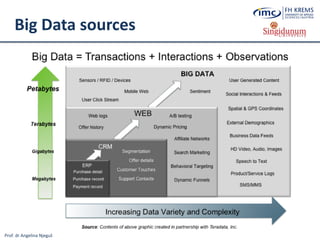
Big Data sources
Prof. dr Angelina Njeguš 
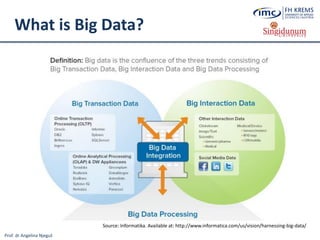
What is Big Data? 
Source: Informatika. Available at: http://www.informatica.com/us/vision/harnessing-big-data/
Prof. dr Angelina Njeguš
Prof. dr Angelina Njeguš 
References 
1.Markiewicz, P. (2013) Computer History – Mainframe Era (1944-1978). Available at: http://plyojump.com/classes/mainframe_era.php (accessed: 17.07.2013) 
2.Venema, M. (2011). Global Distribution Systems (GDS). Edutour – Education for Tourism. Available at: http://www.slideshare.net/magielsr/gds- overview-1232798141856259-2-2359117 (accessed: 18.07.2013) 
3.Introduction to Airline Reservation Systems. Available at: http://www.slideshare.net/mave_boy/introduction-to-airline-reservation-systems-1237705 (Accessed: 17.07.2013) 
4.Dennis, B. (2012). Hospitality Internet Booking Engines & Central Reservation Systems: A thought-piece concerning online reservation technology for the hospitality industry. Buuteeq, Seattle, WA. 
5.Schulz, A. (1996). The Role of Global Computer Reservation Systems in the Travel Industry Today and in the Future. Electronic Markets, 6(2). Available at: http://aws.iwi.uni-leipzig.de/em/fileadmin/user_upload/doc/Issues/Volume_06/Issue_02/The_Role_of_Global_Computer_Reservation.pdf (accessed 17.07.2013) 
6.Amadeus (2012). Corporate presentation 2012. PowerPoint presentation. Amadeus. 
7.Sabre Pacific (2013). Sabre online enhancements power increased productivity. Travel Blackboard. Available at: http://www.etravelblackboard.com/article/143630/sabre-online-enhancements-power-increased-productivity (accessed: 18.07.2013) 
8.Sabre Hospitality Solutions (2013). Central Reservation System (CRS). Sabre. Available at: http://www.sabrehospitality.com/central-reservation- systems.php (accessed 18.07.2013) 
9.Travelport (2013). Travelport GDS Privacy Policy. Available at: http://www.travelport.com/Privacy-Policy/Travelport%20GDS (accessed: 18.07.2013) 
10.Amdekar, J., Padmanabhuni, S. (2006). Future of Travel & Tourism Industry with the adoption of Web Services in Electronic Distribution. Infosys. Available at: http://www.infosys.com/industries/hospitality-leisure/white-papers/Documents/webservices-adoption-travel-tourism.pdf (accessed 18.07.2013) 
11.ETTSA (2010). Technology and Independent Distribution in the European Travel Industry. PhoCusWright . Available at: http://www.ettsa.eu/uploads/documents/ETTSA_Study_2010_Single_Pages.pdf (accessed 18.07.2013) 
12.TechTuners (2013). T-RES. Available at: http://www.techtuners.com/TRES.aspx (accessed 18.07.2013) 
13.Davenport, T.H. (2013). At the Big Data Crossroads: Tuning towards a smarter travel experience. Amadeus IT Group. Available at: http://www.bigdata.amadeus.com/assets/pdf/Amadeus_Big_Data.pdf (accessed 18.07.2013) 
14.Videcom (2013). GDS Distribution. Videcom Airline Reservation Systems. Available at: http://www.videcom.com/airline-global-distribution- systems.aspx (accessed 18.07.2013) 
15.Amadeus (2013). Amadeus Introductory presentation. Available at: http://www.investors.amadeus.com/media/files/english/column_boxes/Introductory Presentation (long form) February 2013.pdf (accessed 18.07.2013)