Objectives:
a. Solve quadraticinequalities in one variable using
three test points.
b. Describe the solution sets of the quadratic
inequalities in one variable.
c. Develop the “value of acceptance” as the lesson
about solving quadratic inequalities reveals that
there are things that are not meant to be equal
especially in real-life situations.
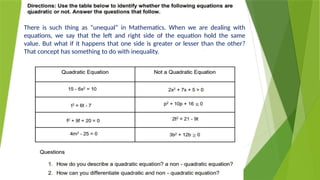
There is suchthing as “unequal” in Mathematics. When we are dealing with
equations, we say that the left and right side of the equation hold the same
value. But what if it happens that one side is greater or lesser than the other?
That concept has something to do with inequality.
14.
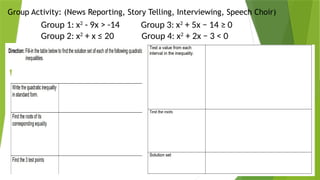
Group Activity: (NewsReporting, Story Telling, Interviewing, Speech Choir)
Group 1: x2
- 9x ˃ -14 Group 3: x2
+ 5x − 14 ≥ 0
Group 2: x2
+ x ≤ 20 Group 4: x2
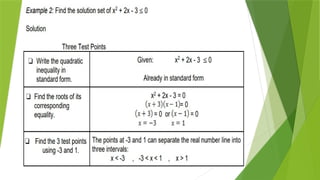
+ 2x − 3 < 0
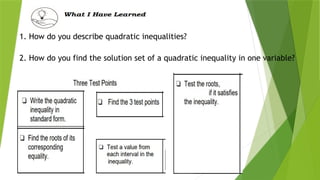
1. How doyou describe quadratic inequalities?
2. How do you find the solution set of a quadratic inequality in one variable?
17.
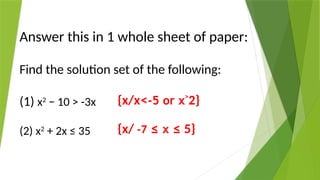
Answer this in1 whole sheet of paper:
Find the solution set of the following:
(1) x2
− 10 > -3x
(2) x2
+ 2x ≤ 35
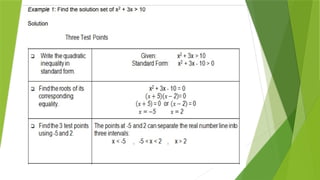
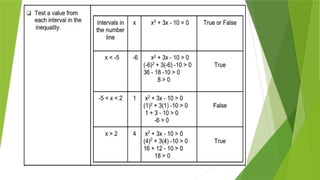
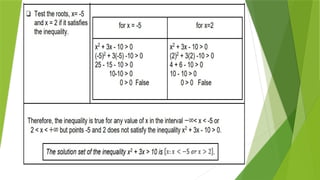
{x/x<-5 or x˃2}
{x/ -7 ≤ x ≤ 5}
18.
Assignment: Form agroup of 4 members and collaborate.
Find the solution set of the inequality.
Editor's Notes
#5 Actually, all things are not created equal - maybe in appearance, quantity, observable features or sometimes, when it comes to quality. It is a clear fact that you can’t compare two things that are entirely different. But then, it is only applicable to us, humans. It is true that we are all created equal and for that reason, it is also implied that people should not discriminate and hence, they do not have the license to judge one’s imperfections.