LESSON 4.1 appropriate units for small and large quantity
2.
GenMath Prayer
Dear God,Thank You for the gift of learning and the beauty of
patterns and numbers. As we begin our General Mathematics
class, Help us to see the order in equations and the logic in
every problem. Guide our minds to think critically, solve wisely,
and learn patiently. May we find meaning in every formula,
purpose in every solution, and become wise decision-makers
beyond probabilities. Bless our teacher and classmates as we
grow together in knowledge.
Amen.
3.
Lesson 4.1:
Quantities ofDifferent Magnitudes:
Choosing Appropriate Units and
Applying Scientific Notation
4.
Learning Competencies
1. determineand apply the
appropriate metric units for various
contexts, such as units for small and
large quantities and scientific
measurements;
5.
Learning
Objectives
1
2
3
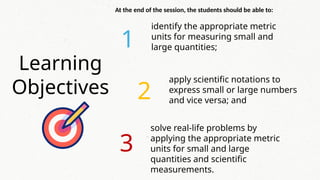
At the endof the session, the students should be able to:
apply scientific notations to
express small or large numbers
and vice versa; and
identify the appropriate metric
units for measuring small and
large quantities;
solve real-life problems by
applying the appropriate metric
units for small and large
quantities and scientific
measurements.
Why Measurement Matters?
ACTIVITY1
Processing Questions:
1. Why do you think having standard units of measurement (like
meters, liters, or kilograms) is important when working together in
science or everyday life?
2. How would you explain what a “unit of measurement” is to someone
who has never heard of it before, perhaps using an everyday example
like cooking or building something?
3. Can you think of a situation where using the wrong unit (like mixing
up grams and kilograms) might lead to a problem or mistake? What
could happen in that scenario?
Explore and Guessit Right!
ACTIVITY 2
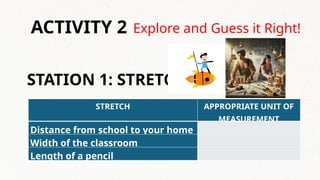
STATION 1: STRETCH
STRETCH APPROPRIATE UNIT OF
MEASUREMENT
Distance from school to your home
Width of the classroom
Length of a pencil
11.
Explore and Guessit Right!
ACTIVITY 2
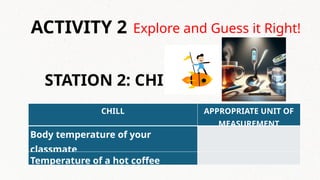
STATION 2: CHILL
CHILL APPROPRIATE UNIT OF
MEASUREMENT
Body temperature of your
classmate
Temperature of a hot coffee
12.
Explore and Guessit Right!
ACTIVITY 2
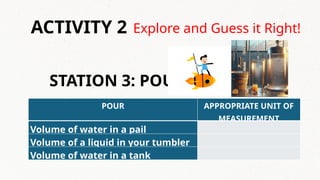
STATION 3: POUR
POUR APPROPRIATE UNIT OF
MEASUREMENT
Volume of water in a pail
Volume of a liquid in your tumbler
Volume of water in a tank
13.
Explore and Guessit Right!
ACTIVITY 2
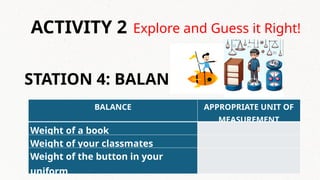
STATION 4: BALANCE
BALANCE APPROPRIATE UNIT OF
MEASUREMENT
Weight of a book
Weight of your classmates
Weight of the button in your
uniform
14.
Explore and Guessit Right!
ACTIVITY 2
STATION 5: TICK
TICK APPROPRIATE UNIT OF
MEASUREMENT
Time it takes to say “GOOD DAY” to your classmates.
Time it takes to finish a movie
Time it takes to travel from Pampanga to Ilocos using
bicycle
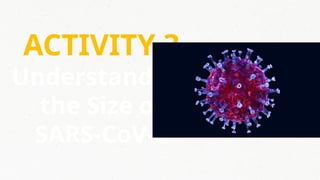
Understanding the Sizeof SARS-CoV-2
ACTIVITY 3
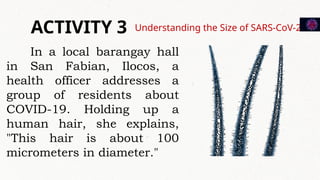
In a local barangay hall
in San Fabian, Ilocos, a
health officer addresses a
group of residents about
COVID-19. Holding up a
human hair, she explains,
"This hair is about 100
micrometers in diameter."
17.
Understanding the Sizeof SARS-CoV-2
ACTIVITY 3
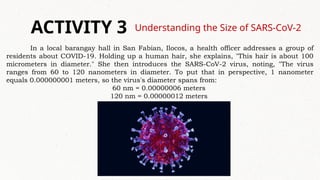
In a local barangay hall in San Fabian, Ilocos, a health officer addresses a group of
residents about COVID-19. Holding up a human hair, she explains, "This hair is about 100
micrometers in diameter." She then introduces the SARS-CoV-2 virus, noting, "The virus
ranges from 60 to 120 nanometers in diameter. To put that in perspective, 1 nanometer
equals 0.000000001 meters, so the virus's diameter spans from:
60 nm = 0.00000006 meters
120 nm = 0.00000012 meters
18.
Understanding the Sizeof SARS-CoV-2
ACTIVITY 3
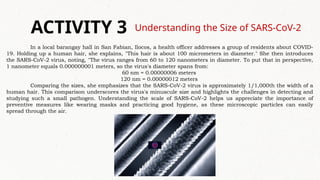
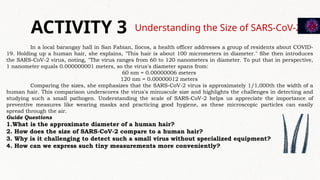
In a local barangay hall in San Fabian, Ilocos, a health officer addresses a group of residents about COVID-
19. Holding up a human hair, she explains, "This hair is about 100 micrometers in diameter." She then introduces
the SARS-CoV-2 virus, noting, "The virus ranges from 60 to 120 nanometers in diameter. To put that in perspective,
1 nanometer equals 0.000000001 meters, so the virus's diameter spans from:
60 nm = 0.00000006 meters
120 nm = 0.00000012 meters
Comparing the sizes, she emphasizes that the SARS-CoV-2 virus is approximately 1/1,000th the width of a
human hair. This comparison underscores the virus's minuscule size and highlights the challenges in detecting and
studying such a small pathogen. Understanding the scale of SARS-CoV-2 helps us appreciate the importance of
preventive measures like wearing masks and practicing good hygiene, as these microscopic particles can easily
spread through the air.
19.
Understanding the Sizeof SARS-CoV-2
ACTIVITY 3
In a local barangay hall in San Fabian, Ilocos, a health officer addresses a group of residents about COVID-
19. Holding up a human hair, she explains, "This hair is about 100 micrometers in diameter." She then introduces
the SARS-CoV-2 virus, noting, "The virus ranges from 60 to 120 nanometers in diameter. To put that in perspective,
1 nanometer equals 0.000000001 meters, so the virus's diameter spans from:
60 nm = 0.00000006 meters
120 nm = 0.00000012 meters
Comparing the sizes, she emphasizes that the SARS-CoV-2 virus is approximately 1/1,000th the width of a
human hair. This comparison underscores the virus's minuscule size and highlights the challenges in detecting and
studying such a small pathogen. Understanding the scale of SARS-CoV-2 helps us appreciate the importance of
preventive measures like wearing masks and practicing good hygiene, as these microscopic particles can easily
spread through the air.
Guide Questions
1.What is the approximate diameter of a human hair?
2. How does the size of SARS-CoV-2 compare to a human hair?
3. Why is it challenging to detect such a small virus without specialized equipment?
4. How can we express such tiny measurements more conveniently?
WHAT IS ASCIENTIFIC NOTATION?
Scientific notation is a
mathematical method used to
express very large or very small
numbers in a more concise and
manageable form. It is especially
useful in scientific disciplines
where such numbers are
prevalent.
22.
WHAT IS ASCIENTIFIC NOTATION?
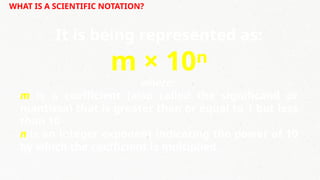
It is being represented as:
m × 10ⁿ
where:
m is a coefficient (also called the significand or
mantissa) that is greater than or equal to 1 but less
than 10
n is an integer exponent indicating the power of 10
by which the coefficient is multiplied.
23.
WHAT IS ASCIENTIFIC NOTATION?
This notation simplifies
calculations and
comparisons, especially
when dealing with
extremely large or small
quantities.
24.
WHAT IS ASCIENTIFIC NOTATION?
To convert a number to scientific
notation:
1. Move the decimal point to create a
number between 1 and 10.
2. Count the number of places the decimal
was moved; this becomes the exponent of
10.
3. If the decimal was moved to the left, the
exponent is positive; if to the right, it's
negative.
25.
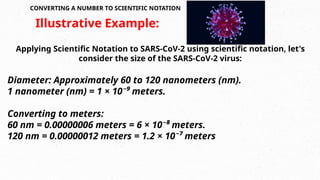
CONVERTING A NUMBERTO SCIENTIFIC NOTATION
Applying Scientific Notation to SARS-CoV-2 using scientific notation, let's
consider the size of the SARS-CoV-2 virus:
Diameter: Approximately 60 to 120 nanometers (nm).
1 nanometer (nm) = 1 × 10⁻⁹ meters.
Converting to meters:
60 nm = 0.00000006 meters = 6 × 10⁻⁸ meters.
120 nm = 0.00000012 meters = 1.2 × 10⁻⁷ meters
Illustrative Example:
26.
WHAT IS ASCIENTIFIC NOTATION?
Expressing these measurements in
scientific notation makes it easier to
comprehend and compare the
minuscule size of the virus. It is also
more convenient for comparisons and
mathematical operations, like
multiplication and division.
27.
WHAT IS ASTANDARD NOTATION?
Standard notation is the
conventional way of writing
numbers using digits, without
exponents or powers of ten. It's the
format we commonly use in
everyday life, such as 4,500,000,000
or 0.00000036.
28.
WHAT IS ASTANDARD NOTATION?
In standard notation, each digit has a
specific place value: units, tens,
hundreds, etc., which influences the
overall value of the number. This
format is intuitive and straightforward
for representing numbers in their
usual form.
29.
WHAT IS ASTANDARD NOTATION?
To convert scientific notation to
standard notation:
1. Identify the exponent.
2. Move the decimal point in the base
number according to the exponent. (If
the exponent is positive, move the
decimal point to the right; if negative, to
the left.)
3. Write the result.
30.
CONVERTING SCIENTIFIC NOTATIONTO STANDARD NOTATION
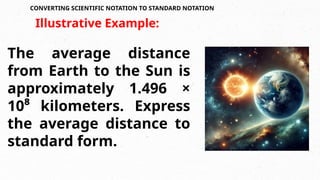
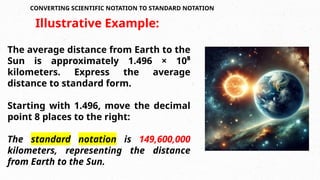
The average distance
from Earth to the Sun is
approximately 1.496 ×
10⁸ kilometers. Express
the average distance to
standard form.
Illustrative Example:
31.
CONVERTING SCIENTIFIC NOTATIONTO STANDARD NOTATION
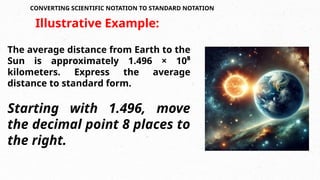
The average distance from Earth to the
Sun is approximately 1.496 × 10⁸
kilometers. Express the average
distance to standard form.
Starting with 1.496, move
the decimal point 8 places to
the right.
Illustrative Example:
32.
CONVERTING SCIENTIFIC NOTATIONTO STANDARD NOTATION
The average distance from Earth to the
Sun is approximately 1.496 × 10⁸
kilometers. Express the average
distance to standard form.
Starting with 1.496, move the decimal
point 8 places to the right:
The standard notation is 149,600,000
kilometers, representing the distance
from Earth to the Sun.
Illustrative Example:
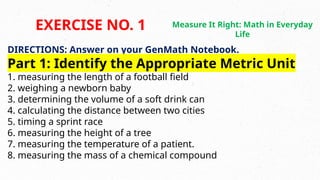
DIRECTIONS: Answer onyour GenMath Notebook.
Part 1: Identify the Appropriate Metric Unit
1. measuring the length of a football field
2. weighing a newborn baby
3. determining the volume of a soft drink can
4. calculating the distance between two cities
5. timing a sprint race
6. measuring the height of a tree
7. measuring the temperature of a patient.
8. measuring the mass of a chemical compound
EXERCISE NO. 1 Measure It Right: Math in Everyday
Life
35.
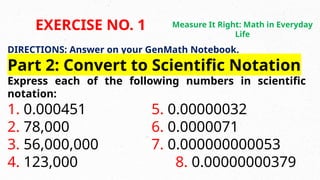
DIRECTIONS: Answer onyour GenMath Notebook.
Part 2: Convert to Scientific Notation
Express each of the following numbers in scientific
notation:
1. 0.000451 5. 0.00000032
2. 78,000 6. 0.0000071
3. 56,000,000 7. 0.000000000053
4. 123,000 8. 0.00000000379
EXERCISE NO. 1 Measure It Right: Math in Everyday
Life
36.
DIRECTIONS: Answer onyour GenMath Notebook.
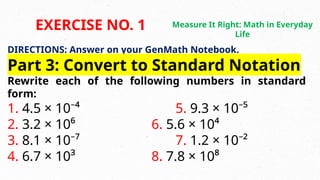
Part 3: Convert to Standard Notation
Rewrite each of the following numbers in standard
form:
1. 4.5 × 10⁻⁴ 5. 9.3 × 10⁻⁵
2. 3.2 × 10⁶ 6. 5.6 × 10⁴
3. 8.1 × 10⁻⁷ 7. 1.2 × 10⁻²
4. 6.7 × 10³ 8. 7.8 × 10⁸
EXERCISE NO. 1 Measure It Right: Math in Everyday
Life
37.
DIRECTIONS: Answer onyour GenMath Notebook.
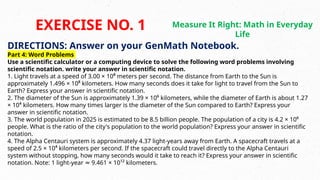
Part 4: Word Problems
Use a scientific calculator or a computing device to solve the following word problems involving
scientific notation. write your answer in scientific notation.
1. Light travels at a speed of 3.00 × 10⁸ meters per second. The distance from Earth to the Sun is
approximately 1.496 × 10⁸ kilometers. How many seconds does it take for light to travel from the Sun to
Earth? Express your answer in scientific notation.
2. The diameter of the Sun is approximately 1.39 × 10⁶ kilometers, while the diameter of Earth is about 1.27
× 10⁴ kilometers. How many times larger is the diameter of the Sun compared to Earth? Express your
answer in scientific notation.
3. The world population in 2025 is estimated to be 8.5 billion people. The population of a city is 4.2 × 10⁶
people. What is the ratio of the city's population to the world population? Express your answer in scientific
notation.
4. The Alpha Centauri system is approximately 4.37 light-years away from Earth. A spacecraft travels at a
speed of 2.5 × 10⁴ kilometers per second. If the spacecraft could travel directly to the Alpha Centauri
system without stopping, how many seconds would it take to reach it? Express your answer in scientific
notation. Note: 1 light-year 9.461 × 10¹² kilometers.
≈
EXERCISE NO. 1 Measure It Right: Math in Everyday
Life




 Most read